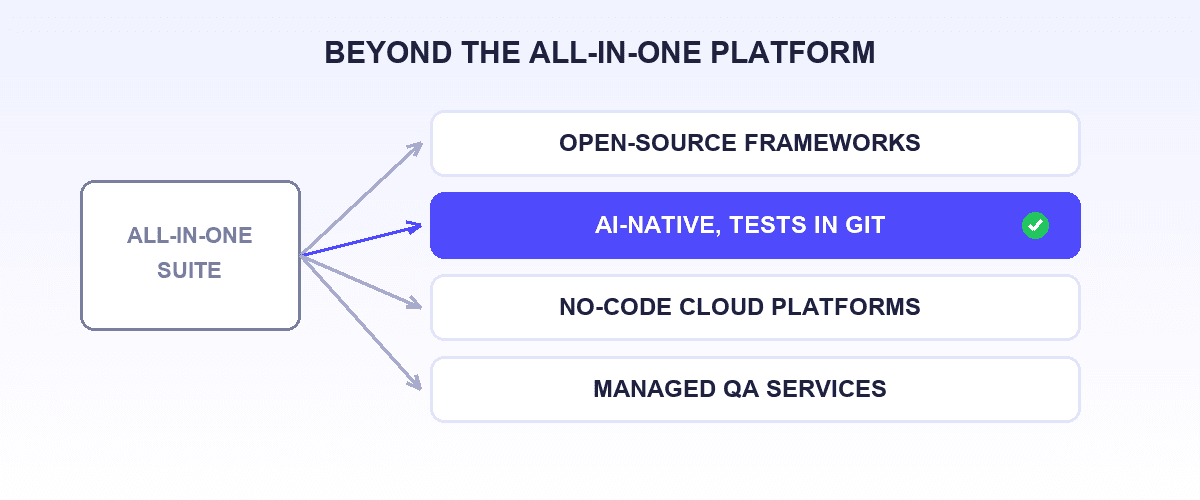
The best Functionize alternative in 2026 depends on where tests should live and who authors them.
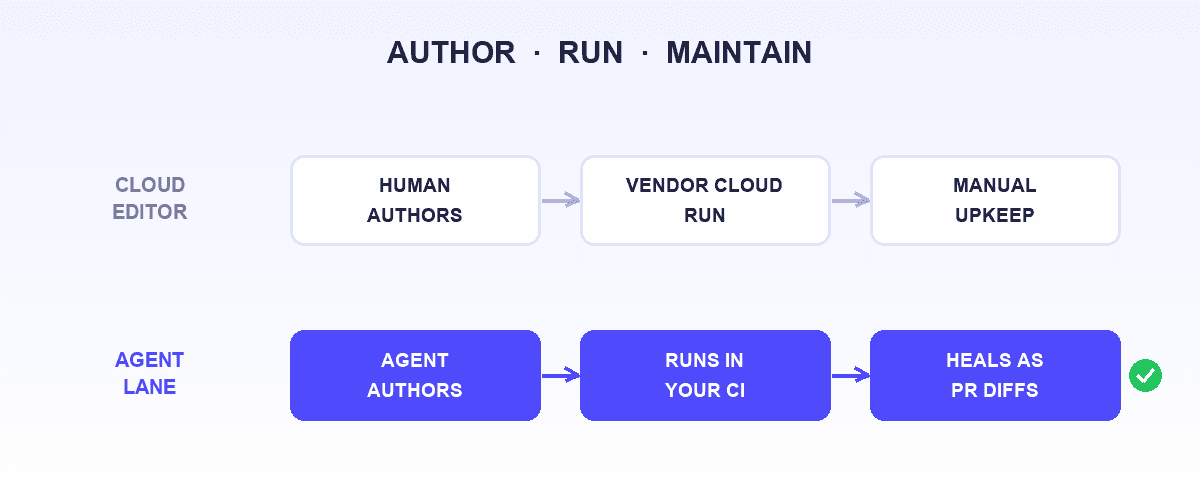
Shiplight AI keeps tests as real, portable YAML in your git repo, diffable and PR-reviewable, instead of data locked in a vendor cloud with no export path. It is genuinely agent-native, with MCP and Skills your own coding agents call directly, where Functionize exposes no agent surface at all.
It is built on Playwright and runs in your own CI on your own infrastructure, where Functionize executes only on its cloud VMs, and it adds deterministic cached execution with intent-based healing surfaced as reviewable PR diffs, plus local runs with no account. Playwright and Cypress are the open-source code frameworks with maximum developer control.
Managed QA services put a vendor's human engineers in charge of your suite. Vendor cloud consoles keep authoring in a low-code or plain-English web app, with tests living in the vendor's cloud.
Why teams look for Functionize alternatives
Functionize is a pre-agent ML testing platform, founded around 2015, whose design center is tests as cloud data rather than code: in their co-founder's public framing, everything becomes data, not source code. You author through a Chrome recorder or by uploading plain-English steps to their Test Cloud, and execution happens only on Functionize's cloud VMs.
Their public docs describe no path to export tests as standard framework code, and no MCP server or other coding-agent surface.
That architecture is exactly what Shiplight inverts, on the axes that matter to a team shipping with coding agents.
If your tests are data in a vendor's cloud, they cannot live in your repo, cannot be reviewed in a PR, cannot run in your own CI, and cannot be authored or driven by the coding agent that just wrote the feature.
Shiplight's bets run the other way: real YAML you own in git, your own agents authoring it over MCP, an open-source engine underneath, and execution wherever you choose.
The alternatives below are ordered by design center; if authoring as data managed entirely inside a vendor cloud is what you want, Functionize's model still fits, and the alternatives win when one of those inverted bets is the point.
1. Shiplight AI: best for AI coding agent teams using MCP
Shiplight AI is an agent-native end-to-end testing platform built around the opposite design center from Functionize: tests are natural-language user intent in plain YAML, committed alongside source in git, not data in a vendor cloud.
Shiplight is built on Playwright, so it supports every Playwright browser and runs alongside existing Playwright suites; local MCP browser automation and test authoring need no account or token.
Running a test file needs an LLM key, ours or your own.
Cached locators committed to the repo heal online at run time, larger changes arrive as reviewable PR diffs from the triage agent, and the Shiplight MCP Server let AI coding agents like Claude Code, Cursor, and OpenAI Codex author and run tests inside the same session they write features.
goal: Verify user can complete checkout
steps:
  - intent: Log in as a test user
  - intent: Add the first product to the cart
  - intent: Proceed to checkout
  - intent: Complete payment with test card
  - VERIFY: order confirmation page shows order number
Every strength below is a point where Shiplight's design center is decisively different from tests-as-cloud-data, in the reader's favor.
Strengths
- Tests are real YAML in your git repo. Committed alongside source: diffable, PR-reviewable, portable, owned. Functionize's founding design center is the opposite, tests as cloud data not source code in their co-founder's public framing, and their public docs describe no export path, so the tests cannot leave the cloud.
- Genuinely agent-native, not agent-free. MCP and Skills let your own coding agents (Claude Code, Cursor, Codex) author, run, and edit tests in the same session they write the feature. Functionize exposes no MCP or coding-agent surface at all, so any agent workflow stops at the cloud's edge. See boost test coverage with agentic AI.
- Built on Playwright, runs on your infrastructure. The YAML transpiles to Playwright at run time, so it supports every Playwright browser, runs alongside an existing Playwright suite in your own CI, and ejects anytime. Functionize executes only on its own cloud VMs.
- Deterministic cached execution with healing you review. Committed locators replay fast and cheap, cached steps call no LLM, AI re-resolves only on change, and larger fixes arrive as reviewable PR diffs. Functionize's healing runs as ML inside its cloud, applied to tests stored as data you do not own. See intent, cache, heal pattern.
- Local runs with no account, no account, plus hosted runners and PR-time CI gates on GitHub Actions, GitLab CI, CircleCI.
- SOC 2, SSO, RBAC, audit logs for enterprise.
Tradeoffs
- Web only: no native mobile or desktop testing.
- Assumes a repo workflow with an engineer or coding agent in the loop; teams authoring in a pure recorder are the design center vendor consoles serve.
- Free is $0 forever and Pro is $60/month (the MCP server, Skills, and local tier are free).
Where it fits. Engineering teams using AI coding agents who want tests authored at agent speed, committed in git, and run on every PR. See agent-first testing.
2. Playwright: best for maximum developer control at lowest cost
Playwright is the most popular open-source browser automation framework: code-based, cross-browser (Chromium, Firefox, WebKit), no vendor lock-in. Teams leaving Functionize on cost or ownership grounds often move web tests to self-hosted Playwright in CI.
Strengths
- Free and open source; no per-seat or per-run cost.
- Cross-browser including Safari (WebKit).
- Maximum flexibility: full programmatic control, excellent traces and debugging.
Tradeoffs
- Code-based and selector-bound: every UI refactor can break tests; ongoing maintenance is the cost, even when a coding agent writes the code.
- No built-in self-healing or natural-language authoring.
- Requires engineering effort to build and maintain the harness.
Where it fits. Engineering teams that want maximum control and lowest licensing cost, and have the capacity to maintain a selector-bound suite. See test authoring methods compared.
3. Cypress: best for developer-friendly JS E2E testing
Cypress is a long-standing open-source E2E framework focused on developer experience: fast local runs, excellent debugging, strong ecosystem.
Strengths
- Excellent debugging and time-travel; fast local feedback.
- Large community and plugin ecosystem.
- Developer-friendly authoring for JavaScript teams.
Tradeoffs
- Code-based and selector-driven: same maintenance ceiling as Playwright.
- Historically Chromium-focused (cross-browser is improving but not native-parity).
- No AI / natural-language authoring.
Where it fits. JavaScript teams that want developer-friendly browser testing and own the maintenance. See Playwright vs Cypress and best Cypress alternatives.
4. Managed QA services: outsource the suite entirely
A different answer to Functionize's authoring problem is to stop authoring at all: managed QA services put the vendor's human engineers (assisted by AI tooling) in charge of building and maintaining your test suite, usually with an outcome or coverage agreement.
Strengths
- Fully managed: you don't author or maintain tests yourself.
- Human review on top of AI generation.
- Fast ramp for teams with no QA function.
Tradeoffs
- You are buying human hours, priced accordingly; coverage grows at the pace of the vendor's engineers.
- Testing knowledge accumulates with an external team rather than in your repo and your heads.
- No agent-native loop: the vendor's staff authors tests, not your coding agent, which points the opposite direction from an AI-native development workflow.
Where it fits. Teams that have decided QA is someone else's job and want a staffed service with a human in the loop.
5. Vendor cloud consoles: recorder or low-code authoring in the vendor's app
Functionize's nearest neighbors are other vendor cloud consoles: your QA team builds tests in the vendor's web application, via a recorder, a visual editor, or a constrained plain-English command language, sometimes spanning web, mobile, and API from one platform.
Strengths
- Accessible to non-engineers; no repo workflow required.
- Often broader surface coverage (mobile, API) than web-focused tools.
- Governed, centralized management for QA organizations.
Tradeoffs
- Tests live in the vendor's cloud, not your git repo; export paths are typically limited, lossy, or absent, so migration means re-authoring. This is Functionize's model, not an escape from it.
- Runs are metered or quote-priced on vendor infrastructure.
- Agent integrations, where offered, drive the vendor's cloud rather than putting tests in your workflow.
Where it fits. Manual-QA-heavy organizations where non-engineers own testing and a governed console is the point. If that is your team, know that switching consoles trades one cloud for another; the tests-as-data constraint stays.
Quick comparison table
| Alternative | Tests in your repo? | Vendor lock-in / export | Agent-native (MCP)? | Where tests execute | Best for |
|---|---|---|---|---|---|
| Shiplight AI | ✓ (YAML) | None: transpiles to Playwright, runs alongside a suite, eject anytime | Your coding agents (Claude Code, Cursor, Codex) via MCP + Skills | Your CI / your infra, or Shiplight-hosted runners | AI-coding-agent web teams |
| Playwright | ✓ (code) | None (open source) | Your engineers, or agent tooling you assemble | Your CI / your infra | Developer control |
| Cypress | ✓ (code) | None (open source; parallelization via paid cloud) | Your engineers | Your CI / your infra | JS team E2E |
| Managed QA services | Varies | Suite knowledge lives with the vendor's team | The vendor's human engineers | Vendor's infrastructure | Fully outsourced QA |
| Vendor cloud consoles | ✗ | High: proprietary formats, limited or no export | The vendor's console tooling | Vendor cloud | Console-authoring QA orgs |
| Functionize (baseline) | ✗ (tests as cloud data) | High: tests as cloud data, no export path in public docs | No agent surface at all | Functionize cloud VMs only | ML-assisted QA inside a vendor cloud |
How to Choose a Functionize Alternative
By your reason for leaving
| Reason for leaving Functionize | Best alternative |
|---|---|
| Tests should live in your git repo | Shiplight AI or Playwright |
| Want AI coding agent integration (MCP) | Shiplight AI |
| Want zero licensing cost and full control | Playwright or Cypress |
| Want QA fully outsourced | A managed QA service |
| Console authoring works; different vendor terms | Another vendor cloud console (same tests-as-data trade-offs) |
By operating model
| Who authors tests, and where do they live? | Fit |
|---|---|
| Your coding agent authors tests that live in your git repo | Shiplight AI |
| Engineers write and self-host test code | Playwright or Cypress |
| A vendor's human engineers own the suite | A managed QA service |
| QA staff author in a vendor web console | A vendor cloud console |
Conclusion
Functionize's founding bet was that tests should become data in a vendor cloud rather than code. In 2026 the momentum points the other way: teams shipping with AI coding agents want tests as reviewable artifacts in their own repo, authored and run by the same agents that write the features. That is a capability tests-as-cloud-data cannot offer.
For AI-native teams, Shiplight AI is built for exactly that: intent-based YAML in your repo, MCP-callable from Claude Code / Cursor / Codex, self-healing by default, local runs with no account on a runtime built on Playwright. For cost-conscious engineering teams, self-hosted Playwright or Cypress eliminates licensing entirely.
Managed QA services and vendor cloud consoles serve teams that have decided authoring should live outside the repo.
Get started with Shiplight or book a 30-minute walkthrough.
Frequently Asked Questions
What is Functionize?
Functionize is a pre-agent ML test automation platform founded around 2015.
Its design center is tests as cloud data rather than code: authoring through a Chrome recorder or plain-English steps in their Test Cloud, execution only on their cloud VMs, and no export path to framework code and no MCP or coding-agent surface. It targets QA organizations that want ML-assisted testing managed inside a vendor cloud.
What is the best Functionize alternative in 2026?
It depends on your reason for leaving. For engineering teams using coding agents, Shiplight AI is the strongest fit: the agent authors tests as YAML in your git repo via MCP, on a runtime built on Playwright. For teams wanting zero licensing cost, self-hosted Playwright or Cypress.
Switching to another vendor cloud console keeps Functionize's core constraint: tests remain data in someone else's cloud.
Is there a free alternative to Functionize?
Yes. Playwright and Cypress are open source and free to run yourself; you trade licensing cost for engineering time on authoring and selector maintenance. Shiplight is also free to install, with local runs with no account and tests owned as YAML in your git repo; Free is $0 forever and Pro is $60/month.
Which Functionize alternative works best with AI coding agents?
Shiplight AI is the alternative on this list with native MCP integration for Claude Code, Cursor, Codex, and GitHub Copilot: the agent generates the feature, generates the test, runs it locally with no account, and commits both in the same PR. Functionize itself exposes no MCP or agent surface. See agent-native autonomous QA and MCP for testing.
Can I migrate from Functionize to Shiplight?
Yes, by re-authoring rather than importing: Functionize's public docs describe no export path, so tests stored as data in their cloud cannot be pulled out as code. The practical route is to have your AI coding agent generate equivalent Shiplight YAML from the same specifications, starting with your highest-value flows. See AI testing tools that automatically generate test cases.
How is Shiplight's self-healing different from Functionize's?
Functionize's healing runs as ML inside their cloud. Shiplight's healing is intent-based and repo-resident: each step stores a natural-language intent, cached locators are committed to your repo, small heals happen at run time, and larger changes arrive as reviewable PR diffs. The difference is where the healing intelligence lives: their cloud, or artifacts you own and review.