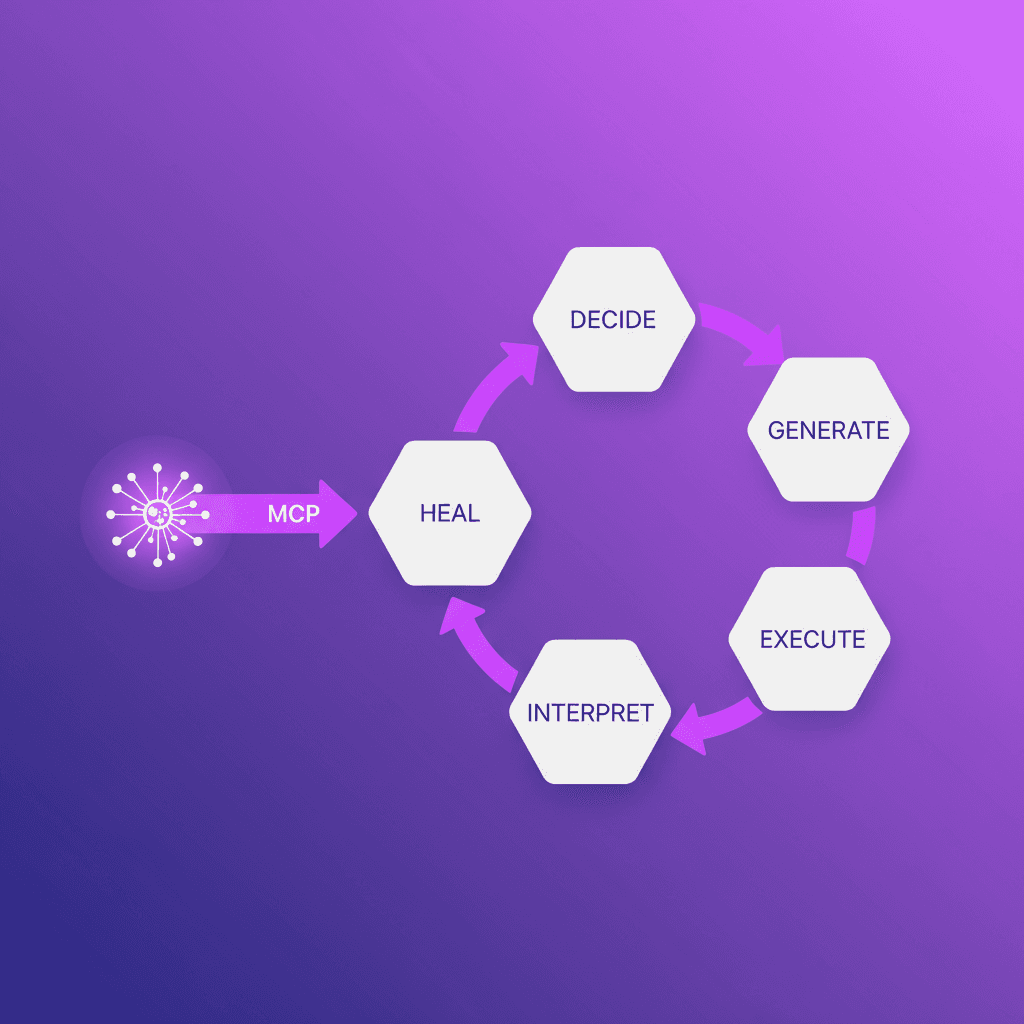
Agent-native autonomous QA is the category of quality tooling that AI coding agents can call directly over MCP, and that generates, runs, heals, and maintains tests without human intervention at each step.
The agents in question are Claude Code, Cursor, Codex and GitHub Copilot.
Shiplight AI is built this way from the ground up: the coding agent drives a real browser through an MCP server, authors intent-based tests that live in your own repo, and maintains them as the UI changes. The YAML transpiles to Playwright, so there is a real exit path.
The two terms, separately
Two terms describe where software quality assurance is heading in 2026: agent-native and autonomous QA. They describe the same shift from different angles. Agent-native is about architecture: QA tools that AI coding agents can invoke directly, rather than dashboards humans operate.
Autonomous QA is about operation: a quality system that runs, heals, and maintains itself without a human in the loop for each step.
Together they define a new category: agent-native autonomous QA. This is the model QA must adopt to keep up with teams building software using AI coding agents like Claude Code, Cursor, Codex, and GitHub Copilot.
This guide explains what each term means, why they matter together, and what a production-ready agent-native autonomous QA system looks like.
What "Agent-Native" Means
Agent-native describes software tools designed so AI agents can use them as peers (invoking capabilities, interpreting output, and incorporating results into an ongoing task) through agent-callable interfaces rather than human dashboards. Agent-native QA tools expose their functionality via Model Context Protocol (MCP) or equivalent protocols. The broader practice this belongs to is agent-native development.
Contrast with two older models:
Human-native tools are built for people. A QA engineer logs into a dashboard, configures a test run, reviews a report. The tool has no API surface an AI agent can use meaningfully.
AI-augmented tools use AI internally to help humans: smart locators, test suggestions, auto-complete for test scripts. The AI lives inside the tool but doesn't expose the tool to external agents.
Agent-native tools are built so AI agents are first-class users. Shiplight is agent-native: browser automation is exposed as MCP tools, and test authoring, healing and review ship as skills, both of which Claude Code, Cursor, Codex, and GitHub Copilot can call directly during development.
Agent-native QA in practice
When the coding agent is building a feature, it can:
- Call
/shiplight verify: Shiplight opens a real browser and confirms the UI change looks and behaves correctly - Call
/shiplight create-yaml-tests: Shiplight generates a self-healing test covering the new flow - Call
/shiplight review: Shiplight runs automated reviews across security, accessibility, and performance
The agent chains these together as part of its development task. No human context switch. No separate QA phase. No dashboard.
What "Autonomous QA" Means
Autonomous QA is software quality assurance where AI agents handle the entire testing loop (deciding what to test, generating tests, executing them, interpreting results, and healing broken tests) without human intervention at each step. The human role is oversight, not execution.
In practice, an autonomous QA system:
- Decides what to test: based on code changes, specifications, or observed behavior
- Generates tests: from natural language intent, not manual scripting
- Executes tests: in a real browser, against the actual application
- Interprets results: distinguishes genuine failures from flakiness
- Heals broken tests: when the UI changes, resolves the correct element from stored intent rather than failing on a stale selector
The human role shifts from execution to oversight: reviewing the system's output, making go/no-go calls, setting quality policies. Everything in between is handled by the agent.
This is different from AI-assisted QA, where humans still drive each step and AI only accelerates parts of the workflow. In autonomous QA, the AI is the driver.
Why Agent-Native and Autonomous QA Matter Together
Either one alone is insufficient.
Autonomous QA without agent-native tooling still works, but it operates as a separate system from development. The coding agent builds, then a QA system runs later in CI. Feedback is delayed. Coverage gaps happen because the QA system doesn't know what the coding agent just changed.
Agent-native tooling without autonomy means the coding agent can call the QA tool, but humans still need to write, maintain, and triage the tests. The agent's calls just trigger more work for humans downstream.
Combining them produces the pattern that matters for agent-first development:
- Coding agent writes code
- Coding agent calls agent-native QA tool to verify
- QA tool autonomously generates coverage, runs tests, interprets results, heals broken tests
- Coding agent incorporates QA results into its task
- Human reviews the completed PR: code and tests together
The human is present at exactly one step: final review. Everything else (implementation and verification) is handled autonomously by agents using agent-native tools.
Traditional QA vs. AI-Assisted QA vs. Agent-Native Autonomous QA
| Capability | Traditional QA | AI-Assisted QA | Agent-Native Autonomous QA |
|---|---|---|---|
| Test authoring | Engineer writes code | AI suggests, human writes | AI generates from intent |
| Test maintenance | Manual locator fixes | AI-suggested fixes | Autonomous intent-based healing |
| Triggered by | Human in CI | Human in CI | Coding agent during development |
| Interface | Human dashboard | Human dashboard | MCP tools for agents |
| Human role | Drives every step | Drives steps, AI assists | Reviews output, sets policy |
| Feedback loop | Hours to days | Hours | Minutes: inside dev loop |
| Scales with dev velocity | No | Partially | Yes |
What an Agent-Native Autonomous QA System Looks Like
Concrete components of a production system:
1. An agent-callable interface
The QA system exposes its capabilities as MCP tools, APIs, or equivalent. AI coding agents can call those tools as part of their autonomous task execution. Human dashboards are optional, not primary.
2. Intent-based test authoring
Tests describe what should happen, not how to click. Intent is portable across UI changes. A test that says intent: Click the Save button survives when the button's CSS class changes, because the agent re-resolves the element from intent at runtime.
Example from Shiplight's YAML test format:
goal: Verify user can complete onboarding
steps:
  - intent: Navigate to the signup page
  - intent: Fill in name, email, and password
  - intent: Submit the registration form
  - intent: Complete the product tour steps
  - VERIFY: user lands on the dashboard with their name shown
3. Real browser execution
Built on Playwright or equivalent for reliability. Tests run against the actual application, not synthetic environments. Screenshots, traces, and step-by-step execution logs are available when failures occur.
4. Intent-based self-healing
When a locator fails, the system re-resolves the correct element from stored intent using AI. Self-healing based on intent handles UI redesigns, not just minor locator changes. Locator-fallback healing (most legacy tools) only handles small variations.
5. Git-native test artifacts
Tests live in your repository, appear in pull request diffs, and are reviewable by non-engineers. Tests in proprietary vendor databases can't be reviewed in code review and create lock-in.
6. CI/CD integration via CLI
The system runs in any CI environment (GitHub Actions, GitLab CI, CircleCI, Jenkins) via CLI. No vendor-locked runners required. The highest-value place to run it is the preview build, before anything merges: see how to test Vercel preview deployments automatically.
Who Needs Agent-Native Autonomous QA?
Teams where:
AI coding agents are generating code faster than QA can verify it. AI coding agents now generate up to 40% of new code in early-adopter teams (per recent GitHub Copilot usage data). Without agent-native QA, coverage gaps grow proportionally: every line the agent writes is a line a human must verify by hand.
With agent-native QA, the coding agent verifies its own work, and coverage grows at agent speed instead of human authoring speed.
See boost test coverage with agentic AI for the 5–10× coverage-growth mechanics, and can coding agents test their own code? for where that self-verification holds and where it does not.
Software is being assembled in AI app builders. Teams shipping from prompt-to-app tools hit the same verification gap sooner, because nobody on the team read the generated code at all: testing AI app builders covers that case.
Test maintenance is consuming engineering time. Teams typically spend 40–60% of QA effort fixing tests broken by routine UI changes. Autonomous intent-based healing eliminates this category of work.
The team wants verification next to the code, not after it. That ambition is old and mostly failed on developer economics; what changed is covered in shift left testing, and what the surrounding discipline becomes is covered in quality engineering.
Release cadence is blocked by manual QA handoffs. Autonomous QA embedded in the development loop removes the QA cycle from the critical path. See QA strategy for AI coding agents for the full tiered CI/CD placement model.
Enterprise teams need compliance plus velocity. Agent-native autonomous QA with SOC 2 certification, RBAC, SSO, and audit logs lets enterprises ship at startup speed without compliance compromise. See our enterprise self-healing test automation guide for how this works in regulated environments.
Best Agent-Native Autonomous QA Tools in 2026
The best agent-native autonomous QA tool in 2026 is Shiplight AI: it combines MCP plus Skills across Claude Code, Cursor, Codex, and more with intent-based YAML tests that live in your git repo, self-healing surfaced as reviewable PR diffs, and Playwright-compatible execution.
Platforms from the pre-agent era serve a different design center: low-code recorder platforms keep tests in the vendor's cloud, and vendor cloud consoles built for manual-QA-heavy organizations author tests in constrained plain-English command sets.
Neither category is agent-native: an AI coding agent cannot invoke them as part of development.
| Tool | Agent-native (MCP)? | Autonomous? | Self-healing |
|---|---|---|---|
| Shiplight AI | ✅ Native MCP for Claude Code, Cursor, Codex, Copilot | ✅ Generates, runs, heals | ✅ Intent-based |
| Low-code recorder platforms | ❌ | Partial (AI-augmented) | Locator-fallback |
| Vendor cloud consoles | ❌ (MCP servers that wrap the console) | Partial | Locator-fallback |
| Playwright + custom scripts | ❌ | ❌ Human-driven | ❌ |
| Selenium | ❌ | ❌ Human-driven | ❌ |
For the full evaluation framework, see Best AI Testing Tools 2026.
Related: the AI-native development lifecycle
Conclusion
Agent-native and autonomous QA are not two separate capabilities; they are two requirements for the same new category of tooling. QA that is agent-native but not autonomous still creates work for humans downstream. QA that is autonomous but not agent-native cannot participate in the agent-first development loop.
Teams building with AI coding agents need both. Shiplight is purpose-built for this: agent-native via MCP integration, autonomous via intent-based generation and self-healing, and production-ready with SOC 2 certification.
Get started with agent-native autonomous QA
FAQ
What is agent-native QA?
Agent-native QA is quality assurance tooling designed so AI coding agents can invoke it directly as part of their autonomous task execution. It exposes capabilities through MCP or equivalent agent-callable interfaces rather than human-only dashboards. Shiplight is an example: its /shiplight verify, /shiplight create-yaml-tests, and /shiplight review commands can be called by Claude Code, Cursor, Codex, or GitHub Copilot during development.
What is autonomous QA?
Autonomous QA is a model where AI handles the full quality assurance loop (deciding what to test, generating tests, executing them, interpreting results, and healing broken tests) without human intervention at each step. Humans provide oversight and judgment, not execution. See agentic QA testing for the full definition and how it differs from AI-assisted testing.
How is agent-native different from AI-powered testing tools?
AI-powered tools use AI internally (smart locators, test suggestions, auto-complete) but are operated by humans through dashboards. Agent-native tools expose their capabilities so AI agents can use them as peers: the AI is an external user, not an internal feature. This distinction matters because agent-first development workflows need QA tools that coding agents can call directly.
Can I get agent-native autonomous QA with existing tools like Playwright or Selenium?
Partially. Playwright and Selenium are excellent execution engines, but they are not autonomous: they run tests humans wrote. To get agent-native autonomous QA you need a layer above them that handles test generation, intent-based healing, and exposes agent-callable interfaces. Shiplight is built on Playwright and adds those layers.
Is agent-native autonomous QA production-ready?
Yes. Teams using Shiplight with AI coding agents are shipping production software today. SOC 2 certification, enterprise SSO, RBAC, and audit logs are available for regulated industries. See enterprise-grade agentic QA for the full enterprise readiness framework.
What's the best agent-native QA platform for Claude Code or Cursor users?
Shiplight is agent-native by design: the coding agent is the operator, and the human supervises. Shiplight's browser MCP server and skills install directly into Claude Code, Cursor, Codex, and GitHub Copilot. The agent runs /shiplight verify, /shiplight create-yaml-tests, and /shiplight review as part of its development workflow, so there is no human context switch and no separate QA dashboard to drive. Tests are readable YAML in your own repository, and you review and change them like a spec. See Shiplight for AI coding agents for setup.
How is agent-native autonomous QA different from agentic QA testing?
The terms overlap. Agentic QA describes the operational model: AI agents driving the testing loop end-to-end. Agent-native is more specific: it describes the architecture (the QA tool exposes capabilities AI agents can call).
Most agent-native tools are also agentic, but not all agentic systems are agent-native: some run agents internally without exposing them to external coding agents. See agentic QA testing for the full definition.