AI test automation software costs anywhere from free, for open-source frameworks and free tool tiers, to six figures a year for quote-only enterprise platforms.
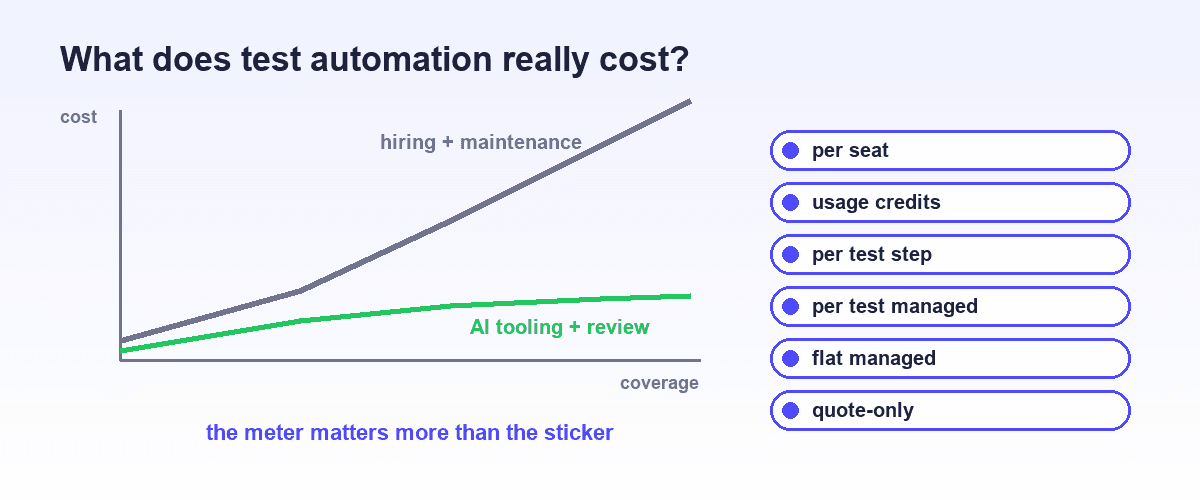
The spread comes less from feature differences than from pricing model: what the vendor meters, and how that meter grows with your usage. Most vendors price per seat, per test, or by quote.
Shiplight meters plain dollar credit for model tokens and compute at published rates: $0 on Free and $60 a month on Pro, with bring-your-own-LLM-key and own-CI options on every plan, so the meter can be bypassed entirely.
Two tools with similar capabilities can differ several-fold in real cost for the same team, purely because one charges per seat and the other per test executed.
So before comparing prices, you have to compare pricing models, and before computing ROI against hiring, you have to count the costs that never appear on a pricing page.
This guide covers both: the pricing models used across the AI testing category, what each one quietly optimizes for, and a build-versus-buy framework for the "is this cheaper than hiring QA engineers" question that treats the answer as math rather than marketing.
The six pricing models in AI test automation
Vendors describe their own pricing in one of roughly six shapes. The labels below follow how vendors present themselves on their pricing pages, not any internal ranking.
Per seat
A monthly or annual fee per user who authors or manages tests. Common among low-code and no-code platforms whose value pitch is letting more people write tests. Predictable, easy to budget, and cheap for small teams with big suites.
The catch: seat counts creep, and per-seat pricing quietly discourages the "everyone can look at the tests" openness that quality cultures want.
For teams budgeting for AI assistants alongside test automation, Coworker's enterprise AI pricing comparison provides a separate reference for assistant subscription costs. Keep those licenses separate from testing costs when estimating the total budget.
Usage-based credits or minutes
You buy a pool of credits, or pay for execution minutes, consumed as tests run. Several AI-native vendors describe their pricing this way, sometimes with AI operations, such as generation or healing, drawing from the same pool.
Costs track activity, which feels fair, but the meter runs on your CI: move from nightly runs to per-pull-request runs and spend can jump an order of magnitude with no change in suite size. Budgeting requires forecasting run frequency, not just test count.
Per test step, metered
A finer-grained usage model some AI-native tools use: each step a test executes, or each AI action, consumes credits. Aligns price tightly with work performed, and small suites stay cheap. The failure mode is a disincentive to write thorough tests, since a 40-step end-to-end flow costs ten times a 4-step smoke check every single run.
Per test under management
Pricing scales with the number of tests the platform maintains for you, a model associated with managed and maintenance-heavy offerings. It prices the vendor's real cost driver honestly. It also means your bill grows with coverage, so teams start rationing which flows deserve a test, which is backwards: coverage should be something you want more of.
Flat managed subscription
A fixed subscription under which a service provider builds and maintains your suite, with humans plus tooling behind the curtain. Managed QA services describe their pricing this way. Highest price band, lowest internal effort, and the economics of a services business: you are paying for people's time, packaged as software pricing.
Quote-only enterprise
"Contact sales." Most vendors' enterprise tiers, and some entire products, price this way, typically bundling deployment options such as private cloud or VPC, compliance features, SLAs, and support. Quote-only is not inherently a red flag; enterprise deals genuinely vary. It does mean list-price comparison shopping is impossible, so negotiate with usage forecasts in hand.
Pricing model comparison
| Pricing model | Meter | Grows with | Budget predictability | Watch for | Typical sellers |
|---|---|---|---|---|---|
| Per seat | Users | Team size | High | Seat creep; discourages shared access | Low-code / no-code platforms |
| Usage credits / minutes | Runs and AI operations | CI frequency | Medium | Per-PR testing multiplies spend | AI-native cloud tools |
| Per test step | Steps executed | Test depth and frequency | Low | Penalizes thorough tests | Some AI-native tools |
| Per test under management | Suite size | Coverage | Medium | Rations coverage growth | Maintenance-focused services |
| Flat managed subscription | Contract | Scope negotiated | High | Services economics at software framing | Managed QA services |
| Quote-only enterprise | Negotiated | Deal specifics | High once signed | No public benchmark | Most enterprise tiers |
| Free / open source | None (infra and labor instead) | Engineering time | N/A | The cost is headcount, not license | Open-source frameworks |
The last row is the one every evaluation should keep in frame. Playwright and Selenium cost nothing to license, and they are the honest baseline: any paid tool's price is really the premium you pay to avoid the engineering hours those frameworks consume. Which leads directly to the hiring question.
What the category actually publishes
We surveyed the published pricing of the major vendors in this category in August 2026, reading each vendor's own pricing page rather than any aggregator. The distribution is worth knowing before you start an evaluation, because it tells you how much of the work will land on you:
| What the vendor publishes | Share of the vendors surveyed |
|---|---|
| A full rate card you can budget from without a call | 2 of 6 |
| Tier prices, but the consumption unit behind them is private | 1 of 6 |
| Some products priced publicly, the flagship quoted privately | 1 of 6 |
| No figure at all; the pricing link leads to a form | 2 of 6 |
So for two thirds of the market, a price comparison is not something you can do at your desk.
That is a legitimate commercial choice on the vendor's part, and it has a practical consequence: your evaluation timeline is set by how fast sales teams call you back, and the tool you can price yourself in an afternoon has an advantage that has nothing to do with its features.
The four traps that make quotes uncomparable
Most of the confusion in this category is not deception. It is four missing variables that nobody thinks to ask for.
1. The unit is undefined. "Per run" means nothing until someone says whether a run is one test or the whole suite, and whether minutes are summed across tests or measured as wall-clock time. With parallel execution those two differ by the parallelism factor, which can be ten times. Settle this before any arithmetic.
2. A per-minute rate is meaningless without the machine. Published minute rates in this category vary by more than tenfold, and some of that gap is just machine size. A minute on 4 vCPU and 16 GB is not a minute on 32 vCPU and 128 GB.
Ask for the runner specification, in vCPU and memory, and normalise before you compare. A vendor that publishes a rate without the specification has not really published a rate.
3. Credits hide two private variables, not one. A credit allowance is only a budget once you know the cost per credit and how many credits one run of your suite consumes. Vendors commonly publish the allowance and neither of the other two. Ask both, then convert.
4. Nobody tells you whether failure is billable. Do reruns consume the meter? Does an automatic heal? Under some models a flaky suite is free and under others it is the single largest line on the invoice, and this is exactly the condition a struggling team is already in when they start shopping.
Ask those four in the first email and a private model becomes a comparable one. Any vendor confident in its pricing will answer all four in writing.
Model it at three times your current coverage
Pricing models look similar at small scale and diverge sharply as suites grow, which is the opposite of how evaluations are usually run. Do the arithmetic twice: once at today's suite, once at three times it.
The reason is that each model rations something different, and the thing it rations is usually the thing you are trying to get more of:
| The model | What it rations |
|---|---|
| Per seat | Who is allowed to write or read tests |
| Per parallel slot | How fast CI can give you an answer |
| Per test under management | How much coverage you dare add |
| Per test step | How thorough any single test can be |
| Undisclosed credits | Your ability to plan at all |
None of these is dishonest, and each is a rational way for that kind of business to charge. But a team whose stated goal is "more coverage, running more often, visible to everyone" should notice when it is about to buy a model that charges extra for all three.
Is AI test automation cheaper than hiring QA engineers? The honest math
The comparison is usually framed as tool subscription versus QA salary. That framing flatters the tool. The real comparison is between two total-cost structures:
Cost of the people path
Fully loaded compensation for QA engineers, which in most markets is well above base salary once benefits, equipment, and management time are counted, multiplied by the number of people needed to author and then permanently maintain the suite.
Maintenance is the dominant term: across the industry, QA engineers routinely report the majority of their automation time going to fixing broken tests rather than writing new ones.
One concrete data point from our own customers: the Head of QA at HeyGen reported going from roughly 60 percent of time spent authoring and maintaining tests to roughly zero within a month of switching, which is a measure of how large that term was before.
Cost of the tool path
License or usage fees, plus the engineering time the tool still requires, because no tool reduces that to zero, plus infrastructure, plus the one-time migration or ramp cost.
Three honest corrections to the vendor math
Three honest corrections to the vendor math you will encounter:
- AI tools do not replace QA judgment. They replace authoring and maintenance labor. Someone still decides what to test, reviews what the AI wrote, and owns quality. If a vendor's ROI model deletes an entire salary, it is overclaiming; what changes is what those people spend their week on, and how many you need per unit of coverage. Our piece on the QA role in the AI era covers where the judgment work moves.
- Count the meter, not the sticker. Under usage pricing, your real cost is the sticker times your CI behavior. Model a per-pull-request world, because that is where AI-native development is heading.
- Count escaped bugs on both sides. The expensive scenario is not paying for testing; it is shipping regressions. If a tool credibly raises coverage, the avoided-incident term can dominate the whole calculation, and if it produces flaky noise, the triage time it creates belongs on its cost line.
A simple framework: for each option, sum license and usage fees, engineering hours times loaded hourly cost, infrastructure, and expected escaped-bug cost, over a 12-month horizon at your projected release cadence. Run it at your current suite size and at 3x, because pricing models diverge most as coverage grows.
The general pattern our customers report, teams reaching reliable end-to-end coverage around 10x faster with near-zero ongoing maintenance, shows up in that framework as a collapse of the engineering-hours term, not the disappearance of people.
What ROI actually looks like when it works
Measured signals from teams that made the switch, attributed by role, drawn from Shiplight customer reports:
- A co-founder and CTO at Jobright reported automating over 80 percent of core regression flows within the first weeks, with manual checks mostly gone.
- A Head of Engineering at Warmly reported reliable end-to-end coverage across critical flows in days, including complex data-driven logic.
- First regression suites of roughly 300 tests built within the first week are typical of the pattern.
The ROI shows up in four ledgers: engineering hours not spent on maintenance, releases not delayed waiting for manual verification, regressions caught before production, and, hardest to price but most strategic, the willingness to ship faster because verification is no longer the bottleneck.
What does Shiplight cost?
Published, and on the same page as the rates behind it. What a real month looks like works one team's usage through these plans end to end.
| Plan | Price | Included credit | Pay as you go |
|---|---|---|---|
| Shiplight Free | $0 forever | $10 signup bonus, once | No |
| Pro | $60/month, or $600/year | $60/month, or $720 granted upfront yearly | Yes, plus auto-recharge |
| Enterprise | Contract priced | Custom | Yes |
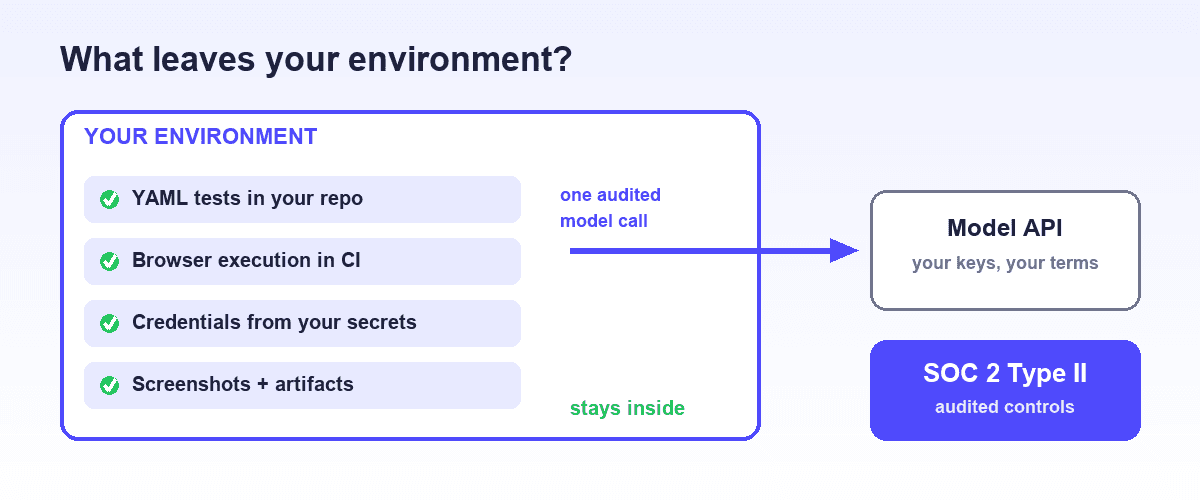
Local usage is free and needs no account at all: MCP browser automation and YAML authoring run inside your coding agent, tests are files in your own repo, and they run with npx shiplight test.
Above that, usage is metered at published rates: compute from $0.008 per minute on a 4 vCPU, 16 GB runner to $0.054 on 32 vCPU, 128 GB, and model usage from $1.00 to $6.00 per million tokens by tier.
Settled steps replay from cache without calling a model, so most of a mature suite's cost is compute you can calculate in advance. Every capability ships on every plan, including bring-your-own model key and running on your own CI; the full breakdown is here, and the tier table is on the pricing page.
Three things about that model are worth stating plainly, because they are what the four traps above are asking about.
Nothing is rationed by plan
AI actions, auto-healing, MCP access, Skills, CI integration, bring-your-own model key, and running on your own infrastructure are on Free, Pro, and Enterprise alike. Plans differ on included credit, retention, recordings, and members, never on capability.
There is no seat charge, so letting the whole team read the tests costs nothing, and no per-test charge, so adding coverage costs only what it runs.
The meter can be bypassed entirely, on any plan
Point Shiplight at your own Anthropic, OpenAI, or Google key and your provider bills the tokens. Run on your own CI runners and our compute is out of the path. You can do both, on Free.
The trade is that some usage and cost analytics thin out when runs do not pass through our runners or proxy, and that is the whole of it.
A mature suite gets cheaper per test, not more expensive
Once a step has resolved, its locator is cached and it replays without calling a model, so a settled suite is mostly compute.
The exception is worth knowing before you budget: AI steps and AI assertions are not cached and call the model on every run, and a heal calls the model because that is the moment something changed.
Enterprise adds volume pricing, custom credit and retention, SOC 2, private cloud and VPC deployment, audit logs, and a dedicated customer success manager.
You can settle all four questions above about Shiplight without talking to anyone: the rates are on the pricing page, the runner specifications are next to them, local runs need no account, and the full cost breakdown works a real month through the arithmetic. A walkthrough is there if you would rather price your own suite with someone.
Frequently Asked Questions
How much does AI test automation software cost?
From free to six figures a year. Open-source frameworks cost nothing to license and plenty in engineering time; commercial plans climb from low hundreds a month upward. Because vendors meter seats, credits, steps, or tests under management, model your own usage rather than the sticker.
Are AI testing tools priced per seat or by usage?
Both, and the category is drifting toward usage. Low-code platforms lean per seat; AI-native tools meter execution minutes, credits, or steps. Per-seat cost grows with your team, usage grows with your CI cadence, so model usage before moving to per-pull-request runs.
Is AI test automation cheaper than hiring QA engineers?
For the authoring and maintenance portion, usually yes, and often by a lot: tool costs are small against loaded compensation. But it is a false substitution. AI removes mechanical labor, not judgment. Compare license fees, engineering hours, infrastructure, and escaped-bug cost over a year.
What is the ROI of switching to AI-driven test automation?
In four places: maintenance hours recovered, release delays avoided, regressions caught before production, and coverage per engineering dollar. Customer reference points include 80% of core regression flows automated within weeks. To compute your own, baseline maintenance hours, manual verification time, and escaped-bug incidents, then re-measure after a pilot like the 30-day playbook.
Why do so many AI testing vendors hide pricing behind "contact sales"?
Usually genuine deal variance rather than concealment: enterprise contracts bundle deployment, compliance, SLAs, and volume, so one list price misleads. Arrive with a usage forecast, make every vendor quote the same scenario, and ask what happens at 3x. A vendor that will not describe its pricing model is the warning sign.
What hidden costs should I budget for beyond the subscription?
Five recur: engineering time for setup and upkeep; CI multiplication once you test every pull request; overage cliffs in heavy release months; migration cost, which tests stored as code in your repo keep near zero; and flaky-test triage, billed in engineer attention.
Can I use my own API keys with an AI testing tool?
Some do, many do not. Shiplight does on every plan including Free: point it at your own Anthropic, OpenAI, or Google key and run in your own CI, with no metered vendor usage in the path. Check for the same before committing to any vendor.