The QA role in 2026 has not disappeared; it has been restructured.
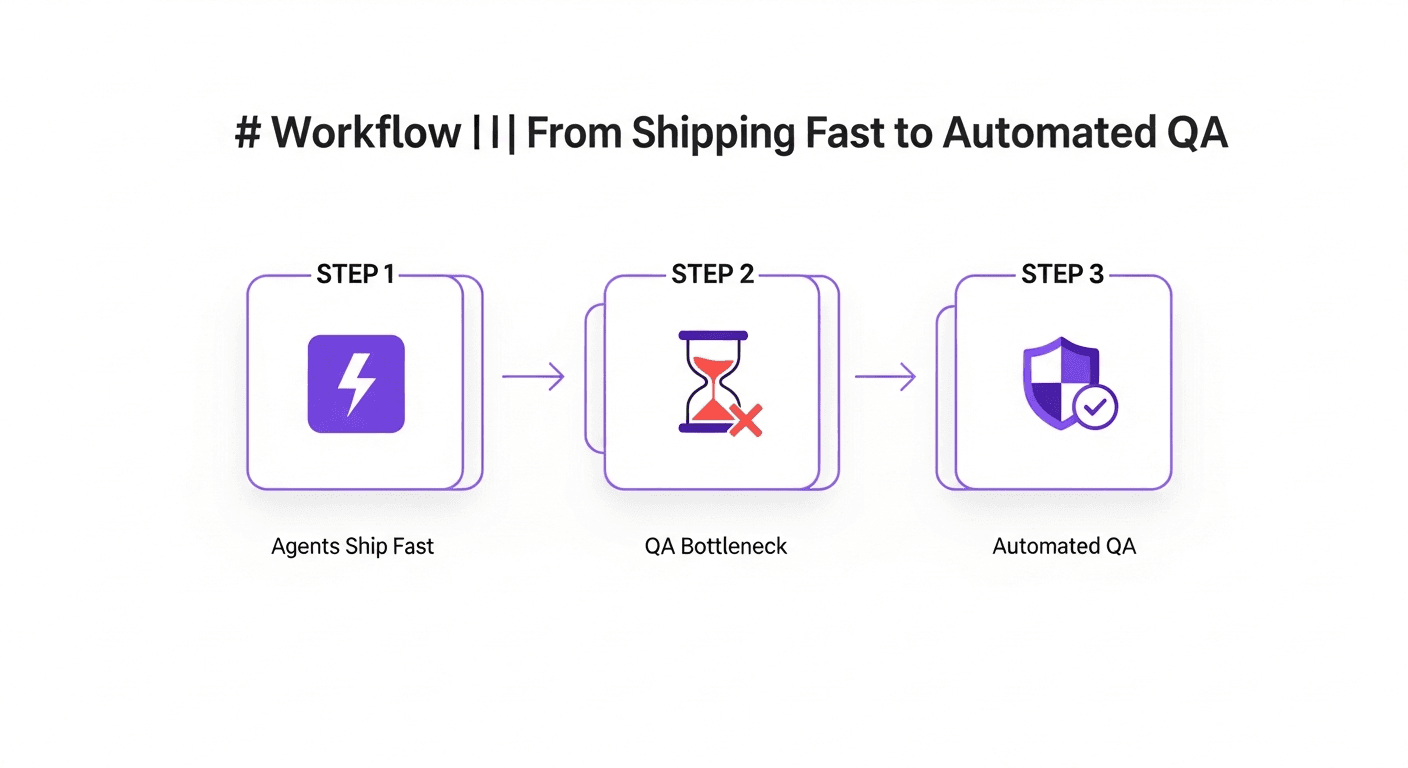
The mechanical parts of the job (selector maintenance, manual click-throughs to verify a release, writing automation scripts after a feature ships) have moved to AI systems and to the AI coding agents that wrote the feature in the first place.
What remains, and grows in importance, is the human work that defines what quality means: deciding what to test, reviewing autonomously-generated tests, owning quality policy, running exploratory testing that no agent thought to do, and handling the regulated and judgment-heavy parts of release decisions.
The result is a QA role with six new responsibilities, five distinct career tracks, and a different mix of required skills than the 2015 baseline.
This guide walks through each, with concrete patterns for QA engineers transitioning into the new role and engineering leaders hiring for it.
Key takeaways
- The QA role is being restructured, not eliminated. Headcount typically stays flat while coverage grows 5–10×; the shift is in the work, not the count. See from human QA bottleneck to agent-first teams.
- Six new responsibilities define the 2026 QA role: quality policy, test strategy ownership, agent oversight, exploratory testing, flaky-test triage policy, and regulated-domain judgment.
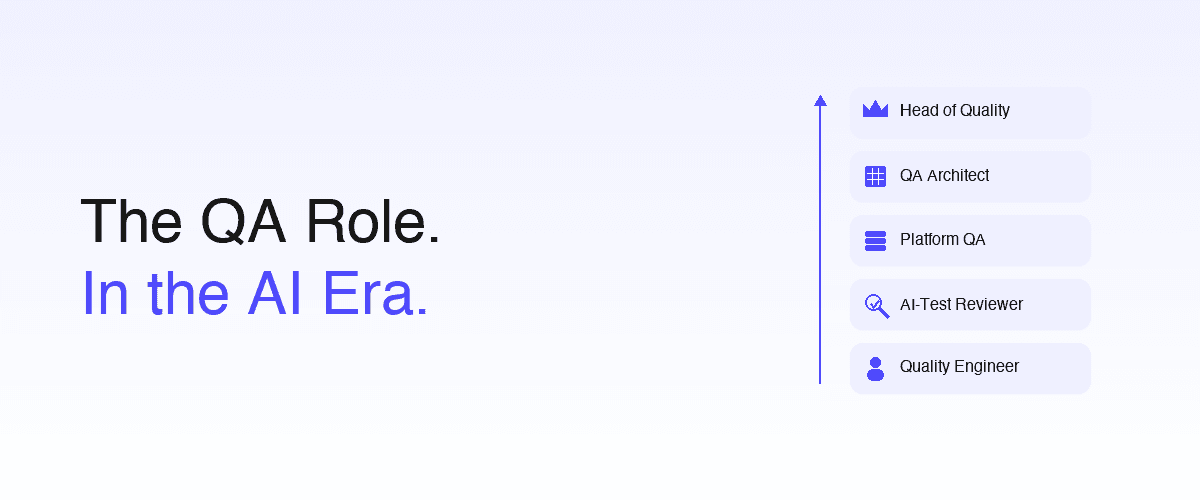
- Five career tracks open up: QA architect, AI-test reviewer, quality engineer (IC), QA platform engineer, and head of quality.
- The skills that matter shift from "write Playwright cleanly" toward "evaluate agent output, define quality policy, design strategy, communicate trade-offs."
- What does NOT happen: QA does not become a rubber-stamp on AI output, and AI does not replace exploratory testing or regulated-domain judgment.
What stays the same, and what changes
Before the new responsibilities, a clear picture of what the AI era keeps and what it transforms:
| Aspect of the QA role | 2015 baseline | 2026 reality |
|---|---|---|
| Define what "quality" means for the product | QA | QA: unchanged |
| Decide which user journeys are mission-critical | QA | QA: unchanged |
| Author E2E tests for new features | QA team | Engineer or coding agent, QA reviews |
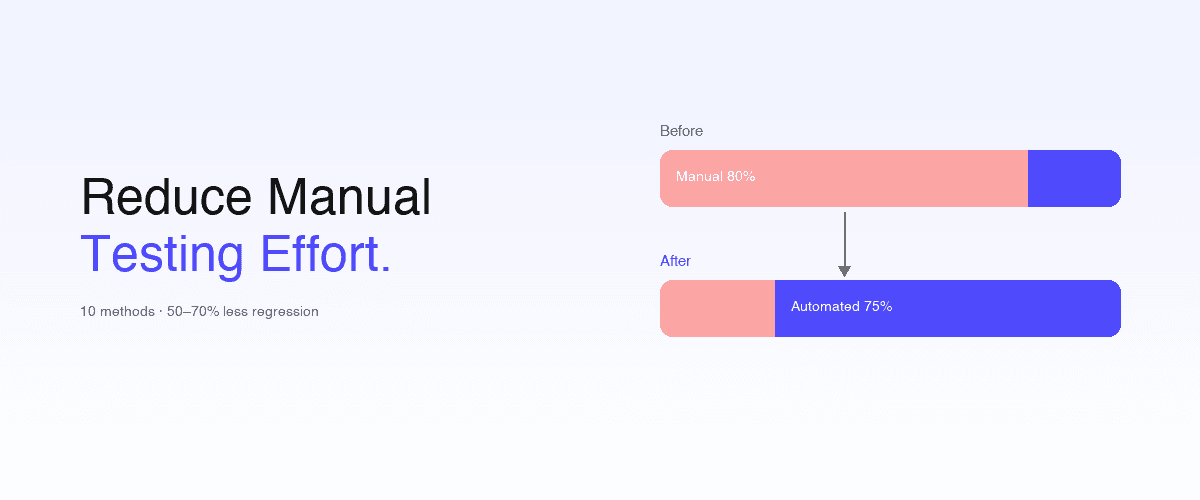
| Maintain selectors as the UI changes | QA, 40-60% of hours | AI Fixer / self-healing, QA approves PR patches |
| Run regression manually | QA team | CI gate, QA owns the metric, not the click-through |
| Triage failed CI runs | QA team | AI clusters failures, QA confirms categorization |
| Exploratory testing for surprising paths | QA | QA: unchanged, and more important |
| Decide release-go / no-go | QA + eng lead | QA + eng lead: unchanged |
| Handle regulated business logic | QA | QA: unchanged, and more important |
The pattern: the judgment work stays with humans. The mechanical work moves to AI. The QA role evolves toward the judgment-dense end of the spectrum, not away from QA.
The 2015 QA role baseline
Worth being explicit about what's being replaced. The 2015 QA engineer typically owned:
- Writing Selenium / Cypress / Playwright scripts for new features (typically authored after the feature shipped)
- Maintaining selectors as the UI evolved: the largest single time sink, 40–60% of hours per the Capgemini World Quality Report
- Running manual regression cycles before each release (often days of click-throughs)
- Triaging every red CI run individually
- Writing detailed test cases in a test-management tool
- Reporting bugs back to engineers in a separate ticketing system
That role was bottlenecked by a fundamental ratio: a QA engineer could maintain ~100–200 E2E tests effectively. Past that, maintenance overhead equaled authoring throughput. Net coverage growth was effectively zero. See the human QA bottleneck in agent-first engineering teams.
That ratio is what the AI era breaks, and the QA role evolves into the work that the broken ratio used to crowd out.
The 6 new QA responsibilities in the AI era
Responsibility 1: Quality policy
The QA engineer (or QA function) owns the written policy that defines what "quality" means for the product. In 2015 this was usually tacit. In 2026, with AI agents authoring tests autonomously, it has to be explicit. The policy answers:
- What user-journey reach is "enough" for production release?
- What flake budget is tolerated before a test is quarantined?
- Which categories of failures block merge vs warn?
- What data residency / privacy requirements apply to which test environments?
This is governance work, owned at the QA leadership layer. The output is a living document reviewed quarterly. See enterprise-ready agentic QA: a practical checklist.
Responsibility 2: Test strategy ownership
A 2026 test strategy is six-component: scope, authoring model, healing posture, gates, coverage targets, ownership. QA owns the strategy document, not the tactical execution. See AI-native test strategy in 2026.
In practice: QA partners with engineering leadership to set the operating model, then signs off on quarterly reviews when KPIs breach or new tooling enters the stack. The day-to-day work of running the strategy belongs to engineers and coding agents.
Responsibility 3: Agent oversight
The largest net-new responsibility. When AI coding agents author tests via MCP or SDK, someone has to review and approve those tests before they become regression gates. That someone is typically QA:
- Reviewing PRs where the coding agent added new tests
- Catching hallucinated assertions or wrong expected values
- Confirming that the test actually covers the user journey it claims to cover
- Periodically auditing the agent-generated portion of the suite for quality drift
This is not rubber-stamping. It is the equivalent of code review for tests, applied to a non-human author. See the testing layer for AI coding agents and Shiplight MCP Server.
Responsibility 4: Exploratory testing
The bug class that AI is worst at catching is the one that exists in flows nobody documented. A QA engineer manually exploring the application (trying weird inputs, racing two windows, abandoning a checkout halfway) surfaces bugs no autonomous explorer prioritizes. In 2026 this work is more important, not less, because:
- AI handles the regression-suite floor automatically; QA freed from selector maintenance has 40–60% more time for exploratory work
- AI agents tend to test what looks normal; humans find the unusual
- Exploratory findings become new candidate flows fed back into the automated suite
The 2026 QA engineer probably spends a larger fraction of the week on exploratory testing than the 2015 QA engineer did, even though headcount is flat.
Responsibility 5: Flaky-test triage policy
When a test fails intermittently without code changes, what happens? In 2015, a human investigated each one. In 2026, AI clusters and categorizes failures automatically, but policy still belongs to QA:
- What's the flake budget? (e.g., 2% of runs allowed to flake before a test moves to quarantine)
- How long can a test stay in quarantine before review?
- What's the SLA for resolving real-defect failures vs flake failures?
See test flakiness budget, quarantine test, and from flaky tests to actionable signal.
Responsibility 6: Regulated-domain judgment
For products in finance, healthcare, payments, or regulated industries, some of the testing decisions cannot be delegated to AI even when the technology could plausibly handle them. Examples:
- Confirming that a tax-calculation flow matches jurisdiction-specific requirements
- Validating that an HL7 / FHIR integration honors a privacy boundary
- Signing off on accessibility (WCAG) compliance for a release
These are the decisions auditors will ask about. They belong to a named human, and that human is typically QA leadership or a specialist QA engineer. See best self-healing test automation tools for enterprises.
The 5 QA career tracks emerging in 2026
The traditional ladder ("Junior QA → Senior QA → QA Manager") still exists, but five distinct career tracks are emerging as the role specializes:
1. QA Architect
Owns the operating model: test strategy, tooling decisions, gate design, metric dashboards. Reports to engineering or product leadership. Heavy on judgment, light on hands-on test writing. Outputs: strategy documents, RFCs, quarterly reviews.
2. AI-Test Reviewer
The QA engineer who specializes in reviewing autonomously-generated tests at scale. Becomes expert in the failure modes of the team's coding agents and testing platform. Outputs: approved test PRs, quality-drift reports, fine-tuning feedback for the test-generation pipeline.
3. Quality Engineer (IC)
The hands-on individual contributor role that combines exploratory testing, ad-hoc automation, and feature-level quality ownership. Looks closest to a 2015 senior QA engineer but spends less time on selector maintenance and more on exploration. Outputs: bug reports, exploratory test sessions, automation for flows agents missed.
4. QA Platform Engineer
Owns the testing infrastructure itself: CI gates, runner pools, observability for the test suite, integration with the AI testing platform. Often comes from an SRE or platform-engineering background and adds the QA lens. Outputs: gate uptime, test-runner cost optimization, integration with Shiplight, MCP Server.
5. Head of Quality
The executive role. Owns the quality-function P&L, hiring, vendor relationships, regulatory and audit interface. Translates between product, engineering, and external stakeholders (compliance, customers, auditors).
Most teams won't have all five named explicitly, but a single QA engineer often plays two or three of these depending on org size.
The QA skills that matter most in 2026
The skill mix shifts. Three buckets:
Grow in importance
- Quality policy authorship: turning tacit standards into written documents
- Test review at scale: judging AI-generated tests, not just writing them
- Exploratory testing methodology: structured curiosity, not random clicking
- Cross-functional communication: translating quality decisions to product and engineering
- Tooling fluency: fluent with intent-based testing, MCP, CI gates, observability dashboards
Stay important
- Domain knowledge for the product (especially regulated domains)
- Bug-reporting discipline
- Understanding of the application's user-experience surface
- Test data and environment management
Shrink in importance
- Hand-writing selectors / Playwright code (still useful, but no longer the bottleneck skill)
- Manual regression click-through
- Test-management tooling (most test definitions now live in
git, reviewed in PR) - Defect-triage volume (AI clustering does the first pass)
The directional change: more time on what should be true and less time on getting tests to pass. See the future of QA for the conceptual framing.
Org structure: how QA fits in a 2026 engineering team
Three common org models in 2026:
- Embedded QA. One QA engineer per feature team, reporting into the team. Owns strategy and exploratory work for that team's product surface. Pairs closely with engineers and the coding agent. Common in mid-stage startups.
- Quality guild + platform QA. A small central platform-QA team owns tooling, gates, and metrics. A guild of "quality champions" (often engineers, not full-time QA) handles in-team quality work. Common in scaling product companies.
- Centralized QA function. A separate quality function reports to the CTO or VP Eng. Owns policy, hires specialist QA engineers, and partners with feature teams via service-level agreements. Common in enterprises and regulated industries.
The single failure mode all three avoid: separating QA physically from the engineers who ship code. The 2026 default keeps QA close enough to the build loop to see failures as they happen, regardless of reporting line.
What the QA role does NOT become
A few things the QA role is sometimes mischaracterized as in the AI era, none of them accurate:
- Not a rubber stamp on AI output. Approving an autonomously-generated test without reviewing it is the same anti-pattern as approving a code review without reading the diff. Both produce false confidence.
- Not eliminated by autonomous testing. Tools that promise "no QA needed" are selling the same headcount-replacement pitch that flopped in the previous wave of testing tools. The QA function is restructured; it does not disappear.
- Not a pure exploratory role. Exploratory testing grows in share, but a 2026 QA engineer still owns policy, strategy, agent oversight, and regulated-domain judgment.
- Not a coding-agent operator. The QA engineer doesn't issue prompts to the coding agent for every test. The agent authors tests as part of building features; QA reviews the output the same way an engineer reviews code.
How QA engineers transition into the new role
For practitioners already in QA, the practical transition path:
Month 1: Build the new toolchain fluency. Get comfortable reading intent-based YAML tests, reviewing PRs with auto-generated tests, navigating a CI gate dashboard.
Month 2: Move work up the stack. Less time on selector maintenance (let the AI Fixer handle it); more time on test strategy, policy authorship, and reviewing agent-generated tests.
Month 3: Specialize. Pick a track (architect / reviewer / quality engineer / platform / head). The five tracks above are differentiated enough that most engineers gravitate toward one within a few months.
Quarter 2+: Lead. Once fluent in the new model, the move that pays back most is teaching it. Document the team's quality policy. Run "test review" guild sessions. Mentor engineers on intent-based test authoring. The QA engineer who can articulate why quality decisions are made the way they are is the one who scales as the org grows.
How engineering leaders hire for the new role
Two patterns:
Hiring an experienced QA engineer: Look for evidence of judgment work, not just automation throughput. Strong signals: has authored a test strategy document; has reviewed AI-generated tests; has owned a quality policy. Weak signals: number of Playwright tests written, certifications, time-in-role.
Promoting an engineer into QA: A backend or frontend engineer who shipped a feature with thoughtful test coverage and clear documentation often translates well into a quality-engineer track. Lower hiring risk than going external; same competency profile.
The interview should test review and judgment, not pure automation skill. Ask candidates to review a deliberately-flawed agent-generated test. Ask them to draft a quality policy for a hypothetical product. Ask them about a time they pushed back on shipping. Automation coding skill matters but is no longer the bottleneck.
Conclusion: the QA role gets harder, not smaller
The 2026 QA role demands more judgment, more communication, more cross-functional skill, and less mechanical execution. The engineers who thrive in it are the ones who saw the selector-maintenance treadmill as a constraint, not a job description, and who took the freed time to invest in policy, strategy, and review skill.
The teams that thrive are the ones that resisted the temptation to "automate QA away" and instead used AI to amplify what the human QA function does best.
For QA practitioners building the new toolchain fluency, Shiplight AI is the system most teams use to operationalize the six new responsibilities: YAML Test Format for reviewable intent-based tests, AI Fixer for self-healing as default, MCP Server for agent oversight at scale, and Cloud runners for PR-time gates that surface the right judgment calls at the right time.
Book a 30-minute walkthrough and we'll map the six new responsibilities to the workflows your team already runs.
Frequently Asked Questions
What is the QA role in 2026?
It owns the judgment-dense parts: defining what quality means, owning strategy, reviewing autonomously-generated tests, exploratory testing, flake and quarantine policy. The mechanical parts, selector maintenance and writing scripts after features ship, have moved to the agents that built the feature.
Is the QA role being replaced by AI?
No. AI replaces tasks, not the role. Most teams report stable QA headcount with 5–10× coverage growth: the same people on work that compounds, spending more time on exploratory testing, strategy, and agent oversight.
What skills do QA engineers need in 2026?
Growing: policy authorship, test review at scale, exploratory methodology, fluency in intent-based testing and MCP. Steady: domain knowledge, bug-reporting discipline, test data management. Shrinking: hand-writing selectors and manual click-through. The shift is from getting tests to pass toward defining what should be true.
How is the QA team structure changing?
Three models: embedded QA, one engineer per feature team pairing with the coding agent; a quality guild plus a central platform team; and a centralized function reporting to the CTO, common in regulated industries. All three avoid the same anti-pattern, separating QA from the engineers who ship.
What does QA oversight of AI coding agents look like?
When an agent authors tests via Shiplight MCP or similar, QA reviews them in the PR the way an engineer reviews code: catching hallucinated assertions, confirming the test covers the claimed journey, auditing for drift. It is the largest net-new responsibility in the role.
Does the QA role still include manual exploratory testing?
More than before, not less. AI handles the regression floor, freeing QA from the 40–60% maintenance overhead that crowded exploratory work out. Exploration also finds the bug class AI is worst at: surprising flows nobody documented, which then become new regression tests.
How do I transition from a 2015-style QA role to the 2026 role?
About three months. Build toolchain fluency with intent-based YAML, PR-based test review, and CI gates. Shift work up the stack, less selector maintenance and more policy authorship. Then specialize into one of the five tracks, and teach the model to the rest of the team.
How should I hire a QA engineer in 2026?
Look for judgment work, not automation throughput. Strong signals: authored a test strategy, reviewed AI-generated tests, owned a quality policy. Weak signals: test counts, generic certifications, time in role. Interview for review skill by handing over a flawed AI-generated test to critique.