Playwright is one of the best browser automation frameworks available. It's fast, supports multiple browsers, and produces reliable test results. But it has one significant barrier: you need to write TypeScript or JavaScript to use it.
For teams where QA engineers, PMs, or developers don't want to maintain Playwright scripts, that barrier is real. Tests written in Playwright require ongoing maintenance: when the UI changes, someone has to update selectors, fix locators, and debug failures in code they may not fully understand.
The market has produced alternatives, but they are not interchangeable. They group into four approaches, and the differences that matter are structural: who authors the tests, where the tests live, and what happens when the UI changes. This guide compares the approaches rather than ranking a parade of lookalike vendors, because the approach determines everything downstream.
Quick Comparison: The Four Approaches
| Approach | Who authors tests | Where tests live | Self-healing | Cost model |
|---|---|---|---|---|
| Agent-native intent tests (Shiplight) | Your coding agent, or anyone on your team | YAML in your git repo | Yes: intent resolution + cached locators | Local runs need no account; Free $0, Pro $60/mo |
| Open-source recorders (Selenium IDE) | Anyone, by recording | Exported files you manage | No | Free |
| Vendor cloud consoles (DSL or recorder platforms) | Your QA team, in the vendor's web app | The vendor's cloud, not your repo | Vendor-dependent, runs in their cloud | Typically quote-based or metered |
| Managed QA services | The vendor's human engineers | Varies; often the vendor's infrastructure | Humans maintain the suite | You buy hours, priced accordingly |
Why Teams Look for Playwright Alternatives
Playwright itself isn't the problem: the maintenance model is. Here's what teams typically run into:
- Selector brittleness. Playwright tests rely on CSS selectors, XPath, or Playwright-specific locators like
getByRole. When the UI changes, these break. Teams report spending 40–60% of their testing time maintaining existing scripts rather than writing new ones. - Skill requirements. Writing and debugging Playwright tests requires TypeScript/JavaScript knowledge. Not every QA engineer, PM, or startup team has that expertise.
- Review burden. Playwright test code is code: it needs to be reviewed in PRs, understood by reviewers, and maintained by whoever inherits the codebase. For fast-moving teams, this adds friction.
- No built-in self-healing. When a button's class changes from
btn-primarytobtn-submit, a Playwright test fails. Someone has to manually find and fix the selector. AI-native tools handle this automatically.
The right alternative keeps what makes Playwright great (real browser testing, cross-browser support, reliability) while removing the code barrier.
Approach 1: Agent-Native Intent Tests (Shiplight)
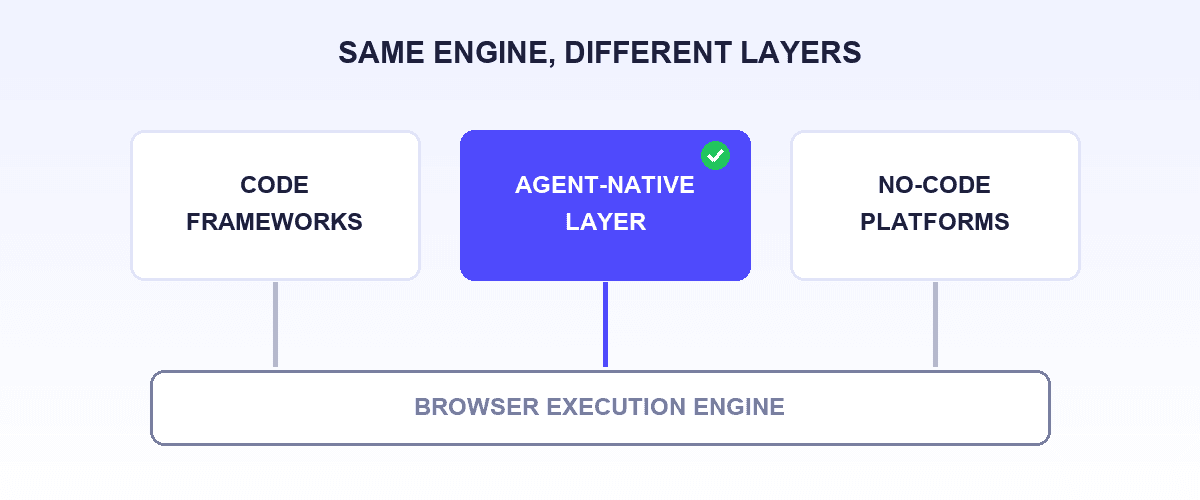
Best for: Developers and AI-native teams who want no-code tests that still live in the repo Shiplight is built on Playwright but replaces TypeScript scripts with YAML test files that use natural language intent. Tests are human-readable, live in your git repo, and self-heal when the UI changes.
What makes Shiplight unique is its browser MCP server and Skills: AI coding agents in Claude Code, Cursor, or Codex can open a real browser, verify UI changes, and generate YAML tests automatically during development.
goal: Verify login and dashboard access
statements:
 - intent: Navigate to the login page
 - intent: Enter email address and password
 - intent: Click the Sign In button
 - VERIFY: the dashboard is visible with a welcome message
Why choose over Playwright: No TypeScript to write or maintain. Tests self-heal via intent-based resolution. YAML files are reviewable by anyone: PMs, designers, QA engineers. Built on Playwright, so you get the same browser engine reliability, and if you already have a Playwright suite, Shiplight runs alongside it.
Pricing: Shiplight starts free: local runs need no account, and the Free plan is $0 forever with every core feature included. Pro is $60 per month; Enterprise is contract priced. SOC 2 certified.
What Is Intent-Based Testing (and Why YAML)?
The core problem with Playwright tests is that they describe how to interact with the page: click this selector, type into that input, wait for this element. When the UI changes, the "how" breaks even though the "what" (the user's goal) hasn't changed.
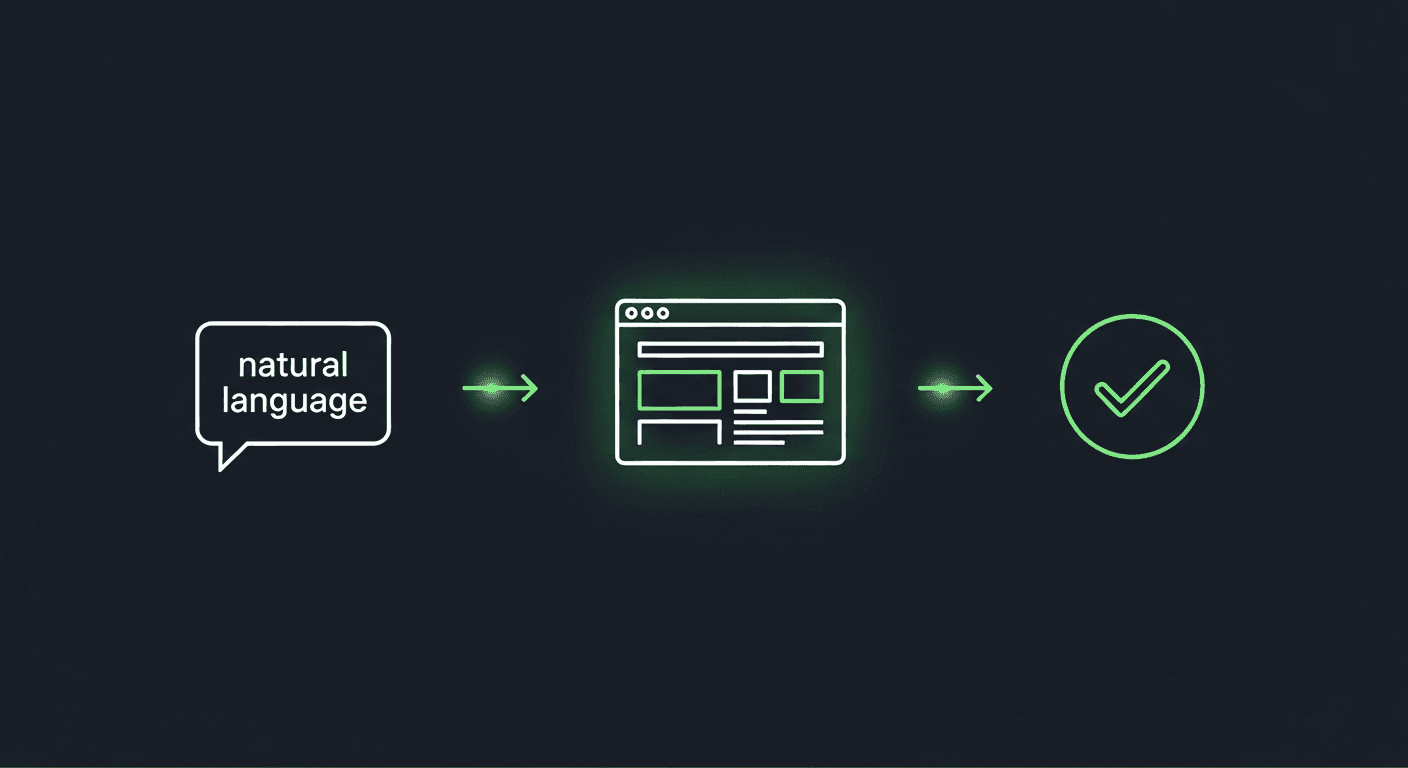
Intent-based testing flips this. Each test step declares what the user wants to accomplish ("Click Sign In," "Verify the dashboard is visible") and the AI figures out the how at runtime.
If a button moves or its class name changes, the intent stays the same and the test adapts. For a deeper look at this pattern, see The Intent, Cache, Heal Pattern.
Why YAML specifically? Three reasons:
- Readable by anyone. A PM can review a YAML test file and understand what's being tested without knowing TypeScript. Playwright test code requires programming knowledge to parse.
- Clean diffs in PRs. When a YAML test changes, the diff shows exactly which intent or verification was added, removed, or modified. Playwright code diffs mix test logic with framework boilerplate. For more on this, see The PR-Ready E2E Test.
- Deterministic speed with AI fallback. YAML tests include Playwright-compatible locators that are cached for fast, deterministic execution. AI resolution only kicks in when a cached locator breaks, giving you Playwright speed by default and self-healing when needed. This two-speed approach is what makes Shiplight different from fully AI-interpreted tools that re-find every element on every run.
The key insight: locators are a cache, not a specification. The intent is the specification. When you think about tests this way, YAML becomes the natural format: structured enough to be deterministic, readable enough to be a spec.
Approach 2: Open-Source Recorders
Design center: free record-and-playback for teams that want no-code without a vendor The open-source world has its own no-code path: browser recorders. Selenium IDE is the long-standing example: a free browser extension that records your clicks and typing into a replayable test, no code required to create it.
Playwright itself ships codegen (npx playwright codegen), which records interactions and generates Playwright test code you can keep.
The trade-off: recorded tests pin themselves to the selectors that existed at record time. There is no self-healing: when the UI changes, you re-record or hand-edit. Recorded suites also tend to accumulate duplication, because recording twice produces two scripts rather than one reusable flow. For a handful of smoke tests these tools are genuinely free and genuinely easy.
As a regression suite grows, the maintenance model becomes the same one that sent you looking for alternatives, minus the code skills to fix it.
Where it fits: small suites, quick smoke coverage, teams that want zero vendor involvement and accept the maintenance.
Approach 3: Vendor Cloud Consoles
Design center: QA staff authoring tests in a vendor's web application, not in your repo A large group of commercial platforms replaces test code with authoring inside the vendor's own console: some use a constrained plain-English command language, others a browser recorder, others a visual editor.
testRigor is a representative example of the category: a cloud-hosted platform (founded 2015) built to make manual QA productive without engineers, where tests are written in a structured English DSL and live as suites in the vendor's web console, running on the vendor's hosted runners.
The category shares a structural shape, whichever vendor you pick:
- Tests live in the vendor's cloud, not your repo. There is no file in git that a developer or coding agent can read, diff, or review in a PR. Export paths, where they exist at all, are typically limited or gated.
- Execution happens on the vendor's runners, usually metered or quote-priced, and reliability depends on their infrastructure.
- The authoring loop is built for QA staff in a console, not for a development workflow. Agent integrations, where offered, drive the vendor's cloud rather than putting tests in the developer's hands.
Where it fits: manual-QA-heavy organizations, often outside the software industry, where non-engineers own testing and a governed vendor console is the point. That is a genuinely different buyer from an engineering-led team. If your developers or coding agents are the ones who will create and review tests, tests that live outside the repo put the work outside your workflow.
Approach 4: Managed QA Services
Design center: outsourcing test authorship and maintenance to the vendor's human engineers The fourth approach is not a tool at all: managed services such as QA Wolf put the vendor's QA engineers (assisted by AI tooling) to work building and maintaining a Playwright suite for you.
The output is often standard test code, which is a genuine plus, but the operating model is a staffed service: coverage grows at the pace of their engineers, and testing knowledge accumulates with an external team rather than in your repo and your heads.
The trade-off is strategic, not just financial. You are buying human hours. For a team that has decided QA is someone else's job, that can work.
For a team building with AI coding agents, it points the opposite direction: the whole opportunity is that your own development workflow can now own testing, with tests that live next to the code they verify.
How to Choose
Keep Playwright if:
- Your team has strong TypeScript expertise
- You need maximum control over test logic
- You want the largest open-source community and ecosystem
- You're comfortable with the maintenance burden
Switch to a no-code alternative if:
- Your team spends more time maintaining tests than writing features
- Non-technical team members need to create or review tests
- You want self-healing that adapts to UI changes automatically
- You're building with AI coding agents and want testing in that loop
Decision by mechanism:
- Tests must live in your repo and your coding agent authors them: Shiplight (Skills, YAML in git, MCP integration)
- Free and simple beats durable: an open-source recorder for smoke coverage you accept re-recording
- A vendor cloud console with QA staff authoring is acceptable: a console-native DSL or recorder platform serves that design center
- Outsourcing QA entirely: a managed QA service, where human engineers own the suite
Final Verdict
Playwright is excellent, but writing and maintaining TypeScript test scripts isn't for every team. The question to ask is not "which vendor," it is "which approach": tests in your repo authored by your team and your coding agents, tests in someone else's cloud authored in their console, or tests owned by someone else's engineers.
If your team builds with AI coding agents, Shiplight gives you the best of both worlds: Playwright's browser engine reliability with YAML-based test authoring that anyone can read and AI that maintains tests automatically.
The question isn't whether to automate E2E testing; it's whether your team should spend time writing code to do it.
This guide focuses on no-code options. If you also want code-based frameworks in the comparison, see the broad guide to the best Playwright alternatives.
Get Started
- Try Shiplight (free, no account needed)
- Book a demo
- YAML Test Format
- Best AI Testing Tools in 2026
- Documentation
References: Playwright Documentation, Gartner AI Testing Reviews, Google Testing Blog
Frequently Asked Questions
Can I use Playwright and a no-code tool together?
Yes. Some teams use Playwright for complex, custom test scenarios and a no-code tool for standard regression tests. Shiplight is particularly suited for this since it is built on Playwright: your existing Playwright infrastructure and knowledge still applies, and the two suites run side by side.
Is Playwright still worth learning in 2026?
Yes. Playwright remains the most capable browser automation framework. But for teams where test maintenance is the bottleneck, an AI-native tool like Shiplight, built on Playwright, gives you both the reliability and the maintainability.
Do no-code testing tools actually work for complex apps?
For 80–90% of E2E test scenarios (login, navigation, form submission, data validation), no-code tools work well. For highly custom scenarios (complex drag-and-drop, canvas interactions, WebSocket testing), you may still need code. Shiplight handles this by allowing inline JavaScript in YAML tests for complex logic.
What is self-healing test automation?
Self-healing tests automatically adapt when UI elements change. Instead of failing because a button's CSS class changed, the AI identifies the element by intent and continues the test. This eliminates the #1 maintenance cost in Playwright and Selenium-based testing.
Which Playwright alternative is actually free?
Shiplight is free with no account required: local MCP browser automation and test authoring need no token. Open-source recorders like Selenium IDE and Playwright's own codegen are free outright, with the maintenance trade-offs above. Vendor cloud consoles typically advertise free sign-ups or trials, with real usage quote-based or metered.