End-to-end tests are supposed to be your final confidence check. In practice, they often become a recurring tax: brittle selectors, flaky timing, and one more dashboard nobody trusts.
AI has promised a reset. But most teams have a reasonable concern: if a model is “deciding” what to click, how do you keep results deterministic enough to gate merges and releases?
Neither rigid scripts nor free-form AI
The answer is not choosing between rigid scripts and free-form AI. It is designing a system where intent is the source of truth, deterministic replay is the default, and AI is the safety net when reality changes.
This is the core idea behind Shiplight AI's approach to agentic QA: stable execution built on intent-based steps, locator caching, and self-healing behavior that keeps tests working as your UI evolves.
The broader category is sometimes described as AI-adaptive testing: testing platforms that adapt to code or UI changes without manual test maintenance.
Intent-cache-heal is Shiplight's specific implementation of that category: we name the three distinct operations (capture intent, cache the resolved locator for speed, re-resolve from intent when the cache fails) so the pattern stays inspectable and debuggable. "AI-adaptive testing" describes the outcome; intent-cache-heal describes the mechanism.
Below is a practical model you can apply immediately, plus how Shiplight supports each layer across local development, cloud execution, and AI coding agent workflows.
Why E2E Tests Break: Two Distinct Failure Modes
When an end-to-end test fails, teams usually treat it like a single category: “the test is red.” In reality, there are two fundamentally different failure modes:
- The product is broken. The user journey no longer works.
- The test is broken. The journey still works, but the automation got lost due to UI drift, timing, or stale locators.
Classic UI automation makes these two failure modes hard to separate because the test definition is tightly coupled to implementation details. If the DOM changes, the test fails the same way it would if checkout genuinely broke.
Shiplight’s design goal is to decouple those concerns by writing tests around what a user is trying to do, then treating selectors as an optimization, not the test itself.
The pattern: Intent, Cache, Heal
1) Intent: write what the user does, not how the DOM is structured
Shiplight tests can be authored in YAML using natural language statements. At the simplest level, a test defines a goal, a starting URL, and a list of steps, including VERIFY: assertions.
A simplified example looks like this:
goal: Verify user journey
statements:
 - intent: Navigate to the application
 - intent: Perform the user action
 - VERIFY: the expected result
This intent-first layer is readable enough for engineers, QA, and product to review together, which is where quality should start. For more on making tests reviewable in pull requests, see The PR-Ready E2E Test.
2) Cache: replay deterministically when nothing has changed
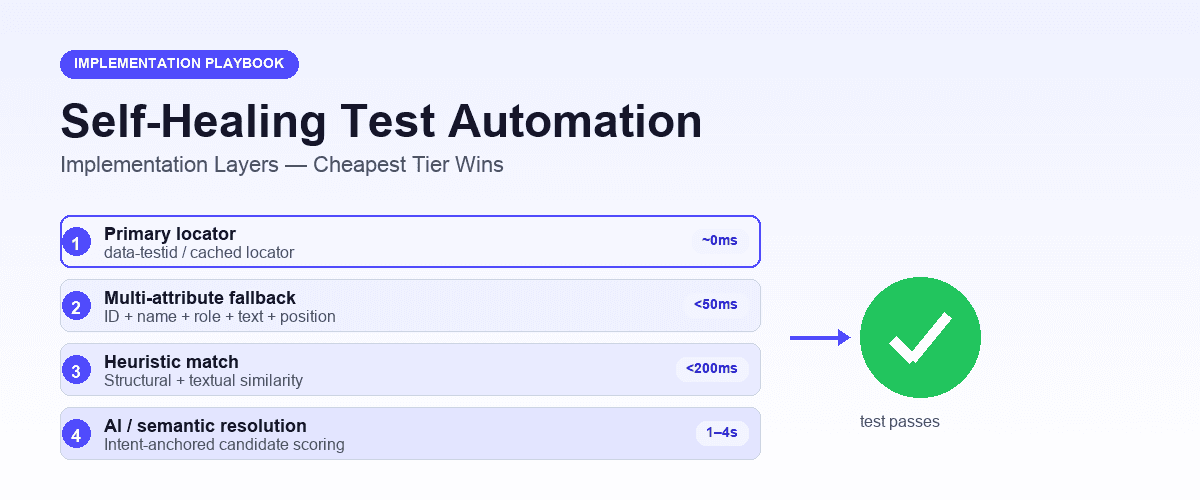
Pure natural language execution is powerful, but you do not want your CI pipeline to “reason” about every click on every run.
Shiplight addresses this with an enriched representation where steps can include cached Playwright-style locators inside action entities. The key concept from Shiplight’s docs is worth adopting as a general rule: Locators are a cache, not a hard dependency. (For a deeper exploration of this mental model, see Locators Are a Cache.)
When the cache is valid, execution is fast and deterministic. When it is stale, you still have intent to fall back on.
Shiplight is also built on Playwright, which gives teams a familiar, proven browser automation foundation. Teams looking for alternatives to raw Playwright scripting can explore Playwright Alternatives for No-Code Testing.
3) Heal: fall back to intent, then update the cache
UI changes are inevitable: a button label changes, a layout shifts, a component library gets upgraded.
Shiplight’s agentic layer can fall back to the natural language description to locate the right element when a cached locator fails. On Shiplight Cloud, once a self-heal succeeds, the platform can update the cached locator so future runs return to deterministic replay. For a deeper look at how this compares to other healing approaches, see What Is Self-Healing Test Automation.
This is how you stop paying the “daily babysitting” tax without sacrificing the reliability standards required for CI.
Making the pattern real: a practical rollout checklist
- Step 1Start with release-critical journeys, not “test coverage”
- Step 2Use variables and templates to avoid test suite sprawl
- Step 3Debug where developers already work
- Step 4Integrate into CI with a real gating workflow
- Step 5Cut triage time with AI summaries
Here is a rollout approach that keeps scope controlled while compounding value quickly.
Step 1: Start with release-critical journeys, not “test coverage”
Pick 5 to 10 flows that create real business risk when broken: signup, login, checkout, upgrade, key settings changes. Write these as intent-first tests before you worry about breadth.
Step 2: Use variables and templates to avoid test suite sprawl
As soon as you have repetition, standardize it.
Shiplight supports variables for dynamic values and reuse across steps, including syntax designed for both generation-time substitution and runtime placeholders. It also supports Templates (previously called “Reusable Groups”) so teams can define common workflows once and reuse them across tests, with the option to keep linked steps in sync.
This is how you prevent your E2E suite from becoming 200 slightly different versions of “log in.”
Step 3: Debug where developers already work
Shiplight’s VS Code Extension lets you create, run, and debug *.test.yaml files with an interactive visual debugger directly inside VS Code, including step-through execution and inline editing.
This matters because reliability is not just about test execution. It is also about shortening the loop from “something failed” to “I understand why.”
Step 4: Integrate into CI with a real gating workflow
Shiplight provides a GitHub Actions integration built around API tokens, environment IDs, and suite IDs, so you can run tests on pull requests and treat results as a first-class CI signal.
Once the suite is stable, add policies like “block merge on critical suite failure” and “run full regression nightly.” Make quality visible and enforceable.
Step 5: Cut triage time with AI summaries
Shiplight Cloud includes an AI Test Summary feature that analyzes failed test results and provides root-cause guidance using steps, errors, and screenshots, with summaries cached after the first view for fast revisits.
This is not just convenience. It is how E2E becomes decision-ready instead of investigation-heavy.
Where Shiplight fits depending on how your team ships
Shiplight is designed to meet teams where they are:
- Shiplight is built to work with AI coding agents, ingesting context (requirements, code changes, runtime signals), validating features in a real browser, and closing the loop by feeding diagnostics back to the agent.
- Shiplight runs alongside existing Playwright-based test infrastructure rather than replacing it, keeping execution deterministic and code-rooted while adding AI-native stabilization and self-healing.
- Shiplight Desktop (macOS) runs the Shiplight web UI while executing the browser sandbox and agent worker locally for fast debugging, and includes a bundled MCP server for IDE connectivity.
The bottom line: AI should reduce uncertainty, not introduce it
If your test system depends on brittle selectors, you will keep paying maintenance forever. If it depends on free-form AI decisions, you will struggle to trust results.
The Intent, Cache, Heal pattern is the middle path that works in production: humans define intent, systems replay deterministically, and AI intervenes only when the app shifts underneath you.
Shiplight AI is built around that philosophy, from YAML-based intent tests and locator caching to self-healing execution, CI integrations, and agent-native workflows. See how Shiplight compares to other AI testing approaches in Best AI Testing Tools in 2026.
Intent, Cache, Heal: Key Takeaways
- Verify in a real browser during development. Shiplight lets AI coding agents validate UI changes before code review.
- Generate stable regression tests automatically. Verifications become YAML test files that self-heal when the UI changes.
- Reduce maintenance with AI-driven self-healing. Cached locators keep execution fast; AI resolves only when the UI has changed.
- Integrate E2E testing into CI/CD as a quality gate. Tests run on every PR, catching regressions before they reach staging.
Get Started
References: Playwright Documentation, GitHub Actions documentation, Google Testing Blog
Frequently Asked Questions
What problem does the pattern solve?
Two failure modes at once. Rigid scripts break on cosmetic change and free-form AI is non-deterministic; caching a resolved intent gives you the first behaviour normally and the second only on a miss.
When does healing actually run?
Only when a cached locator fails to resolve. A passing test never calls the model, which is what keeps runs deterministic and cheap.
How is this different from fallback selectors?
A fallback list is a guess written in advance. Re-resolving from intent asks what the step meant and finds the element that means it now, which survives a restructure a list cannot.
Can I see what healed?
Yes, and you should insist on it. A repair that arrives as a reviewable diff is a decision; one applied silently in a vendor cloud is a liability.