The Hidden Cost of Manual Test Maintenance
Every engineering team that has invested in end-to-end testing knows the pattern. You build a test suite, it provides confidence for a few sprints, and then the maintenance burden takes over. Locators break. Page structures shift. Components get renamed. Tests fail for reasons unrelated to actual product regressions.
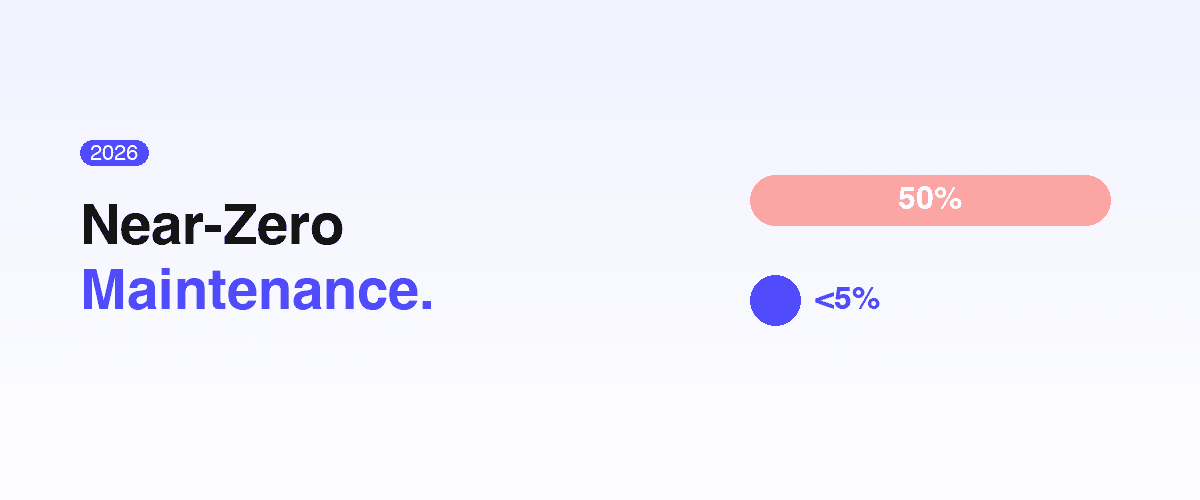
According to research published on the Google Testing Blog, teams spend between 40% and 60% of their total testing effort maintaining existing tests rather than writing new ones. For a team of five QA engineers, that means two or three people doing nothing but fixing broken selectors.
This is a business problem, not just a testing problem. When calculating test automation ROI, the maintenance cost is the variable that makes or breaks the investment.
Self-healing tools shift this equation by eliminating the regression testing maintenance tax entirely: the same shift-left testing philosophy applied to test upkeep rather than just test execution.
What Manual Test Maintenance Actually Looks Like
To understand the ROI case for self-healing test automation, consider where time goes in a traditional maintenance workflow:
- Triage -- An engineer investigates a CI failure to determine whether it is a real bug or a broken test. 15-30 minutes per failure.
- Diagnosis -- Identifying the root cause: a changed selector, timing issue, or modified page layout. Another 15-45 minutes.
- Repair -- Updating the locator, adjusting wait conditions, or restructuring the test. 10 minutes to several hours.
- Validation -- Running the repaired test locally and in CI. Another 15-30 minutes of waiting.
Multiply this by the 10-50 test failures a mid-sized team encounters each week, and you arrive at the 60% maintenance figure.
How Self-Healing Tests Change the Equation
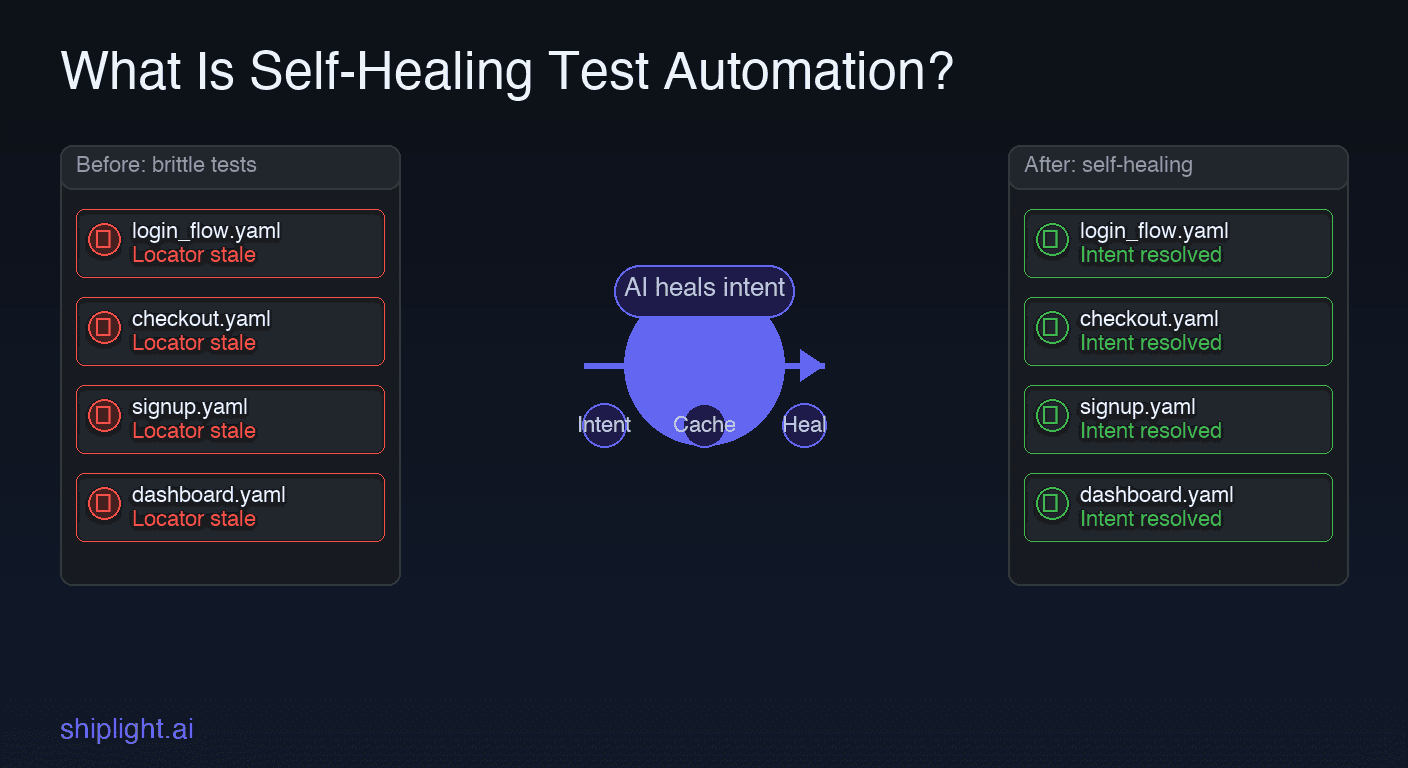
Self-healing test automation eliminates most of these steps. When a locator breaks, the system detects the failure, resolves the intended element through alternative strategies, and updates the test definition automatically. The test passes on the next run without human intervention.
The intent-cache-heal pattern that Shiplight uses takes this further. Instead of maintaining a list of fallback selectors, Shiplight records the semantic intent behind each test step. When the UI changes, the system uses that intent to locate the correct element regardless of how the DOM has been restructured. The healed locator is cached so subsequent runs are fast and deterministic.
Teams using self-healing automation report a 95% reduction in maintenance effort. That is not a theoretical projection. It reflects measured outcomes where test suites that previously required 20-30 hours per week of maintenance attention now require 1-2 hours of occasional review.
The ROI Framework
- Step 1Measure Your Current Maintenance Cost
- Step 2Project the Self-Healing Reduction
- Step 3Factor In Indirect Benefits
- Step 4Compare Against Tool Cost
Here is a straightforward framework for calculating the ROI of switching from manual maintenance to self-healing test automation.
Step 1: Measure Your Current Maintenance Cost
Track these metrics over a four-week period:
- Hours per week spent triaging, diagnosing, and repairing broken tests
- Number of test failures per week caused by UI changes (not real bugs)
- Average time to repair a single broken test
- Fully loaded cost per engineer hour (salary, benefits, overhead)
For a typical team, the numbers look like this:
| Metric | Typical Value |
|---|---|
| Weekly maintenance hours | 20-30 hours |
| False failures per week | 30-50 |
| Average repair time | 35 minutes |
| Engineer cost per hour | $75-$150 |
| Monthly maintenance cost | $6,000-$18,000 |
Step 2: Project the Self-Healing Reduction
With self-healing automation handling 95% of locator-related failures, the math is direct:
| Metric | Before | After Self-Healing |
|---|---|---|
| Weekly maintenance hours | 25 | 1.25 |
| Monthly maintenance cost | $12,000 | $600 |
| Annual maintenance cost | $144,000 | $7,200 |
| Annual savings | -- | $136,800 |
Step 3: Factor In Indirect Benefits
The direct time savings are only part of the story. Self-healing tests also deliver:
- Faster release cycles -- Tests no longer block deployments with false failures
- Higher test coverage -- Engineers freed from maintenance write more tests
- Reduced flaky test fatigue -- Teams stop ignoring test results when they trust the suite
- Lower onboarding cost -- New engineers do not need to learn the archaeology of fragile selectors
Conservative estimates put the indirect benefit at 30-50% on top of the direct savings.
Step 4: Compare Against Tool Cost
Self-healing tools vary in pricing, but even enterprise-tier solutions typically cost $500-$2,000 per month. Against annual savings of $100,000 or more, the payback period is measured in weeks, not months.
You can run that arithmetic before talking to anyone at our end of the range, because our plans and rates are published rather than quoted.
Why Intent-Based Healing Outperforms Selector Fallbacks
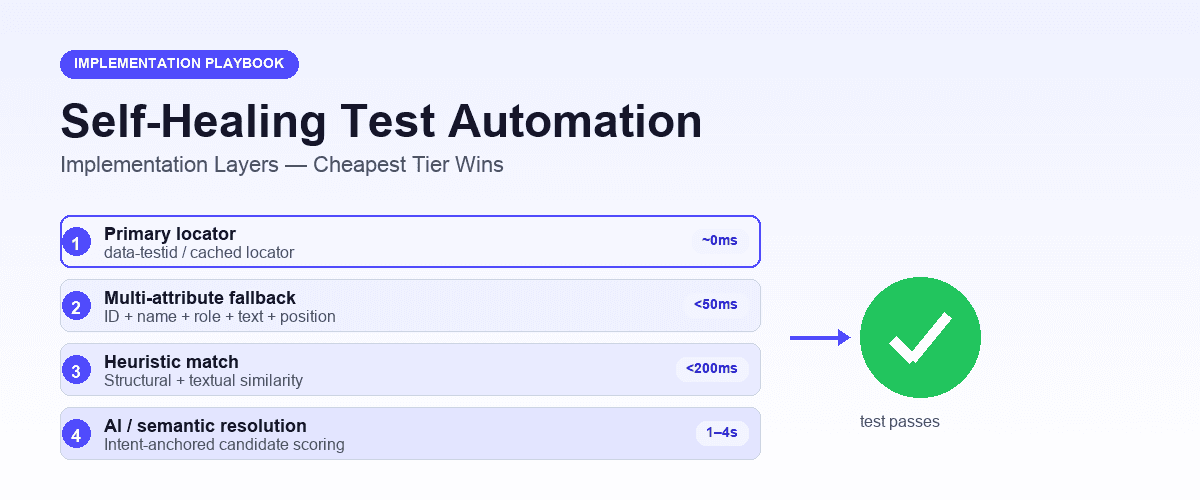
Not all self-healing approaches deliver the same ROI. Tools that rely on ranked locator fallbacks can handle simple changes but still break when the UI is significantly restructured. Intent-based healing, as described in the intent-cache-heal pattern, captures what the test is trying to do rather than how it locates elements.
This distinction matters for ROI because intent-based healing covers a wider range of failure scenarios. Teams using Playwright-based frameworks with intent-driven healing report fewer residual maintenance tasks than those using selector-fallback approaches.
Shiplight's plugin architecture integrates directly with your existing Playwright tests, which means you do not need to rewrite your test suite to get self-healing capabilities. The migration cost is minimal, and the ROI timeline starts immediately.
Key Takeaways
- 60% of QA effort in traditional test suites goes to maintenance, not new coverage
- Self-healing automation reduces maintenance by 95%, translating to six-figure annual savings for mid-sized teams
- Intent-based healing covers more failure scenarios than simple locator fallbacks
- Payback period for self-healing tools is typically 2-6 weeks
- Indirect benefits including faster releases and higher coverage add 30-50% to direct savings
Get Started
Ready to see the ROI case applied to your own test suite? Request a demo and walk through the numbers with the Shiplight team. Bring your maintenance metrics and we will show you a projected savings timeline based on your actual test suite size and change velocity.
You can also explore the Shiplight for AI coding agents to understand how self-healing integrates with your existing Playwright setup.
References: Google Testing Blog, Playwright Documentation
Frequently Asked Questions
How long does it take to see ROI from self-healing test automation?
Most teams see measurable reduction in maintenance effort within two weeks. The full ROI becomes clear after one month, once the system has handled a representative sample of UI changes.
Does self-healing work with our existing test framework?
Shiplight works with Playwright-based test suites through its plugin system. You do not need to rewrite tests or migrate to a proprietary framework, which keeps adoption risk low.
Can self-healing tests still catch real bugs?
Yes. Self-healing only activates when a test step fails due to a locator resolution issue, not when application behavior has changed. The intent-cache-heal pattern distinguishes between cosmetic UI changes and functional regressions.