Self-healing test automation, also called auto-healing test automation, is testing infrastructure that detects when a test has broken because the application under test changed and repairs the test automatically, so it continues to pass without a human editing selectors.
Instead of failing on a changed button ID or shifted DOM structure, a self-healing test re-identifies the intended element and updates itself.
Three mechanisms, not one
Not all healing is the same mechanism, and the differences matter more than vendor marketing suggests. Every tool that claims self-healing implements one of three types: locator-fallback healing (retry alternative selectors), visual healing (re-find the element by appearance), or intent re-derivation (re-resolve the element from the step's stated purpose).
A large share of what is marketed as "self-healing" is the first type only: a selector retry loop that fails exactly when you need it most, during redesigns and component migrations.
This page is a taxonomy of all three types with the honest limits of each. Shiplight implements the third type through its intent-cache-heal pattern, and this page is explicit about what that approach does and does not solve.
How Does Self-Healing Test Automation Work?
The core problem self-healing solves is test maintenance. Traditional end-to-end tests are notoriously brittle. A developer renames a CSS class, restructures a component, or moves a button from one container to another, and dozens of tests fail even though the application behavior has not changed.
Engineering teams routinely spend 30-40% of their testing effort maintaining existing tests rather than writing new ones.
Self-healing automation aims to eliminate that overhead by making tests resilient to superficial UI changes while still catching genuine regressions in product behavior.
At a high level, every self-healing system follows a three-step cycle:
- Detection -- The system recognizes that a test step has failed, typically because a locator (CSS selector, XPath, test ID) no longer resolves to an element on the page.
- Resolution -- The system attempts to find the correct element through alternative strategies: nearby text, visual similarity, DOM structure analysis, or AI-based inference.
- Update -- Once the correct element is found, the system updates the stored locator or test definition so future runs succeed without repeating the resolution step.
The sophistication of the resolution step is where tools diverge, and it defines the three types of healing.
What Are the Types of Self-Healing Test Automation?
Three mechanisms exist, with three very different ceilings. When a vendor says "self-healing," the first question to ask is which of these it actually ships.
Locator-Fallback Healing (Rule-Based)
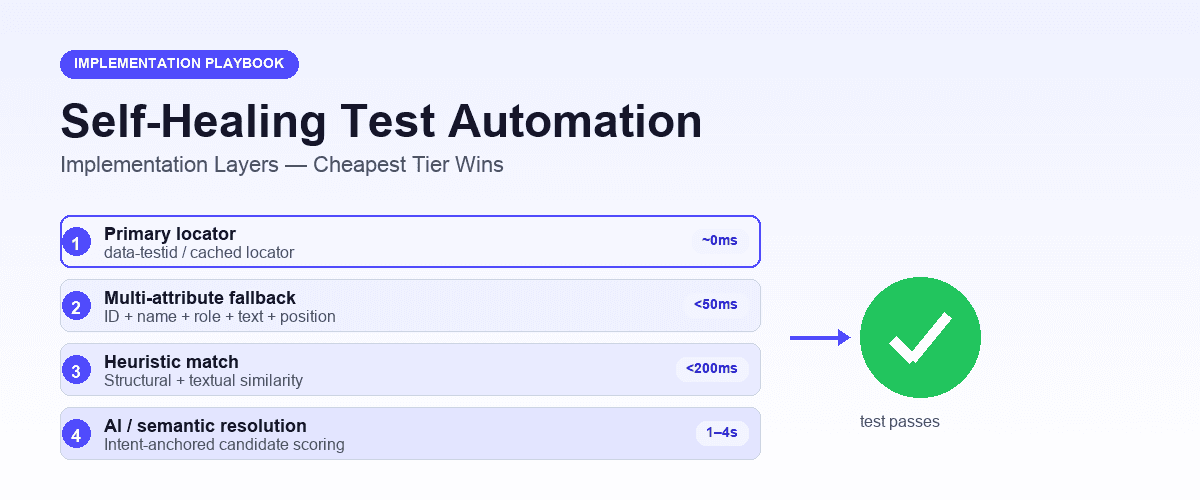
Locator-fallback systems maintain a ranked list of alternative locator strategies. When the primary locator fails, the system tries alternatives in order: first by data-testid, then by aria-label, then by text content, then by XPath position.
This approach is deterministic, fast, and auditable. It works well when changes are minor, such as a renamed class or a restructured parent container where the element itself retains some stable attribute.
Honest limit: locator fallback breaks down when the UI undergoes significant restructuring or when no stable attribute survives. Nothing in the fallback list knows what the step was trying to accomplish, so it cannot recover from a redesign.
This is also the mechanism behind the "fake self-healing" critique circulating in the testing market: a selector retry loop described as AI healing.
The critique is fair when the retry loop is the whole story, because it heals the easy breaks and fails on exactly the changes that generate most maintenance work.
Visual Healing
Visual healing re-finds the element by appearance rather than by DOM attributes: a computer-vision model or screenshot-region match locates the target on the rendered page. This handles cases DOM-based strategies cannot touch at all, such as canvas-rendered UIs, elements with runtime-generated attributes, and pages where the DOM structure changes completely between releases.
Honest limit: a visual redesign defeats it, because the element no longer looks like its reference. It can also silently match a look-alike element, which turns a broken test into a wrong test. Visual approaches carry model or baseline maintenance of their own.
Intent Re-Derivation (AI-Driven)
Intent re-derivation stores the semantic purpose of each step ("submit the checkout form") and, when a locator fails, uses AI to re-resolve the correct element from the live page against that purpose. Because the system knows what the step means, it survives redesigns, component library migrations, and framework changes that break both fallback lists and visual baselines.
Honest limit: re-derivation costs compute and adds latency on each heal, and it is non-deterministic unless the tool caches resolved locators. It also requires intent to be captured at authoring time. A suite of raw selector scripts has no intent to re-derive from, so this type of healing cannot be bolted onto an existing selector-only suite without rewriting the steps.
Comparison: The Three Healing Types
| Healing type | How it repairs a broken step | Survives | Fails on | Auditability |
|---|---|---|---|---|
| Locator fallback | Tries stored alternative selectors in ranked order | Renamed classes, minor DOM moves | Redesigns, migrations, no stable attribute | High (deterministic list) |
| Visual | Re-finds the element by appearance | Attribute churn, canvas UIs | Visual redesigns, look-alike elements | Medium (screenshot evidence) |
| Intent re-derivation | Re-resolves the element from the step's stated purpose | Redesigns, migrations, framework swaps | Missing or vague intent, genuine behavior changes | Depends on tool (best: reviewable diffs) |
For the argument that locators should be treated as a disposable performance artifact rather than the source of truth, see locators are a cache. The next section covers how Shiplight combines caching with intent re-derivation.
The Intent-Cache-Heal Pattern
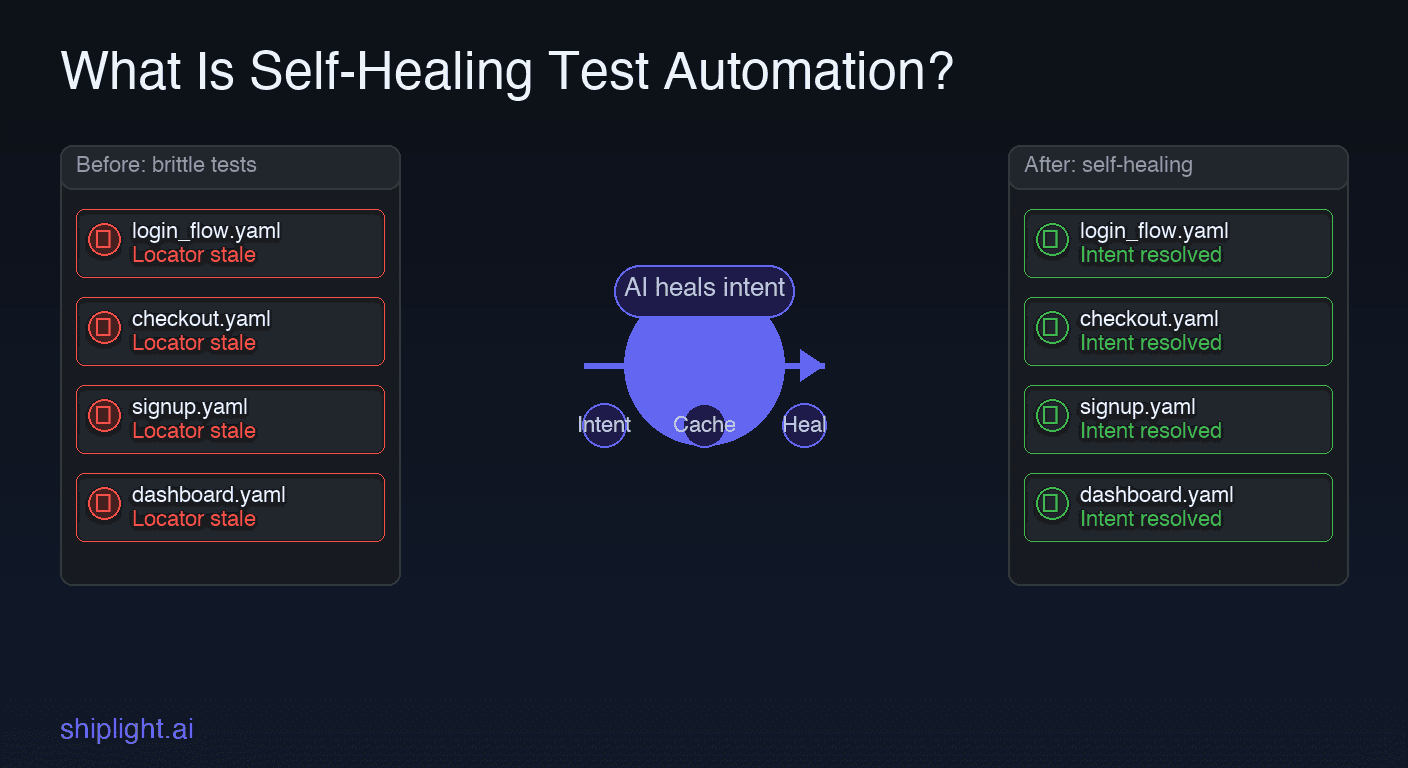
Shiplight's intent-cache-heal pattern is an implementation of intent re-derivation that adds the speed and determinism of the locator-fallback approach through caching.
The pattern works as follows:
- Intent -- Each test step is defined by its semantic purpose in natural language (e.g., "Click the submit button" or "Enter the user's email address"). Tests are written in YAML format where each step carries an
intentfield. The intent is the source of truth, not the locator. - Cache -- When a test runs successfully, the resolved locator is cached as a performance optimization. On subsequent runs, the cached locator is tried first, making execution as fast as any traditional test.
- Heal -- When a cached locator fails, the system falls back to AI-based resolution using the original intent. The AI examines the current page state and finds the element that matches the described intent. The new locator is then cached for future runs.
This pattern ensures that tests are deterministic and fast in the common case (cache hit) while remaining resilient to UI changes (AI-powered heal). Because the intent is expressed in natural language, the healing process has rich semantic context to work with, producing more accurate results than either pure rule-based or pure AI approaches.
What Are the Benefits of Self-Healing Test Automation?
Reduced Maintenance Burden
The most immediate benefit is time savings. Teams using self-healing automation report spending significantly less time updating broken tests after UI changes. This frees QA engineers and developers to focus on expanding test coverage rather than maintaining existing tests.
Faster CI/CD Pipelines
Broken tests slow down deployment pipelines. When tests self-heal, pipelines stay green through routine UI changes, reducing deployment delays and the temptation to skip or disable flaky tests.
Higher Test Coverage Sustainability
Without self-healing, teams often cap their test suites at a manageable size because each additional test adds to the maintenance burden. Self-healing removes this constraint, allowing teams to grow their test suites in proportion to their application's complexity.
Better Developer Experience
Developers are more likely to write and maintain tests when the tests do not generate false negatives on every UI change. Self-healing shifts testing from an adversarial relationship ("the tests are broken again") to a collaborative one.
What Are the Limitations of Self-Healing Test Automation?
Self-healing test automation is not without trade-offs.
False positives in healing -- A self-healing system might "heal" a test by targeting the wrong element, causing the test to pass when it should fail. This is particularly risky with rule-based systems that lack semantic understanding of the test's purpose. Shiplight mitigates this risk by anchoring healing to natural language intent rather than locator heuristics.
Performance overhead -- AI-based healing introduces latency during the resolution step. Systems like Shiplight address this through caching: the AI is invoked only when the cache misses, which in practice is a small fraction of test runs.
Transparency and trust -- When a test heals itself, engineers need to understand what changed and why. Systems that heal silently can mask real issues. Good self-healing implementations produce audit logs showing what was healed, what the old and new locators were, and the confidence level of the resolution.
Not a substitute for test design -- Self-healing addresses locator brittleness, not poorly designed tests. A test that validates the wrong behavior will continue to validate the wrong behavior whether it self-heals or not.
How Do You Choose a Self-Healing Approach?
When evaluating self-healing tools, consider these factors:
- How are tests defined? Tools that anchor tests to semantic intent (like Shiplight) provide richer context for healing than those that work purely at the locator level.
- Is healing deterministic? Can you reproduce the healing behavior, or does it vary between runs?
- What evidence is produced? Does the tool explain what it healed and why?
- How does it integrate with your stack? Look for tools that work with established frameworks like Playwright rather than requiring a proprietary runtime.
Where to go next:
- A side-by-side comparison of tools that support self-healing: best self-healing test automation tools.
- A step-by-step rollout once you've chosen a tool: how to implement self-healing test automation effectively.
- A broader look at AI-powered testing: best AI testing tools in 2026.
- No-code options specifically: best no-code test automation platforms.
Self-Healing Test Automation: Key Takeaways
- Self-healing test automation automatically detects and repairs broken tests caused by UI changes, reducing maintenance effort by targeting locator brittleness.
- Three healing types exist: locator fallback (fast, auditable, fails on redesigns), visual (handles canvas and attribute churn, fails on visual redesigns), and intent re-derivation (survives redesigns, needs intent captured at authoring time).
- Shiplight's intent-cache-heal pattern is intent re-derivation plus caching: natural language intent provides semantic context, caching ensures speed, and AI resolves only when needed.
- Self-healing is not a substitute for good test design. It addresses locator brittleness, not flawed test logic.
- Transparency matters. Look for tools that explain what was healed and produce auditable evidence.
Frequently Asked Questions
What are the best self-healing test automation tools?
The right tool depends on which healing type you need: locator fallback for stable UIs, visual for canvas-heavy UIs, and intent re-derivation for teams shipping redesigns where fallback lists fail.
Shiplight is the third type: intent-based YAML tests in your git repo that heal against stated intent and surface larger heals as reviewable PR diffs. See our guide to the best self-healing test automation tools.
How does self-healing help a fragile UI test suite?
First classify the failures: healing fixes structural breaks like renamed classes and moved elements, but not flakiness from timing or environment.
Intent re-derivation needs intent that raw selectors never captured, so the practical path is incremental: keep the existing suite running and rewrite the most fragile flows as intent-based tests first. Shiplight runs alongside Playwright for this pattern, so no rip-and-replace is required.
What is the difference between self-healing and auto-waiting in test frameworks?
Auto-waiting (as implemented in Playwright and similar frameworks) retries a locator until the element appears or a timeout is reached. It handles timing issues but does not handle structural changes. Self-healing goes further by finding the element through alternative means when the original locator no longer matches any element.
Does self-healing work with any test framework?
It depends on the implementation. Some self-healing tools are standalone platforms, while others integrate with existing frameworks. Shiplight's plugins work alongside Playwright, letting teams keep their existing infrastructure while adding self-healing capabilities.
Can self-healing tests mask real bugs?
Yes, this is a real risk. A self-healing system might target a different element than intended, causing a test to pass incorrectly. Intent-based healing reduces this risk because the system evaluates candidates against the semantic purpose of the step, not just attribute similarity. Teams should review healing logs and treat healed tests with appropriate scrutiny.
How do I get started with self-healing test automation?
Start by evaluating how much time your team spends maintaining broken tests. If maintenance dominates your testing effort, self-healing will have a measurable impact. Request a demo of Shiplight to see how the intent-cache-heal pattern works with your application.
Is self-healing only useful for UI tests?
Self-healing is most commonly applied to UI tests because locator brittleness is primarily a UI problem. However, the concept extends to API tests (healing against schema changes) and integration tests (healing against environment differences). The principles are the same: detect the break, resolve it through alternative means, and update the test.