Shiplight is an agent-native testing platform built on Playwright: tests are plain YAML committed in your git repo, your own coding agents author and heal them, and you can eject to plain Playwright anytime.
Mabl is a low-code platform from the browser-recorder generation: tests are authored in its Trainer, stored as proprietary steps in mabl's cloud, and executed on credit-metered cloud runs.
The decisive differences are where tests live, who authors them, and whether you can leave without re-authoring.
We build Shiplight, so we have a perspective. This comparison describes each tool by its operating model and leads with the axes where the two are genuinely different.
Quick Comparison
| Axis | Shiplight | Mabl |
|---|---|---|
| Where tests live | Plain YAML in your git repo | Proprietary steps in mabl's cloud workspace |
| Vendor lock-in | None: YAML transpiles to Playwright, eject anytime | High: documented-lossy or no export from the Trainer |
| Who authors tests | Your coding agents (Claude Code, Cursor, Codex) or your engineers | QA staff in the visual Trainer (a browser recorder) |
| Coding-agent integration | Agent-native: MCP + Skills, agents edit the YAML directly | Agent-integrated: MCP wraps mabl's cloud console |
| Self-healing | Intent-based, cached locators, heals surfaced as reviewable PR diffs | Auto-heal opaquely inside mabl's cloud |
| Run economics | Local runs with no account; both modes, your choice | Cloud runs metered by credits |
| Infrastructure | Hosted CI runners + LLM proxy, OR your own CI and LLM keys | Vendor cloud only |
| Playwright compatibility | Built on Playwright; runs alongside an existing suite | Proprietary runtime |
| Enterprise | SOC 2, VPC, RBAC | SOC 2, SSO, RBAC |
Where Tests Live: Your Repo vs Their Cloud
This is the most important difference between the two tools.
Shiplight stores tests as plain YAML files in your git repository, alongside your application code. Tests go through the same code review as any other file: diffs are meaningful, branches work naturally, and the test is co-located with the feature it covers.
Mabl stores tests as proprietary step sequences in its cloud workspace. You create and edit them through the mabl Trainer, a browser recorder, relying on mabl's built-in versioning rather than git. The tests are not part of your codebase, so they do not branch with your code or go through your review process.
The follow-on is lock-in. Mabl documents a CLI export to Playwright or Selenium-IDE, but it is lossy: its own docs list unsupported step types, some assertions do not survive, and Trainer-generated tests can't be exported at all. What comes out is not a runnable standalone suite.
Shiplight's YAML transpiles to Playwright at run time, so the execution layer is the open-source standard and you can eject to plain Playwright whenever you want. Leaving Mabl means rebuilding; leaving Shiplight means keeping the Playwright you already run.
Who Authors Tests: Your Coding Agent vs a Recorder
Shiplight is authored by the coding agents your team already uses. The Shiplight MCP Server let Claude Code, Cursor, and Codex read, write, and edit the YAML directly. The agent that wrote the feature also authors, runs, and heals its test in the same session, so coverage tracks code-generation throughput. See agent-first testing.
Mabl is authored by QA staff in the visual Trainer. Mabl offers an MCP server too, but it wraps mabl's cloud console: the agent operates mabl's platform remotely rather than editing test files next to your code. The tests it touches still live as proprietary steps in mabl's cloud, outside your branches and your review process.
That is agent-integrated (a remote control over the cloud console), not agent-native (your agent owning the test as a file). For teams whose agents own testing, the distinction decides the workflow.
Self-Healing: Reviewable PR Diffs vs Opaque Cloud Auto-Heal
Both platforms self-heal, but you see the result differently.
Mabl's auto-healing detects UI changes and adjusts selectors by monitoring multiple element attributes. Both the tests and the healing live inside mabl's platform, so the change is applied for you in the cloud, not surfaced as something you inspect in your own workflow.
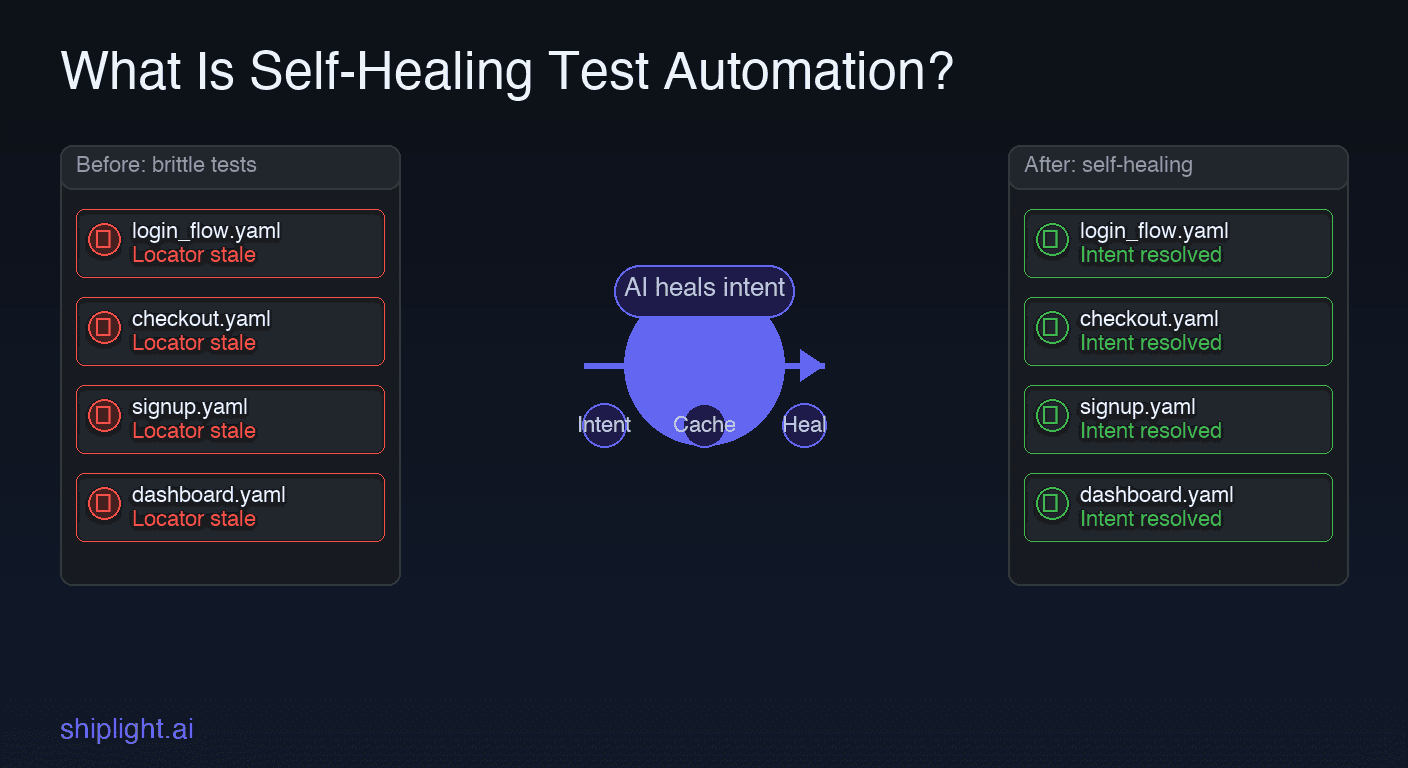
Shiplight's self-healing is based on the intent-cache-heal pattern. Tests reference elements by intent ("login button") rather than by selector.
When a cached locator breaks, the engine re-resolves the intent using AI, and the change is visible as a git diff you review in your normal process; larger changes arrive as reviewable PR diffs from the triage agent. You approve the heal instead of trusting it silently.
Run Economics: Local Runs With No Account and Both Modes vs Credit-Metered Cloud
Mabl runs tests in its cloud on credit-metered runs, with quote-based pricing. You pay for execution capacity on the vendor's infrastructure, and cost grows with test volume, parallel execution, and team size.
Shiplight ships hosted CI runners, dashboards, and an LLM proxy for teams that want zero setup, AND runs the same tests in your own CI on your own runners, with your own Anthropic, OpenAI, or Google keys (Azure, Bedrock, and Vertex included).
Cached deterministic steps call no LLM at all, and local runs (npx shiplight test) need no Shiplight account. Note that AI steps and AI assertions are never cached, so they call the model on every run.
Both modes are switchable, and the choice is yours rather than a single closed metered mode.
Playwright Compatibility
Because Shiplight is built on Playwright, its YAML transpiles to Playwright tests at run time, so it supports every Playwright browser and runs alongside an existing Playwright suite. Adoption is incremental: new flows first, nothing rewritten, and existing Playwright configs reused.
Mabl runs on its own proprietary runtime, so there is no equivalent path to adopt it next to code you already have or to leave it cleanly later. See CI/CD integration.
Mabl's Design Center
Mabl comes from the browser-recorder generation of low-code testing. Its design center is a vendor cloud console: tests are authored visually in the Trainer, stored as proprietary steps in mabl's cloud, and executed on credit-metered cloud runs.
API testing and visual checks are built into the same console, so a QA team can cover UI, API, and visual assertions without leaving it, and mabl manages the browsers and runners.
That model is built for organizations where QA staff author tests visually and no engineer or coding agent is in the authoring loop. For an established QA organization that wants one vendor-supported cloud suite with mature auto-heal and managed infrastructure, it is a polished consolidated platform.
That buyer is a QA department buying a console, a different operating model from a dev team wiring tests into a coding agent, not a variant of it.
When to Choose Shiplight
Shiplight is the better choice when:
- Your team uses AI coding agents (Claude Code, Cursor, Codex) and wants tests authored and healed in that workflow, with the agent editing the YAML directly
- You want tests version-controlled in your git repository alongside your code, diffable and PR-reviewable
- You want no lock-in: the YAML transpiles to Playwright and you can eject anytime
- You want transparent self-healing surfaced as reviewable PR diffs, not applied silently in a vendor cloud
- You want local runs with no account and the choice between hosted CI runners and your own infrastructure with your own LLM keys, rather than credit-metered cloud runs
- You need enterprise-grade security: SOC 2, VPC deployment, RBAC
Shiplight is web only and assumes an engineer or coding agent in the loop. If tests are authored visually by QA staff and a vendor cloud holding them is acceptable, that is the design center Mabl was built for.
If you are working through the whole console category rather than this one pairing, our roundup of Mabl alternatives covers it by approach.
Try the Shiplight demo to see the YAML-based, agent-native approach in action.
Frequently Asked Questions
What is the main difference between Shiplight and Mabl?
Where tests live and who authors them. Shiplight tests are plain YAML committed in your git repo, authored by your coding agents; Mabl tests are proprietary recorder steps in mabl's cloud workspace, authored by QA staff in the Trainer. Shiplight is built on Playwright with no lock-in; Mabl runs on a proprietary metered cloud runtime.
Can I export tests from Mabl?
Mabl documents a CLI export, but tests are proprietary Trainer steps in its cloud, so export is lossy: its own docs list unsupported step types, and what comes out is not a runnable standalone suite. Shiplight is the opposite: tests are YAML in your git repo that transpile to Playwright, so they stay with you if you switch tools.
Does Shiplight offer low-code or visual test creation like Mabl?
Mabl was built around the visual Trainer for non-technical testers. Shiplight tests are natural-language YAML intent statements, readable by the whole team but authored as files by your engineers or coding agent. The two are built for different buyers.
Which has better self-healing?
Both self-heal when the UI changes. Mabl applies auto-healing inside its cloud platform. Shiplight heals via intent and cached locators and surfaces each heal as a reviewable diff in your workflow, since tests live in your repo, so you approve the change rather than trusting it silently.
How does coding-agent integration differ?
Mabl's MCP server wraps its cloud console, so an agent drives mabl's platform remotely: agent-integrated. Shiplight's MCP and Skills let your agent read and edit the YAML directly, so the agent that wrote the feature authors and heals the test in the same session: agent-native.
Is Shiplight cheaper than Mabl?
The models differ, so it depends on usage. Mabl's pricing is quote-based with credit-metered cloud runs. Shiplight's local runs need no account, Free is $0 forever and Pro is $60/month, and because tests can run on your own infrastructure with your own LLM keys (cached steps call no LLM), you control parallelization and execution cost.