Shiplight puts end-to-end testing where your code already lives. Your team and the coding agents you already use author, run, and heal tests in the same session they ship a feature, in plain YAML committed to your repo, on Playwright you control.
Coverage grows as fast as your agents write code, self-healing keeps the suite green through UI changes, and nothing runs on someone else's infrastructure unless you choose it.
The opposite answer: a managed service
QA Wolf answers the same coverage problem the opposite way: it is a managed QA service. Their human engineers, assisted by AI tooling, write and maintain standard Playwright and Appium tests for you, and those tests live and run on QA Wolf's platform. You get coverage without building an in-house testing function, at the pace their engineers can staff it.
We build Shiplight, so read this as our perspective, checked against QA Wolf's public documentation. The comparison below is about mechanisms: who owns testing, where tests live and run, how coverage scales, how maintenance happens, and whether your coding agents are in the loop.
Quick Comparison
The axes below are the ones that decide the choice for a team building an in-house, agent-native testing capability.
| Axis | Shiplight | QA Wolf |
|---|---|---|
| Who owns and authors testing | Your team and your coding agents, in-session | An outside human QA service |
| Coverage scales with | Your code-generation throughput | The vendor's engineering staffing |
| Where tests live and run | Your git repo; Playwright you control | QA Wolf's infrastructure (export is the exit) |
| Maintenance model | Self-healing runtime: intent re-resolves, larger changes arrive as PR diffs | Human-backed maintenance SLA |
| Coding-agent integration | MCP + Skills across every major coding agent (Claude Code, Cursor, Codex) | None; no MCP server for coding agents |
| How you adopt it | Self-serve; local runs with no account; hosted runners or your own CI, your choice | A staffed service bought by the hour |
| Enterprise | SOC 2, VPC, RBAC, audit logs | SOC 2 |
Where Shiplight Is Decisively Different
Each point below is where Shiplight's design center diverges from QA Wolf's for a team that wants to own testing.
- Your team and your coding agents own testing, not an outside service. Shiplight is agent-native: the coding agent that ships a feature reads, writes, runs, and heals its test in the same session, and the resulting YAML lives in your repo where your engineers review it like any other code. QA Wolf is people-powered coverage. Their engineers learn your product and write the suite, so the knowledge of your critical flows and the suite itself accumulate on the vendor's side of the wall, not in your team.
- Coverage scales with how fast you ship, not with a vendor's headcount. Because your agents author tests as they build features, Shiplight coverage tracks your code-generation throughput. Add more agents shipping code and coverage rises with it, at no extra staffing. QA Wolf coverage grows at the pace their engineers can be assigned to your account, so scaling coverage means the vendor scaling human hours.
- Tests in your repo, running on Playwright you control. Shiplight tests are versioned, branched, and diffed alongside your application, and they run on the open-source Playwright engine wherever Node.js runs, in your CI or on hosted runners you opt into. With QA Wolf the tests live and run on their infrastructure; the code is standard Playwright you can export, but export is the escape hatch, not the home you build in.
- Self-healing runtime, not a maintenance SLA. When the UI changes, Shiplight re-resolves the test's intent against the current page, and larger changes arrive as reviewable PR diffs from the triage agent, resolving in your own commit. QA Wolf's maintenance is a human-backed service commitment: when your product changes, their engineers update the tests and the turnaround routes through their queue.
- Your coding agents are in the loop; QA Wolf has no such loop. The Shiplight MCP Server and Skills let Claude Code, Cursor, Codex, and 40+ other agents drive test authoring and runs directly. QA Wolf publishes no MCP server for coding agents, so there is no path for the agent that wrote your feature to also write its test.
- Self-serve, with local runs with no account and infrastructure your way. Install Shiplight, run tests locally with no Shiplight account, and decide your own infrastructure: Shiplight-hosted runners, dashboards, and an LLM proxy for zero setup, or your own CI with your own Anthropic, OpenAI, or Google keys (Azure, Bedrock, and Vertex included). QA Wolf is a staffed service you buy by the hour, priced for the human engineers dedicated to your account.
How Shiplight Works
Shiplight tests are YAML files stored in your repository. Each test describes user intent rather than DOM interactions:
name: Complete checkout flow
statements:
 - intent: Log in as a returning customer
 - intent: Add "Premium Plan" to cart
 - intent: Navigate to checkout
 - intent: Enter valid payment details
 - intent: Submit the order
 - VERIFY: order confirmation page shows "Thank you"
These files go through pull request review like any other code. They run in CI via a CLI command, and they are versioned, branched, and diffed alongside your application. The YAML transpiles to Playwright at run time, which is why it runs on every Playwright browser and why you can eject to plain Playwright whenever you want.
Shiplight connects to AI coding agents like Claude Code and Cursor. When a developer builds or changes a feature, the agent generates or updates the corresponding tests in the same workflow, so coverage grows as a natural part of development rather than as a separate activity handed to an external team.
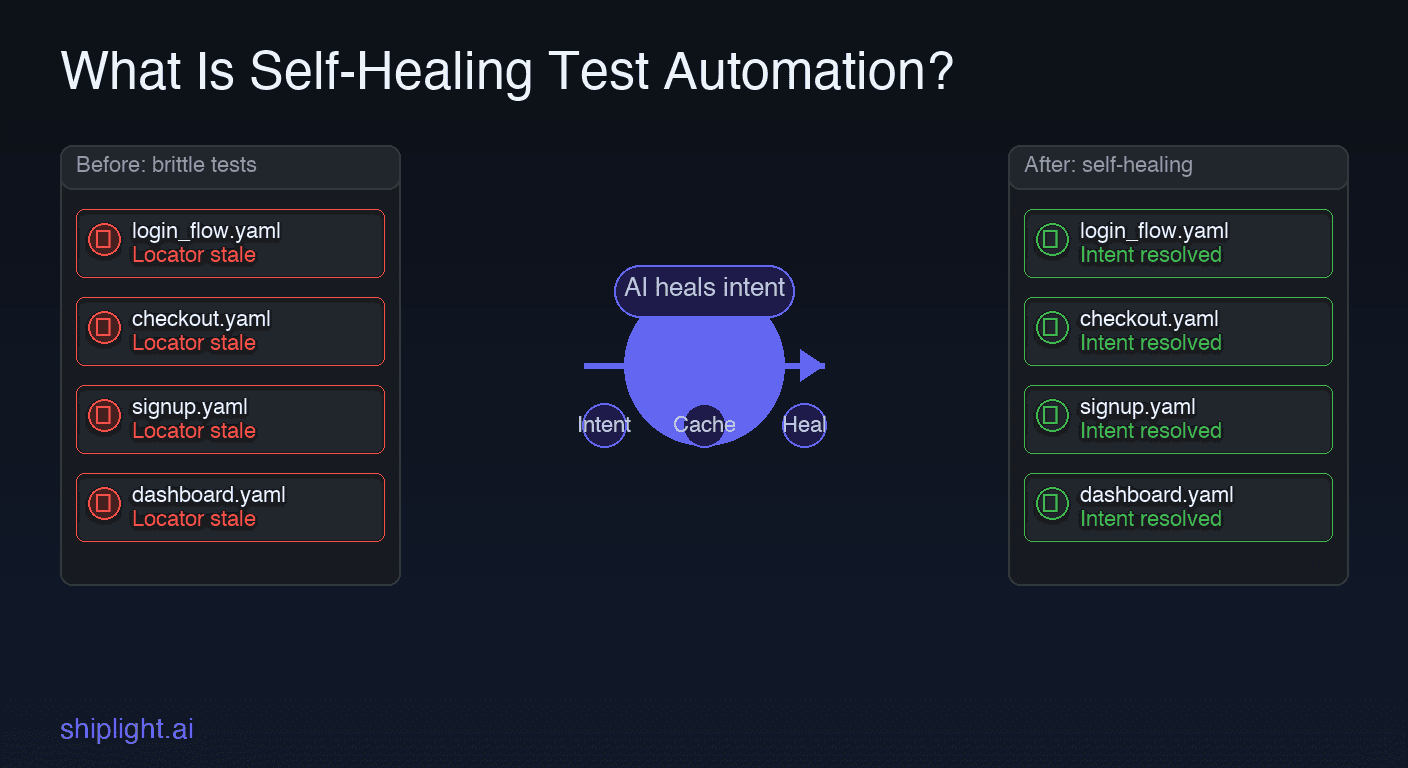
Self-healing works through intent resolution: when a cached locator breaks because the UI changed, Shiplight re-resolves the intent against the current page, and larger changes are proposed as reviewable PR diffs by the triage agent. See the intent, cache, heal pattern and agent-first testing.
How QA Wolf Works
QA Wolf's operating model is a human service, and that service is the product. When you sign up, their onboarding team studies your application, identifies critical user flows, and writes standard Playwright and Appium tests for them, assisted by AI tooling. The tests live and run on QA Wolf's infrastructure, and results report through your existing CI pipeline.
When your product changes, their engineers update the tests: maintenance is a human-backed service commitment, not a self-healing runtime. You do not need internal QA headcount to maintain the suite, because the maintenance work sits with their team.
The tests are standard Playwright you can export and keep, though the day-to-day ownership of the suite sits with their engineers rather than yours.
The One Case for the Managed Model
There is a buyer the managed model genuinely serves: a team that has decided to outsource E2E testing entirely, with no in-house testing function it wants to build. For that buyer a staffed service delivers real Playwright the customer owns and a fast ramp without hiring.
That is a legitimate purchase, and it is the exact opposite of Shiplight's design center.
Shiplight is built for teams building an internal, agent-native testing capability, where the agent that writes the feature owns its test and coverage compounds inside the team rather than at a vendor.
When to Choose Shiplight
Choose Shiplight if your team:
- Wants to own and control the test suite inside the repo
- Uses AI coding agents as part of the development workflow and wants them authoring tests via MCP
- Wants coverage that scales with how fast you ship, not with a vendor's staffing
- Prefers a self-healing runtime over a human-backed maintenance SLA
- Values tests as code artifacts that run on Playwright you control
Moving From Managed to Owned
Teams sometimes arrive at Shiplight with a suite a managed service built for them.
Because QA Wolf's tests are standard Playwright and export is the escape hatch, those exported flows can seed a Shiplight migration: each flow becomes a YAML intent your team owns in the repo, your coding agents extend coverage from there, and self-healing takes over the maintenance that previously routed through the vendor's engineers.
Explore Shiplight with a live demo, read about our enterprise capabilities, or see how we compare across the best AI testing tools in 2026. For the managed-service category on its own, our roundup of QA Wolf alternatives covers who else is in it.
Frequently Asked Questions
What is the main difference between Shiplight and QA Wolf?
Shiplight is agent-native testing your team owns: your coding agents author, run, and heal tests in your repo, on Playwright you control. QA Wolf is a managed QA service where an outside team writes and maintains your tests on their infrastructure. The difference is who owns testing and where the knowledge of your flows accumulates.
Does QA Wolf work with coding agents like Claude Code or Cursor?
QA Wolf publishes no MCP server for coding agents, so the agent that ships your feature cannot author its test. Shiplight exposes MCP and Skills across every major coding agent, so authoring, running, and healing happen inside the same session your agent writes the code. See MCP for testing.
Which model scales better as coverage grows?
Shiplight coverage scales with your code-generation throughput: more agents shipping code means more tests, with self-healing absorbing maintenance. QA Wolf coverage grows at the pace their engineers can be staffed to your account, so scaling coverage means scaling human hours. Compare based on whether you want coverage tied to your shipping speed or a vendor's headcount.
Do I own my tests with QA Wolf?
QA Wolf's tests are standard Playwright you can export, but they live and run on QA Wolf's infrastructure and their engineers maintain them, so export is the exit rather than the home. With Shiplight, tests are YAML files committed to your own repo, owned and reviewed by your team like any other code.
Can I migrate from QA Wolf to Shiplight?
Yes. QA Wolf's tests are standard Playwright and can be exported, so the underlying flows map to Shiplight YAML intents your team owns in the repo. Your coding agents extend coverage from there, and self-healing replaces the vendor-side maintenance.
Does Shiplight require a managed services contract?
No. Shiplight is self-serve: the MCP server and Skills are free to start, local runs need no account, and your team and coding agents author and maintain tests directly, with self-healing reducing the manual upkeep.