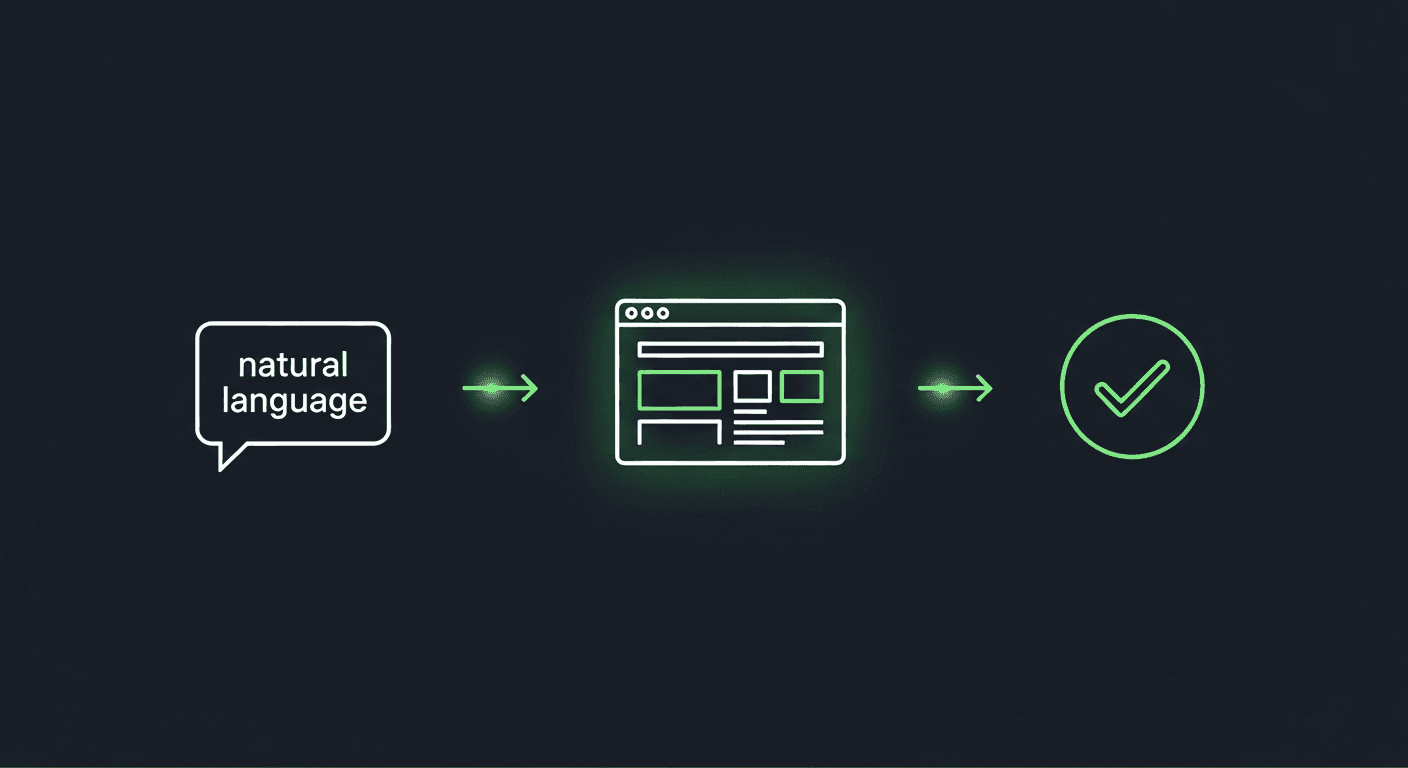
No-code test automation enables teams to create, configure, and execute automated tests without writing traditional programming code. Instead of authoring test scripts in JavaScript, Python, or Java, testers define tests using visual interfaces, structured markup languages like YAML, or plain English descriptions that a system interprets and executes.
The goal is to make test automation accessible to a broader set of contributors: product managers who understand the requirements, QA analysts who know what to test but may not code, and developers who want to write tests faster without wrestling with selector logic and framework boilerplate.
No-code does not mean no skill. Effective no-code testing still requires understanding what to test, how to structure test scenarios, and how to interpret results. What it eliminates is the need to express that understanding in programming syntax.
Why No-Code Test Automation Matters
The economics of software testing have a structural problem. The number of features, pages, and user flows in a typical application grows faster than the capacity of engineering teams to write and maintain tests for them. Traditional coded test automation requires specialized skills that create bottlenecks.
No-code testing addresses this bottleneck in three ways:
- Broader participation -- More team members can contribute to test coverage, distributing the workload beyond the engineering team.
- Faster authoring -- Defining a test in YAML or plain English is faster than writing equivalent code, especially for straightforward user flows.
- Lower maintenance -- Tests expressed at a higher abstraction level tend to be more stable across UI changes than tests written against specific DOM structures.
For a deeper exploration of how no-code approaches compare to traditional Playwright scripting, see our guide on Playwright alternatives for no-code testing. For tools that sit between no-code and scripting (offering visual authoring with optional code extensions) see our roundup of best low-code test automation tools.
Three Approaches to No-Code Test Automation
The no-code testing landscape includes several distinct approaches, each with different trade-offs. We will examine three representative categories.
1. YAML-Based Testing (Shiplight)
YAML-based testing uses structured markup to define tests as a sequence of intents, actions, and assertions. Each step describes what should happen in a combination of natural language and structured data.
goal: Verify core user journey
statements:
 - intent: Log in as a test user
 - intent: Navigate to the target page
 - intent: Perform the key action
 - VERIFY: the expected outcome is visible
Shiplight uses this approach with its YAML test format. Tests are human-readable, version-controllable, and executable on Playwright without any proprietary runtime.
Strengths:
- Tests live in the repository alongside application code and are versioned with Git.
- Each step has explicit structure (intent, action, locator, expected outcome), making tests unambiguous and reviewable in pull requests.
- Locators are treated as a cache, not a source of truth. When the UI changes, the intent drives re-resolution. This concept is explored in our intent-first E2E testing guide.
- Full compatibility with Playwright's execution engine, assertions, and reporting.
Trade-offs:
- Testers need to understand YAML syntax and Playwright locator conventions.
- The structured format is more verbose than plain English for simple scenarios.
2. Plain English Testing (testRigor)
Plain English testing tools accept test definitions written as natural-language sentences, with no structured format or locator references. In practice the parsed English is a constrained command set rather than free prose: testRigor's own docs note the language "has some syntax to it", and free-form phrasing is translated into their command vocabulary.
navigate to "https://your-app.com/products"
click on "Running Shoes"
click on "Add to Cart"
check that page contains "1 item in cart"
Tools like testRigor interpret these instructions using NLP and AI to resolve elements on the page based on the text description alone.
Strengths:
- Accessible to non-technical QA staff in manual-QA-heavy organizations, a buyer profile distinct from engineering-led teams.
- Tests read like user stories, making them accessible to non-technical stakeholders.
- No locator syntax to learn or maintain.
Trade-offs:
- Ambiguity is a real risk. "Click on the submit button" might match multiple elements on a page. The tool must make assumptions, and those assumptions may be wrong.
- Debugging failures is harder because the mapping from plain English to element interaction is opaque.
- Vendor lock-in is common. Tests written in a proprietary plain English format do not port to other frameworks.
- Tests live as suites in the vendor's cloud console and run on hosted runners, not in your repo, so they do not appear in pull requests alongside the code they cover.
- Performance can suffer because every step requires NLP interpretation with no caching layer.
3. Record-and-Playback (Selenium IDE)
Record-and-playback tools let testers perform actions in a browser while the tool captures each interaction as a test step. The recorded test can then be replayed to verify the same flow.
Open-source tools like Selenium IDE and commercial codeless suites have used this approach for years, and modern versions add features like element highlighting, step editing, and basic self-healing.
Strengths:
- Immediate gratification. You perform the test once, and it is automated.
- No need to understand page structure, locators, or test syntax during recording.
- Good for creating initial test drafts that can be refined later.
Trade-offs:
- Recorded tests are extremely brittle. They capture the exact DOM state at recording time, and any structural change breaks the test.
- Tests cannot be authored without a running application. You cannot define tests from a PRD before the feature is built.
- The generated scripts are often verbose and hard to maintain.
- Tests are tightly coupled to a specific viewport size, browser state, and data context.
Comparing the Three Approaches
| Characteristic | YAML-Based (Shiplight) | Plain English (testRigor) | Record-and-Playback (Selenium IDE) |
|---|---|---|---|
| Authoring skill required | YAML + basic locator knowledge | Natural language only | Browser interaction only |
| Version control friendly | Yes (text files) | Varies by platform | Typically no |
| Resilience to UI changes | High (intent-based healing) | Medium (NLP re-resolution) | Low (brittle selectors) |
| Debugging transparency | High (structured steps with locators) | Low (opaque NLP mapping) | Medium (step-by-step replay) |
| Framework compatibility | Playwright native | Proprietary | Varies |
| Pre-implementation testing | Yes (define tests before UI exists) | Partially (needs running app for execution) | No (requires running app) |
| CI/CD integration | Native (CLI-based) | API-based | Tool-dependent |
Choosing the Right No-Code Approach
The best approach depends on your team's composition and workflow.
Choose YAML-based testing if your team values version control, code review workflows, and framework compatibility. This approach works well for teams that include developers and QA engineers who collaborate through pull requests. Shiplight's plugins are built for exactly this workflow.
Choose plain English testing if a vendor console workflow, with non-technical staff authoring in a constrained English command set, is acceptable, and you are willing to accept the trade-offs in debugging transparency, vendor independence, and tests living outside your repo.
Choose record-and-playback if you need to quickly capture existing user flows for regression testing and plan to refine the generated tests manually. This approach is a starting point, not an end state.
Many teams combine approaches. They might use YAML-based tests for critical paths maintained in version control, plain English tests for exploratory scenarios defined by product managers, and recorded tests as drafts that are converted to structured formats.
The Role of AI in No-Code Testing
AI is transforming every no-code testing approach. YAML-based tools use AI to resolve intents to locators and heal broken tests. Plain English tools use AI to interpret instructions. Even record-and-playback tools are adding AI-powered self-healing.
The key differentiator is where the AI sits in the workflow. In Shiplight's model, AI is an execution-time capability that resolves intent to interaction, while the test definition itself remains a deterministic, reviewable artifact. This separation ensures that tests remain predictable and auditable even as AI handles the complexity of element resolution.
Key Takeaways
- No-code test automation removes the requirement to write programming code, making test creation accessible to more team members.
- Three main approaches exist: YAML-based (structured and version-controllable), plain English (lowest barrier to entry), and record-and-playback (immediate but brittle).
- YAML-based testing, as implemented by Shiplight, offers the strongest balance of accessibility, maintainability, and framework compatibility.
- No approach eliminates the need for test design skill. No-code lowers the syntax barrier, not the thinking barrier.
- AI enhances all three approaches, but the most maintainable systems separate the deterministic test definition from AI-powered execution.
Frequently Asked Questions
Is no-code test automation suitable for complex applications?
Yes, but with caveats. No-code approaches handle standard user flows (navigation, form filling, data validation) effectively. Complex scenarios involving multi-tab interactions, file uploads, custom browser APIs, or intricate data setup may require extending no-code tests with custom logic. Shiplight's YAML format supports this through Playwright integration, allowing teams to add coded steps when the no-code format is insufficient.
Can no-code tests run in CI/CD pipelines?
This depends entirely on the tool. YAML-based tests that execute on standard frameworks like Playwright integrate with any CI/CD system that supports command-line test execution. Cloud-based plain English platforms typically provide API triggers for CI/CD integration. Record-and-playback tools vary widely in their CI/CD support.
How do no-code tests handle authentication and test data?
Most no-code tools support environment variables and configuration files for authentication credentials and test data. Shiplight's YAML format uses variable interpolation (e.g., {{TEST_EMAIL}}) to separate test logic from environment-specific data, following the same patterns used in coded test frameworks.
Will no-code testing replace coded test automation?
No. No-code testing expands who can create tests and accelerates test authoring for common scenarios. Coded testing remains essential for complex test logic, custom assertions, performance testing, and scenarios that require fine-grained control over browser behavior. The two approaches are complementary, not competitive.
How do I migrate existing coded tests to a no-code format?
Migration typically involves extracting the intent from each test step and expressing it in the no-code format. For Shiplight, this means converting Playwright test files into YAML definitions where each step describes its purpose in natural language. AI tools can assist with this conversion, but human review is important to ensure the migrated tests capture the original intent accurately.