The best Mabl alternative in 2026 depends on the mechanism you need.
Shiplight AI is the agent-native option without the cloud lock-in. Tests are plain YAML committed in your git repo instead of recorder steps in a vendor workspace, your own coding agents author and heal them instead of a browser recorder, and it is built on Playwright so you can adopt it incrementally and eject anytime.
Infrastructure is your choice: Shiplight-hosted runners and LLM proxy for zero setup, or your own CI runners with your own LLM keys, with local runs with no account.
Playwright and Cypress are the open-source code frameworks with maximum developer control. Managed QA services put a vendor's human engineers in charge of your suite.
Vendor cloud consoles keep the low-code recorder workflow Mabl pioneered, with tests living in the vendor's cloud rather than your repo.
Why teams look for Mabl alternatives
Mabl was an early mover in AI-assisted test automation. Its design center is a low-code, browser-recorder workflow: tests are authored visually through the mabl Trainer, stored in mabl's cloud workspace as proprietary step sequences, and executed on credit-metered cloud runs. That fit teams that wanted smarter testing without writing Selenium scripts.
The design center has shifted since. AI coding agents are now part of daily development, and many teams want tests that live in their repos, go through PR review, and are authored by the same agent that wrote the feature.
Mabl's export to code is documented as lossy (its own docs list unsupported step types, and Trainer-generated tests can't be exported at all), so tests built in the recorder stay bound to mabl's platform.
Its MCP server wraps the cloud console, so an agent drives mabl's platform rather than owning tests in your workflow: agent-integrated, not agent-native.
The right Mabl alternative depends on why you're looking: where tests should live, who or what should author them, and whether you can leave without re-authoring. We build Shiplight, so it is listed first, and we describe every option by its design center.
1. Shiplight: AI-Native, Repo-Based Testing
Shiplight AI is built for engineering teams that develop with AI coding agents and want tests treated like code. That is the opposite architecture bet from Mabl, on the axes that decide everything downstream.
Tests live in your git repo instead of a vendor workspace, your own coding agents author and heal them instead of a recorder, and it is built on Playwright instead of a proprietary cloud runtime you can't cleanly leave.
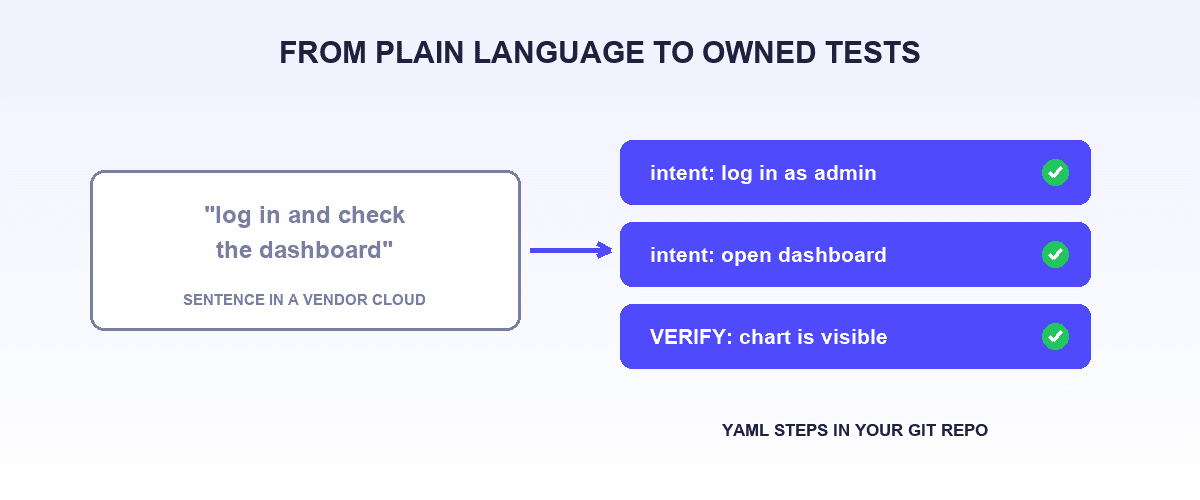
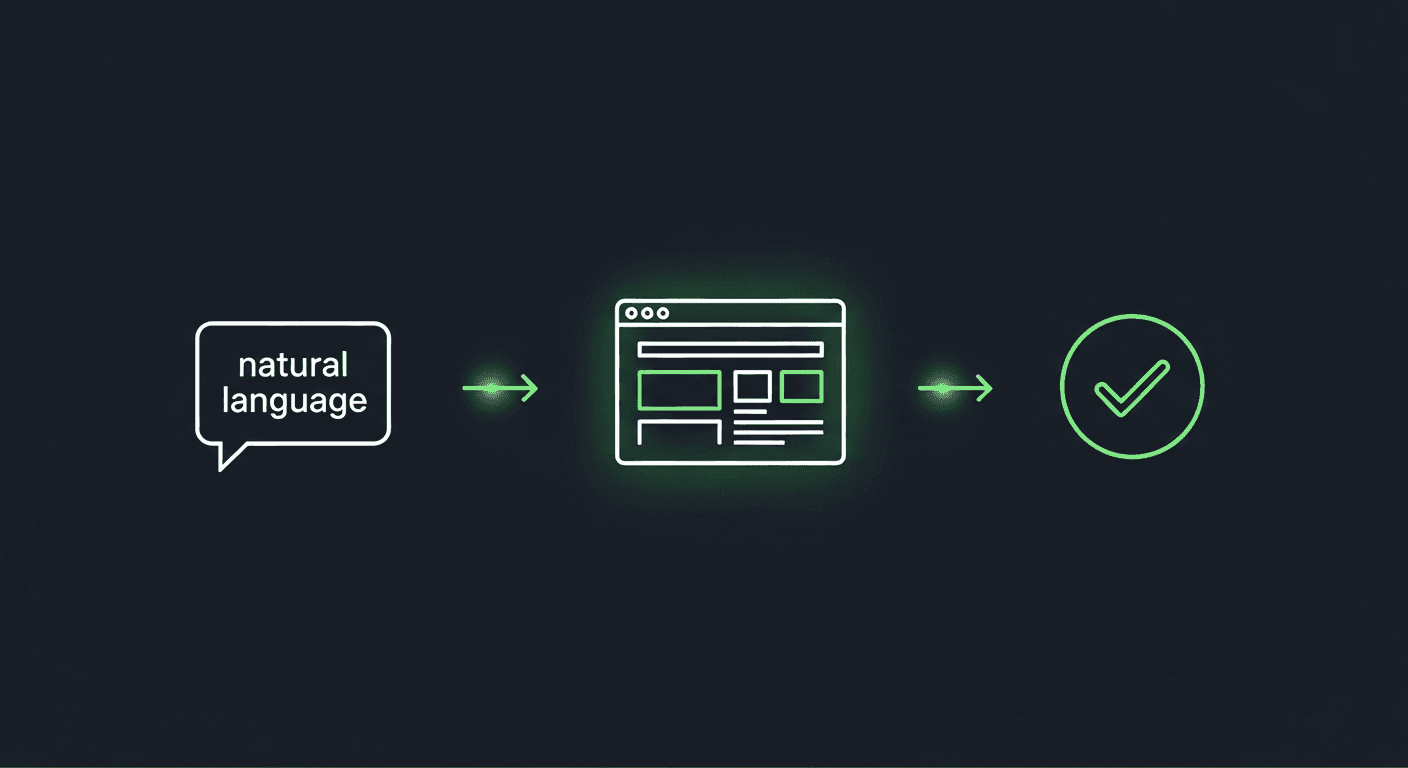
Tests are written in YAML and stored in your repository. They describe user intent, not DOM selectors. Shiplight resolves intents to locators at run time, caches them, and re-resolves only when the UI changes: the intent-cache-heal pattern.
goal: Verify dashboard loads
statements:
 - intent: Log in as an admin user
 - intent: Navigate to the analytics dashboard
 - VERIFY: the revenue chart is visible
 - VERIFY: the date range selector defaults to "Last 30 days"
Shiplight connects to AI coding agents like Claude Code, Cursor, and Codex through the Shiplight MCP Server. When a developer builds a feature, the agent generates the Shiplight test, runs it, and fixes failures inside the same session, editing the YAML directly. No tool switching, no separate QA handoff. See agent-first testing.
Strengths
- Code-grade tests in your git repo, not recorder artifacts in a vendor cloud. Shiplight tests are plain YAML committed alongside your source: diffable, PR-reviewable, portable, owned. Mabl's tests are proprietary Trainer step sequences that live in mabl's cloud workspace, and its documented export to code is lossy or unavailable, so they stay bound to the platform.
- Your coding agents author tests, not a browser recorder. Claude Code, Cursor, and Codex read, write, and edit the YAML directly via MCP and Skills, so the agent that wrote the feature also authors, runs, and heals its test in the same session, and coverage tracks code-generation throughput. Mabl is authored by QA staff in the visual Trainer, and its MCP server wraps the cloud console, so the agent drives mabl's platform rather than owning tests in your workflow: agent-integrated, not agent-native. See boost test coverage with agentic AI.
- Built on Playwright, no lock-in, adopted incrementally. The YAML transpiles to Playwright at run time, so the execution layer is the open-source standard, every Playwright browser is supported, and Shiplight runs alongside an existing Playwright suite: new flows first, nothing rewritten, eject to plain Playwright anytime. Mabl commits you to a proprietary cloud format with documented-lossy export, so leaving means re-authoring.
- Intent-based self-healing surfaced as reviewable PR diffs. When a cached locator breaks, the engine re-resolves the intent and the change lands as a git diff you review in your normal process; larger heals arrive as PR diffs from the triage agent. Mabl auto-heals opaquely inside its cloud, so you can't inspect the change in your own workflow.
- Both-modes infrastructure and local runs with no account, not credit-metered cloud runs. Shiplight ships hosted CI runners, dashboards, and an LLM proxy for zero setup, AND runs the same tests in your own CI with your own Anthropic, OpenAI, or Google keys (Azure, Bedrock, and Vertex included); cached deterministic steps call no LLM, and local runs need no account. Both modes, your choice. Mabl offers one closed mode: cloud runs metered by credits.
- SOC 2, SSO, RBAC, and audit logs for enterprise, with hosted runners, dashboards, and first-party support: a full platform, not a framework you assemble.
Tradeoffs
- Web-focused; no native mobile or desktop testing.
- Assumes a repo workflow with an engineer or coding agent in the loop; teams authoring purely in a visual builder are the design center vendor consoles serve.
- Free is $0 forever and Pro is $60/month (the MCP server, Skills, and local tier are free).
When to choose Shiplight: Your team uses AI coding agents, wants tests in the repo, and prioritizes developer ownership of the test suite.
Request a demo or explore Shiplight for AI coding agents.
2. Playwright: Maximum Developer Control at Lowest Cost
Playwright is the most popular open-source browser automation framework: code-based, cross-browser (Chromium, Firefox, WebKit), no vendor involved. For teams leaving Mabl because tests live in a vendor's cloud, Playwright is the fullest swing the other way: everything is code in your repo, run wherever you like.
Pros:
- Free and open source; no per-seat cost, no credit-metered runs.
- Cross-browser including Safari (WebKit).
- Maximum flexibility: full programmatic control over the browser.
Cons:
- Code-based and selector-bound: every UI refactor can break tests, and the ongoing maintenance is the cost, even when a coding agent writes the code.
- No built-in self-healing or natural-language authoring.
- Requires engineering effort to build and maintain the harness, runners, and reporting.
Where Playwright fits: engineering teams that want maximum control and lowest licensing cost, and have the capacity to maintain a selector-bound suite. See best Playwright alternatives for no-code testing.
3. Cypress: Developer-Friendly JS E2E Testing
Cypress is a long-standing open-source E2E framework focused on developer experience: fast local runs, excellent debugging, a large ecosystem.
Pros:
- Excellent debugging and time-travel; fast local feedback.
- Large community and plugin ecosystem.
- Developer-friendly authoring for JavaScript teams.
Cons:
- Code-based and selector-driven: the same maintenance ceiling as Playwright.
- Historically Chromium-focused; cross-browser support is improving but not at parity.
- No AI or natural-language authoring.
Where Cypress fits: JavaScript teams that want developer-friendly browser testing and own the maintenance. See Playwright vs Cypress and best Cypress alternatives.
4. Managed QA Services: Outsource the Suite Entirely
A different answer to Mabl's authoring problem is to stop authoring at all: managed QA services put the vendor's human engineers (assisted by AI tooling) in charge of building, running, and maintaining your test suite.
QA Wolf is the archetype: their engineers write standard Playwright that lives and runs on their infrastructure, and you buy the service rather than a tool.
Pros:
- Fully managed: you do not author or maintain tests yourself.
- Human review on top of AI generation.
- Fast ramp for teams with no QA function.
Cons:
- You are buying human hours, priced accordingly; coverage grows at the pace of the vendor's engineers.
- Testing knowledge accumulates with an external team, outside your repo and your heads.
- No agent-native loop: the vendor's staff authors tests, not your coding agent, which points the opposite direction from an AI-native development workflow.
Where managed QA fits: teams that have decided QA is someone else's job, with no internal QA team and no plans to build one, and budget for a staffed service.
5. Vendor Cloud Consoles: Low-Code Authoring in the Vendor's App
The largest commercial category keeps Mabl's basic shape while varying the authoring surface: your QA team builds tests in the vendor's web application, via a recorder, a visual editor, or a constrained plain-English command language, sometimes spanning web, mobile, and API from one platform.
Pros:
- Accessible to non-engineers; no repo workflow required.
- Often broader surface coverage (mobile, API, desktop) than web-focused tools.
- Governed, centralized management for QA organizations.
Cons:
- Tests live in the vendor's cloud, not your git repo; export paths are typically limited, lossy, or absent, so switching later means re-authoring. This is the same trade-off that brought you to this page.
- Runs are metered or quote-priced on vendor infrastructure.
- Agent integrations, where offered, drive the vendor's cloud console rather than putting tests in your workflow.
Where vendor consoles fit: manual-QA-heavy organizations where non-engineers own testing and a governed console is the point, a genuinely different buyer from the repo-and-agent workflow.
Quick Comparison
| Alternative | Tests in your repo? | Vendor lock-in | Your infra, your LLM keys? | Whose agent authors tests? | Best for |
|---|---|---|---|---|---|
| Shiplight AI | ✓ (YAML) | None: YAML transpiles to Playwright, runs alongside an existing suite, eject anytime | ✓ Your choice: Shiplight-hosted runners + LLM proxy, or your own CI and LLM keys; local runs need no account | Your coding agents (Claude Code, Cursor, Codex) via MCP + Skills | AI-coding-agent teams |
| Playwright | ✓ (code) | None (open source) | ✓ | Your engineers, or agent tooling you assemble | Developer control |
| Cypress | ✓ (code) | None (open source; parallelization via paid cloud) | ✓ | Your engineers | JS team E2E |
| Managed QA services | Varies | Suite knowledge lives with the vendor's team | Vendor's infrastructure | The vendor's human engineers | Fully outsourced QA |
| Vendor cloud consoles | ✗ | High: proprietary formats, limited or no export | Vendor cloud, metered runs | The vendor's console tooling | Console-authoring QA orgs |
| Mabl (baseline) | ✗ | High: proprietary Trainer steps in mabl's cloud, documented-lossy or no export | ✗ Cloud runs metered by credits | Mabl's cloud console (MCP wraps it; QA staff author in the Trainer) | Recorder authoring on credit-metered cloud runs |
How to Decide
The right Mabl alternative depends on three questions:
Where must the tests live, and who or what authors them?
If tests must live in your git repo, be reviewed in PRs, and be authored by your engineers or your coding agent, Shiplight is built around that mechanism. Mabl's tests are recorder step sequences in its cloud workspace, authored in the Trainer. Playwright and Cypress also keep tests in your repo, as code you maintain.
If a vendor-console workflow is acceptable, that category serves it, with tests staying in the vendor's platform. If you want to outsource QA entirely, a managed QA service exists for exactly that.
Do you use AI coding agents?
If your team develops with Claude Code, Cursor, or similar tools, Shiplight installs into the agent itself via MCP plus Skills, so the agent edits the YAML directly, with tests in your repo and local runs with no account. The other approaches on this list require a human (or a vendor's team) to author tests after the feature ships.
Mabl's own MCP server wraps its cloud console, so the agent drives mabl's platform rather than owning tests in your workflow: agent-integrated, not agent-native. See MCP for testing.
What platforms do you need to test?
Shiplight is web only, with no native mobile or desktop testing. If mobile or desktop surfaces are in scope, that points to a multi-platform vendor console or to Appium alongside your web stack.
The Bigger Picture
Mabl brought AI-assisted healing to the recorder workflow early. The alternatives here are built around different mechanisms: open-source code frameworks, managed services, vendor consoles, and repo-based YAML authored by coding agents.
For AI-native teams that want natural-language authoring and tests owned in git and coding-agent integration (the combination the recorder-and-cloud model does not offer), Shiplight AI is built for exactly that: intent-based YAML in your repo, MCP-callable from Claude Code / Cursor / Codex, self-healing surfaced as PR diffs, PR-time CI gates.
For the broader landscape, read the best AI testing tools in 2026, or book a 30-minute walkthrough and we'll map your current Mabl suite to a Shiplight migration path.
Frequently Asked Questions
What is Mabl?
A low-code cloud platform with browser-recorder heritage. Tests are authored visually in the Trainer, stored in mabl's cloud as proprietary step sequences, and run on metered credits. Export to code is documented as lossy, and its MCP server wraps the console.
What are the best Mabl alternatives in 2026?
Four approaches: Shiplight AI (agent-native, plain YAML in your repo, built on Playwright), Playwright and Cypress (open-source code), managed QA services, and other vendor consoles. Which fits depends on where tests should live and who authors them.
What is the difference between Mabl and Shiplight?
Opposite sides of the ownership line. Mabl tests are proprietary step sequences in mabl's cloud, with metered runs and lossy export. Shiplight tests are plain YAML in your repo, authored by your engineers or agent, with heals as reviewable diffs. See Shiplight vs Mabl.
Why look for a Mabl alternative?
Tests locked in a vendor workspace with only lossy export, so switching cost grows with every test. Metered runs that do not fit your scale. Auto-heal that happens opaquely rather than as a diff. Or an agent-driven workflow a recorder-and-console model was never designed for.
Which Mabl alternative is best for AI coding agents like Claude Code or Cursor?
Shiplight. Your agent authors, runs, and commits the test in the same session it writes the feature, editing YAML directly via MCP, with local runs needing no account. Mabl ships MCP too, but it wraps the console, so the agent operates mabl rather than owning tests.
Which Mabl alternative is open source?
Playwright and Cypress are open-source frameworks, free to run with no vendor involved. Shiplight is commercial but free to install, with tests owned in your repo, which gives open-source-like ownership of the definitions.
Which Mabl alternative is best for enterprise?
Depends who owns testing. If a QA organization authors in a governed console, the vendor-cloud category serves that. If engineering owns it, Shiplight is SOC 2 certified with VPC deployment and RBAC, keeping tests in your repo where heals are reviewed as diffs.
Can I migrate from Mabl to another tool?
Every path re-authors, because export is documented as lossy and the step sequences are proprietary. Shiplight makes it incremental: new flows in YAML as features change, old tests retired as they age out. Because the tests are intent, re-authoring is describing a flow rather than scripting one.