For enterprise teams building with AI coding agents, the self-healing option whose tests live as reviewable YAML in your own git repo is Shiplight.
The established enterprise incumbents in this guide (Tricentis Tosca, Tricentis Testim, ACCELQ, and Virtuoso QA) clear the same baseline security review but heal differently: attribute-scoring or module-model maintenance applied to proprietary test artifacts in their own platforms.
Because everything here passes security review, the real differentiator is the healing mechanism and where the tests live.
What enterprise buyers need beyond healing
Self-healing test automation eliminates the largest hidden cost in enterprise QA: the 40–60% of engineering time spent fixing tests broken by routine UI changes rather than catching real bugs.
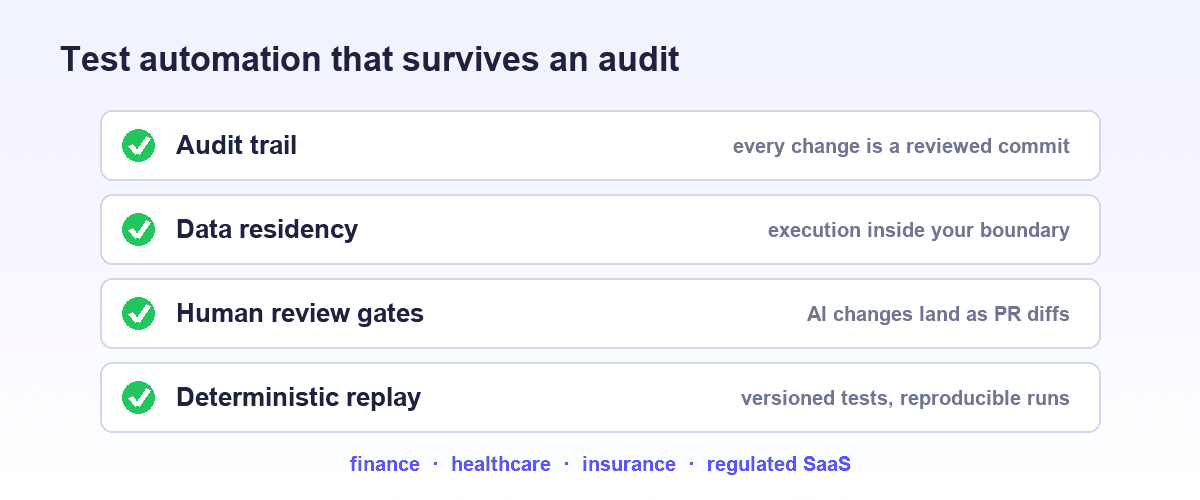
But enterprise teams evaluating self-healing tools have requirements that consumer-grade and startup-focused tools don't address: SOC 2 certification, single sign-on, role-based access control, immutable audit logs, dedicated support, and the ability to scale to thousands of tests across hundreds of applications.
Shiplight is SOC 2 certified and built for this profile. But we'll compare it honestly against the incumbent enterprise options, because the right tool depends on your stack, team structure, and compliance requirements.
How Self-Healing Test Automation Works
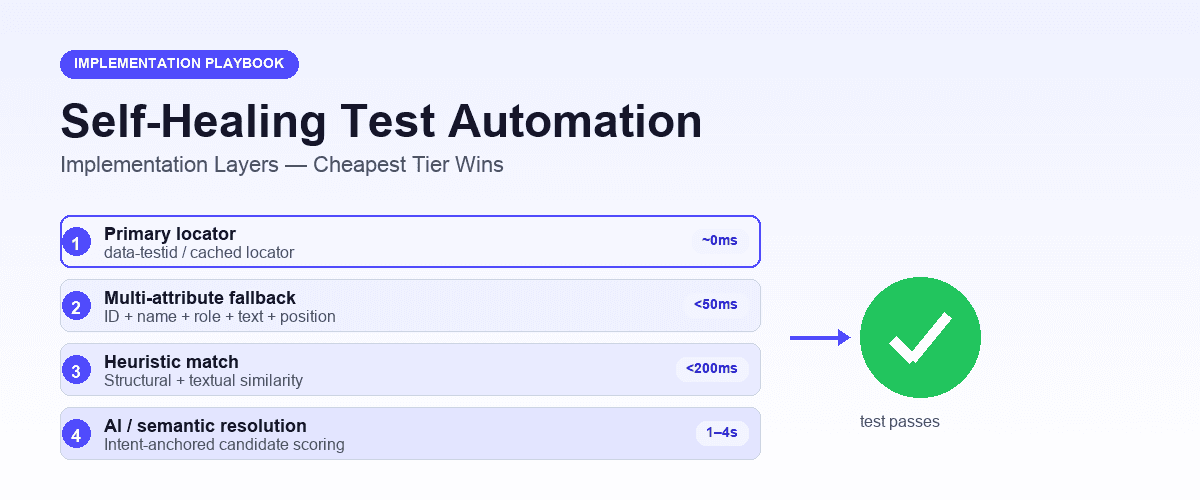
Enterprise self-healing tools use one of four mechanisms, and the mechanism determines both what gets healed and who can audit the heal:
Intent-Based Resolution in Your Repo
The test stores the semantic intent of each step: for example, "click the primary submit button on the checkout form," alongside a cached locator. When the locator fails, AI resolves the correct element from the live DOM using that intent, then updates the cache; larger repairs arrive as reviewable PR diffs in your git repo.
Handles major UI changes, component library migrations, and framework switches that break locator-based healers, and keeps every heal inside normal engineering review. Shiplight AI ships this mechanism.
Attribute-Scoring and Fallback Locators in a Vendor Cloud
The most common enterprise mechanism. The platform stores multiple attributes or alternative selectors per element and, when the primary fails, tries fallbacks in ranked order or scores attributes to pick the highest-confidence match. Tricentis Testim is a representative example: an ML model weights element attributes and adapts with test history.
Reliable for minor DOM changes; fails on large redesigns where the stored attributes no longer match anything, and the heal happens opaquely inside the vendor's platform.
Module-Model Propagation
The model-based approach: screens are scanned into reusable modules, tests compose those modules, and fixing a module once propagates everywhere. Tricentis Tosca is the incumbent example. A human still makes the fix, but only once per module, which centralizes maintenance across SAP-class packaged-application estates.
Human-Maintained Suites
Managed QA services skip the mechanism: the vendor's engineers, assisted by AI tooling, fix your tests under a maintenance SLA. The suite stays green, but the healing is staffing, the tests live on the vendor's infrastructure, and testing knowledge accumulates outside your walls.
Healing Accuracy in Practice
Enterprise teams consistently report:
- Minor DOM changes (label rename, class change): high auto-heal rates across mechanisms
- Major UI changes (layout restructure, component migration): 40–70% for attribute-scoring and fallback healing; 75–90%+ for intent-based resolution
The gap widens significantly when teams move fast: redesigns, framework migrations, and component library upgrades are where intent-based healing earns its keep. Treat any vendor-published healing-accuracy percentage with suspicion: those numbers are measured on the vendor's own applications under undisclosed conditions and are not comparable across tools.
What Enterprise Teams Actually Need From Self-Healing Tools
Before comparing platforms, it helps to define what enterprise-grade means in this context. A tool qualifies as enterprise-ready for self-healing test automation if it satisfies most of the following:
- Security compliance: SOC 2, ISO 27001, or equivalent certification
- Identity management: SSO via SAML or OIDC (Okta, Azure AD, Google Workspace)
- Access control: Role-based permissions (admins, developers, read-only reviewers)
- Audit trails: Immutable logs of who ran what, when, and what changed
- Data residency: Control over where test data and results are stored
- Scale: Parallel test execution at hundreds or thousands of tests without performance degradation
- Integrations: Jira, Azure DevOps, GitHub Enterprise, Slack, PagerDuty
- Support: Dedicated CSM, hands-on onboarding, direct access to the engineers who build the product
- Stability: Established vendor with enterprise references
Self-healing quality matters too, but enterprise buyers are often blocked at security review before they ever evaluate healing accuracy.
Enterprise Self-Healing Tools: Quick Comparison
Every platform in this guide clears the baseline enterprise bar (SOC 2, SSO, RBAC, audit logging, parallel execution, enterprise support), so a checkmark grid would tell you nothing. The axes that actually separate them:
| Tool | Healing mechanism | Who authors tests | Where tests live | What a heal looks like |
|---|---|---|---|---|
| Shiplight AI | Intent-based resolution with cached locators | Your coding agents or engineers, in YAML | Your git repo | Cache update; larger heals as reviewable PR diffs |
| Tricentis Tosca | Module-model propagation | QA org, in a Windows desktop app | Database objects in Tosca's repository | One module fix propagates to every dependent test |
| Tricentis Testim | ML-weighted attribute scoring | QA team, in a low-code recorder | Testim's cloud | Opaque model re-selection inside their platform |
| ACCELQ | ML-assisted locator repair | QA org, codeless in their console | ACCELQ's cloud (proprietary object model) | Locator update inside their platform |
| Virtuoso QA | Self-healing selectors on cloud execution | QA org, NLP authoring in their console | Virtuoso's platform (proprietary journey objects) | Selector repair on their cloud runners |
The Best Self-Healing Test Automation Tools for Enterprises
1. Shiplight AI
Best for: Enterprise engineering teams building with AI coding agents who need self-healing tests that survive aggressive product change cycles.
Shiplight's self-healing approach is differentiated from every other tool on this list: it heals based on intent, not stored locator alternatives. When a UI changes, Shiplight doesn't try CSS selector fallbacks; it re-resolves the element from scratch using the natural language intent of the test step.
This means tests survive redesigns, component library migrations, and framework changes that would break locator-based healers.
Enterprise security:
- SOC 2 certified
- Encrypted data in transit and at rest
- Role-based access control
- Immutable audit logs
- Google Workspace SSO (SAML/OIDC roadmap)
Enterprise integrations:
- GitHub Actions, GitLab CI, Bitbucket, Azure DevOps
- Shiplight for Claude Code, Cursor, and Codex (MCP)
- CLI for any CI environment
- Slack notifications
Support model: Every enterprise customer gets a dedicated customer success manager, a shared Slack channel with the engineering team, and hands-on help building initial test coverage. Shiplight is a full platform - authoring, self-healing, hosted runners, dashboards, reporting, first-party support - so you are not on your own.
Scale: Parallel test execution across unlimited runners. Tests run in real browsers on Playwright: no emulation, no performance degradation at scale.
Healing approach: Intent cache: tests store the semantic intent of each step. When a locator fails, the intent drives AI resolution of the correct element rather than falling back to a list of alternative selectors. Results in higher heal rates on major UI changes.
Larger repairs are proposed as reviewable PR diffs rather than silent rewrites, and the YAML tests live in your git repo and run alongside existing Playwright suites, so review and audit stay inside the normal engineering workflow.
Honest scoping: Web-focused. SAP, desktop, and native mobile estates are outside Shiplight's scope; the incumbents below exist for exactly those surfaces.
Shiplight for enterprise teams
2. Tricentis Tosca
Designed for: Global enterprises testing SAP, Oracle, and packaged-application landscapes with large manual-QA organizations.
Tosca is the model-based-testing incumbent: screens are scanned into reusable Modules in a Windows desktop application, tests compose those modules, and changing a module once propagates everywhere. Tests are database objects in Tosca's proprietary repository, with a C# plugin SDK as the escape hatch. SAP resells Tosca, and its coverage of legacy technologies extends far beyond what browser-first tools touch.
Enterprise fit: The default choice for SAP-class estates; module-model maintenance genuinely centralizes change, and the enterprise support and services organization is mature.
Honest limits: Module-model propagation is centralized maintenance, not runtime healing: a person still updates the module. Authoring is a Windows desktop application, there is no documented export path out, pricing is quote-only with a steep learning curve, and reviewer complaints center on cost and execution speed. There is no coding-agent authoring surface in your repo.
Pricing: Quote-only.
3. Tricentis Testim
Designed for: enterprises already in the Tricentis ecosystem (Tosca, qTest, NeoLoad) that want to add self-healing web UI testing under the same orchestration and reporting layer.
Testim (now part of Tricentis) is the representative example of ML-weighted attribute scoring: its model scores element attributes simultaneously (text, position, class, ID, structure), selects the highest-confidence match, and adapts based on test history as it learns your application.
Enterprise fit: Deep integration with the broader Tricentis quality platform, plus Tricentis's enterprise support, professional services, and training.
Honest limits: ML resolution is opaque: you can't see why a specific element was chosen, and there is no heal-as-diff review model. Tests are proprietary artifacts in Testim's cloud and cannot be exported. Healing fails on redesigns that invalidate the stored attributes. Primarily web-focused, with no coding-agent authoring in your repo.
Pricing: Free community edition; enterprise pricing varies.
4. ACCELQ
Designed for: enterprises that need codeless self-healing across web, mobile, API, and SAP, particularly orgs with non-engineer QA teams.
ACCELQ pairs codeless authoring in its cloud console with ML-assisted element handling: it tracks multiple element properties and repairs locators when the application changes. Its enterprise differentiator is breadth: web, mobile, API, database, and packaged apps like Salesforce and SAP on one platform, with genuine on-premise and private cloud deployment options for behind-the-firewall requirements.
Enterprise fit: Heterogeneous application portfolios that include SAP, legacy desktop apps, or mixed-technology stacks alongside modern web apps, tested by non-programmer QA staff.
Honest limits: Locator-level healing, so major redesigns still require manual updates. Tests live in ACCELQ's proprietary object model, not files in git, with no documented export path and no coding-agent surface. Pricing is enterprise-oriented and quote-only.
Pricing: Custom enterprise.
5. Virtuoso QA
Designed for: enterprise QA organizations authoring in structured natural language in Virtuoso's platform, particularly in Salesforce, SAP, and Dynamics 365 environments.
Virtuoso is an enterprise NLP/low-code platform focused on packaged-app verticals. It combines constrained natural-language authoring with self-healing execution, visual regression, and API testing, with pre-built libraries for the major packaged enterprise applications.
Enterprise fit: Packaged-app estates where visual consistency is a business requirement alongside functional coverage, particularly in regulated industries where UI changes must be tracked.
Honest limits: Tests are proprietary journey objects in Virtuoso's web console, executed exclusively on their cloud, with lossy export. Healing happens inside their platform rather than as reviewable artifacts in your repo, and no coding-agent interface is documented. Performance statistics circulating about the platform are vendor-authored without published methodology; benchmark on your own application.
Pricing: Custom enterprise pricing.
The managed-service alternative
Some enterprises solve test maintenance by outsourcing it: a managed QA service's engineers, assisted by AI tooling, write and fix the tests under a maintenance SLA. The suite stays green, but the healing mechanism is people on retainer, the tests live and run on the vendor's infrastructure, and the testing knowledge your product accumulates sits outside your engineering org.
For enterprises whose thesis is that testing belongs inside the development loop (especially teams shipping with AI coding agents), this is the opposite operating model, and it prices as human hours, quote-only.
How to Evaluate Self-Healing Tools for Enterprise Use
- Step 1Pass security review first
- Step 2Evaluate healing quality on your actual application
- Step 3Consider your authoring model
- Step 4Evaluate at scale
Step 1: Pass security review first
Most enterprise purchasing decisions stall at security review. Before running any PoC, confirm:
- SOC 2 report is available (request current report dated within 12 months)
- SSO supports your identity provider (Okta, Azure AD, Ping, Google Workspace)
- Data residency meets your compliance requirements (GDPR, HIPAA as applicable)
- Penetration test results are available under NDA
Every platform in this guide will pass standard enterprise security reviews. Differences emerge in data residency flexibility and on-premise deployment options; confirm the specific residency and deployment terms during your own security review.
Step 2: Evaluate healing quality on your actual application
Self-healing benchmarks on vendor websites are meaningless. Run a PoC on 20–30 tests against your real application, then intentionally break them:
- Rename a CSS class on a frequently-used component
- Change a button label
- Restructure a form
- Move a navigation element
Measure: what percentage of tests self-heal without human intervention? What does the healing change look like: can your team review and approve it?
Intent-based healing (Shiplight) tends to outperform attribute-scoring healing on large UI changes. Attribute-scoring and fallback healing perform well for minor DOM changes and degrade as the change gets larger.
Step 3: Consider your authoring model
| If the deciding mechanism is... | Built for that design center |
|---|---|
| Tests live in your git repo, authored by engineers or AI coding agents | Shiplight (MCP + YAML) |
| SAP, Oracle, or packaged-app estates with a large manual-QA org | Tricentis Tosca |
| Codeless authoring by non-technical QA staff across web, mobile, API, SAP | ACCELQ, Virtuoso QA |
| Existing Tricentis toolchain adding self-healing web UI tests | Tricentis Testim |
| Outsourced maintenance under an SLA | A managed QA service |
Step 4: Evaluate at scale
Request a parallel execution demonstration at 2–5x your expected test volume. Enterprise pricing often includes parallel runner limits: understand the cost model at scale before signing.
Conclusion
For most enterprise teams, the shortlist comes down to three questions:
- Are you using AI coding agents? If yes, Shiplight installs as an MCP server plus Skills across every major coding agent and authors tests as YAML in your repo, closing the loop between code generation and quality verification. Where incumbents ship MCP servers, they wrap a cloud console (agent-integrated); Shiplight authors and heals in your repo (agent-native).
- Is your estate packaged applications (SAP, Salesforce, D365, desktop)? Those surfaces are outside Shiplight's web-only scope; Tricentis Tosca, ACCELQ, and Virtuoso QA are built for exactly that estate.
- Are you already in the Tricentis ecosystem? Tricentis Testim shares its orchestration and reporting layer.
For enterprise teams without those constraints, the deciding axis is where tests live and who reviews heals: the incumbent platforms keep authoring and healing inside their own clouds and consoles, while Shiplight keeps YAML tests and heal diffs in your git repo under normal PR review.
Run a 30-day PoC on your real application: self-healing quality varies significantly by application architecture, and vendor benchmarks won't tell you what you need to know.
Not at the enterprise stage yet? See our broader self-healing test automation tools comparison for all team sizes.
Shiplight Enterprise: SOC 2, SSO, RBAC, dedicated support
FAQ
What are the best self-healing test automation tools for enterprises?
The serious options all clear the baseline bar of SOC 2, SSO, RBAC and audit logs, so choose by healing mechanism instead. Attribute scoring is predictable for minor DOM changes, module-model propagation centralises maintenance across packaged-app estates, and intent-based resolution survives redesigns, which is what Shiplight does. Run the proof of concept on your own application.
What is self-healing test automation?
Self-healing test automation is a capability where the test platform automatically detects when a UI change breaks a test step (such as a renamed button, moved element, or changed CSS class) and repairs it without human intervention.
Enterprise self-healing tools apply this to regression suites at scale, preventing the 40–60% of QA engineering time typically lost to manual test maintenance. See our full breakdown: What is self-healing test automation?
How does self-healing work in enterprise tools?
Four mechanisms. Intent-based resolution re-derives the element from the step's stated intent, with heals reviewable in your repo. Attribute scoring keeps ranked alternative selectors in the vendor's cloud and repairs silently. Module-model propagation fixes a shared module once. Managed services put engineers on it under an SLA. The section above compares them.
Is self-healing reliable enough for enterprise regression suites?
Yes, with the right tool. Enterprise teams running Shiplight at scale consistently report 70–90%+ of UI-change-induced failures are healed automatically. The remaining 10–30% typically involve genuine behavior changes that require human judgment, which is correct behavior.
Do self-healing tools require engineers to set them up?
Setup complexity varies by design center. Tosca and the codeless enterprise suites are built so non-programmer QA staff author tests, but rolling them out is an organizational program with training and professional services. Shiplight requires basic YAML familiarity, and teams using AI coding agents have the agent author the tests. All enterprise vendors here include dedicated onboarding support.
How do self-healing tools integrate with enterprise CI/CD?
Every platform in this guide integrates with GitHub Actions, GitLab CI, Azure DevOps, and Jenkins via native integrations or CLI. Enterprise configurations typically include: triggered runs on PR, scheduled nightly runs, parallel execution across environments, and Slack/PagerDuty alerting on failures.
What is the difference between self-healing and flaky test management?
Self-healing addresses the root cause: tests break because the UI changed, and the tool fixes the test. Flaky test management addresses symptoms: tests fail intermittently for timing, network, or environment reasons. Enterprise platforms handle both, but they are separate capabilities. See: Turning flaky tests into actionable signal and self-healing vs manual test maintenance