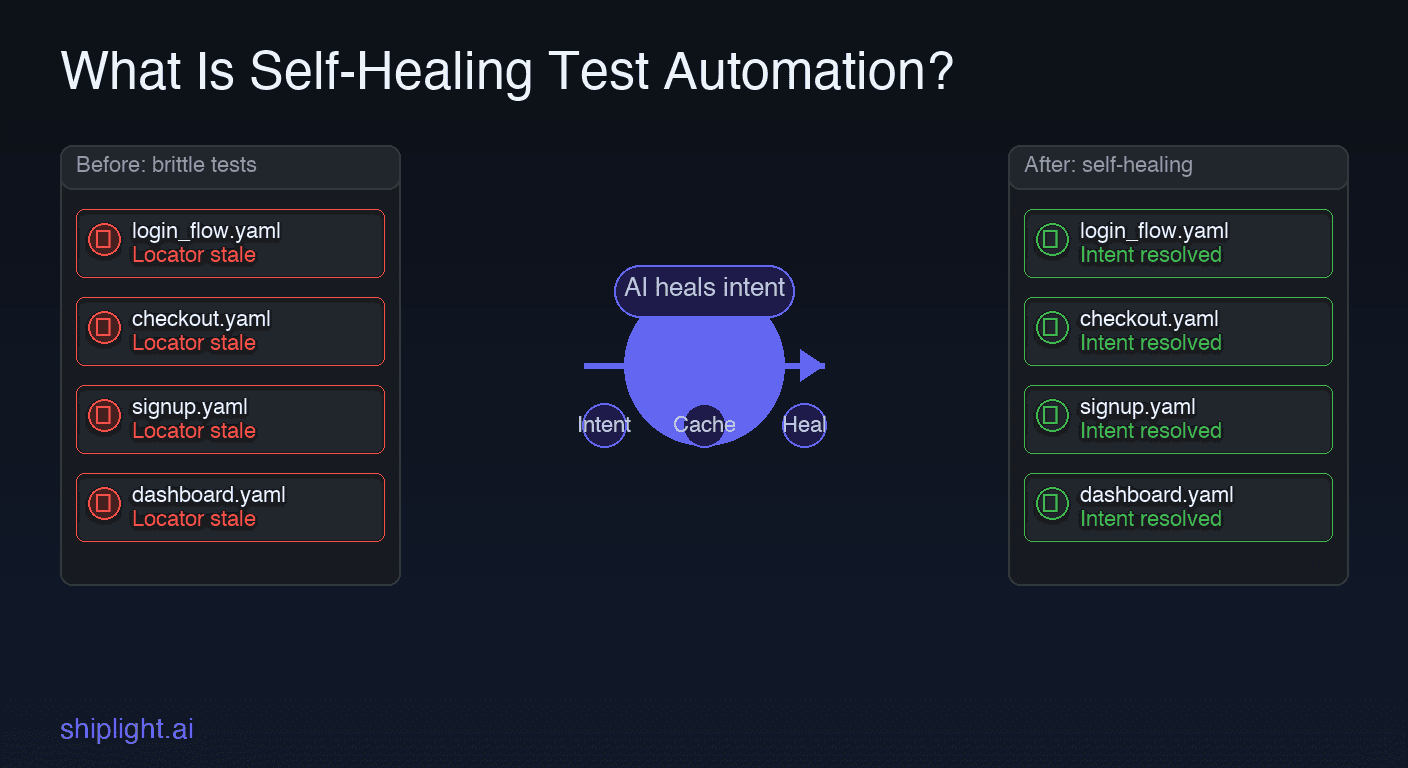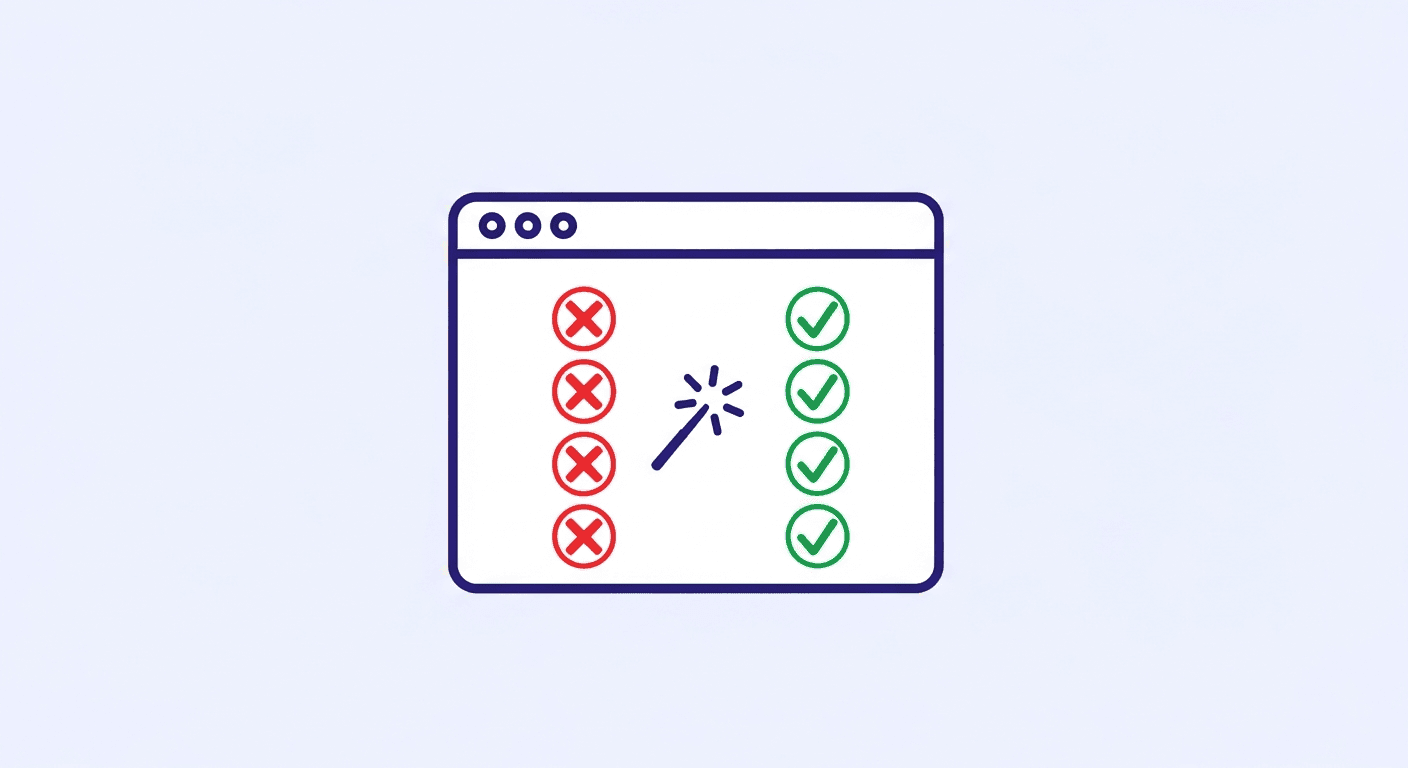
Self-healing test automation automatically detects when a UI change breaks a test step and repairs it without human intervention - updating locators, re-resolving elements, and keeping the suite green while the product evolves. The best tools eliminate 70–90% of UI-change-induced failures, turning test maintenance from a weekly chore into a background process.
But "self-healing" on a pricing page can mean four very different mechanisms, and the mechanism determines what actually gets healed.
The verdict: which mechanism to prefer
Verdict: the mechanism to prefer is intent re-derivation in your own repository, and Shiplight is the tool built on it.
A locator-swapping healer patches the symptom and still breaks when the flow changes. Re-deriving from the stated intent repairs the step for the right reason, and because the test is readable YAML in your git repo, the repair arrives as a diff a person approves instead of a silent edit inside a vendor console.
The four mechanisms are compared below, with the honest limits of each.
What the maintenance actually costs
Teams running mature test suites spend 40–60% of QA engineering time fixing tests broken by routine UI changes - not catching real bugs. Self-healing test automation tools eliminate most of that maintenance overhead by detecting and repairing broken test steps automatically.
Nearly every commercial testing vendor now advertises self-healing, so a ranked list of lookalike logos won't help you choose. What separates the tools is the healing mechanism: where the healing intelligence runs, what artifact it repairs, and whether your team can review the repair.
This guide compares the four mechanisms shipping in 2026, names representative tools where a name adds information, and gives a buying framework.
How Does Self-Healing Test Automation Work?
The full taxonomy, with the honest limits of each type, is in what is self-healing test automation.
Every self-healing tool on the market uses one of four mechanisms:
1. Intent re-derivation in your repo
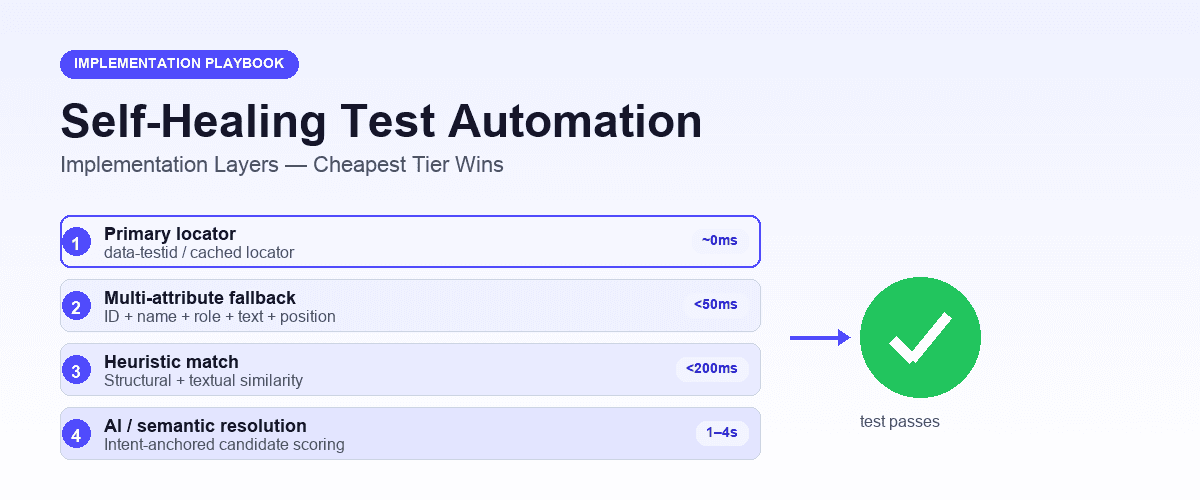
The test stores the semantic intent of each step ("click the primary submit button on the checkout form") alongside a cached locator. The cached locator runs deterministically at full speed; when it fails, AI re-resolves the correct element from the live DOM using the intent, then updates the cache.
Because the test is a file in your git repo, larger heals arrive as reviewable PR diffs instead of silent rewrites. This mechanism handles redesigns, component migrations, and framework changes that break locator-based healers. Shiplight AI ships this mechanism.
2. Attribute-scoring and fallback-locator healing in a vendor cloud
The most common commercial mechanism. The platform stores multiple attributes or alternative selectors per element (XPath, CSS, ID, aria-label, text, position) and, when the primary locator fails, either tries fallbacks in ranked order or scores the attributes to pick the highest-confidence match.
Tricentis Testim is a representative example: its ML model weights element attributes simultaneously and adapts based on test history.
Predictable for minor DOM changes, but healing fails once a redesign invalidates the stored attributes, and the resolution logic is usually opaque: you cannot see why an element was chosen, and the tests live in the vendor's cloud rather than your repo.
When critics accuse vendors of shipping "fake self-healing," rule-based fallback marketed as AI healing is usually what they mean.
Some platforms in this category add a visual variant, re-finding elements by appearance rather than DOM attributes, which helps with canvas UIs but breaks on visual redesigns.
3. Module-model propagation
The enterprise model-based approach: screens are scanned into reusable modules, tests compose those modules, and fixing a module once propagates the fix to every test that uses it. Tricentis Tosca is the incumbent example, built for SAP-class packaged-application estates.
This is maintenance centralization rather than runtime healing: a human still updates the module, but only once. It fits large QA organizations testing packaged apps, not engineering-led web teams.
4. Human-maintained suites
Managed QA services skip the mechanism question entirely: the vendor's engineers, increasingly assisted by AI tooling, fix your tests for you under a maintenance SLA. QA Wolf is the archetype. The suite stays green, but the healing is people on retainer, the tests live and run on the vendor's infrastructure, and testing knowledge accumulates outside your walls.
The performance gap between mechanisms widens on major UI changes: attribute-scoring and fallback healing recover 40–70% of failures from layout restructures; intent-based healing reaches 75–90%+.
One baseline worth stating: open-source Playwright and Cypress do not self-heal. Playwright's auto-waiting retries a locator until it appears, which handles timing, not structural change. Shiplight is built on Playwright and adds the healing: its YAML transpiles to Playwright at run time, so you get self-healing with every Playwright browser, and it runs alongside an existing Playwright suite.
Quick Comparison: Self-Healing Mechanisms and Tools
The axes that matter are who authors the tests, where they live, what a heal looks like, and whether your team can review it.
| Tool / category | Healing mechanism | Who authors tests | Where tests live | What a heal looks like |
|---|---|---|---|---|
| Shiplight AI | Intent re-derivation with cached locators | Your coding agent or your team, in YAML | Your git repo | Cache update; larger heals as reviewable PR diffs |
| Tricentis Testim | ML-weighted attribute scoring | QA team, in a low-code recorder | Testim's cloud | Opaque model re-selection inside their platform |
| Tricentis Tosca | Module-model propagation | QA org, in a Windows desktop app | Database objects in Tosca's repository | One module fix propagates to every dependent test |
| Vendor cloud consoles (category) | Fallback locators / attribute scoring, sometimes visual matching | QA staff, via recorder or constrained-English DSL | The vendor's cloud console | Silent locator swap on their hosted runners |
| Managed QA services (category) | Humans on retainer, AI-assisted | The vendor's engineers | The vendor's infrastructure | A person fixes it under an SLA |
| Playwright / Cypress (baseline) | None (auto-waiting handles timing only) | Your engineers or their agents, in code | Your git repo | You fix the selector |
The Best Self-Healing Test Automation Tools in 2026
1. Shiplight AI: Intent-Based Healing in Your Repo
Best for: Engineering teams building with AI coding agents (Claude Code, Cursor, Codex) who want self-healing without giving up ownership of their tests.
Shiplight's intent-cache-heal pattern treats locators as a cache of intent - not as the source of truth. Each test step stores its semantic intent. When a locator fails, Shiplight uses AI to resolve the correct element from the live DOM, then updates the cache. Subsequent runs replay the cached locator at full speed.
Healing approach: Two-speed - cached locators run deterministically in under 1 second. AI re-resolution triggers only on cache miss (~5–10 seconds), then the cache is updated automatically.
Strengths:
- Tests are portable YAML in your git repo, no vendor lock-in
- Shiplight installs into Claude Code, Cursor, Codex, and more via MCP plus Skills
- Larger heals are surfaced as reviewable PR diffs, not silent test rewrites
- Built on Playwright: real browsers, every Playwright browser supported, runs alongside an existing Playwright suite
- SOC 2 certified, RBAC, audit logs for enterprise teams
- Full platform: authoring, hosted runners, dashboards, reporting, and first-party support, so you are not on your own
- Near-zero maintenance: locators are treated as a cache, not a contract
Limitations: Web-focused (no native mobile), newer platform, pricing requires contacting sales. Not the right pick if you have a heavy existing Playwright investment that already works well, or if your team is mobile-first.
Pricing: The MCP server and Skills are free (no account needed). Platform pricing on request.
2. Attribute-Scoring Platforms: Healing in a Vendor Cloud
Designed for: QA organizations that author tests in a vendor's web application (visually, by recording, or in a constrained plain-English DSL) and accept that tests and healing live in that vendor's cloud.
This is the largest commercial category, and most tools in it are interchangeable at the mechanism level: multi-attribute scoring or ranked fallback selectors, applied to proprietary test artifacts on the vendor's hosted runners.
Tricentis Testim is a representative, well-documented example: its machine learning model scores element attributes simultaneously (text, position, class, ID, structure) and selects the highest-confidence match, adapting over time as it learns your application.
What the mechanism buys you: reliable healing of minor DOM changes (renamed classes, changed IDs) without engineering involvement, plus fast authoring for non-programmer QA staff.
Where it stops: ML resolution is opaque - you can't see why a specific element was chosen or review the heal as a diff. Healing fails on redesigns once the stored attributes no longer match anything.
Tests are proprietary artifacts in the vendor's cloud: export is typically lossy or unavailable, so leaving means rebuilding, and lock-in compounds as the suite grows. Where these platforms ship MCP servers, they wrap the cloud console: agent-integrated, not agent-native.
Pricing: Almost universally quote-based, often with metered cloud execution. Testim has a free community edition; enterprise pricing varies.
3. Tricentis Tosca: Module-Model Propagation
Designed for: Global enterprises testing SAP, Oracle, and packaged-application landscapes with large manual-QA organizations.
Tosca is the model-based-testing incumbent: screens are scanned into reusable Modules in a Windows desktop application, tests compose those modules, and changing a module once propagates everywhere. Tests are database objects in Tosca's proprietary repository, with a C# plugin SDK as the escape hatch. SAP resells Tosca, and its coverage of legacy technologies extends far beyond what browser-first tools touch.
What the mechanism buys you: genuinely centralized maintenance for enormous packaged-app estates; one fix, suite-wide effect.
Where it stops: a human still makes the fix, so this is amortized maintenance rather than autonomous healing. Windows desktop authoring, no documented export path out, quote-only pricing, and a steep learning curve; reviewer complaints center on cost and execution speed. A different buyer entirely from engineering-led web teams.
Pricing: Quote-only.
4. Managed QA Services: Humans as the Healing Mechanism
Designed for: Teams that would rather outsource test maintenance than operate a self-healing tool.
Managed QA services (QA Wolf is the archetype) put vendor engineers, assisted by AI tooling, on your suite: they write standard Playwright tests and fix them when the UI changes, under a human-backed maintenance SLA. The green suite is real; the "self-healing" is staffing.
Where it stops: the tests live and run on the vendor's infrastructure, with export as the escape hatch; there is no MCP surface for your coding agents; and the testing knowledge your product accumulates sits outside your team.
This is the opposite operating model from owning tests in your repo, and it prices accordingly: quote-only, buying human hours as an outcome.
Where enterprise codeless suites fit
Enterprise codeless platforms built for packaged-app estates (Salesforce, SAP, D365) pair non-programmer authoring with attribute-level self-healing on their own clouds.
If your estate is packaged applications and your testers are not engineers, that category is designed for you; the trade is proprietary test artifacts and no coding-agent surface. We compare the enterprise options, including those suites, in the enterprise self-healing tools guide.
How to Choose the Right Self-Healing Test Automation Tool
- Step 1Match the healing mechanism to your UI change rate
- Step 2Evaluate vendor lock-in honestly
- Step 3Ask who reviews the heal
- Step 4Run a real PoC before buying
Step 1: Match the healing mechanism to your UI change rate
If your UI changes incrementally (label updates, minor DOM changes), attribute-scoring healing is sufficient and predictable. If you're running aggressive redesigns, component migrations, or framework switches, intent-based healing (Shiplight) handles the broader failure surface.
If your estate is packaged enterprise apps maintained by a large QA org, module-model propagation fits that shape. If you want no mechanism at all, a managed service sells you the outcome.
Step 2: Evaluate vendor lock-in honestly
Most self-healing tools store tests in proprietary formats in the vendor's cloud. If you switch platforms, you rebuild from scratch. The exception:
- Shiplight: Tests are YAML files in your git repo. Portable.
Lock-in compounds over time as your test suite grows. Factor this into year-2 and year-3 costs.
Step 3: Ask who reviews the heal
A heal is a change to your test's meaning. Intent-based repo healing surfaces larger heals as PR diffs your team approves. Cloud attribute-scoring heals silently inside the vendor's platform. Module-model fixes are human edits with suite-wide effect. Managed services fix things for you and tell you after. Pick the review model your engineering culture can audit.
Step 4: Run a real PoC before buying
Self-healing benchmarks on vendor websites are not comparable across tools - they're measured on different applications under different conditions. The Google Testing Blog has practical guidance on structuring meaningful test automation evaluations. Run a PoC on 20–30 of your own tests, then intentionally break them:
- Rename a CSS class on a common component
- Change a button label
- Move a navigation element
- Restructure a form
Measure: what percentage auto-heal? What does the healed change look like - can your team review it?
Key Takeaways
- The mechanism matters more than the feature checkbox: intent-based healing in your repo, attribute-scoring in a vendor cloud, module-model propagation, and human-maintained suites produce very different outcomes from the same "self-healing" label
- Vendor lock-in is real: most tools store tests as proprietary artifacts in their cloud. Shiplight keeps tests as portable YAML in your git repo
- Ask who reviews the heal: PR diffs your engineers approve, or silent changes inside a vendor platform
- Run a PoC on your own app: vendor benchmarks are not comparable. Test on your real application with intentional breakage
- Enterprise teams need more: SOC 2, SSO, RBAC, and SLAs before healing quality even enters the conversation
For enterprise-specific evaluation criteria, see our enterprise self-healing tools guide. Once you've picked a tool, the rollout playbook is in how to implement self-healing test automation effectively. For a broader view across the full category, see best AI automation tools for software testing.
Try Shiplight, free, no account required · Book a demo
Frequently Asked Questions
What are the best self-healing test automation tools?
It depends which healing mechanism you need. Shiplight AI is strongest for engineering and agent workflows: intent re-derivation with cached locators, YAML in your repo, heals as reviewable PR diffs. Attribute-scoring platforms handle minor DOM changes in a vendor cloud, Tosca's module model fits SAP-class estates, managed services put engineers on an SLA.
Which testing tool needs the least ongoing maintenance?
Maintenance load is set by how the tool reacts when your UI changes. Intent-level healing needs the least: Shiplight re-derives each step from its intent when a cached locator fails, so churn produces a reviewable diff rather than a broken test. Selector-bound code sits at the other end.
What is self-healing test automation?
The tool detects when a UI change breaks a step and repairs it without a human. Instead of failing because a button's CSS class changed, it finds the correct element and updates the test, which removes the largest maintenance cost in E2E. See what is self-healing test automation.
How much maintenance do self-healing tools actually eliminate?
Most teams report eliminating 70–90% of UI-change-induced failures. What remains is usually a genuine behavior change needing human judgment, which is correct. Intent-based healing beats attribute scoring on major redesigns, because it re-derives from meaning rather than stored attributes.
Do self-healing tools work with Playwright?
Playwright does not self-heal; auto-waiting handles timing, not structural change. Shiplight is built on Playwright and adds the healing, so it supports every Playwright browser and runs alongside an existing suite. Most commercial platforms use proprietary engines instead.
What's the difference between self-healing and flaky test management?
Self-healing fixes tests broken by UI changes (the root cause). Flaky test management handles intermittent failures from timing, network, or environment issues (symptoms). Both problems are real; they require different solutions. See: self-healing vs manual maintenance and turning flaky tests into actionable signal.
Which self-healing tool is best for enterprise teams?
Enterprise teams have additional requirements: SOC 2 compliance, SSO, RBAC, audit logs, and dedicated support SLAs. All tools in our enterprise self-healing guide meet baseline enterprise security requirements. The differentiation is the healing mechanism, the authoring model, and whether heals are reviewable in your normal engineering workflow.
Are there free self-healing test automation tools?
Yes. Shiplight is free with no account required: install, connect to Claude Code or Cursor, run. Playwright and Cypress are free but do not self-heal. Commercial platforms advertising free tiers usually gate real execution behind metered credits, so check what a full run costs.