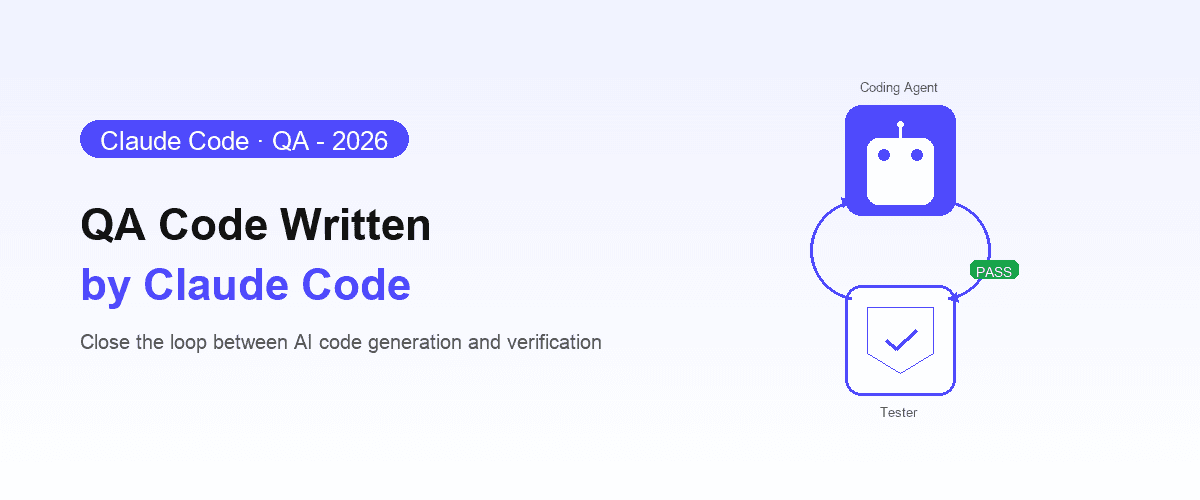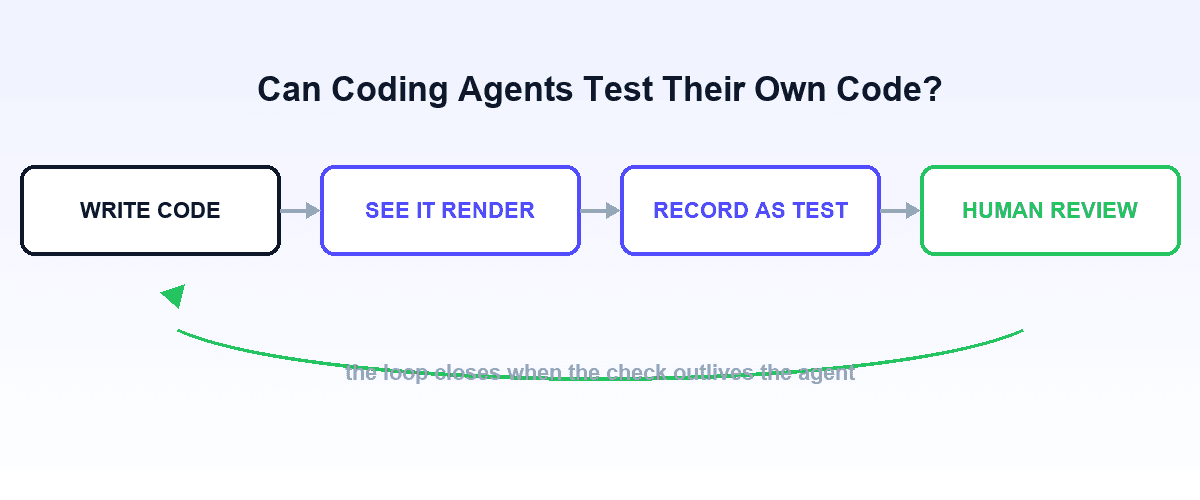
Can a coding agent test its own code? Yes, and most of the industry is arguing about the wrong thing. The real question is not whether the agent that wrote the code should also check it. The real question is what the agent can see when it checks, and what evidence it leaves behind.
An agent with a real browser and a persistent, human-reviewable test artifact closes its own verification loop. An agent with neither is guessing, and no amount of independence fixes guessing.
I run an AI-native testing company, so read this knowing where I sit. But the position I am arguing against is the one that happens to sell competing products, so we are even.
The case against, taken seriously
Testing vendors have converged on a talking point: coding agents grading their own homework. The argument goes like this. An agent rewrites three components, runs whatever check it invented for itself, declares success, and moves on.
It has no incentive to find the bug it just introduced, no memory of which behaviors used to work, and no view of the app beyond the code it edited.
Therefore verification must live somewhere else: a separate platform, a separate agent, sometimes a separate team of humans.
Parts of this are simply true, and worth conceding specifically:
- Self-assessment is not verification. When an agent reads its own diff and concludes "this looks correct," that is a vibe, not a check. Studies of AI-generated code consistently find defect rates that make review-by-author insufficient.
- Code-level checks miss rendered reality. Unit tests pass while the button renders off-screen. Type checks pass while the modal traps focus. The gap between "the code is plausible" and "the product works" is exactly where AI-written regressions live.
- Context evaporates. The agent that shipped Tuesday's change is not around for Thursday's regression. If verification lived only in that agent's head, it is gone.
If that were the whole story, the conclusion would follow: keep coding agents away from testing. But the argument quietly assumes the agent is blind and amnesiac, then blames the agent for being blind and amnesiac. Both are fixable properties, not laws of nature.
The homework metaphor breaks down
"Grading your own homework" fails as an analogy for one reason: homework grading is a judgment call, and verification is not. When an agent verifies a UI change by driving a real browser, clicking the actual flow, and asserting on what actually rendered, the result is not the agent's opinion of its work.
It is an observation of the application. The browser does not care who wrote the code.
The objection has force only when verification is a self-report. It has none when verification is an instrument reading. Nobody says a developer who runs the test suite on their own PR is grading their own homework. The suite is the grader. The developer just pressed the button.
So the honest version of the debate is not "should the coding agent verify its own work" but "what does the agent's verification produce":
- A transcript nobody reads? Then the critics are right. Self-verification without an artifact is theater.
- A persistent test, written as intent, stored in the repo, reviewed like code, replayed deterministically in CI? Then the "independence" everyone wants is exactly what you got. The test outlives the agent that wrote it, runs against every future change including changes by other agents and other humans, and a person approved it in review.
The unit of independence is the artifact, not the vendor.
What an agent actually needs to close the loop
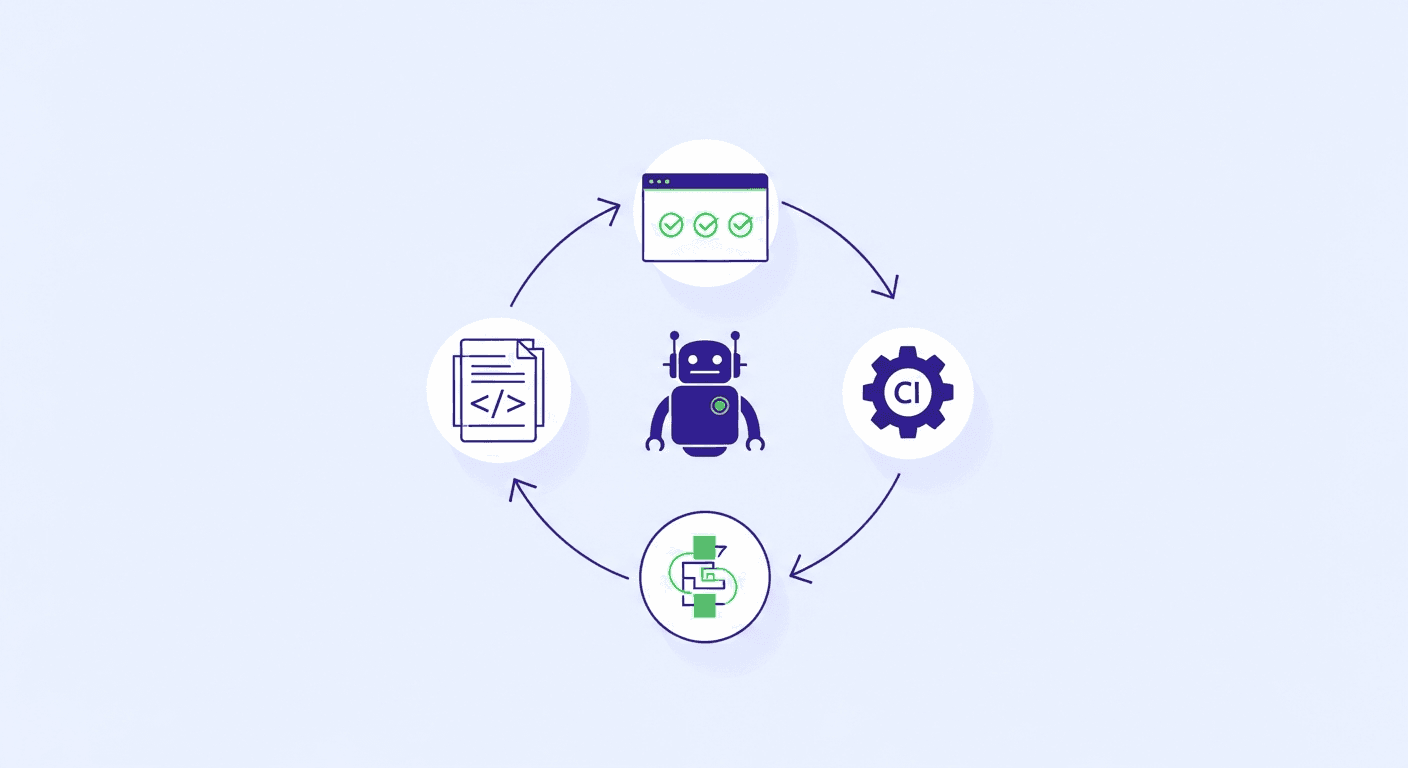
Three components have to exist. Most setups are missing at least one, and every popular criticism of agent self-testing maps to one of these gaps.
Eyes: a real browser, not a guess about one
An agent without browser access verifies UI changes by rereading its own code, which is how you get confidently wrong.
Give the agent eyes and hands in a real browser and the loop changes character: it makes the change, watches the app do the thing, and catches its own regression before a human ever context-switches.
This needs to work well, not just exist. Reading the raw accessibility tree produces wrong and unstable element identification often enough to poison trust. We mark interactive elements visually before resolving them, and when locators fail entirely, on a canvas or an unlabeled region, a vision model finds the pixel and clicks it.
The technique matters less than the requirement: the agent's view of the app must be the rendered app.
Memory: verification that compounds into regression protection
The verify-while-building step should not evaporate. It should become the regression test, in a format a human can read like a spec. Ours is YAML that states intent rather than selectors, lives in your git history, and runs locally or in CI without any account.
The point generalizes past any vendor: if the agent's verification does not produce a durable, replayable check, you are paying the verification cost on every change and banking none of it.
Accountability: a human gate that actually functions
Agents propose, people approve. Tests get reviewed like code because they are code, in the same PR flow. When something drifts and a locator heals, the heal shows up as a reviewable diff, not a silent rewrite inside someone's cloud.
This is the part of "independent verification" worth keeping: not a separate vendor between your agent and your app, but a human between proposal and merge.
Put those together and the "-10x engineer" story inverts. The agent closes its own inner loop, so it runs longer without supervision. Failures arrive as specific, replayable evidence instead of a vague red build. The morning triage question, app bug or test bug or infra, gets an answer from the test artifact itself.
Does your coding agent need a separate testing agent?
No: it needs a verification layer that produces independent evidence. The "separate testing agent" pitch bundles two different claims, and only one survives scrutiny.
The true claim is that an agent grading its own work from its own context is weak evidence, so verification must come from outside that context: a real rendered browser, checks derived from stated intent rather than from the diff, deterministic replay in CI.
The false claim is that this independence requires a second vendor-run agent, with its own metered loop, its own cloud, and artifacts that accumulate outside your repo.
The distinction is architectural, not semantic. Independence of evidence comes from where the check runs and what it reads (the live app, the original intent), not from whose logo is on the agent. A verification layer your own coding agent can call, that writes durable tests into your git history and replays them without an account, delivers the independence.
A second agent subscription delivers a second inner loop to supervise. Teams evaluating "testing agents" should ask one question first: after the run, what do I own?
What this does not fix
Honesty about the limits, because the limits are real:
- Judgment stays human. An agent can verify that checkout completes. It cannot decide that the new checkout flow is worse for users. Product judgment, exploratory instinct, and taste do not automate.
- Specification gaps pass through. If nobody said the export should preserve timezone, the agent will verify the wrong behavior faithfully. Verification confirms intent. It cannot invent it.
- A broken app needs a bug report, not a healed test. Any healing system must distinguish "the UI legitimately changed" from "the product broke." When triage cannot tell, a human should see both hypotheses, with evidence. Vendors that heal everything silently convert real bugs into green checkmarks.
- Some teams do not have this problem. If you have strong engineers and a Playwright suite that is genuinely not a bottleneck, an agent-native verification layer is not solving anything for you today. That is fine. This argument is for the teams where verification, not code generation, is now the constraint.
The stakes are larger than tooling
Teams using AI coding assistants ship a large and rising share of agent-written code. The old QA bottleneck did not disappear; it moved downstream into the developer's lap, and brittle checks recreate the QA tax inside engineering.
The industry's answer so far is to sell chaperones: platforms whose pitch is that your agents cannot be trusted, so route verification through us.
The alternative is to make the agent trustworthy: give it eyes, make its checks durable, and keep a human on the merge button. That is not a smaller version of QA. It is verification at the speed the code is now written, by the thing writing the code, with evidence a person can audit. We built Shiplight on that bet.
At HeyGen, the QA lead's team went from spending most of their time authoring and maintaining tests to close to none within a month, not because a vendor took testing away from them, but because the agents doing the work started leaving verifiable artifacts behind.
Agents that cannot see broke your UI last sprint. The fix is not to take testing away from them.
Related: AI code review vs verification · tests as context for coding agents
Frequently Asked Questions
How do I make sure an AI coding agent didn't break my UI?
Give the agent a way to check the rendered application, not just its own code. Connect a browser-automation layer via MCP, have it verify the affected flows in a real browser right after the change, and persist that as an E2E test that runs on every PR.
The immediate check catches the regression just caused; the persisted test catches the next one.
What is the best way to review code an AI agent wrote?
Review the behavior evidence with the diff, not the diff alone. An agent-written PR should carry three things: the code change, the verification the agent ran against the live app, and any new or updated tests as reviewable files. Reviewers are bad at spotting rendered-UI regressions by reading code, so make the pipeline show the rendered result.
How do teams maintain software quality when AI writes most of the code?
The teams doing this well share one pattern: verification became a byproduct of shipping, not a separate project. Every agent-built feature leaves executable checks in the repo, coverage grows automatically, and CI replays the accumulated suite deterministically. Quality then scales with shipping volume instead of competing against it.
How do teams enforce quality gates when shipping with AI coding agents?
Gate on artifacts, not on trust. Concretely: agent-authored tests must merge through human review like any code; PRs run the relevant E2E slice against a preview environment before merge; failures block with evidence attached (trace, screenshots, the failed step's intent); and test heals arrive as diffs someone approves. The gate is enforceable precisely because every step produces something inspectable.
What are the risks of shipping AI-generated code without QA?
The defect volume matters less than its distribution: AI-generated bugs cluster in rendered behavior and cross-component interactions, exactly where unit tests and code review are weakest. Teams that ship agent code with no browser-level verification typically find regressions in production, through users, with no artifact trail explaining what broke.
Do AI coding agents need a separate testing agent?
They need independent verification, not necessarily a separate vendor agent. The independence that matters is evidential: checks that run against the rendered app, derive from intent rather than the code diff, and replay deterministically in CI.
A verification layer your agent calls directly provides that while keeping the tests in your repo; a second metered agent loop adds supervision cost without adding evidence quality.
Can a coding agent and a testing platform be the same thing?
They already are converging. Coding agents are gaining browser access; testing platforms are adding agent integrations. The durable distinction is not which vendor category wins but where the artifacts live and what they cost to run. Tests that live in your repo, in a readable format, replayable anywhere for free, survive any vendor decision, including ours.