Shiplight costs $0 on Free, $60 a month on Pro, and is contract priced on Enterprise. Every capability ships on every plan, including Free.
That includes AI actions, auto-healing, MCP access for your coding agent, Skills, CI integration, bring-your-own model key, and running on your own infrastructure.
What the plans change is how much usage credit you start with, how long artifacts are kept, and whether you can spend past the credit. The full table is on the pricing page; this page explains what drives the number and how to estimate yours.
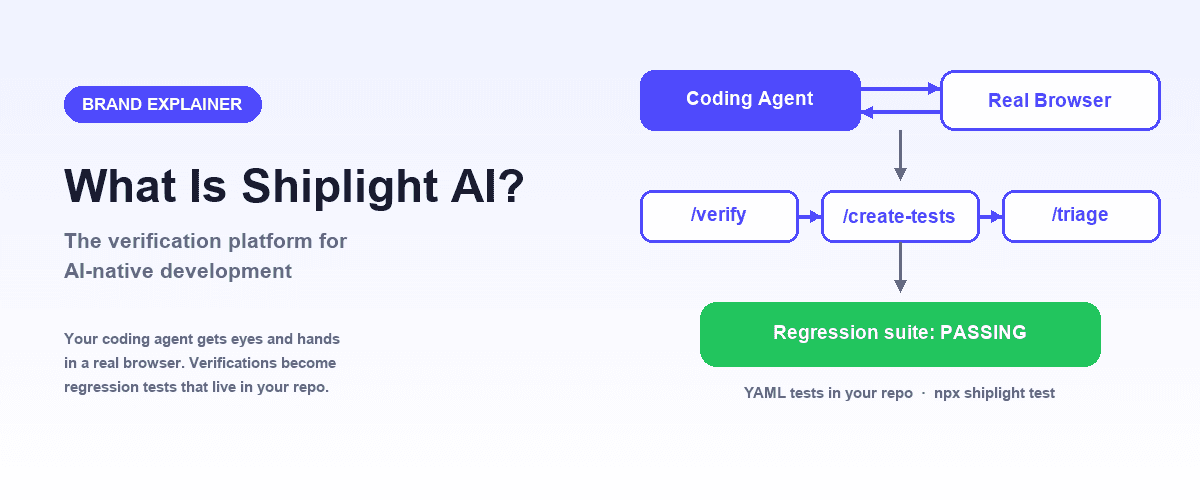
The shortest version: local use costs nothing and needs no account. Install the MCP server into Claude Code, Cursor, or Codex and your agent can drive a real browser and write tests today, without signing up. An account is what adds hosted runners, CI result uploads, dashboards, and artifact history.
What each plan costs
| Plan | Price | Included credit | Pay as you go | Artifact retention | Members |
|---|---|---|---|---|---|
| Shiplight Free | $0 forever | $10 signup bonus, once | No | 30 days | 5 |
| Pro | $60/month, or $600/year | $60/month, or $720 granted upfront on a yearly term | Yes, plus auto-recharge | 90 days | 100 |
| Enterprise | Contract priced | Custom | Yes | Custom | Unlimited |
Paying yearly saves 17% and hands you the whole year of credit at the start of the term. You pay less and receive the same total credit.
What actually consumes credit
Credit is granted to you, not billed to you, and it is spent on two things:
| What you are charged for | Unit | Rate |
|---|---|---|
Compute, shiplight-small (4 vCPU, 16 GB) | Per minute a runner is working | $0.008 |
Compute, shiplight-medium (8 vCPU, 32 GB) | Per minute | $0.014 |
Compute, shiplight-large (16 vCPU, 64 GB) | Per minute | $0.028 |
Compute, shiplight-xlarge (32 vCPU, 128 GB) | Per minute | $0.054 |
| Model usage, Lite tier (Claude Haiku, Gemini Flash, or similar) | Per million tokens | $1.00 |
| Model usage, Standard tier (Claude Sonnet, Gemini Pro, or similar) | Per million tokens | $3.00 |
| Model usage, Pro tier (Claude Opus, or similar) | Per million tokens | $6.00 |
Free and Pro pay the same rates. A plan changes how much credit you start with, not what a minute or a token costs.
The mechanic that matters most for your bill is the action cache. Once a step has resolved, its locator is cached and the step replays without calling a model at all, so a settled suite is mostly compute.
Two exceptions are worth knowing before you budget: AI steps and AI assertions are not cached and call the model on every run, and a heal calls the model because that is the moment something changed.
Working out your own number
Define the unit first, because "per run" means nothing until you say what a run is. Below, a run is one full pass of your suite, and compute minutes are summed across the tests in it.
Take a suite of 100 settled tests averaging two minutes each on the small runner. That is 200 minutes of compute at $0.008, so $1.60 for a full-suite run. Pro's $60 monthly credit covers roughly 37 of those before pay-as-you-go starts.
Three things move that number, and all three are yours to control:
- AI steps and assertions. Every one calls a model on every run. A suite that leans on them costs more than a suite that leans on cached deterministic steps, which is also the difference between a suite that runs in a predictable time and one that does not.
- Runner size. A test that needs
shiplight-largecosts 3.5 times what the same minute costs onshiplight-small. - How often the UI changes. Heals call the model. A quiet week is cheaper than a redesign week, which is the honest shape of maintenance cost in any tool.
The two ways to pay less than the rate card
Both work on every plan, including Free, and neither is gated behind an upgrade.
Bring your own model key. Point Shiplight at your own Anthropic, OpenAI, or Google key, including Azure, Bedrock, and Vertex. Token usage is then billed by your provider at whatever rate you have negotiated, and our proxy is out of the path.
Run on your own CI. The same YAML tests run on your own runners rather than ours, so our compute is out of the path too. Some usage and cost analytics depend on runs going through our runners or proxy, so those views get thinner when you bring your own. That is the trade, and it is the only one.
Neither choice is a downgrade in capability, and you can mix them: your key with our runners, or our key with yours.
How this compares with the way the category usually prices
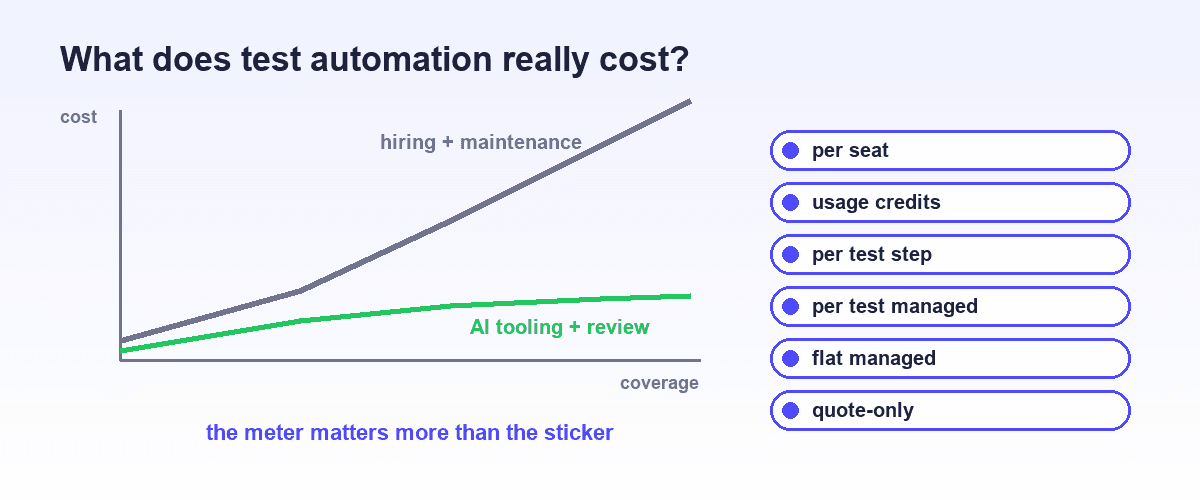
Most test automation is sold by the seat, by the parallel slot, or by a quoted annual contract you cannot see before a sales call. Those models bill you for capacity you may not use, and they punish exactly the thing you want more of, which is more tests running more often.
| Pricing model | What you are billed for | What it punishes |
|---|---|---|
| Per seat | People with logins | Letting the whole team read results |
| Per parallel slot | Concurrency you reserved | Running the suite faster |
| Per test or per run | Suite size | Adding coverage |
| Annual quote, undisclosed | Whatever was negotiated | Comparing before you commit |
| Shiplight | Minutes and tokens you actually consumed | Nothing structural; a cached suite is cheap to run often |
The practical consequence is that adding your hundredth test does not change your plan, and letting the whole engineering team look at run history does not either.
What Enterprise adds
Enterprise is contract priced and the substance is people, not features: hands-on support fitted to your workflows, help rolling Shiplight out across your engineers, and cost reviews as usage grows. Alongside that come volume pricing, custom credit and retention, SOC 2, private cloud and VPC deployment, unlimited members, audit logs, and a dedicated customer success manager.
If you want to sanity-check a number against your own suite before committing to anything, a walkthrough is the fastest way, and you can start on Free in the meantime without talking to anyone.
Frequently Asked Questions
How much does Shiplight cost per month?
Free is $0 forever with a one-time $10 credit. Pro is $60 per month, or $600 per year, and includes $60 of monthly usage credit. Enterprise is contract priced. The pricing page carries the full feature matrix.
Is Shiplight free?
Yes, genuinely. Local MCP browser automation and YAML test authoring need no account and no API token at all, and the Free plan adds hosted runs against a $10 signup credit. Every core capability is on Free, including bring-your-own model key.
What happens when my credit runs out?
On Pro, pay-as-you-go takes over at the published rates, and auto-recharge tops the balance up when it drops below a threshold you set. Free has no pay-as-you-go, so runs stop until the next term or an upgrade. Nothing is charged without a plan that allows it.
Does unused Shiplight credit roll over?
Included plan credit does not: it is granted for the term and expires with it. Credit you add yourself is different, since pay-as-you-go top-ups and auto-recharge have no term and roll over until you spend them.
Can I use my own API keys to cut the cost?
Yes, on every plan including Free. Point Shiplight at your own Anthropic, OpenAI, or Google key and your provider bills the tokens instead of us. You can also run on your own CI runners so our compute is out of the path.
Do cheaper plans have fewer features?
No. AI actions, auto-healing, failure recovery, MCP access, Skills, and CI integrations are identical on Free, Pro, and Enterprise. Plans differ on included credit, retention, recordings, members, and pay-as-you-go, never on capability.
Is Shiplight cheaper than hiring a QA engineer?
Different budget lines, so compare honestly. A loaded QA engineer costs six figures a year; Pro is $720 a year plus metered usage. The fair comparison is against the engineering hours currently spent authoring and repairing tests, which is where test automation cost math usually lands.