
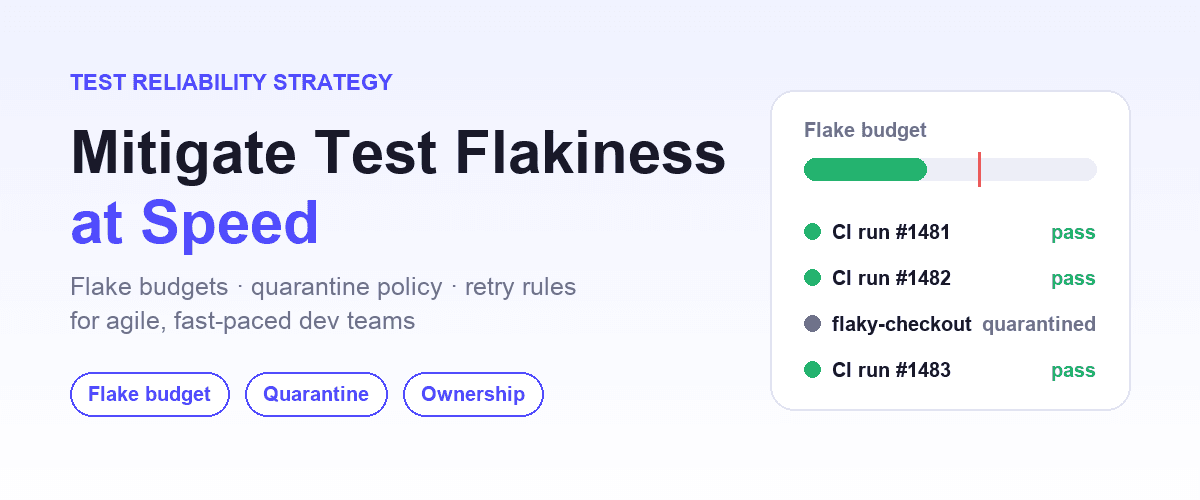
To mitigate test flakiness on a fast-paced team, treat it as a managed system, not a backlog of individual bugs.
Set a flake budget (a hard ceiling on tolerated flake rate), quarantine flaky tests out of the release gate immediately, replace blanket retries with a strict retry policy, assign clear ownership for the quarantine queue, and instrument detection so flake is measured before it erodes trust.
Speed and reliability are not a trade-off; the strategy is what lets you keep both.
Why flakiness hits fast-paced teams harder
Agile and fast-paced teams have a specific problem with flaky tests that slower teams don't feel as sharply: the release gate is on the critical path of every merge.
When you ship multiple times a day, a test that fails 5% of the time is not a minor annoyance; it is a 5% tax on every pull request, multiplied across every engineer, every day.
Worse, it is contagious: the first time the team merges past a "known flaky" failure, the gate stops meaning anything, and now every failure is suspect.
This guide is not about diagnosing why a specific test is flaky. That is covered in depth in how to fix flaky E2E tests: root causes and permanent fixes. This is the strategy layer: the policies, budgets, and workflows that keep a fast-moving team shipping safely while the underlying flakiness is being driven down.
You need both. Fixing tests one at a time without a strategy means new flakiness arrives faster than you clear it.
A flaky test is a test that passes sometimes and fails sometimes on the same code, with no changes: a non-deterministic result. (See the flaky test glossary entry for the precise definition.) On a team that ships weekly, you absorb the cost in occasional reruns. On a team practicing continuous delivery, the math changes:
- The gate is in the critical path. Every flaky failure either blocks a deploy or trains the team to ignore the gate. There is no third option.
- Flake compounds with frequency. A 2% per-test flake rate across a 300-test suite means roughly 1 − 0.98³⁰⁰ ≈ a near-certain spurious failure on every run. Fast teams run the suite far more often, so they hit this wall first.
- Trust is the real asset. The value of a test suite is not coverage; it is that a red build means something. Once a team merges past red builds, you have lost the gate, and the next real regression ships to production unblocked.
- Velocity masks the damage. Fast teams are good at routing around obstacles, so flaky tests get tolerated rather than fixed, until an incident traces back to "that test was flaky, so we ignored it."
The strategic goal is therefore not "zero flaky tests" (unachievable in a living UI) but a managed, measured, bounded flake rate that keeps the release gate trustworthy.
The five strategies
1. Set a flake budget
A flake budget is an explicit, agreed ceiling on the flake rate the team will tolerate before flakiness work preempts feature work: the testing analog of an error budget. (See test flakiness budget.)
Make it concrete and visible:
- Define the metric. Flake rate = (runs that failed then passed on retry with no code change) ÷ (total runs), measured per week.
- Set the ceiling. A common starting point: suite-level flake rate ≤ 1%, no single test above a defined per-test threshold.
- Define the consequence. When the budget is breached, flakiness work moves ahead of feature work until it's back under. This is the part teams skip: a budget with no consequence is a dashboard, not a policy.
The budget converts an unbounded, invisible tax into a bounded, visible one that the whole team owns.
2. Quarantine aggressively, by policy
The single most useful move for a fast team is to get flaky tests out of the release gate immediately (within the same day they're detected) so one flaky test cannot block unrelated deploys.
A workable quarantine policy:
| Rule | Why it matters for fast teams |
|---|---|
| Auto-quarantine on detection (e.g., 2 flips in N runs) | A human triage step is too slow when you deploy hourly |
| Quarantined tests still run, but non-blocking | You keep the signal without gating releases on noise |
| Quarantine has a hard expiry (e.g., 14 days) | Prevents quarantine from becoming a graveyard where coverage silently dies |
| Quarantine queue has a named owner | Unowned queues grow without bound |
The failure mode to avoid: quarantine with no expiry and no owner. That doesn't mitigate flakiness; it hides the loss of coverage. (See quarantining flaky tests for the mechanics.)
3. Replace blanket retries with a strict retry policy
Retries are the most over-used and most misused flakiness tool. A blanket "retry everything 3×" makes the dashboard green while hiding a growing flake problem and tripling worst-case CI time: a direct hit to a fast team's cycle time.
A disciplined retry policy:
- Retry only at the boundary you don't control (e.g., one retry for genuine network/infra flake), never as a blanket suite setting.
- Every retry is a recorded signal, not a silent pass. A test that only passes on retry is already flaky and must count against the flake budget and be eligible for quarantine, even though the build is "green."
- Never retry to hit a deadline. Retrying to make a release is borrowing reliability you have to pay back with interest.
The mental model: retries buy you time to fix or quarantine; they are not the fix. A green build that depended on retries is a yellow build wearing a disguise.
4. Assign ownership
Flakiness is a classic tragedy of the commons: everyone is slowed by it, no one owns it, so it grows. Fast teams need ownership defined before the budget is breached, not after.
Practical models that work:
- Rotating flake warden. One engineer per sprint owns the quarantine queue and the flake budget. Bounded, fair, and keeps knowledge spread across the team.
- Code-owner routing. Auto-assign a newly quarantined test to the owner of the code under test, with the warden as backstop.
- Definition of done includes the gate. A feature is not "done" if it shipped flaky tests into the suite. This stops the inflow at the source.
5. Instrument detection before it erodes trust
You cannot manage what you cannot see. Most teams discover flakiness anecdotally ("ugh, that test again"), which means it has already cost trust by the time anyone acts.
Minimum instrumentation:
- Per-test pass/fail history across runs (not just the latest result).
- Automated flip detection (same commit, different result) feeding the flake-rate metric automatically.
- A visible dashboard of flake rate vs. budget and the current quarantine queue, reviewed in the team's regular cadence.
Detection is what turns the other four strategies from good intentions into a managed system. For the deeper treatment of turning this signal into action without drowning in maintenance, see from flaky tests to actionable signal.
The fast-team flakiness operating model
Putting the five together as a loop the team runs continuously:
- Detect: instrumentation flags a flip automatically.
- Quarantine: the test leaves the release gate the same day, by policy, not by debate.
- Account: the flip counts against the flake budget whether or not retries made the build green.
- Own: the warden or code owner is assigned automatically.
- Fix at the root: using the root-cause playbook, not another retry.
- Review: flake rate vs. budget is a standing agenda item; a breach preempts feature work.
This is the difference between teams that ship fast and safely and teams that ship fast until an ignored red build becomes an incident.
How Shiplight reduces flakiness at the source
The strategies above bound and manage flakiness.
Reducing the inflow is the other half, and the largest single source of inflow on a fast team is locator drift: the UI changes (often many times a day when AI coding agents like Cursor, Claude Code, Copilot, and Codex are generating UI), and tests bound to brittle CSS or DOM selectors break even though the user-visible behavior is fine.
Shiplight attacks this directly:
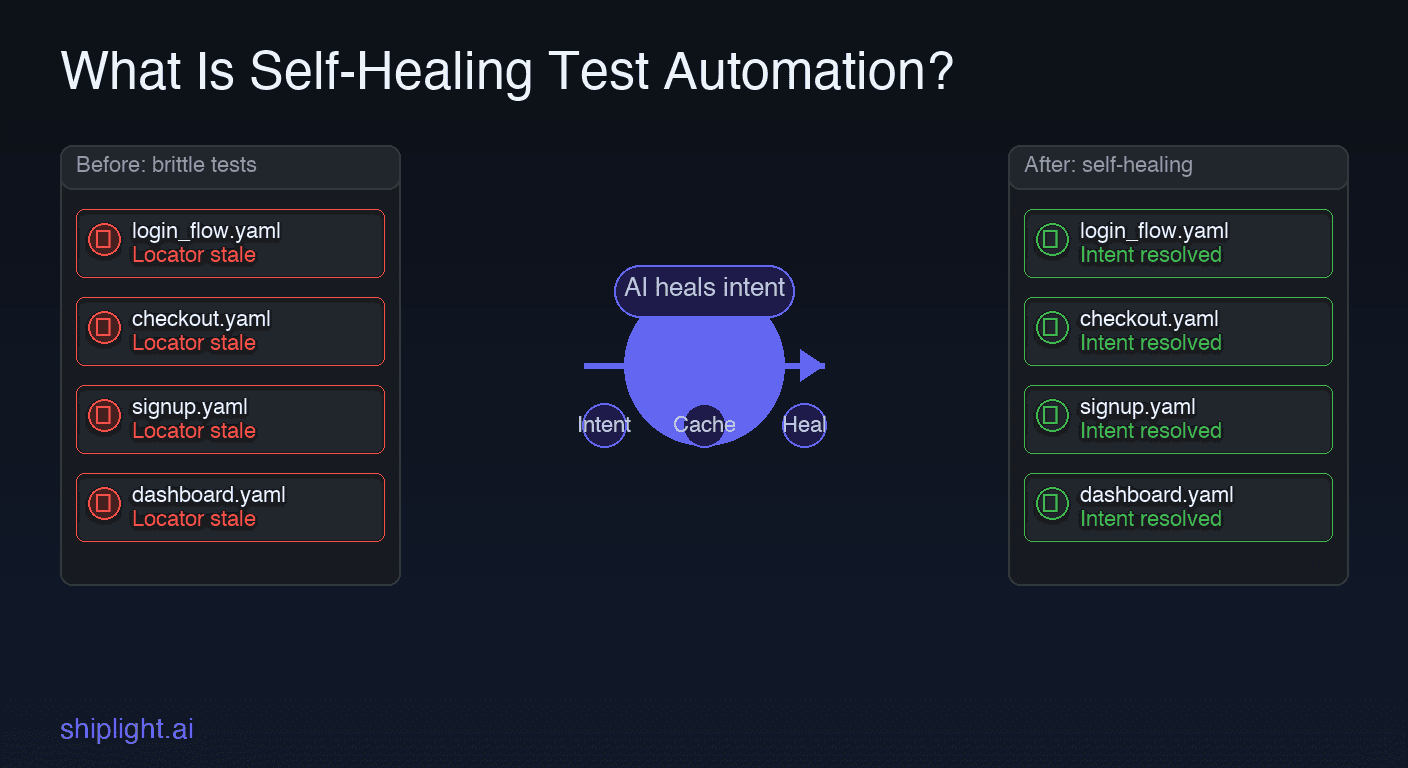
- Intent-based, self-healing tests. Shiplight tests describe what the user is trying to do, not which
divto click. When the UI changes, the test resolves the element semantically instead of failing, eliminating the most common, highest-volume source of flakiness on fast-moving codebases. (See what is self-healing test automation.) - Real-browser verification. Tests run in a real browser, so timing and rendering behavior matches production rather than a mocked approximation that drifts.
- Authored by your coding agent via MCP. Because Shiplight integrates with your AI coding agent through MCP, test coverage is generated and updated alongside the code that changes, closing the "feature shipped, test went stale" gap that feeds the quarantine queue.
The honest framing: Shiplight does not make flake budgets, quarantine policy, or ownership unnecessary; a mature fast team still needs all five strategies. What it does is sharply reduce the dominant inflow (selector/UI drift), so the strategies are managing a small, bounded problem instead of an ever-growing one.
Common mistakes that quietly defeat the strategy
- Quarantine with no expiry or owner. Coverage silently dies; the suite looks green because it stopped testing the thing.
- A flake budget with no consequence. Without "breach preempts features," it's a dashboard nobody acts on.
- Counting retried passes as passes. Hides the true flake rate: the metric must count retried passes as flake.
- Treating flakiness as individuals' bugs, not a system. One-at-a-time fixes lose to inflow on a fast team. The system is the unit of work.
- Optimizing the dashboard, not the signal. Green-via-retries is the most expensive kind of red.
Frequently Asked Questions
How do you mitigate test flakiness on a fast-paced agile team?
Treat flakiness as a managed system, not a list of bugs. Set a flake budget with a real consequence, quarantine flaky tests out of the release gate the same day, replace blanket retries with a strict policy where retried passes count as flake, assign clear ownership, and instrument detection.
The result is a bounded flake rate that keeps the release gate trustworthy without slowing delivery.
What is a flake budget and why do fast teams need one?
A flake budget is an agreed ceiling on the flake rate a team tolerates before flakiness work preempts feature work: the testing analog of an SRE error budget. Fast teams need one because they run the suite far more often, so even a low per-test flake rate produces near-certain spurious failures on every run. See test flakiness budget.
Should fast-paced teams just retry flaky tests to keep shipping?
No, not as a blanket strategy. Blanket retries make the dashboard green while hiding a growing flake problem and tripling worst-case CI time.
A disciplined policy retries only at boundaries you don't control, counts every retried pass against the flake budget, and never retries just to hit a deadline. Retries buy time to fix or quarantine; they are not the fix.
How is mitigating flakiness different from fixing flaky tests?
Fixing flaky tests is the per-test root-cause work: diagnosing whether a failure is timing, selector drift, or shared state, and applying the right fix (see how to fix flaky E2E tests). Mitigating flakiness is the strategy layer that keeps a fast team shipping safely while that fixing happens: budgets, quarantine, retry rules, ownership, and detection. You need both.
Does Shiplight eliminate the need for a flakiness strategy?
No. Shiplight sharply reduces the dominant inflow of flakiness on fast teams (selector and UI drift) through intent-based, self-healing tests authored by your coding agent and verified in a real browser. But a mature fast team still needs flake budgets, quarantine policy, and ownership; Shiplight makes those strategies manage a small, bounded problem instead of an ever-growing one.
Related posts
Guides
How to Fix Flaky E2E Tests: Root Causes and Permanent Fixes
Apr 7, 2026 · 18 min read

Engineering
From Flaky Tests to Actionable Signal
Mar 25, 2026 · 8 min read
Guides
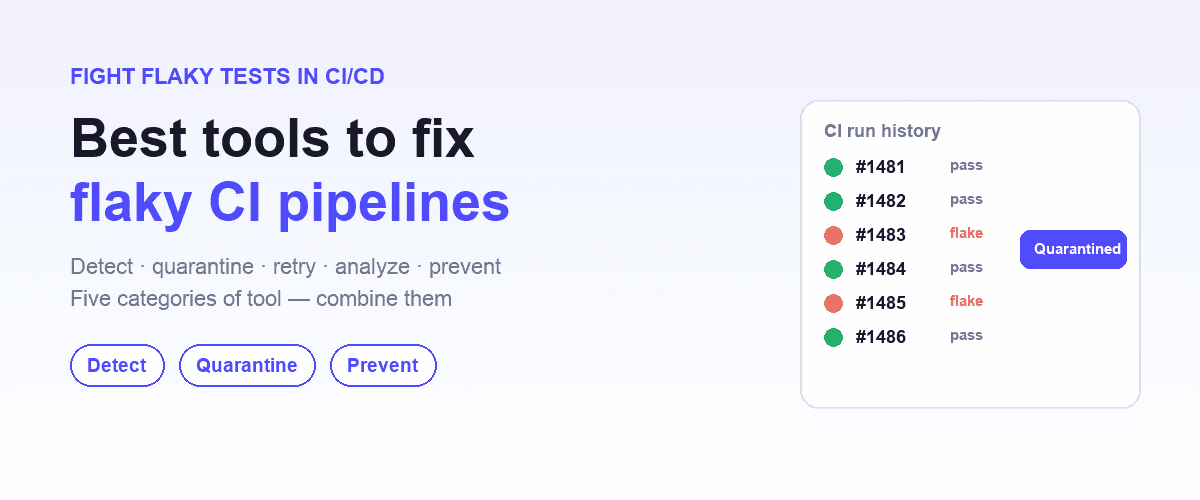
Best Tools to Fight Flaky Tests in CI/CD
May 19, 2026 · 8 min read
Testing Concepts
What Is Self-Healing Test Automation
Apr 1, 2026 · 10 min read
Flaky test
Test flakiness budget
Quarantining flaky tests