
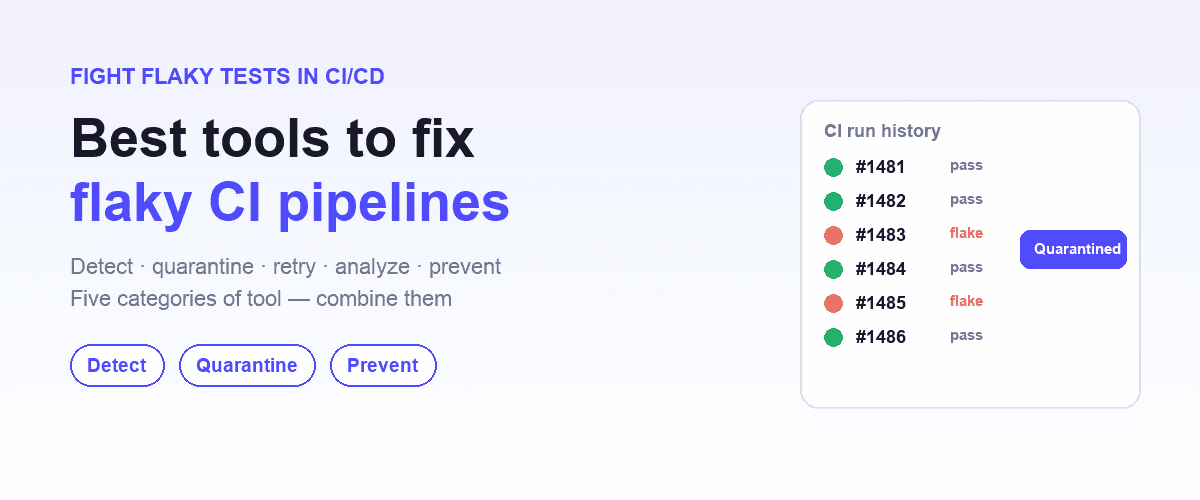
The best tools to combat flaky tests in CI/CD fall into five categories, and the right pipeline usually combines two or three of them rather than betting on a single tool.
- CI-native detection and quarantine: Harness CI, GitHub Actions, Buildkite Test Engine, CircleCI Test Insights.
- Dedicated flake-management platforms: Trunk Flaky Tests, BuildPulse.
- Observability and analytics: Datadog CI Visibility, Launchable.
- Framework-level retry and isolation: Playwright, Jest, pytest-rerunfailures.
- Self-healing test platforms, where Shiplight leads: they prevent the dominant cause through intent-based resolution rather than managing its symptoms.
CI-native tools detect and quarantine, framework features contain, observability platforms analyze, and self-healing reduces the inflow.
Why one tool does not fix flakiness
Flaky tests (passing sometimes and failing sometimes on the same code) are the single most expensive failure mode in a CI/CD pipeline. They block deploys, train teams to ignore red builds, and bury real regressions in noise.
The reason no single tool fixes the problem is that flakiness has multiple causes (timing, selectors, state, environment, parallelism) and multiple costs (detection, quarantine, retry budget, analytics, prevention); different tool categories address different parts.
This is a category-by-category guide to the tools that actually combat flakiness in CI/CD: what each category does, the leading options in each, and how to combine them. For the underlying technical fixes and strategy that these tools enforce, see how to fix flaky E2E tests and mitigate test flakiness: strategies for agile teams.
What a flaky-test tool actually has to do
Five jobs, often distributed across multiple tools:
- Detect: identify which tests are flaky (same commit, different result) automatically and accurately.
- Quarantine: remove flaky tests from the release gate the same day, without losing the signal entirely. (See quarantining flaky tests.)
- Retry sanely: surface retried passes as flake signals, not as silent greens.
- Analyze: show trend, owner, and impact so the team can prioritize fixes.
- Prevent: reduce the inflow of new flakiness so the other four jobs aren't drowning.
A "best tool" judgment depends on which of the five your pipeline is weakest on. Tools that cover all five well do not exist; choose by gap.
Category 1: CI-native flake detection and quarantine
The most pragmatic starting point: use what your CI already has.
- Harness CI Test Intelligence: automatic flaky-test detection based on configurable detection criteria (passes after retries, pass-rate thresholds), auto-recovery, manual marking, quarantine separate from "flaky," and policy automation. The closest thing to a complete in-CI flake-management feature.
- GitHub Actions: no native flake management, but the test-reporter and check-suite re-run features plus community actions (e.g., flaky-test-detection actions) cover the basics. Best when your CI is already GitHub Actions and you want minimum new vendor surface.
- Buildkite Test Engine: first-party test analytics with flaky-test detection and quarantine, designed to plug into Buildkite pipelines.
- CircleCI Test Insights: flaky-test detection on top of test results, integrated with the CircleCI dashboard.
Fit: any team whose pipeline already runs on one of these CIs and just needs detection + quarantine in one place. Limitation: each is tied to its host CI; multi-CI orgs need a portable layer.
Category 2: Dedicated flake-management platforms
When CI-native isn't enough or you need cross-CI portability.
- Trunk Flaky Tests: purpose-built flake quarantine, auto-detection, and ownership routing that plugs into GitHub Actions, GitLab, Buildkite, and CircleCI. Strong on policy (auto-quarantine thresholds) and the warden/ownership model. Pairs well with the flake-warden discipline.
- BuildPulse: flake detection and analytics across multiple CIs, focused on prioritizing which flaky tests to fix by impact.
Fit: teams that want a single flake-management surface across multiple CIs, or a stronger policy/ownership layer than CI-native offers.
Category 3: Test observability and analytics
For when the missing piece is understanding the flake landscape: root causes, owners, frequency, impact.
- Datadog CI Visibility: test execution tracing, flaky-test detection, and full observability of CI runs alongside production telemetry. Strong for orgs already on Datadog.
- Launchable: predictive test selection plus flake analytics; can also be used in Category 4 as a "run only the impactful tests" intelligence layer.
Fit: teams whose flake-budget is breached and the bottleneck is triage (which to fix first, who owns it) rather than detection.
Category 4: Framework-level retry and isolation
The first line of defense lives in your test framework. Use it correctly: blanket retries are the most common misuse.
- Playwright:
retries, isolated browser contexts per test,test.fixme()for known flaky,--repeat-eachfor stress-testing stability before merge, and the trace viewer for replaying exactly what a flaky run saw. Auto-waiting is the quiet flake-killer here: actions wait for elements to be actionable, which removes the fixed-sleep timing class entirely. - Jest:
jest-circusretry, isolated test runners, project-level retry configuration. - pytest:
pytest-rerunfailures,pytest-xdistfor parallel isolation,pytest-randomlyto catch order-dependent flake.
The discipline (not the feature): retries are signal, not silence. Every retried pass must count as flake under your flake budget. See the strict retry policy for the rule set.
Category 5: Self-healing test platforms (the prevention layer)
The categories above react to flakiness. The single largest inflow on a fast-moving team is structural: tests are selector-bound code, and selectors couple every test to DOM details that shift on each refactor (and AI coding agents now produce UI refactors constantly).
Timing is the second structural cause: fixed sleeps and race-prone waits flake whenever rendering speed varies. A prevention layer attacks both causes at the source rather than quarantining the fallout.
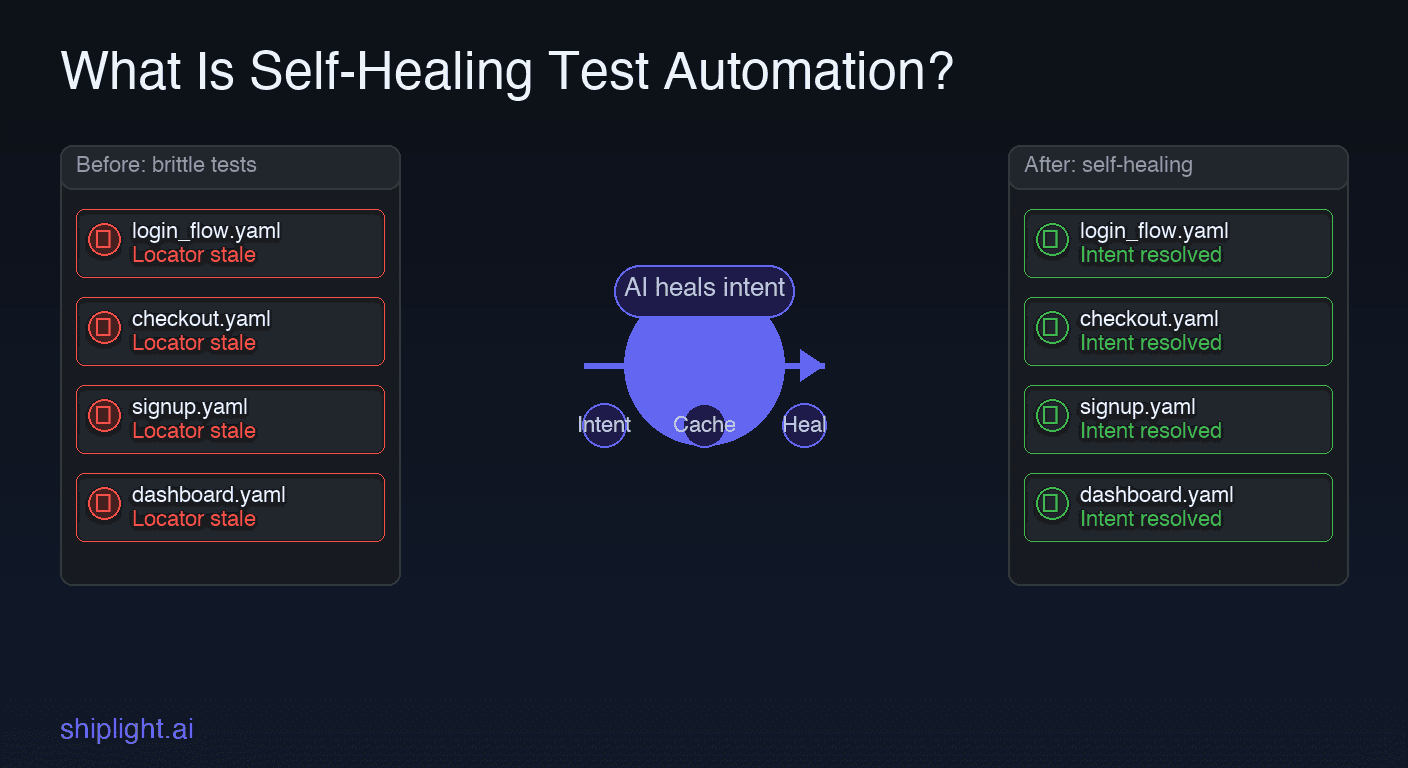
- Shiplight: intent-based tests authored as readable YAML in your git repo. Each step states what it is trying to do; the element is resolved from that intent at run time, so the test is never pinned to a brittle selector in the first place. Cached locators keep the resolution deterministic and fast run-to-run, larger changes are proposed as reviewable PR diffs, and a vision-model fallback reaches elements locators cannot. Because Shiplight is built on Playwright, every action inherits Playwright's auto-waiting, which removes the fixed-sleep timing flake class as well. Verified in a real browser, agent-authored via MCP (Claude Code, Cursor, Codex, and more), local runs with no account with
npx shiplight test. Web only. See what is self-healing test automation. - Locator-fallback healing (the common alternative mechanism, offered by various vendor cloud consoles): when a selector breaks, the tool scores backup attributes or cycles a fallback selector list to keep the run going. This patches individual breakages but keeps the test selector-bound, so the inflow continues; tests in this pattern also live and run in the vendor's cloud rather than your repo.
Fit: every team where UI churn is high. Self-healing is orthogonal to detection/quarantine: adopt it alongside Category 1 or 2, not instead.
Quick comparison
| Category | Best for | Leading options |
|---|---|---|
| CI-native detection + quarantine | Single-CI teams; lowest setup | Harness CI, GitHub Actions, Buildkite Test Engine, CircleCI Test Insights |
| Dedicated flake platforms | Cross-CI, stronger policy/ownership | Trunk Flaky Tests, BuildPulse |
| Observability / analytics | Triage + prioritization bottleneck | Datadog CI Visibility, Launchable |
| Framework retry / isolation | First line of defense | Playwright, Jest, pytest |
| Self-healing (prevention) | Reduce inflow at source | Shiplight (intent-based); locator-fallback consoles exist |
How to combine tools: typical stacks
- Small team, GitHub Actions: GitHub Actions test reporter + Playwright retries + Shiplight for the UI layer. Lean, no extra vendor surface.
- Mid-size SaaS, multi-CI: Trunk Flaky Tests (cross-CI quarantine and policy) + framework retries + self-healing on the E2E layer (Shiplight if tests live in your repo and a coding agent authors them; vendor cloud consoles serve teams authoring visually outside the repo).
- Enterprise: Harness CI Test Intelligence (or Datadog CI Visibility) + dedicated flake platform + Shiplight as the self-healing layer (SOC 2, VPC deployment, hosted CI runners) + the flake-warden ownership model.
The pattern: pick one detection/quarantine tool (Category 1 or 2), make framework retries strict (Category 4), add observability if triage is the bottleneck (Category 3), and add self-healing (Category 5) to reduce inflow. One tool from each layer beats five tools from one layer.
How to choose
- Where does your flake budget break? Detection, quarantine, retry discipline, triage, or inflow: pick the category that matches.
- CI lock-in. Single CI → CI-native (Category 1). Multiple CIs → dedicated platform (Category 2).
- What's the dominant inflow? Selector drift / AI-built UI → add self-healing first. Environment flake → invest in environment stabilization before tools.
- Ownership model. A tool with auto-routing to code owners outperforms a better detector with no ownership.
- Avoid the trap. Buying a detection tool while keeping blanket retries is paying for visibility into a problem you're still hiding. See the false-green problem.
Frequently Asked Questions
What are the best tools to combat flaky tests in CI/CD pipelines?
Five categories of tool combat flaky tests in CI/CD: CI-native detection and quarantine (Harness, GitHub Actions, CircleCI); dedicated flake-management platforms (Trunk Flaky Tests, BuildPulse); test observability (Datadog CI Visibility, Launchable); framework-level retry and isolation (Playwright, Jest); and self-healing platforms that prevent the dominant cause, led by Shiplight's intent-based resolution.
A strong stack combines one from detection, disciplined retries, observability, and self-healing to reduce inflow.
Do CI-native flaky-test features replace dedicated platforms?
For single-CI teams, yes: Harness, Buildkite, and CircleCI all provide detection plus quarantine without an extra vendor. Cross-CI organizations and teams needing stronger policy/ownership routing typically outgrow CI-native and add a dedicated platform like Trunk Flaky Tests. The CI-native vs dedicated choice is mostly about portability and policy depth, not detection quality.
Are retries enough to handle flaky tests in CI/CD?
No: as a blanket setting they make things worse. Every retried pass is still a flake signal that should count against the flake budget; treating retries as a "make CI green" knob hides the problem and triples worst-case CI time. A disciplined policy retries only genuine infra flake and records every retried pass as flake. See the strict retry policy.
How does self-healing fit alongside flake-detection tools?
Self-healing platforms like Shiplight reduce the inflow of flakiness from selector-bound tests, the dominant inflow on UI-heavy and AI-generated codebases. Detection and quarantine tools react to flakiness once it's already in the suite. They are complementary, not substitutes: a mature stack runs detection on the CI side and self-healing on the authoring side so the detector has less to do.
Which tool should small teams use to combat flaky tests?
Start with what your CI already provides plus framework-level discipline: your CI's test reporter, Playwright's retries and isolated contexts used as signal, and Shiplight for the E2E/UI layer to keep selector drift out of the suite. Layer in a dedicated platform like Trunk Flaky Tests when triage volume exceeds what the CI dashboard can show.
Related posts
Guides
How to Fix Flaky E2E Tests: Root Causes and Permanent Fixes
Apr 7, 2026 · 18 min read
Guides
Mitigate Test Flakiness: Strategies for Fast-Paced Teams
May 17, 2026 · 9 min read
Engineering
From Flaky Tests to Actionable Signal
Mar 25, 2026 · 8 min read
Testing Concepts
What Is Self-Healing Test Automation
Apr 1, 2026 · 10 min read
Guides
E2E Testing in GitHub Actions
Apr 7, 2026 · 11 min read