

Shiplight and Katalon solve web test automation from opposite design centers, and four differences decide most evaluations. Shiplight runs in CI with no separate execution license, where Katalon gates headless and CI runs behind its separately licensed, paid Runtime Engine.
The four differences that decide it
Shiplight tests are readable YAML your own coding agents author, where Katalon authoring happens in Katalon Studio, a heavyweight desktop IDE built for QA engineers writing Groovy. Shiplight tests are portable YAML that lives in your git repo, where a Katalon project is a proprietary format only Katalon runtimes execute, with no documented export path.
And Shiplight is built on Playwright, modern and cloud-native, where Katalon is Selenium-heritage desktop tooling from the pre-agent generation.
We build Shiplight, so we have a perspective. This comparison leads with where Shiplight is built differently, then describes Katalon by its design center: the incumbent all-in-one suite from the pre-agent IDE generation.
Quick Comparison
The table axes are the four differences that decide most evaluations, plus how each heals and where it runs.
| Axis | Shiplight | Katalon |
|---|---|---|
| CI / headless execution | Included: run in your CI with no separate execution license | Requires the separately licensed, paid Runtime Engine on top of per-seat tiers |
| Who authors, and how | Your coding agents (Claude Code, Cursor, Codex) write readable YAML via MCP + Skills | QA engineers author in Katalon Studio, a desktop IDE (recorder + Groovy/Java) |
| Test format and ownership | Portable YAML in your git repo: diffable, PR-reviewable, yours | Proprietary Katalon project, only Katalon runtimes execute it, no documented export |
| Engine | Built on Playwright: transpiles to Playwright, every Playwright browser | Selenium-heritage desktop tooling from the pre-agent generation |
| Self-healing | Intent-based; heals surface as reviewable PR diffs | Two-stage: fallback locators, then LLM matching, inside its runtime |
| Local runs | No account or token; authoring is free, execution uses your LLM key or ours | Authoring free; execution licensed via the Runtime Engine |
Where Shiplight Is Built Differently
CI Execution Is Included, Not a Paid Add-On
Running Shiplight in CI needs no separate execution license. The CLI runs anywhere Node.js runs, so the same tests you write locally gate every pull request without a runtime purchase.
Katalon moves the money gate to execution: authoring in Katalon Studio is free, but running suites headless or in CI requires the separately licensed, paid Runtime Engine on top of per-seat platform tiers.
The cost scales with how much you run, and CI, the place most teams run tests most often, is where that license applies.
Your Coding Agents Author Readable YAML
Shiplight tests are natural-language user intent in plain YAML. Your coding agents, the ones your team already uses, read and write that YAML directly:
name: Create new project
statements:
 - intent: Log in as a test user
 - intent: Click the "New Project" button
 - intent: Fill in "Project Name" with "My Test Project"
 - intent: Click "Save"
 - VERIFY: "My Test Project" appears on the projects page
Shiplight installs into Claude Code, Cursor, Codex, VS Code, and more as an MCP server plus Skills, and the local MCP needs no account or token. When a developer builds a feature, the agent that wrote the code authors the test, runs it, and fixes failures in the same session.
Katalon authoring happens in Katalon Studio, a heavyweight desktop IDE built for QA engineers writing Groovy, where reviewers report crashes, lag, and heavy memory use.
Its 2026 agent and MCP layer drives that platform rather than putting authorship in the coding agents your team already runs: agent-integrated, not agent-native.
Portable YAML in Your Repo, Not a Proprietary Project
Shiplight tests are YAML files committed alongside your application code. They go through the same pull request review, the same branching strategy, and the same CI pipeline as everything else, and they are portable text you own.
A Katalon project is git-storable, but it is Groovy or Java plus recorded objects in Katalon's own proprietary structure, and only Katalon runtimes execute it.
There is no documented export path, so the tests are not portable code and leaving means re-authoring against another runner.
Built on Playwright, Modern and Cloud-Native
Shiplight is built on Playwright: each run transpiles the YAML into Playwright tests at run time, which is why it supports every Playwright browser and feature without you writing or maintaining any Playwright yourself. That is a modern, cloud-native execution layer.
Katalon is Selenium-heritage desktop tooling from the pre-agent IDE generation, authored in a studio and executed through its own runtime.
Intent-Based Healing as PR Diffs
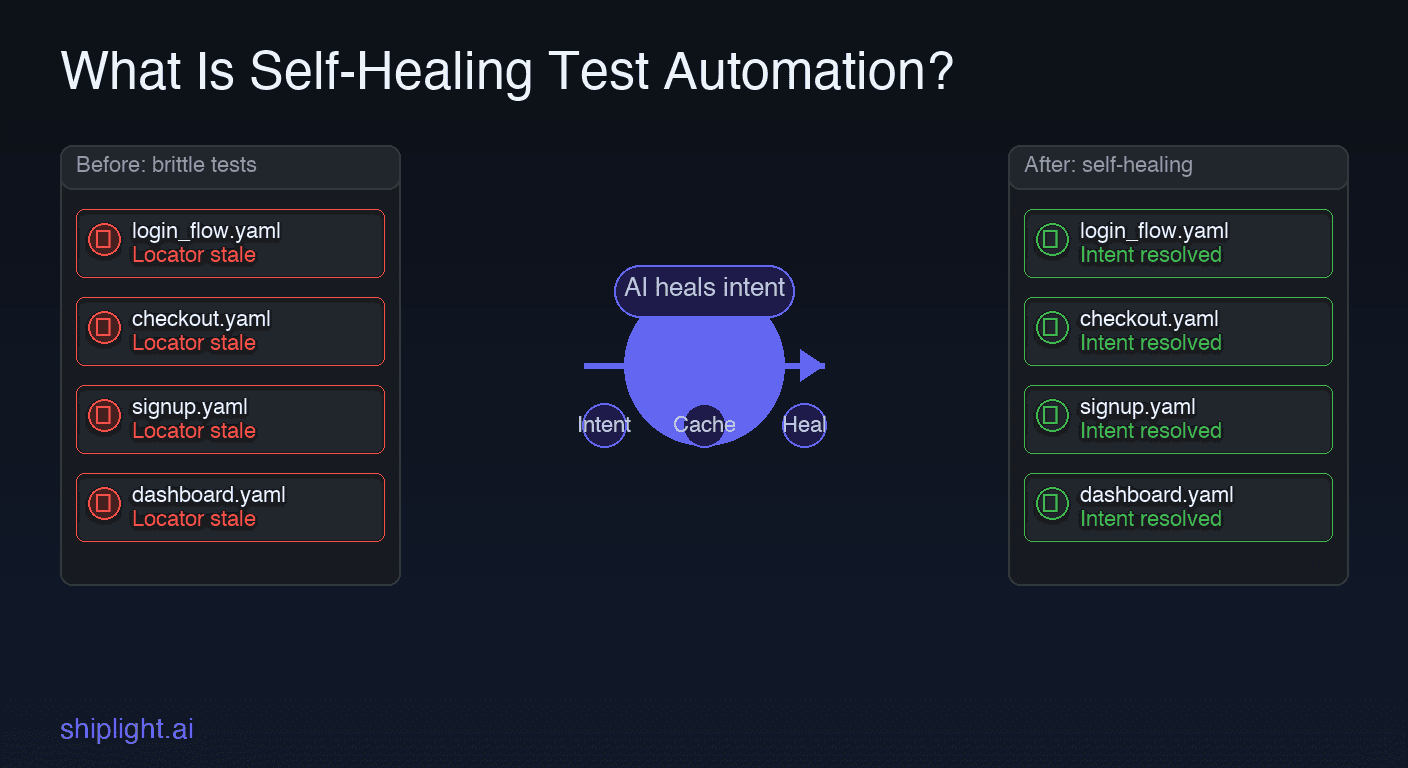
Shiplight self-healing works through the intent-cache-heal pattern. Each step describes what the user wants to do, not how to find a DOM element. Shiplight resolves intents to locators through set-of-marks visual prompting, commits the cached locators to your repo, and heals them online at run time.
Larger changes arrive as reviewable PR diffs from the triage agent, and because the original intent is preserved, heals regenerate steps from that intent rather than patching selectors blindly.
Katalon's self-healing is two-stage, fallback locators first, then an LLM pass, inside its own runtime, so the fix is not a diff you review in your workflow.
Where Katalon's Design Center Is
Katalon was built for breadth. From a single platform, a mixed-skill QA organization can automate web, mobile, API, and desktop tests, with manual testers on the recorder and engineers in Groovy. Shiplight is web only; it does not serve mobile or desktop surfaces.
If you need one suite that covers every test surface and is authored in a vendor studio by testers of varying technical skill, that is Katalon's design center.
The trade is the studio authoring model, the proprietary project format, and execution through the licensed Runtime Engine.
The genuine, scoped strength: a Katalon project is real Groovy or Java underneath, git-storable, so the authoring ceiling is a language rather than a recorder. The cost of that ceiling is per-seat plus per-runtime licensing on execution.
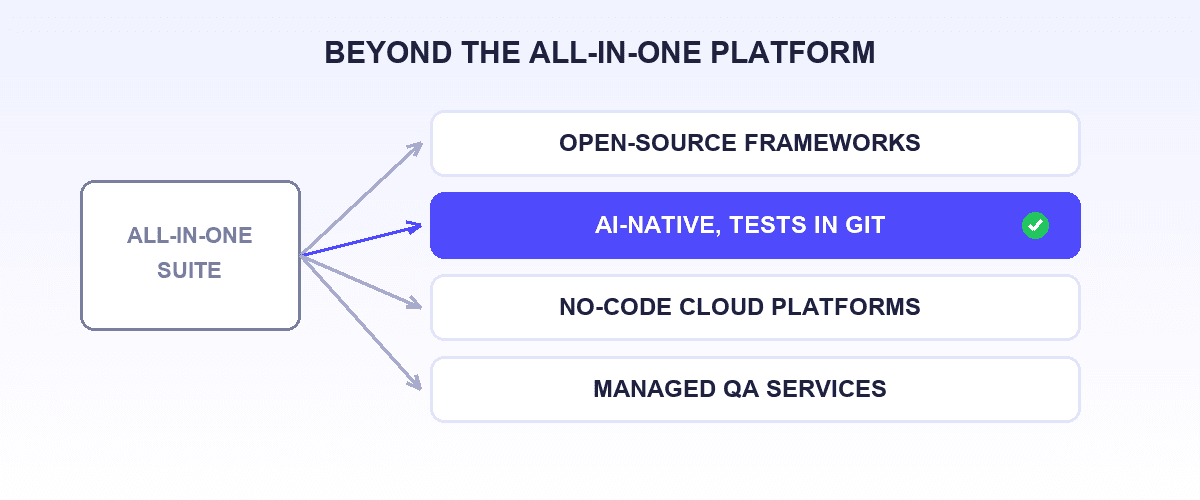
Teams weighing the field rather than this one comparison usually start from our roundup of Katalon alternatives, which sorts the options by who authors the tests and where they live.
When to Choose Shiplight
Choose Shiplight if your team:
- Wants CI runs without a separate execution license
- Uses AI coding agents (Claude Code, Cursor, Codex) that should author and maintain tests in your repo
- Wants portable YAML tests owned like code, reviewed in PRs
- Prefers self-healing that surfaces as reviewable diffs and survives UI redesigns
- Focuses on web application testing rather than mobile or desktop
Making the Decision
The choice comes down to design center. If you need one suite across every test surface, authored in a vendor studio by testers of varying skill and executed through a licensed runtime, that is Katalon.
If your team ships with AI coding agents and wants CI-ready, portable YAML tests in the repo, built on Playwright, Shiplight is built for that workflow.
One honest carve-out: if your existing Playwright suite genuinely works and is not a maintenance bottleneck, keep it. Shiplight is built on Playwright and runs alongside existing suites, so the natural entry point is the new and hard tests.
You can explore Shiplight's approach with a live demo or read our broader comparison of the best AI testing tools in 2026. For teams evaluating no-code options more broadly, our guide to Playwright alternatives for no-code testing covers the wider landscape.
Frequently Asked Questions
Does Katalon charge extra to run tests in CI?
Authoring in Katalon Studio is free, but running suites headless or in CI requires the separately licensed, paid Runtime Engine on top of per-seat tiers. Shiplight runs in your CI with no separate execution license, so the same tests you write locally gate every pull request without a runtime purchase.
Can Katalon tests be exported or run outside Katalon?
No documented export path exists. A Katalon project is git-storable but a proprietary Groovy/Java format only Katalon runtimes execute, so leaving means re-authoring. Shiplight tests are portable YAML in your git repo that run anywhere Node.js runs.
Who authors tests in each tool?
Katalon authoring happens in Katalon Studio, a desktop IDE built for QA engineers writing Groovy, with a recorder for non-technical users. Shiplight tests are readable YAML your own coding agents (Claude Code, Cursor, Codex) author directly via MCP and Skills, in the same session they write the feature.
Which has better self-healing?
Both reduce maintenance from UI changes. Katalon's is two-stage, fallback locators then LLM matching, inside its runtime. Shiplight heals via intent and cached locators and surfaces each heal as a reviewable diff in your workflow, so you approve the fix rather than trust an opaque runtime patch.
Does Shiplight test mobile or desktop apps like Katalon?
No. Shiplight is web only and built on Playwright; it does not serve mobile or desktop testing. Katalon covers those surfaces as part of its all-in-one suite, which is its genuine strength for mixed-skill QA organizations.
Can I use both Shiplight and Katalon?
Technically yes, but most teams choose one primary tool to avoid maintaining two ecosystems. The decision usually comes down to all-in-one suite breadth authored in a studio (Katalon) versus CI-ready, agent-native web testing in your repo (Shiplight).
References
Related posts
Guides
Best Katalon alternatives compared
Jul 12, 2026 · 14 min read
Guides
Best AI testing tools in 2026
Mar 31, 2026 · 22 min read

Guides
Playwright alternatives for no-code testing
Apr 1, 2026 · 9 min read
Testing Concepts
What is self-healing test automation
Apr 1, 2026 · 10 min read
Guides
Shiplight vs Mabl
Apr 1, 2026 · 7 min read