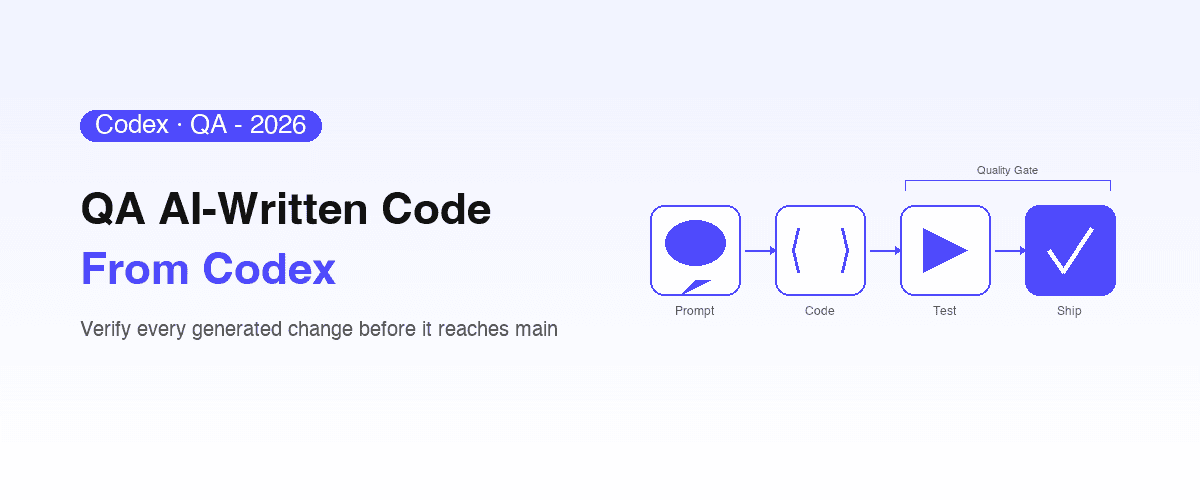
OpenAI Codex is an autonomous coding agent that can take a task, implement it across your codebase, and produce a pull request, without a developer writing a line of code. For engineering teams, that is a significant acceleration. For QA teams, it raises an immediate question: who verifies what Codex wrote?
The honest answer for most teams: nobody, systematically. Codex generates code faster than any human can review it end-to-end. Manual verification does not scale. And most teams have not yet built the automated QA layer that would catch what Codex misses.
This article covers how to build that layer: a testing workflow that keeps pace with Codex's output, catches regressions before they reach production, and does not create a new maintenance burden every time Codex refactors something.
The Quality Challenge with AI-Generated Code
AI coding agents like Codex are optimized for producing syntactically correct, functionally reasonable code based on the task specification. They are not optimized for:
- Edge cases not mentioned in the prompt: Codex implements what you asked for, not everything that could go wrong
- Cross-browser compatibility: generated CSS and JavaScript may behave differently across browser engines
- Interaction with existing code: Codex changes may introduce unexpected behavior in adjacent features it did not directly modify
- Real-world user flows: a feature that works in isolation may fail when combined with authentication, real data, or specific browser states
Research consistently shows that AI-generated code introduces bugs at higher rates when the verification loop is truncated. The issue is not that Codex writes bad code; it is that the review step cannot keep pace with the generation step without tooling support.
What a Codex QA Workflow Needs
An effective QA workflow for Codex-generated code has three components:
- Live browser verification: test the actual running application, not just the code in isolation
- Regression coverage: ensure Codex's changes did not break existing functionality
- Automatic test generation: capture verifications as persistent tests without manual test authoring
Each component addresses a specific failure mode. Browser verification catches integration bugs that unit tests miss. Regression coverage catches unintended side effects. Automatic test generation ensures the coverage grows with the codebase without creating a maintenance backlog.
Browser Verification for Codex Output
The most direct way to verify Codex output is to run the application and interact with the new feature the way a user would.
Shiplight's browser MCP server enables this for any MCP-compatible agent. After Codex implements a feature, an AI agent with MCP access can:
- Open the application in a real browser
- Navigate to the new feature
- Execute the user journey end-to-end
- Assert that the expected outcomes are present
- Capture screenshots as verification evidence
This happens within the same development loop: no context switch to a separate testing environment. The verification step becomes part of how the feature gets built, not a separate phase after it.
For teams using Codex alongside other agents (Claude Code, Cursor, or custom orchestration), the Shiplight MCP server integrates with any tool that supports the Model Context Protocol.
Generating Self-Healing Tests from Codex Verifications
One-time browser verification catches bugs at the point of implementation. Persistent regression tests catch bugs that future changes introduce.
Shiplight converts browser verifications into YAML test files that live in your repository and run automatically in CI. Each test step is expressed as a user intent rather than a DOM locator:
goal: Verify task creation flow works end-to-end
base_url: https://app.example.com
statements:
  - URL: /dashboard
  - intent: Click "New Task" to open the task creation dialog
  - intent: Enter a task title and assign it to a team member
  - intent: Click "Create Task"
  - VERIFY: New task appears in the dashboard task list
This format is critical for Codex workflows specifically. Codex frequently refactors component structure, renames classes, and reorganizes DOM hierarchies as part of implementation. Tests written against specific CSS selectors break constantly. Tests written against user intent (what the user is doing, not how the DOM is currently structured) survive refactors because the intent does not change when the implementation does.
This is the intent-cache-heal pattern: intent as the source of truth, cached locators for speed, AI resolution when the cache is stale. It is the only testing approach that keeps pace with agents that change your UI frequently.
Setting Up CI Gates for Codex Pull Requests
The final step is making the test suite a blocking check on every Codex pull request. Without a CI gate, tests are advisory. With one, Codex cannot merge code that breaks an existing user flow.
Shiplight integrates with GitHub Actions for automatic test execution on pull requests:
name: E2E Regression Tests
on:
  pull_request:
    branches: [main, staging]

jobs:
  e2e:
    runs-on: ubuntu-latest
    steps:
      - uses: actions/checkout@v4
      - name: Run E2E suite
        uses: shiplight-ai/github-action@v1
        with:
          api-token: ${{ secrets.SHIPLIGHT_TOKEN }}
          suite-id: ${{ vars.SUITE_ID }}
          fail-on-failure: true
When a Codex PR breaks a test, GitHub flags the PR as failed. The agent receives the failure output and can diagnose and fix the issue before the PR reaches human review.
This closes the Codex quality loop: the agent implements, verifies, generates tests, and responds to CI failures, all without waiting for a human to click through the feature manually.
Handling High-Velocity Codex Output
Teams using Codex for autonomous development often have multiple PRs open simultaneously. A QA workflow for this environment needs to handle:
Parallel test runs: multiple PRs running tests concurrently without blocking each other. Shiplight Cloud handles parallel execution without additional configuration.
Test suite growth: as Codex adds features, the test suite grows. YAML templates allow common sequences (login, navigation, data setup) to be defined once and reused across tests, preventing the suite from becoming thousands of one-off scripts.
Failure triage: when multiple PRs fail tests, engineering teams need to understand which failures are real regressions vs. expected changes. Shiplight's AI Test Summary analyzes failure output and provides root-cause context, reducing the time from "something failed" to "we know why and who owns it."
Codex Testing: What to Automate vs. What to Review Manually
| Automate with Shiplight | Review manually |
|---|---|
| Critical user journeys (signup, login, checkout, key settings) | Visual design quality |
| Regression across existing features | Business logic correctness for new requirements |
| Cross-browser behavior | Security-sensitive flows |
| CI gate on Codex PRs | Accessibility audits |
| Evidence capture (screenshots, step logs) | Final production approval |
The goal is not to eliminate human judgment; it is to ensure that by the time a Codex PR reaches human review, you know it does not break anything that was already working. That frees reviewers to focus on whether the implementation is correct for the requirement, not on whether it accidentally broke the login flow.
Related: Cursor testing guide · Gemini CLI testing
Frequently Asked Questions
What is OpenAI Codex and how does it differ from ChatGPT?
OpenAI Codex is an autonomous coding agent designed to implement software tasks end-to-end: reading your codebase, writing code, running tests, and opening pull requests. ChatGPT generates conversational responses. Codex is optimized for code generation and repository-level task execution.
Can Codex write its own tests?
Codex can write unit tests and sometimes integration tests as part of its implementation. For end-to-end browser tests that verify real user journeys, Codex needs browser access via an MCP server and a test format that survives frequent UI changes. Shiplight provides both.
How do self-healing tests work with Codex's frequent refactors?
Self-healing tests use AI to resolve user intent against the current page state when a cached locator fails. If Codex restructures a component, the test finds the correct element by matching its semantic description rather than a specific CSS selector. See What Is Self-Healing Test Automation for the full explanation.
Does this work with Codex's GitHub integration?
Yes. Codex submits pull requests to GitHub. Shiplight's GitHub Actions integration runs tests automatically on those pull requests and reports pass/fail status as a PR check, the same as any other CI workflow.
How do I handle tests for features that change frequently during Codex development?
Write tests at the user journey level, not the implementation level. If a test describes "user can create a project and invite a collaborator," it will stay valid through UI changes. If it describes "click the element with id='project-create-btn'", it will break every time Codex refactors the component.
References
OpenAI Codex documentation, Playwright Documentation, GitHub Actions documentation