
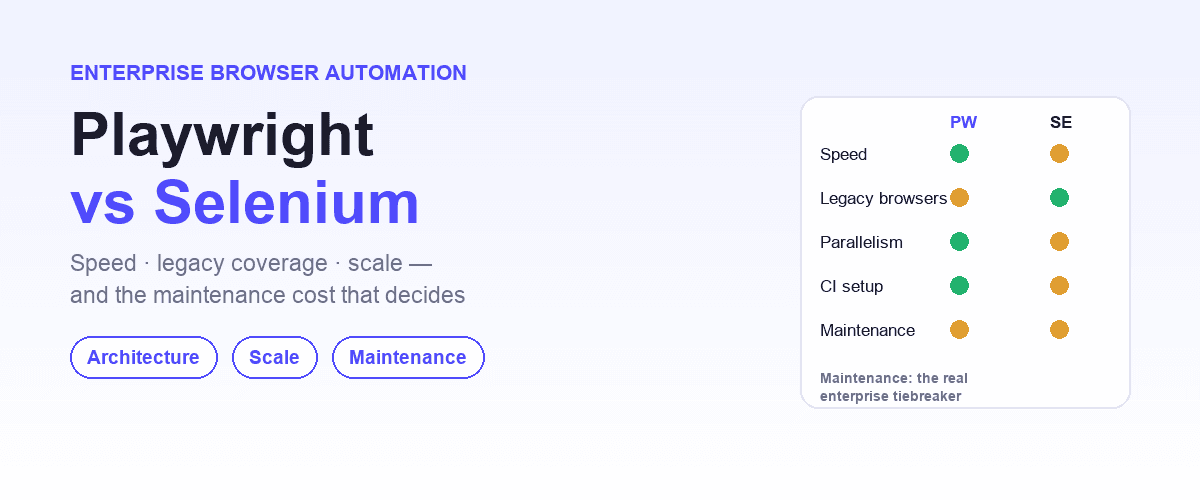
For enterprise-grade browser automation, Playwright generally offers faster, more reliable end-to-end execution, modern browser coverage, built-in parallelism, and simpler CI setup, while Selenium offers broader legacy-browser support and a decades-deep ecosystem that large organizations have already invested in.
For a new initiative on modern web apps, most enterprises should start with Playwright and keep a separate path for any legacy-browser-targeted tests. But the cost that actually dominates at enterprise scale is neither tool's runtime: it's selector maintenance, which both share.
Shiplight addresses that third axis with intent-based, self-healing tests that run on a real browser without selector binding.
What "enterprise-grade" changes
"Enterprise-grade" changes the Playwright vs Selenium question. At small scale the decision is about authoring ergonomics. At enterprise scale (thousands of tests, many teams, regulated environments, multi-year maintenance) the decision is about total cost of ownership, governance, and how the suite degrades over time.
This guide covers the standard technical comparison (because it still matters) and then the enterprise dimensions and the maintenance axis that usually decides.
Quick verdict
| Situation | Better choice |
|---|---|
| New automation program, modern web/SPA | Playwright |
| Must test IE11 / legacy or niche browsers | Selenium |
| Large existing Selenium Grid + codebase investment | Selenium (migrate selectively) |
| Fast CI feedback, minimal infra | Playwright |
| Dominant pain is selector maintenance at scale | Neither alone: add intent-based/self-healing |
Architecture and speed
Playwright uses modern browser-automation protocols over a single persistent connection, driving the browser in-process. This yields faster, more stable execution and less flakiness in dynamic, client-rendered UIs: enterprises commonly report noticeably quicker runs and fewer timing issues.
Selenium uses the W3C WebDriver protocol with an HTTP-based driver stack. The extra hop adds overhead and more timing sensitivity in heavy client-side apps. It is a mature, standardized protocol: its strength is interoperability, not raw speed.
For SPAs and modern enterprise apps with heavy dynamic rendering, Playwright's architecture is the meaningful advantage.
Browser coverage
- Playwright: Chromium, WebKit, Firefox, with strong support for the latest browser features and mobile emulation. It does not support IE11 or very legacy browsers: a real constraint for enterprises with strict legacy targets.
- Selenium: the broadest coverage via WebDriver bindings and drivers, including older and less common browsers. If a legacy-browser matrix is a hard requirement (still common in finance, government, healthcare), this is Selenium's decisive advantage.
This is the single dimension where many enterprises must keep Selenium regardless of everything else below.
Parallelism and scalability
- Playwright: built-in parallelism via browser contexts and workers: scale tests in CI without standing up a separate grid. Lower infrastructure complexity for large suites.
- Selenium: scales via Selenium Grid or third-party runners (e.g., cloud providers). Effective and battle-tested at large enterprises, but the Grid is infrastructure you operate and maintain.
If you have an existing, well-run Selenium Grid, that investment has value. If you are building fresh, Playwright's built-in parallelism removes a whole operational layer.
CI/CD and setup
- Playwright: one-command setup, automatic browser-binary downloads, official Docker images with browsers included: streamlined CI with low maintenance overhead.
- Selenium: managing language bindings, browser drivers, and possibly Grid orchestration: more configuration, but consistent with teams already invested in the Selenium ecosystem and its tooling.
Reliability and waits
- Playwright: auto-waiting and resilient selectors reduce the most common flakiness causes (acting before an element is ready). Lower maintenance on dynamic content.
- Selenium: relies on explicit/implicit waits; without careful synchronization it is more prone to timing flakiness: a recurring enterprise maintenance tax in large suites.
Auto-wait is one of Playwright's strongest practical advantages for enterprise suites with dynamic UIs. It reduces but does not eliminate flakiness: selector brittleness remains (see the maintenance section).
API, language, and ecosystem
- Playwright: modern, consistent API across browsers; fast authoring for teams starting fresh or migrating from Puppeteer-style patterns. Strong, fast-growing community and vendor support.
- Selenium: decades of language bindings and the largest automation ecosystem. For organizations with substantial existing Selenium codebases, staying minimizes migration effort: at the cost of inheriting slower performance and higher timing maintenance.
Migration and ecosystem considerations
- New program, modern apps: Playwright, for faster CI, simpler maintenance, active support.
- Heavy legacy-browser requirements or large Selenium/Grid investment: Selenium remains viable and widely supported in enterprise contexts; migrate selectively rather than wholesale. Selenium testing in 2026 sets out where it is still the right answer.
- Common enterprise pattern: start new initiatives on Playwright, isolate any legacy-targeted tests on Selenium, and converge over time.
The enterprise dimension both comparisons miss: maintenance at scale
Here is what changes the answer at enterprise scale. Playwright vs Selenium is a comparison of execution engines.
But the dominant line item in a large enterprise test budget is not execution; it is maintenance: tests bound to CSS selectors and XPaths break every time the UI changes, and at enterprise scale the UI changes constantly (more so when AI coding agents generate it).
Industry surveys consistently put test maintenance at 40–60% of QA effort. Playwright's auto-wait reduces timing flakiness; it does nothing for selector brittleness. Selenium has the same exposure, often worse.
This is why the enterprise decision is frequently not "Playwright or Selenium" but "which execution engine plus what maintenance strategy":
- Both Playwright and Selenium couple every test to implementation details, so the suite's maintenance cost grows with UI change rate, not value delivered.
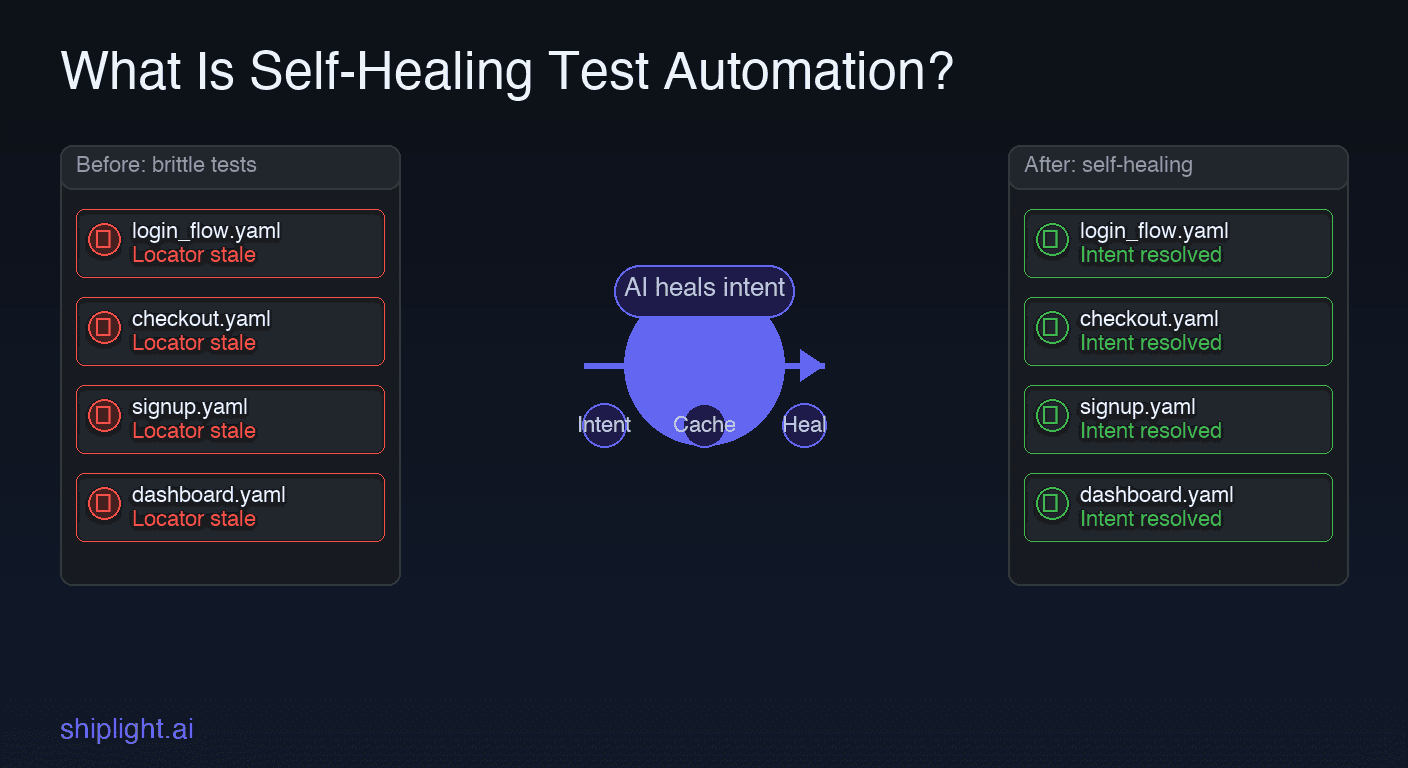
- Intent-based, self-healing testing decouples the test from selectors: the test describes what the user is doing, and the element is resolved semantically at runtime, so UI refactors don't cascade into hundreds of broken tests. See what is self-healing test automation and self-healing vs manual maintenance: the ROI case.
Shiplight is the intent-based option built for this: tests authored as structured natural-language intent, run in a real browser (the same fidelity you'd get from Playwright), self-healing across UI change, version-controlled in your git repo, and (via MCP) authored by the AI coding agent that wrote the feature.
It does not replace Playwright everywhere: Playwright remains excellent for deterministic, developer-owned flows and is in fact a common execution substrate.
The honest framing: choose Playwright as the modern engine, keep Selenium only where legacy browsers force it, and add an intent-based/self-healing layer where selector-maintenance cost is the actual enterprise problem.
Side-by-side summary
| Dimension | Playwright | Selenium | Intent-based (e.g. Shiplight) |
|---|---|---|---|
| Speed / architecture | Fast, in-process | Slower, WebDriver/HTTP | Real-browser, agent-resolved |
| Legacy browsers | No (no IE11) | Yes (broadest) | Modern browsers |
| Parallelism | Built-in | Grid (operate it) | Managed runners |
| CI setup | One-command | Bindings + drivers/Grid | Hosted / minimal |
| Timing flakiness | Low (auto-wait) | Higher (manual waits) | Low |
| Selector maintenance | High (selector-bound) | High (selector-bound) | Low (self-healing) |
| Ecosystem maturity | Growing fast | Largest, decades | Newer, AI-native |
| Best enterprise fit | Modern apps, fast CI | Legacy matrix, sunk Grid | High UI-churn, maintenance-bound |
Practical guidance
Choose Playwright if: your apps are modern with heavy client-side rendering, you want fast execution and low timing flakiness, you want simple parallelization and CI with minimal infra, and you can forgo IE11/legacy testing.
Choose Selenium if: you must test a wide range of legacy/niche browsers, or you have large existing Selenium suites and Grid investment and want maximum interoperability with established WebDriver tooling.
Add an intent-based/self-healing layer if: your real enterprise pain is the maintenance cost of selector-bound tests at scale, especially with fast-changing or AI-generated UIs: this is orthogonal to the engine choice and often the highest-ROI move.
Frequently Asked Questions
Is Playwright or Selenium better for enterprise-grade browser automation?
For a new program on modern web apps, Playwright is generally the stronger enterprise choice: faster, more reliable execution, built-in parallelism, and one-command CI setup. Selenium wins when you must test legacy or niche browsers (broadest coverage, including IE11) or have substantial existing Grid investment.
At enterprise scale, evaluate selector-maintenance cost separately; it usually dominates the budget more than the engine choice.
Why is Playwright faster and less flaky than Selenium?
Playwright drives the browser in-process over a single persistent connection and auto-waits for elements to be actionable before interacting. Selenium uses the HTTP-based WebDriver protocol, adding network overhead per command, and relies on explicit waits that are more sensitive to timing in dynamic apps. The result is faster runs and fewer timing-related flaky failures, especially for SPAs.
When should an enterprise stay on Selenium?
Stay on Selenium when you must test legacy or uncommon browsers (its WebDriver ecosystem has the broadest coverage, including IE11), or when you have a large, well-operated Grid and codebase where wholesale migration cost outweighs the benefit. In those cases, migrate selectively: new modern-app suites to Playwright, legacy-targeted tests kept on Selenium.
Does Playwright eliminate test maintenance for enterprises?
No. Auto-wait significantly reduces timing flakiness, but Playwright tests are still bound to CSS selectors and XPaths, so they break when the UI changes, the same exposure Selenium has. At enterprise scale, selector maintenance is typically 40–60% of QA effort and the cost that dominates. Reducing it requires an intent-based, self-healing approach, orthogonal to the engine decision.
How does intent-based/self-healing testing fit alongside Playwright or Selenium?
It addresses a different axis. Playwright and Selenium are execution engines that both couple tests to selectors. Intent-based testing like Shiplight describes what the user is doing and resolves the element semantically at runtime in a real browser, so UI refactors don't cascade into broken tests. It's complementary to the engine choice, not a replacement for it.
Related posts

Guides
Playwright vs Cypress: Which Testing Framework in 2026?
Apr 1, 2026 · 8 min read

Guides
Best Selenium Alternatives for AI-Native Testing
Apr 1, 2026 · 11 min read

Guides
Best Playwright Alternatives for No-Code Testing
Apr 1, 2026 · 9 min read
Testing Concepts
What Is Self-Healing Test Automation
Apr 1, 2026 · 10 min read

AI Testing
Self-Healing vs Manual Maintenance
Apr 1, 2026 · 5 min read