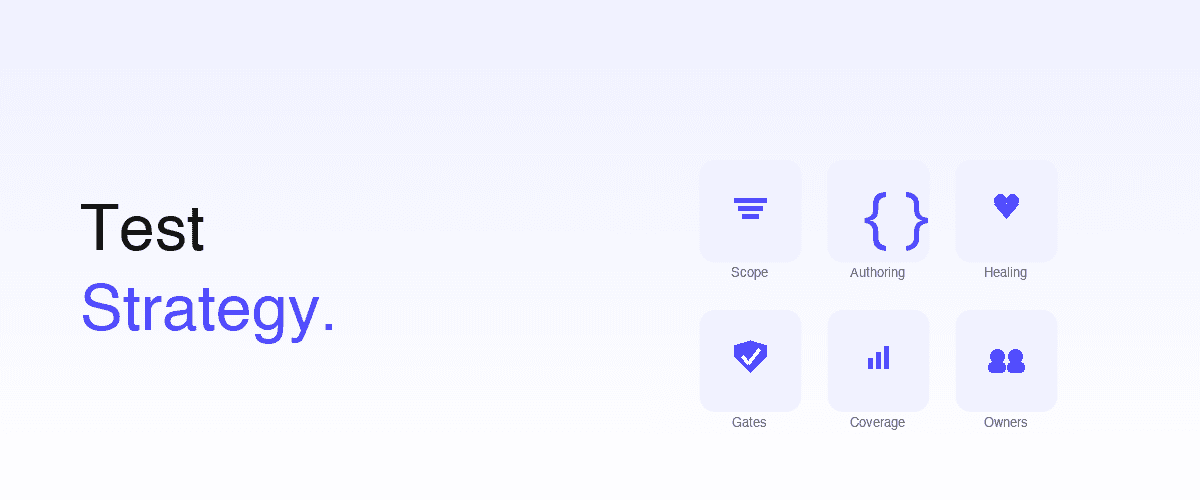
An AI-native test strategy in 2026 is the document and operating model that defines what a team tests, how tests are authored, who is accountable when they break, and how coverage is measured, in a world where AI coding agents ship faster than any human-authored suite can keep up.
The strategy has six components: test scope, authoring model, healing and maintenance posture, verification gates, coverage targets, and ownership. Each one answers a specific question about the testing operating model.
The 2015 test strategy template (Selenium pyramid, separate QA team, nightly regression) does not survive contact with agent-speed development. This guide replaces it with the 2026 template, gives you a concrete document outline, and maps each component to the Shiplight feature that implements it.
Key takeaways
- A test strategy is not a test plan. Strategy = the operating model (what gets tested, how, by whom, measured how). Plan = the specific test cases and release schedule. See the strategy vs plan section below.
- The 2015 template breaks under AI coding agents. When PRs land at 50/week instead of 5/week, nightly regression and selector-bound automation become structural bottlenecks, not minor inconveniences.
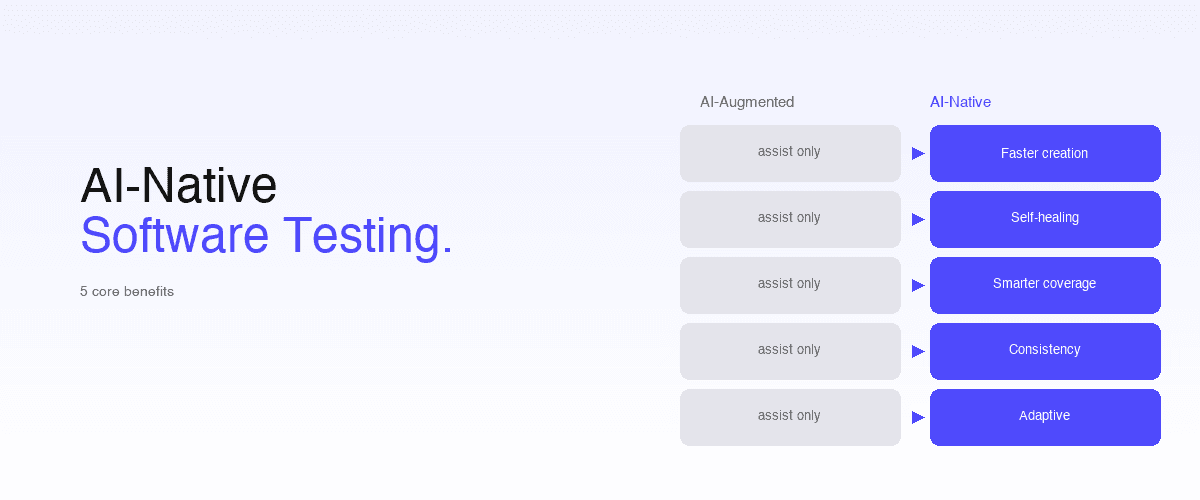
- The six components of an AI-native test strategy are: test scope, authoring model, healing posture, verification gates, coverage targets, and ownership. (For why the AI-native model produces better outcomes than AI-augmented automation, see AI-native software testing and its 5 core benefits.)
- Coverage is measured in user-journey reach, not test count. Raw test count is gameable; user-journey reach is the only metric that maps to user-experienced quality.
- The 2026 ownership model is shared. The engineer (or coding agent) who shipped the feature owns the test for the feature. A small QA function owns strategy, exploratory testing, and policy, not selector maintenance.
What "test strategy" means in 2026
A test strategy is the document and operating model that answers six questions about how your team produces software quality:
- What do we test? (Layers, surfaces, environments)
- How do we author tests? (Code, no-code, intent-based, generated)
- What happens when tests break from non-code changes? (Heal, patch, ignore, escalate)
- When and where do tests run? (Local, PR-time, nightly, release gate)
- How do we measure coverage? (Test count, journey reach, decay rate)
- Who is accountable? (Engineer, agent, QA team, oversight)
A strategy is not a list of test cases. It is the framework that shapes which test cases are valuable in the first place. If your team has documented test cases but no documented strategy, you have a plan without a strategy: the tactical execution layer floating without the operating-model layer that should constrain it.
For the broader umbrella of what counts as AI testing, see what is AI testing. For the practical 2026 floor that every strategy should assume, see software testing basics in 2026.
Why the 2015 test strategy template breaks under AI-speed development
The dominant test strategy template before 2024 looked like this:
- Test pyramid (many unit, fewer integration, fewest E2E)
- Selenium / Cypress / Playwright for the E2E layer, written by a dedicated QA team
- Nightly full-suite regression
- "Stable selectors" and "smart waits" as the maintenance discipline
- Test plan as a release-by-release artifact
That template was reasonable when human engineers shipped 5–10 PRs per week per team. It collapses for three measurable reasons under AI coding agents like Claude Code, Cursor, and OpenAI Codex:
- Authoring throughput is the binding constraint. AI agents now generate 50+ PRs per week per team. A QA team that can author 5–10 new E2E tests per week cannot close the gap. Coverage falls behind code on day one.
- Maintenance overhead compounds non-linearly. With 10× more UI changes per week, selector-bound tests break 10× more often. A suite that took 2 hours/week to maintain now demands 20 hours/week. Past a threshold, the suite is a permanent maintenance backlog.
- Nightly latency is too slow. Bugs introduced at 9am by an AI-generated PR ship at 5pm because the regression suite runs at 2am tomorrow. The 16-hour latency was tolerable when humans shipped slowly; it isn't anymore.
The AI-native test strategy template below replaces each of these failure modes with a component that scales. For the full collapse-and-rebuild narrative, see QA for the AI coding era.
The 6 components of an AI-native test strategy
- 1Test scope, which layers, why
- 2Authoring model (code, no-code, intent, generated)
- 3Healing & maintenance posture
- 4Verification gates, when and where tests run
- 5Coverage targets, what to measure
- 6Ownership (engineer, agent, reviewer)
Component 1: Test scope, which layers, why
A 2026 test strategy explicitly declares which layers are tested and why each is in scope:
| Layer | Owns which question | 2026 default |
|---|---|---|
| Unit | Does this function/component work in isolation? | Engineer-authored, runs on every save and PR |
| Integration | Do components/services work together at API boundaries? | Engineer-authored, runs on every PR |
| E2E (browser) | Does the user-experienced flow work end-to-end? | Intent-based, agent-authorable, runs on every PR |
| Visual regression | Does the rendered UI look right? | Optional; gated on user-facing surfaces only |
| Performance | Does it stay within latency/throughput SLOs? | Selective; gated on high-traffic paths |
| Security | Are vulnerabilities introduced? | Continuous; static + dynamic scans on every PR |
The mistake the 2015 template made was treating E2E as a separate ceremony. The 2026 default treats E2E as a co-equal layer with unit and integration, authored at the same speed and gated at the same latency.
See E2E vs integration testing and the E2E coverage ladder for the deeper decomposition.
Component 2: Authoring model (code, no-code, intent, generated)
The single most strategic decision in your test strategy is how tests are written. Four options:
- Code-bound (Playwright, Cypress, Selenium). Maximum control. Locked to selectors. Breaks on UI refactors. Authored by engineers at typing speed.
- No-code vendor-console authoring (visual builders; constrained plain-English commands). No engineering required. Tests live in the vendor's cloud console. Difficult to git-review.
- Intent-based (YAML / natural-language). Tests describe user actions, runtime resolves to DOM. Survives most refactors. Authored by engineers OR coding agents. See YAML-based testing.
- AI-generated (from specs, exploration, or agent sessions). The system produces test candidates that a human approves. Scales coverage with code generation throughput. See AI testing tools that automatically generate test cases.
The 2026 strategy default is intent-based + AI-generated, with the coding agent authoring the test in the same session it writes the feature. See agent-first testing.
Shiplight feature. Shiplight YAML Test Format is the intent-based language; Shiplight MCP Server and AI Skills are how the coding agent generates tests programmatically.
Component 3: Healing & maintenance posture
When a test fails because the UI changed (not because the code is broken), what happens? Your strategy needs an explicit posture:
- Manual repair. A human investigates every failure and patches the test. This is the 2015 default; it's also where 40–60% of QA hours go.
- Smart locators. Tools attempt to find replacement selectors when the original breaks. Reduces some failures; doesn't address intent drift.
- Self-healing as default. Every run re-resolves intent against the current DOM; unhealed steps emit PR-reviewable patch suggestions (not silent rewrites). See self-healing vs manual maintenance and near-zero maintenance E2E testing.
- Agent-fixed. The AI coding agent that broke the UI also patches the affected tests in the same session, before the PR opens.
The 2026 strategy default is self-healing as default + agent-fixed for routine UI drift. Manual repair is reserved for genuine defects, never for selector noise.
Component 4: Verification gates, when and where tests run
A 2026 test strategy declares an explicit gate timeline:
| Gate | What runs | Latency | Blocks merge? |
|---|---|---|---|
| Pre-commit | Unit tests for touched files | Seconds | Optional (developer choice) |
| PR-time | Unit + integration + E2E for affected flows | < 10 minutes | Yes, required |
| Nightly | Full E2E suite + extended scenarios | Hours | No, informational |
| Release | Smoke suite + release-critical journeys | < 15 minutes | Yes, required |
The strategically important gate is PR-time. If your nightly is blocking but your PR is not, bugs land in main, then get caught after, then get reverted: a slow, expensive cycle. PR-time gates catch breakage before it reaches main. See a practical quality gate for AI pull requests.
Shiplight feature. Shiplight Cloud runners integrate with GitHub Actions, GitLab CI, and CircleCI for sub-10-minute PR-time gates. See E2E testing in GitHub Actions: setup guide.
Component 5: Coverage targets, what to measure
Raw test count is the worst test-coverage metric. A team can game it by writing 1,000 redundant assertions. A 2026 strategy measures coverage with four numbers:
- User-journey reach: % of mapped flows the suite covers end-to-end. Target: > 60%.
- Coverage decay rate: % of previously-passing tests now broken because of UI drift without code changes. Target: < 2% / week. See coverage decay.
- PR-time verification density: % of merged PRs that ran at least one E2E test in CI before merge. Target: > 80%.
- Maintenance budget: % of QA engineering hours spent on test fixes (rolling 4-week). Target: < 5%. See near-zero maintenance E2E testing.
Track these as a single dashboard with rolling four-week trends. They are the only metrics that tell you whether the strategy is working. See the agentic QA benchmark for the full rubric.
Component 6: Ownership (engineer, agent, reviewer)
The 2015 default ownership model was a separate QA team that owned the entire test suite. The 2026 default is shared:
- The engineer (or coding agent) who shipped the feature owns the test for the feature. Test diff appears in the feature PR. No handoff. No separate QA cycle.
- The AI coding agent participates as an author through the testing tool's API or MCP server. See Shiplight MCP Server and MCP for testing.
- A small QA function owns strategy, exploratory testing, quarantine review, and policy. They do not own selector maintenance: that's been automated.
- The release engineer or tech lead owns the gates and the metrics dashboard. Strategy is owned at the leadership layer; tactical execution is distributed.
See from human QA bottleneck to agent-first teams for the full ownership-model migration.
Test strategy vs test plan: clearing the confusion
These two terms get used interchangeably and that's wrong.
| Dimension | Test Strategy | Test Plan |
|---|---|---|
| Scope | Org / team / product line | Specific release or feature |
| Lifespan | Quarterly to annual | Release cycle (days to weeks) |
| Answers | How do we produce quality? | What are we testing this release? |
| Owned by | QA leadership / Engineering leadership | Release engineer / PM |
| Output | Operating model, gates, metrics | Test case list, schedule, exit criteria |
| Changes when | Operating model shifts (new tooling, agent adoption) | Every release |
If you have a test plan but no documented test strategy, you have tactics without a framework. Tests will be authored, will be run, will sometimes pass, but no one can answer "why these tests, why this way?" That's the strategy.
If you have a test strategy but no test plan, you have a framework with no execution. Tests don't get prioritized, releases don't have exit criteria.
You need both. The strategy makes the plan possible.
A test strategy template you can copy
Below is the document outline for an AI-native test strategy. Adapt the specifics to your stack; keep the section structure.
# [Team / Product] Test Strategy: [Year]

## 1. Scope
- In-scope: web app, public API, mobile web
- Out-of-scope: native mobile (separate strategy)

## 2. Test layers and ownership
- Unit: engineer-authored, runs on save + PR
- Integration: engineer-authored, runs on PR
- E2E browser: intent-based YAML, authored by engineer or coding agent, runs on PR
- Visual regression: enabled for marketing site only
- Performance: smoke-level on PR; full on nightly

## 3. Authoring model
- Tool: Shiplight + YAML Test Format
- Coding agents allowed to author tests via Shiplight MCP server
- All test changes reviewed in the same PR as the feature

## 4. Healing & maintenance posture
- Self-healing on every run (default state)
- Unhealed steps surface as PR-reviewable patch diffs
- Manual repair reserved for real defects only
- Quarantine: 2-consecutive-failure tests move to quarantine; weekly review

## 5. Gates
- PR-time: affected unit + integration + E2E (< 10 min, blocking)
- Nightly: full E2E + extended scenarios (informational)
- Release: smoke + release-critical journeys (blocking)

## 6. Coverage targets (rolling 4-week)
- User-journey reach: > 60%
- Coverage decay rate: < 2% / week
- PR-time verification density: > 80%
- Maintenance budget: < 5% of QA-eng hours

## 7. Ownership
- Engineer / coding agent: tests for features they ship
- QA function: strategy, exploratory, quarantine review, policy
- Release engineer: gates and metrics dashboard

## 8. Review cadence
- This strategy reviewed quarterly
- Adjustments triggered by: tooling change, agent-adoption change, KPI breach
That's the structure. Fill in the bracketed parts with your team's specifics. Treat the file as living: review every quarter, change when the operating model changes, archive the previous version in version control. See tribal knowledge to executable specs for the broader case for documented strategy.
2015 test strategy vs 2026 test strategy
| Component | 2015 Strategy Template | 2026 Strategy Template |
|---|---|---|
| Test scope | Pyramid; E2E as separate ceremony | E2E as co-equal layer authored at PR speed |
| Authoring model | Code-bound (Selenium/Playwright) | Intent-based + AI-generated |
| Maintenance posture | "Stable selectors" + manual repair | Self-healing default + agent-fixed |
| Verification gates | Nightly regression | PR-time gating (< 10 min) |
| Coverage metric | Test count + pass rate | User-journey reach + decay rate + maintenance budget |
| Ownership | Separate QA team | Engineer + coding agent + small QA function |
| Test storage | Vendor UI or screenshots | Plain text in git |
| Strategy review cadence | Annual | Quarterly |
If most of your test strategy still sits in the left column, you're operating below the 2026 floor. The migration is component-by-component, not all-at-once. See the roadmap below.
A migration roadmap (one component per sprint)
You don't rewrite a test strategy in one sprint. Migrate component-by-component:
Sprint 1: Component 5 (coverage targets). Stop measuring test count. Start measuring user-journey reach + maintenance budget + decay rate. Without baseline metrics, every other change is unprovable.
Sprint 2: Component 2 (authoring model). Every new test goes into the intent-based format (YAML Test Format). Existing Playwright keeps running unchanged.
Sprint 3: Component 3 (healing posture). Enable self-healing on the YAML suite. Patches surface as PR diffs. Measure the maintenance-budget delta.
Sprint 4: Component 4 (verification gates). Wire PR-time gates via Shiplight Cloud. Keep nightly Playwright as a safety net. See the 30-day agentic E2E playbook.
Sprint 5: Component 6 (ownership). Coding agents author tests via Shiplight MCP Server. Engineer + agent now own feature tests; QA shifts to strategy and exploratory work.
Sprint 6: Component 1 (scope refresh). With the operating model now AI-native, revisit which layers and surfaces are in scope. Some 2015-era decisions (e.g., separate "smoke" suites) may collapse into the PR-time gate.
By the end of sprint 6, you have a documented AI-native strategy with measurable baselines. From there it's quarterly refinement.
Conclusion: a strategy is what makes the rest of it possible
A test plan without a test strategy is tactics without a framework. A toolchain choice without a strategy is shopping without a budget. The six-component template above is the framework: sized for 2026, opinionated toward AI-native operating models, designed to survive the shift to agent-speed development that has already happened on most engineering teams.
For teams ready to adopt the template, Shiplight AI implements the recommended defaults out of the box: intent-based YAML for authoring, AI Fixer for self-healing as default, MCP server and Skills for agent-native verification, and Cloud runners for PR-time gates. Book a 30-minute walkthrough and we'll map your current strategy to the six components and project the migration delta.
Frequently Asked Questions
What is an AI-native test strategy?
The operating model a team uses to produce quality when AI coding agents ship features faster than tests keep up. Six components: scope, authoring model, healing posture, gates, coverage targets, ownership. Its defining property is that the coding agent is an active author of the suite.
Why does the 2015 test strategy template break under AI coding agents?
Agents generate 50+ PRs a week while human-authored E2E tests grow at 5–10, so coverage falls behind on day one. Selector-bound automation breaks more often as the UI churns. And nightly regression latency cannot keep pace. The fixes are intent-based authoring, self-healing, and PR-time gates.
What are the 6 components of an AI-native test strategy?
Scope: which layers and surfaces are tested. Authoring model: code, no-code, intent-based, or AI-generated. Healing posture: what happens when tests break from non-code changes. Gates: when tests run. Coverage targets: what counts as covered enough. Ownership: who is accountable.
How do I measure test coverage in an AI-native strategy?
Track four metrics together: user-journey reach (target > 60%), coverage decay rate from UI drift (< 2%/week), PR-time verification density (> 80% of merged PRs ran E2E), and maintenance budget (< 5% of QA hours). Raw test count is gameable and should never be tracked in isolation.
Do AI coding agents author tests in this strategy?
Yes, and that is the central shift: the agent that wrote the feature also writes its test, in the same session, before the PR opens. It needs the testing tool exposed programmatically, via an MCP server. Without that, the agent ships code your tests never saw.
Is a test strategy still relevant if my team only does manual testing?
Yes, more so. A team without automation still makes implicit decisions about what gets tested, how, and by whom; a strategy makes them explicit, which is the prerequisite for introducing automation at all. The components apply whichever authoring model you use.
Can I use multiple test authoring models in the same strategy?
Yes, and most teams do. A common pattern: code-bound for legacy Playwright suites kept running unchanged, intent-based YAML for all new feature tests, AI-generated for autonomous exploration of edge cases. The strategy declares which authoring model applies to which scope, and migrates progressively. See test authoring methods compared.
What's the fastest way to migrate from a 2015 test strategy to an AI-native one?
Do not rewrite. One component per sprint: baseline the metrics, switch new tests to intent-based authoring, enable self-healing, wire PR-time gates, give the agent authoring access, then refresh scope. Six sprints, no big bang. See the 30-day playbook.