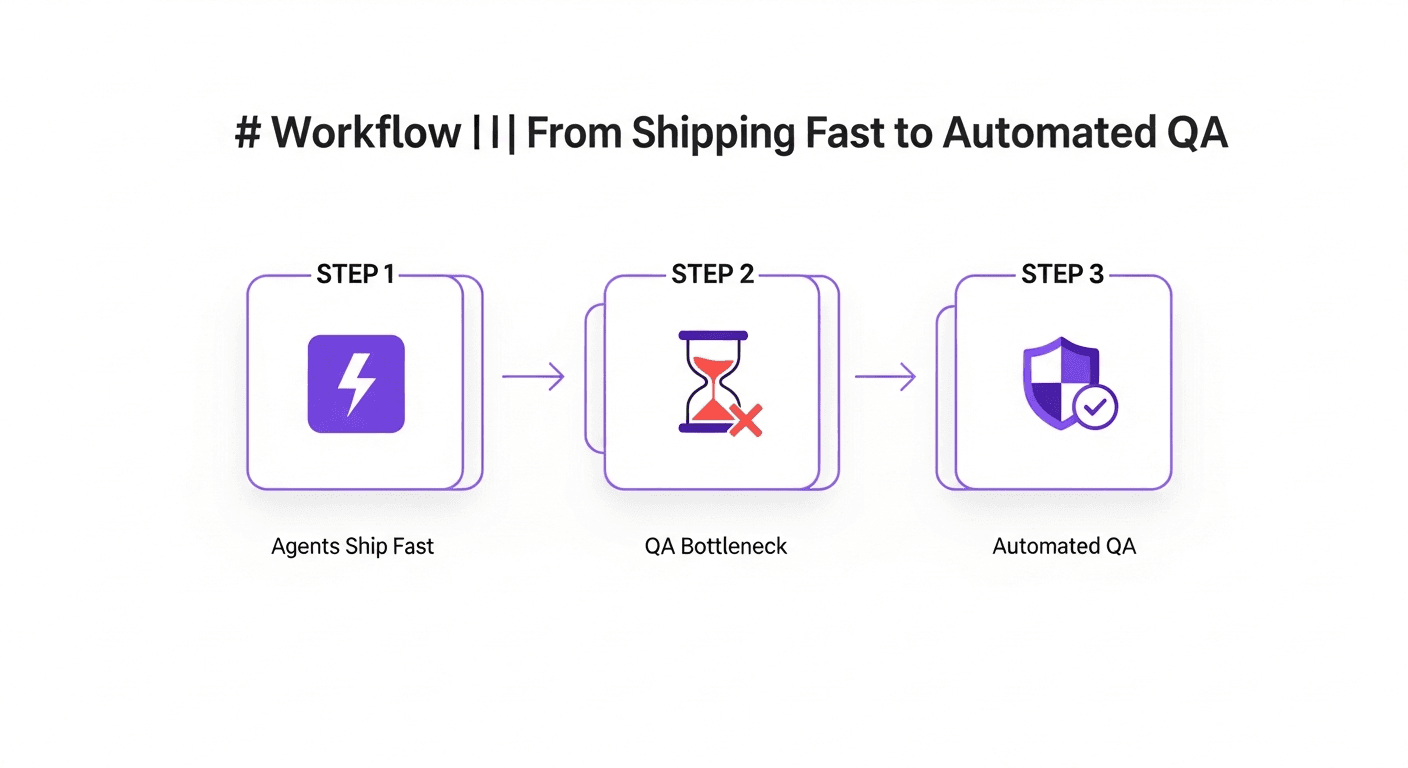
OpenAI's harness engineering team published a detail that most coverage glossed over. They built a production product (a million lines of code, zero written by hand) and named the constraint that nearly stopped them:
> "As code throughput increased, our bottleneck became human QA capacity."
Not model quality. Not context management. Not architectural coherence. Human QA.
When AI coding agents ship code faster than humans can verify it, every conventional quality assurance process becomes a bottleneck. This post explains why that happens structurally, how teams try to cope (and fail), and what a solution actually looks like. For the broader operational answer, see how to scale test automation with AI.
Why Agent-First Teams Hit a QA Wall
In a traditional engineering team, code throughput and QA capacity grow together. You hire more engineers, you hire more QA. The ratio stays roughly manageable.
In an agent-first team, that ratio breaks completely.
OpenAI's team of three engineers drove 1,500 pull requests over five months: roughly 3.5 PRs per engineer per day. That throughput increased as the team grew to seven engineers. No QA organization scales to match that rate without becoming the bottleneck by definition.
The problem isn't just volume. It's also verification depth. AI agents produce code that passes surface-level review: it compiles, tests pass, the logic looks plausible. The failures are subtle: UI behavior that's technically correct but wrong for the user, edge cases that only surface in real browser sessions, regressions in flows the agent didn't touch but affected indirectly.
Human reviewers catch these. But only if they have time to look, which, at agent throughput, they increasingly don't.
The Three Ways Teams Try to Cope
When QA becomes the constraint, teams reach for familiar tools. None of them solve the underlying problem.
1. Add more retries to CI
The first response is usually configuration: add more retries, increase timeouts, relax merge gates. OpenAI notes this explicitly: at high throughput, "test flakes are often addressed with follow-up runs rather than blocking progress indefinitely."
This is the right tradeoff for them, because they have other verification layers. For most teams, loosening CI gates without a replacement quality signal just lets more regressions through.
2. Require human review of every PR
The obvious fix: keep humans in the loop on every pull request. This works until it doesn't, which is usually within the first week of sustained agent throughput. Reviewers start rubber-stamping. Review quality degrades as fatigue sets in. The bottleneck shifts from throughput to reviewer bandwidth, and throughput drops to match.
3. Add more QA engineers
Headcount is the traditional answer to QA capacity problems. In an agent-first context, it's economically backwards: you're adding expensive human labor to keep pace with AI that is 10x cheaper per unit of output. You're also not solving the speed problem: QA engineers don't run browsers in parallel at agent scale.
The Structural Problem: Verification Doesn't Scale Like Generation
The core issue is asymmetry. AI agents generate code fast. Verifying that code (actually running it, checking UI behavior, catching regressions) requires executing the application, which takes real time.
OpenAI's solution was to make verification itself agent-executable:
> "We made the app bootable per git worktree, so Codex could launch and drive one instance per change. We also wired the Chrome DevTools Protocol into the agent runtime and created skills for working with DOM snapshots, screenshots, and navigation. This enabled Codex to reproduce bugs, validate fixes, and reason about UI behavior directly."
In other words, they gave the agent the ability to open a browser, interact with the running application, and validate its own output, before any human reviewed the PR.
This is the structural answer to the QA bottleneck: move verification into the agent loop, so it runs at agent speed rather than human speed.
What This Looks Like in Practice
The verification loop OpenAI describes is now a defined pattern in agent-first engineering. For any given PR:
- Agent implements the change
- Agent boots the application in an isolated environment (per git worktree)
- Agent drives the browser via Chrome DevTools Protocol: screenshots, navigation, DOM inspection
- Agent validates the target behavior (explicit VERIFY assertions or acceptance criteria)
- Agent either self-corrects or opens the PR with attached validation evidence
- Human reviews outcomes (did the behavior change as intended?) rather than implementation (is this code correct?)
This shifts human attention from line-by-line code review to outcome validation, a far better use of the time.
Shiplight Closes the Loop Without Building It Yourself
OpenAI spent months building the Chrome DevTools infrastructure that makes this work. Most teams don't have months, and they shouldn't have to.
Shiplight provides the browser-driving verification layer as a drop-in MCP tool for Claude Code, Cursor, and Codex. Your AI coding agent can:
- Open a real browser against your staging or local environment
- Navigate through user flows with full screenshot capture
- Run intent-based E2E tests that validate behavior, not selectors
- Post verification evidence back to the PR
The tests themselves use Shiplight's intent-cache-heal pattern: they're expressed as natural language intent so they survive the rapid UI changes that come with agent-driven development. When the agent refactors a component, the test adapts rather than breaking.
For teams already running Playwright E2E tests in CI, Shiplight integrates into the existing pipeline. You don't replace what you have; you add the autonomous verification layer that agent-first throughput requires.
The Shift: From QA as Execution to QA as System Design
OpenAI describes a reorientation that every engineering team using AI agents will eventually hit:
> "The primary job of our engineering team became enabling the agents to do useful work."
For QA, that means the job is no longer running tests. It's designing the system that makes quality self-sustaining: writing acceptance criteria that agents can execute, building the verification harness that runs at PR time, and encoding quality standards as machine-checkable rules rather than human judgment calls.
Teams that make this shift stop being the bottleneck. They typically report 5–10× test coverage growth at the same headcount as the work moves from human authoring to agentic verification. Teams that don't find themselves sprinting to keep pace with agents that are shipping faster than anyone can check.
FAQ
Why do AI coding agents create a QA bottleneck specifically?
AI agents can generate code significantly faster than humans can verify it. The mismatch is structural: generation is cheap and parallelizable; verification traditionally requires human judgment and runs serially. The bottleneck emerges whenever agent throughput outpaces the human review capacity of the team.
Is the solution to give AI agents the ability to test themselves?
Partially, but with an important caveat. An agent cannot reliably evaluate its own output. Anthropic's research shows that "models confidently praise mediocre work when grading their own output." The right architecture is a separate verification system (an independent evaluator) that runs against the agent's output. See Planner, Generator, Evaluator: The Multi-Agent QA Architecture for the full pattern.
What is harness engineering and how does it relate to QA?
Harness engineering is the discipline of designing the constraints, feedback loops, and tooling that allow AI coding agents to do reliable work. QA verification is one of the most critical harness components: it's the feedback signal that tells the agent whether its output is correct. Without a verification harness, agents generate code with no quality signal other than "it compiled."
How does Shiplight fit into an agent-first workflow?
Shiplight for AI coding agents provides the browser-driving verification layer as an MCP tool. Your coding agent (Claude Code, Cursor, Codex) calls Shiplight to validate UI behavior in a real browser, run intent-based E2E tests, and attach verification evidence to pull requests, all without human intervention. See how to adopt Shiplight AI for integration options.
Do I need to rewrite my tests to work with AI coding agents?
Not necessarily. Shiplight adds intent-based healing alongside existing Playwright tests. Tests expressed as semantic intent survive the rapid UI changes that come with agent-driven development; tests coupled to CSS selectors break constantly. The migration path is incremental: you don't need to rewrite everything at once.
References
OpenAI Harness Engineering, Anthropic Harness Design, Playwright documentation, Google Testing Blog