

Testing an app built by an AI app builder means verifying that the generated flows actually behave the way the preview implies, and that they keep behaving after the next regeneration. The tools that produce these apps optimize for one thing: getting a working-looking interface in front of you fast.
What they do not do is prove that signup writes a row, that checkout charges once, or that the change you prompted this morning did not quietly break the flow you shipped yesterday.
That verification gap is the same one every AI-generated codebase carries, and it is the part you own the moment the code lands in a repository you control.
This guide is organized around four questions: why app-builder output ships unverified, when and where to add verification, the workflow that turns generated code into an app with maintained end-to-end tests, and the limits you hit while some of the code still lives inside a builder's sandbox.
Why app-builder output ships unverified
The specifics differ across tools, but the shape of the problem does not. A generated preview is a demo, not a guarantee.
An AI app builder turns a prompt into a running application. v0 by Vercel generates Next.js, React, Tailwind CSS, and shadcn/ui components that render immediately in a live preview (v0 docs). Lovable produces React with a Supabase backend and a deployed URL.
Bolt.new, built by StackBlitz, boots a full Node.js runtime inside your browser tab using WebContainers and lets the model drive the filesystem, package manager, and dev server directly (StackBlitz WebContainers). Replit's Agent scaffolds, runs, and deploys across many languages from a single chat.
Each produces something you can click within minutes. That speed is the point, and it is genuinely useful. But the loop inside a builder rewards output that looks right, not output that is proven right. The model generates code, the preview renders, and you move to the next prompt.
Nothing in that loop asserts that the form submission reached the database, that the auth boundary blocks an unauthenticated request, or that the payment path handles a declined card. The preview shows the happy path because the happy path is what got prompted.
Three properties make this failure mode predictable:
- The demo is the test. Rendering a signup page is not the same as verifying that a new user can complete signup end to end. Builders confirm the first and imply the second.
- Every regeneration is a silent rewrite. Prompt the builder to change the header and it may refactor component boundaries, rename elements, and alter behavior in flows you did not mention. There is no regression check between generations.
- Backends are generated too. When a tool wires up Supabase, auth, and API routes from a prompt, the seams between those pieces are where generated apps break, and none of it was exercised against real inputs.
For the broader version of this problem across all AI-written code, see how to test vibe-coded applications, which covers the reliability techniques that apply regardless of which tool produced the code.
When and where to add verification
The right place to add real verification is the moment you own the code, which in practice means the moment it lands in your Git repository. Every one of these builders supports that handoff, and it is the natural seam to bolt testing onto.
- v0 has a bidirectional GitHub integration and an "Add to Codebase" flow that exports generated work into a repo with proper structure and Git integration (v0 docs).
- Lovable offers two-way GitHub sync on paid plans, where every prompt creates a commit and every push syncs back, plus a ZIP export on the free plan (Lovable GitHub docs).
- Bolt.new lets you push the generated project to GitHub or download it, and because the output is standard Node.js it runs anywhere (bolt.new on GitHub).
- Replit exports through its Version Control panel with a Publish to GitHub action, or as a downloadable archive (Replit docs).
Once the code is in a repo, you have a filesystem, a package manager, and a CI surface, which is everything a real test suite needs. Verifying flows while the app lives only inside the builder's chat is fighting the tool; verifying them once you own the repo works with it.
The timing question has a clean answer: add verification before the app has real users, and re-run it on every change after that. A generated app taking payments cannot tolerate a single unverified regeneration. If you are gating a launch, the pre-launch testing workflow for vibe-coded apps turns this into a concrete checklist.
The workflow: from generated code to maintained tests
Once the code is in your repository and connected to your coding agent, verification becomes part of the build loop rather than a separate phase.
This is where Shiplight fits: it is the verification layer for AI-native development, plugging into your coding agent, giving it a real browser to drive, and having the agent author end-to-end tests that live in your repo and heal themselves as the app changes.
It installs as an MCP server plus Skills with a one-line setup for Claude Code, Cursor, Codex, VS Code, and more. The workflow has three moves.
Verify the flow right after it generates
When your agent brings v0 or Lovable output into the repo and wires it up, run /shiplight verify. The agent opens the app in a real browser, walks the flow you care about, and confirms the rendered result matches intent rather than trusting the preview.
This catches the gap between "the signup page renders" and "a user can actually sign up" at the moment the code arrives.
Author tests from intent, not selectors
Run /shiplight create-yaml-tests and the agent walks the app and writes end-to-end tests in readable YAML, described by what the user is trying to do instead of brittle CSS selectors. That distinction matters more here than almost anywhere else, because app-builder output is refactored on every prompt.
A test bound to .btn-primary breaks the next time you ask the builder to restyle a button; a test that says "a new user signs up with email and password" survives the refactor.
See verify AI-written UI changes for how intent-based verification holds up under constant UI churn.
Maintain the suite as the app regenerates
The tests live as YAML in your Git repo, not a vendor cloud, and run locally with npx shiplight test. They are Playwright-compatible and run alongside any Playwright tests you already have.
When a regeneration moves an element, Shiplight heals the test in a real browser and surfaces the change as a reviewable PR diff, not a silent rewrite.
When the app itself is broken rather than just changed, /shiplight fix reproduces the failure, root-causes it, and reports the bug instead of quietly editing the test to pass.
Run the suite as a gate on every pull request and the regression question ("did this generation break a flow I already shipped?") gets answered before merge instead of after a user finds it.
The first suite of end-to-end tests exists within the first week of owning the code, and it keeps working as the builder keeps generating. One team's Head of QA went from spending roughly 60 percent of their time maintaining Playwright tests to near zero within a month by moving to this model.
The vibe coding testing guide covers how to add this QA layer without slowing the build loop down.
Limits: some code stays in the sandbox
This workflow starts when you own the code, and not all app-builder code is fully yours at every moment. Bolt.new runs inside WebContainers in the browser tab, so until you push to GitHub the app lives in a sandbox you cannot point external tooling at (StackBlitz WebContainers).
Lovable's two-way sync is on paid plans; the free tier gives you a ZIP rather than a live connection (Lovable GitHub docs).
And a test suite in your repo verifies the code you exported, not necessarily whatever a builder is serving from its own hosting.
Treat the in-builder phase as prototyping and the in-repo phase as production. Iterate freely inside the tool while shaping the idea. The moment the app matters enough to have users, export it, connect your coding agent, and put a real verification gate around it.
Every one of these builders ships a path to your own repository, and that path is where verification becomes possible and where it should become mandatory.
Key Takeaways
- App builders prove a UI renders, not that its flows behave; the preview is a demo, not a guarantee.
- Every regeneration can silently rewrite flows you did not touch, which is why regression checks matter more here than in hand-written code.
- Add verification the moment the code lands in your Git repository, which every major builder supports exporting to.
- Intent-based end-to-end tests survive the constant refactoring that app builders produce, where selector-bound tests do not.
- Run the suite as a per-PR gate so the "did the last generation break something" question is answered before merge.
Frequently Asked Questions
How do I test an app built with v0, Lovable, or Bolt?
Export the generated code to your own Git repository, which all three support, then connect your coding agent and add end-to-end verification. Have the agent author intent-based tests in your repo and run them as a gate on every change. The builders confirm a UI renders; the tests confirm signup, login, and checkout keep working after the next generation.
Why do AI-generated apps need extra testing if the preview already works?
The preview shows the happy path because that is what was prompted. It does not verify that a form submission reached the database, that an auth boundary blocks unauthenticated access, or that a payment path handles a declined card. Generated backends and the seams between modules are where these apps break, and a rendering preview exercises none of it.
When should I add tests to an app-builder project?
When the code lands in your Git repository and before the app has real users. A prototype with no users can stay unverified briefly, but a generated app taking payments cannot tolerate a single unverified regeneration. Add verification at the repo handoff, then run it on every change.
Can I test the app while it is still inside the builder's sandbox?
Only partially. Tools like Bolt.new run inside browser-based WebContainers, and some builders serve previews from their own hosting, so external test tooling cannot reach the app until you export it. Treat the in-builder phase as prototyping and add real verification once the code is in a repository you control.
Will my tests break every time I regenerate part of the app?
Not if they are written from intent rather than bound to CSS selectors. App builders rename elements and refactor component boundaries on nearly every prompt, so selector-bound tests break constantly. Intent-based tests that describe what the user is trying to do survive those refactors, and a self-healing runner surfaces genuine changes as reviewable PR diffs.
Related posts
AI Testing
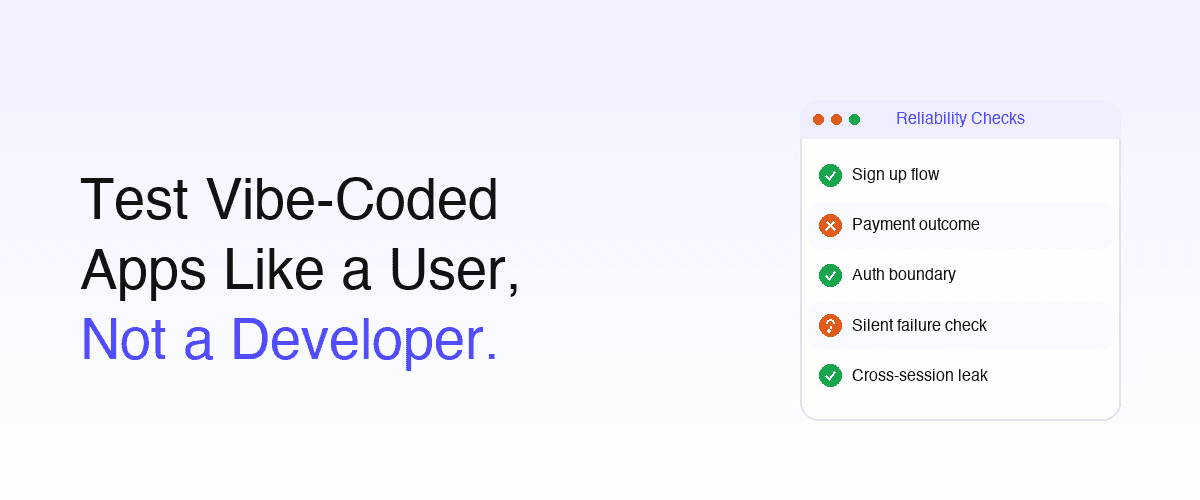
How to test vibe-coded applications
May 14, 2026 · 13 min read
AI Testing
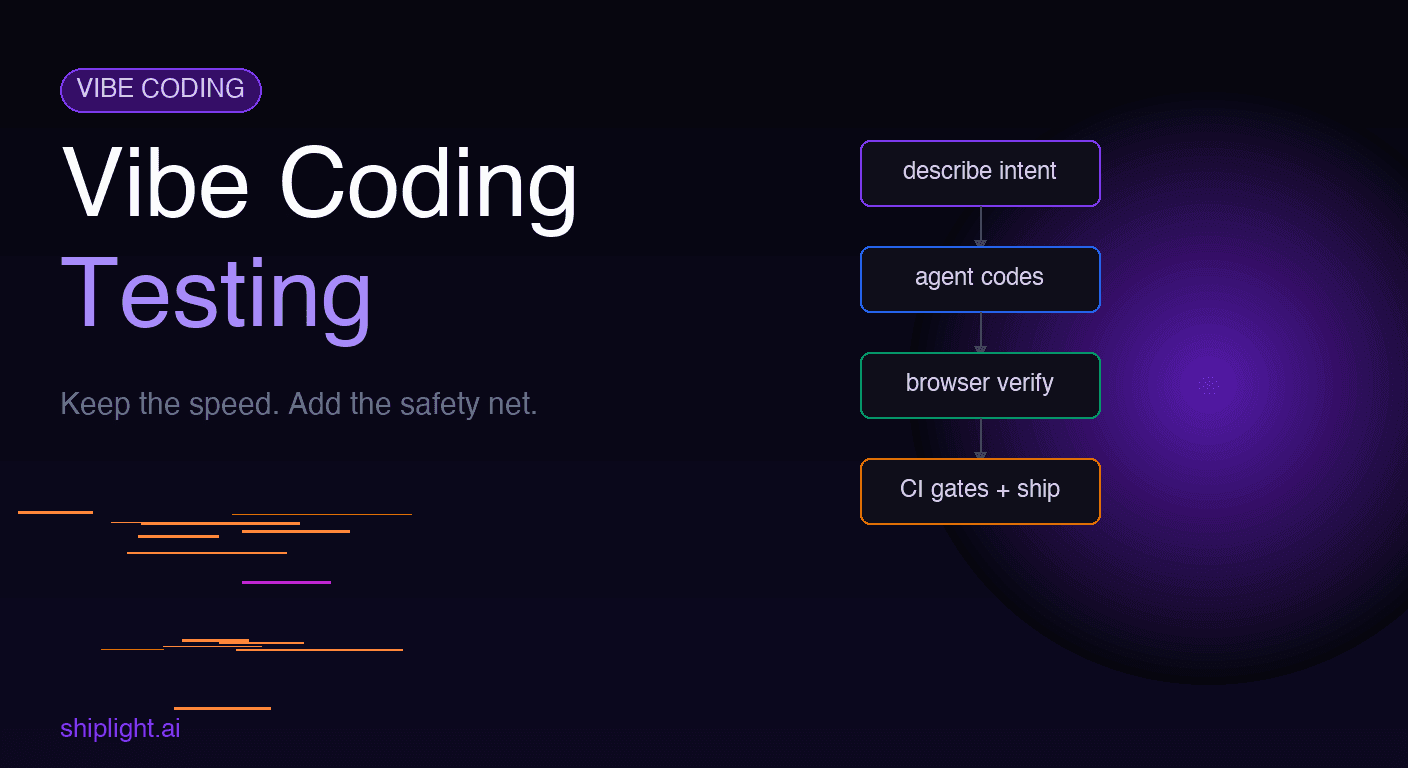
Vibe coding testing: how to add QA without slowing down
Apr 10, 2026 · 11 min read
AI Testing
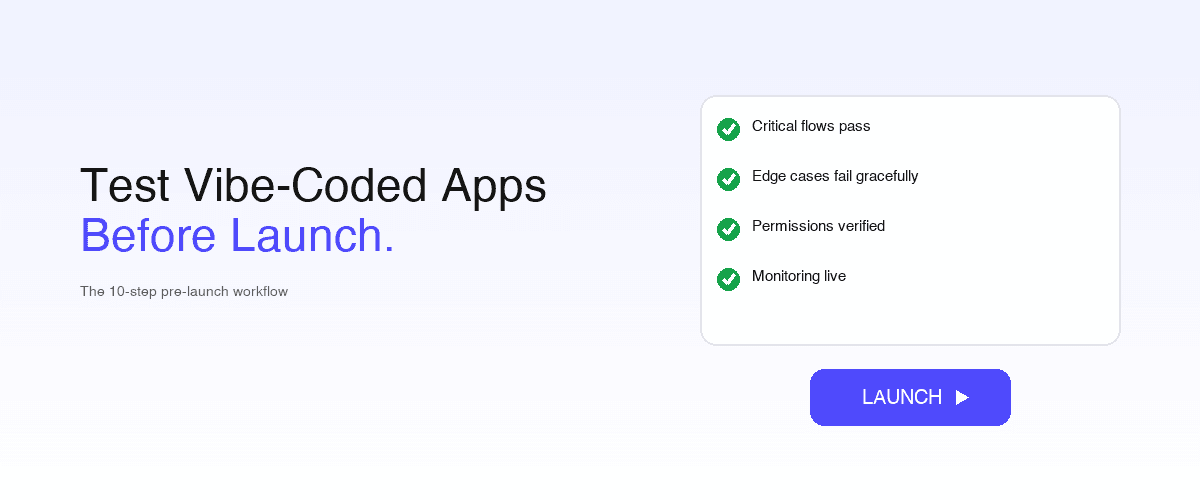
How to test vibe-coded apps before launch
May 19, 2026 · 8 min read
Engineering
Verify AI-written UI changes
Mar 25, 2026 · 7 min read