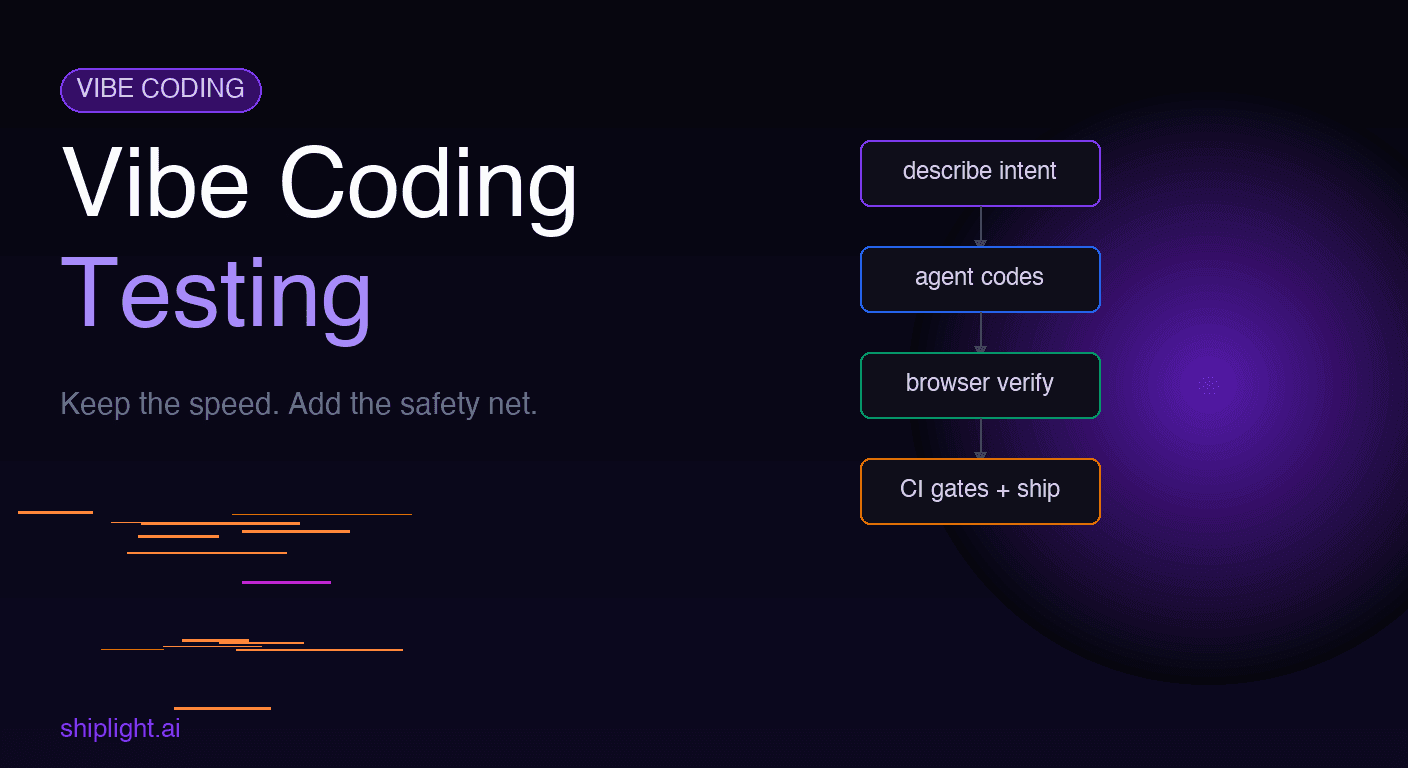
Vibe coding testing (sometimes called vibe testing) is the practice of adding automated quality verification to vibe coding workflows without slowing down the development speed that makes vibe coding attractive.
It relies on self-healing E2E tests generated by your AI coding agent during development, not a separate manual QA phase afterward. Shiplight is the tool that does this: your agent verifies the change in a real browser and leaves the check behind as a test in your repository.
What Is Vibe Coding? What Is Vibe Testing?
Vibe coding is exactly what it sounds like: you describe what you want, your AI coding agent writes the implementation, and you ship it. No wrestling with boilerplate, no context-switching into unfamiliar APIs, no debugging stack traces line by line. Just intent → code → deploy.
It is genuinely fast. Teams that have adopted AI-first development workflows report shipping features in hours that previously took days. The experience is intoxicating.
The problem shows up in production. Not always immediately, not always dramatically, but consistently. A checkout flow that worked in the demo breaks for users in a specific browser. An edge case in the new auth logic causes silent failures.
A UI component that the agent refactored now behaves differently when the viewport changes. The AI wrote correct code for the happy path, but nobody verified the full surface area.
This is the vibe coding quality gap: the speed gain is real, but the verification step got left out.
Vibe coding is a term coined by Andrej Karpathy in early 2025 to describe a development style where you describe intent in natural language, an AI coding agent writes the implementation, and you iterate on "vibe" (the overall feel) rather than line-by-line code review.
The phrase captured a shift that was already happening in teams using Claude Code, Cursor, Codex, and GitHub Copilot: the unit of development became the prompt, not the commit.
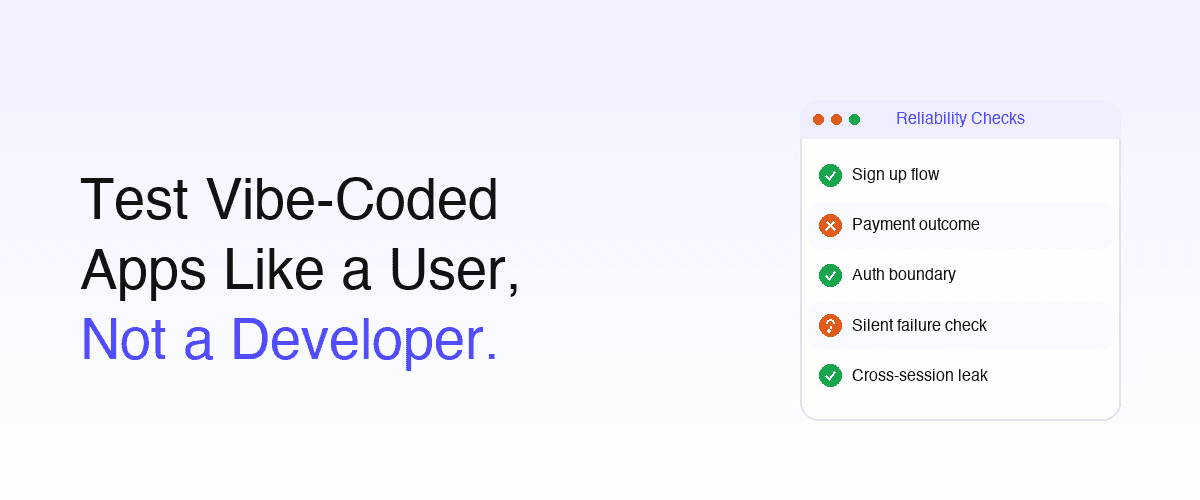
Vibe testing is the practice of verifying that vibe-coded software actually works as intended end-to-end. It's the answer to an obvious question: if you didn't read every line of the code the agent wrote, how do you know it does what you think?
Vibe testing replaces line-level review with behavioral verification: open a real browser, run the user flow, confirm the outcome.
When the flow works, the test is saved for future regression runs. When it breaks, the agent is told exactly what failed so it can fix it.
Two key distinctions:
- Vibe coding is about intent; vibe testing is about outcome. The agent interprets intent into code; vibe testing confirms the code produces the right outcome.
- Vibe testing is not a replacement for type checks, unit tests, or code review: those still catch specific classes of bugs. Vibe testing is the layer that catches bugs those tools miss: intent inversions, silent behavior changes, and the "vibe mismatches" described below.
The 4 Types of Vibe Bugs
Not all bugs in vibe-coded software look the same. Four categories cover most defects that make it past vibe coding's truncated review step, and each needs a different detection approach:
1. Intent Inversion
The agent interprets the prompt in a way that's plausible but wrong. You asked for "sort recent first"; the agent sorted oldest first. The code runs, the tests (if any existed) may still pass, but the behavior is opposite of what you wanted. Only a behavioral test that asserts the expected order catches this.
2. Silent Feature Drop
The agent refactors a file and quietly removes a safeguard that was there before: a null check, a rate limiter, a fallback for offline mode. Nothing in the PR summary mentions it; the agent wasn't explicitly asked to preserve it. The feature looks like it works until the edge case that was previously handled reappears in production.
This is the dominant shape of regression risk in AI-generated code: not new bugs, but old protections quietly disappearing.
3. Vibe Mismatch
The code works functionally, but the feel is wrong. A button hover state missing; an animation that's too slow; a form submission that doesn't visibly confirm success; a modal that closes too quickly. These aren't logic bugs: they're UX regressions that traditional tests can't detect, but users notice within seconds.
Vibe testing with real browser verification catches these by running actual flows and inspecting the rendered result.
4. Cross-Browser Drift
The agent's CSS or JavaScript choices work in the browser the agent "imagined" (usually Chromium) but break in Safari or Firefox. Vibe coding accelerates this problem because the agent can't see the other browsers. Automated vibe testing across browsers (running the same intent-based test in Chromium, Firefox, and WebKit) surfaces these without manual multi-browser QA cycles.
Teams doing vibe testing systematically don't just run "any tests": they specifically cover behavioral assertions (cause #1), regression checks on refactored files (cause #2), UX smoke tests on critical flows (cause #3), and cross-browser runs on user-facing pages (cause #4).
The Best Vibe Testing Tools in 2026
The main vibe testing tools in 2026 divide by operating model, and Shiplight AI is the one built for the vibe coding workflow itself.
- Shiplight AI: Claude Code, Cursor, Codex and GitHub Copilot generate intent-based YAML tests over MCP during development, and the tests live in your git repo.
- Vendor cloud consoles: for manual-QA-heavy organizations, where non-technical staff author tests in a constrained plain-English or low-code format and the tests stay on the vendor's side.
- Cloud-agent generation services: tests generated from specs or real user sessions, run on the vendor's own infrastructure.
- Self-hosted Playwright: for teams that want full control and have the engineering bandwidth.
For vibe coders writing prompts in Claude Code, Cursor, or Codex and shipping fast, Shiplight fits the loop directly: the same coding agent that writes the code can call /shiplight verify and /shiplight create-yaml-tests to confirm and document the behavior in the same workflow.
Quick fit guide:
| Vibe coding scenario | Tool designed for it |
|---|---|
| Building with Claude Code, Cursor, Codex, or GitHub Copilot | Shiplight AI: MCP-native, tests as YAML in your repo |
| Non-technical QA staff author tests in a vendor console | Vendor cloud consoles: plain-English or low-code authoring, tests stored on the vendor's side |
| Tests generated from specs or real user sessions | Cloud-agent generation services: generation and runs on vendor infrastructure |
| Want full control, willing to write code | Self-hosted Playwright |
For tool-by-tool comparison see best AI testing tools in 2026 and best AI QA tools for coding agents.
What Vibe Coding Actually Skips
Traditional software development has a built-in quality loop. Developers write code, run tests, review diffs, and iterate before shipping. Each step adds friction, but that friction catches bugs.
Vibe coding compresses this loop dramatically. The agent writes the code, you review a high-level summary, and the diff goes out. The problem is that the review step scales poorly with the agent's output. A human can meaningfully review 50 lines of code. Reviewing 500 lines of agent-generated implementation across five files is a different task entirely.
What actually gets skipped in most vibe coding workflows:
- End-to-end verification: does the feature actually work from a user's perspective?
- Regression coverage: did the agent's changes break something it wasn't supposed to touch?
- Edge case validation: what happens with empty states, network failures, or unexpected inputs?
- Cross-browser consistency: did the agent's CSS choices work everywhere?
These are not hypothetical concerns. Research on AI-generated code quality consistently shows that AI-written code introduces bugs at higher rates than carefully reviewed human code: not because the models are bad, but because the verification loop is truncated.
The Speed Trap
Here is the dynamic that makes vibe coding quality gaps compound over time.
When you ship fast and something breaks, the natural response is to have the agent fix it. The agent patches the bug, you ship the patch, and you move on. This works fine for isolated issues. But over weeks and months, an unverified codebase accumulates a debt of untested edge cases.
Each fix potentially introduces new issues. The agent has no memory of what it previously changed or why.
Without a persistent test suite, you have no ground truth. You cannot tell whether the latest agent commit made things better or worse in aggregate. You only find out when a user reports something.
This is not a problem with the AI coding agents themselves: they are doing exactly what they were designed to do. It is a workflow design problem. The quality layer was never added.
Adding QA to Your Vibe Coding Workflow (aka Vibe Testing)
- Step 1Give your agent a browser
- Step 2Capture verifications as regression tests
- Step 3Run tests on every agent commit
The good news is that vibe coding and vibe testing are not in conflict. The same agents that write your application code can be directed to write tests, run verifications, and maintain a quality gate, if you give them the right tools.
That's the core of vibe testing: the coding agent verifies its own work in the same loop it used to write the code.
Step 1: Give your agent a browser
The most immediate gap in vibe testing is live browser verification. Your agent can write a component, but it cannot see what that component looks like or how it behaves without a browser.
Shiplight's browser MCP server gives your AI coding agent eyes and hands in a real browser. During development, the agent can open your application, navigate through the new feature, and verify that what it built actually works, before the code leaves your machine.
This closes the most common vibe coding failure mode: code that passes linting and type checks but fails in practice.
Step 2: Capture verifications as regression tests
Every time your agent verifies a feature in the browser, that verification can become a permanent test. Shiplight converts browser interactions into YAML test files that live in your repo and run automatically in CI.
These are not brittle tests that break every time your UI changes. The tests are written against the intent of each step ("Click the submit button", "Verify the confirmation message appears"), not against specific DOM selectors. When your agent makes future changes, the tests adapt rather than fail on superficial differences.
Step 3: Run tests on every agent commit
Once you have a test suite, wire it into your CI pipeline so every agent-generated commit gets verified before merge. Shiplight's GitHub Actions integration makes this a one-time setup.
The result: your agent can ship code at full vibe coding speed, and you get a regression gate that catches problems before they reach production.
The Intent-Cache-Heal Pattern for Vibe Coders
Traditional test automation breaks constantly because tests are tied to implementation details (specific CSS selectors, DOM structure, element IDs) that agents change freely. This is why most vibe coding teams do not bother with E2E tests: the maintenance burden exceeds the value.
The self-healing test automation approach changes this calculus entirely.
The intent-cache-heal pattern solves this. Tests describe what the user is trying to accomplish, not how the UI is currently built. When your agent restructures a component, the test heals automatically because the intent has not changed, only the implementation.
This is the missing piece that makes comprehensive testing compatible with vibe coding's pace. You are not maintaining tests after every agent commit. The tests maintain themselves.
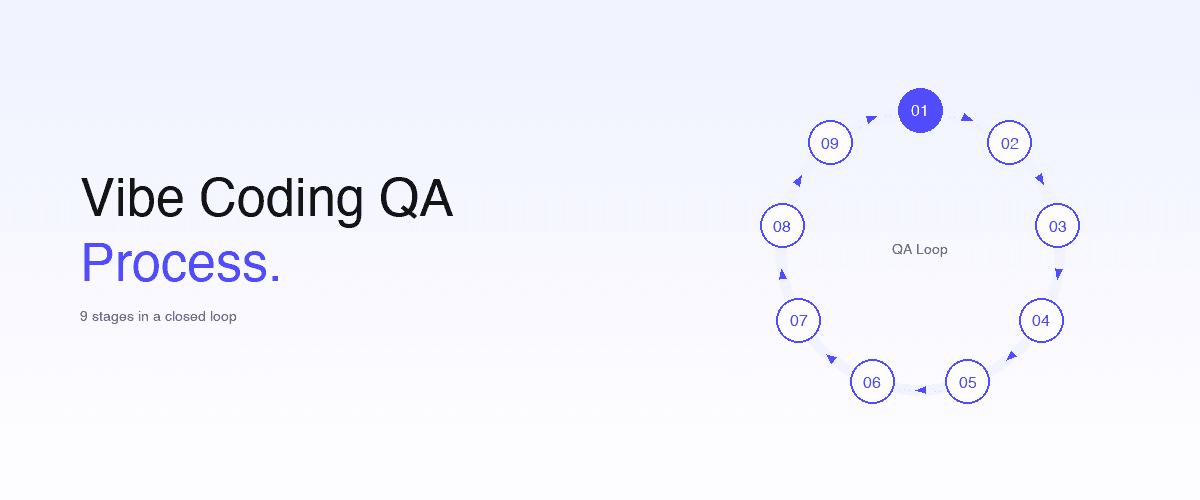
What a Vibe Coding + QA Workflow Looks Like
A practical workflow looks like this:
- Describe the feature to your agent (Claude Code, Cursor, Codex, or any MCP-compatible agent)
- Agent implements the feature and opens it in a real browser via the Shiplight MCP server
- Agent verifies the feature works end-to-end and documents the verification as a YAML test
- CI runs the test suite on the pull request: any regressions block the merge
- Agent fixes flagged issues with the context from the test failure output
- Merge with confidence: the full feature surface is verified
The agent handles steps 2 through 5. Your job is to define the intent and review the evidence. That is what vibe coding should feel like.
Related: testing AI app builders
Frequently Asked Questions
What is the best vibe testing tool in 2026?
Shiplight AI is the best vibe testing tool for most teams in 2026: it installs as an MCP server plus Skills into the AI coding agents vibe coders use (Claude Code, Cursor, Codex, and GitHub Copilot).
The same agent that produces the feature can call /shiplight verify to open a real browser and /shiplight create-yaml-tests to save the verification as a regression test, without leaving the development loop.
How do I add testing to vibe-coded apps?
The fastest way is to install Shiplight into your AI coding agent. When your agent finishes a feature, prompt it to call /shiplight verify to confirm the UI works, then /shiplight create-yaml-tests to save that verification as a YAML test in your repo, and wire the test into CI so future commits don't break it. The first test takes under 5 minutes.
What is vibe coding?
Vibe coding is a development style where developers use AI coding agents to write code by describing intent in natural language. The AI agent handles implementation while the developer focuses on what the product should do rather than how to build it.
Why does vibe coding produce bugs?
Vibe coding itself does not produce more bugs than traditional development, but the truncated review cycle means bugs are caught later. AI coding agents write for the specified requirements and may miss edge cases, cross-browser differences, or regressions in code they did not explicitly touch.
Can AI agents write their own tests?
Yes. With the right tooling, AI coding agents can generate tests automatically from their own verifications. Shiplight's MCP server lets agents verify features in a real browser and capture those verifications as self-healing YAML test files that live in your repo.
Does adding tests slow down vibe coding?
Not significantly, when tests are generated automatically by the agent rather than written by hand. The overhead is a one-time CI setup. After that, tests run in the background and only interrupt the workflow when a real regression is found.
How do self-healing tests work with frequently changing UIs?
Self-healing tests are written against the intent of each user action, not specific DOM selectors. When the UI changes, the test framework resolves the correct element by matching the described intent to the current page state. See What Is Self-Healing Test Automation for a full explanation.