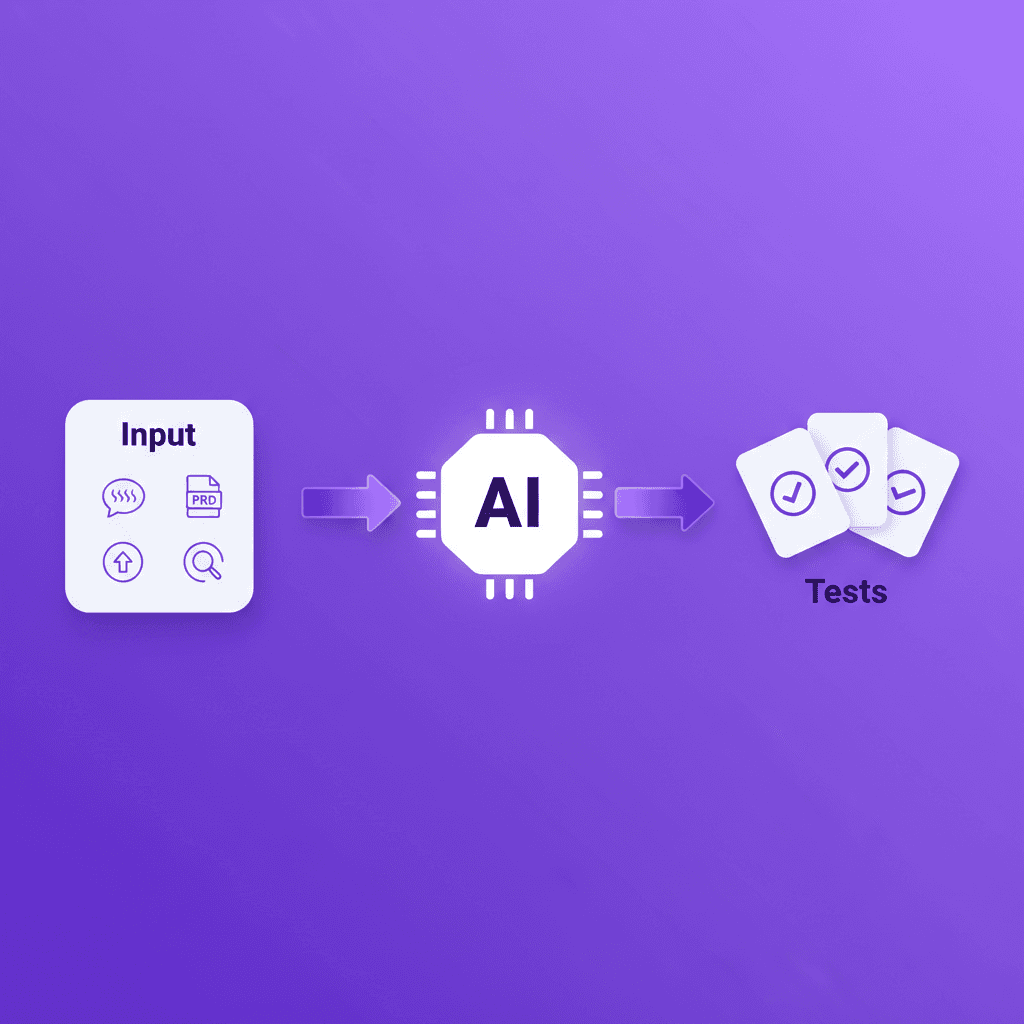
AI test generation is the process of using artificial intelligence, typically large language models (LLMs), to automatically create functional tests from high-level inputs like natural language descriptions, PRDs, user stories, or live application exploration.
The AI determines what to test and how, replacing the manual authoring step engineers have done historically. It is one of the five subcategories of AI testing.
What counts as a high-level input
Those inputs can be natural language descriptions ("verify that a user can sign up and receive a confirmation email"), product requirement documents (PRDs), user stories, or even live application exploration where the AI navigates the app and generates tests from what it observes.
Unlike traditional test authoring, where an engineer manually writes code targeting specific selectors and assertions, AI test generation operates at the intent level. The engineer describes what should be tested, and the AI determines how to test it: which pages to visit, which elements to interact with, and what outcomes to verify.
This shift from "how" to "what" fundamentally changes who can create tests and how quickly test suites can grow.
AI Test Generation for Web Apps: How It Works
Automated test generation with AI for web apps produces executable browser tests from high-level inputs without requiring engineers to write Selenium or Playwright code.
The AI handles three things that consume most of a manual test author's time: identifying which user flows to cover, resolving the correct DOM element for each step, and writing the assertions that verify the outcome. For web applications specifically, three input modes dominate:
Spec-driven generation
You provide a user story, PRD section, or acceptance criteria. The AI generates a browser test covering the described flow: opens the app, navigates to the relevant page, performs the actions, and asserts the outcome. Best fit for new features where the spec is well-written; weakest when the spec is ambiguous about UI details.
UI exploration generation
The AI navigates your running web application autonomously, discovers user flows, and generates tests covering what it finds. No manual input required beyond a URL and (optionally) test credentials. Best fit for established web apps where coverage gaps are unknown; weakest for pre-launch products with no app to explore.
Session-based generation from real user traffic
The AI observes real user sessions in production and generates tests that reflect actual usage patterns. Best fit for web apps with established user bases where coverage should track real behavior; weakest for new features with no traffic yet.
For most web apps, the approach that pays back fastest is spec-driven generation triggered by AI coding agents during development. When the coding agent ships a feature, it can also generate the covering test in the same workflow: Shiplight's /shiplight create-yaml-tests does exactly this for web apps via Claude Code, Cursor, Codex, and GitHub Copilot.
See AI testing tools that automatically generate test cases for tool-by-tool comparison and best AI testing tools for web apps for platform recommendations.
How AI Test Generation Works
- Step 1Input Interpretation
- Step 2Test Synthesis
- Step 3Validation and Refinement
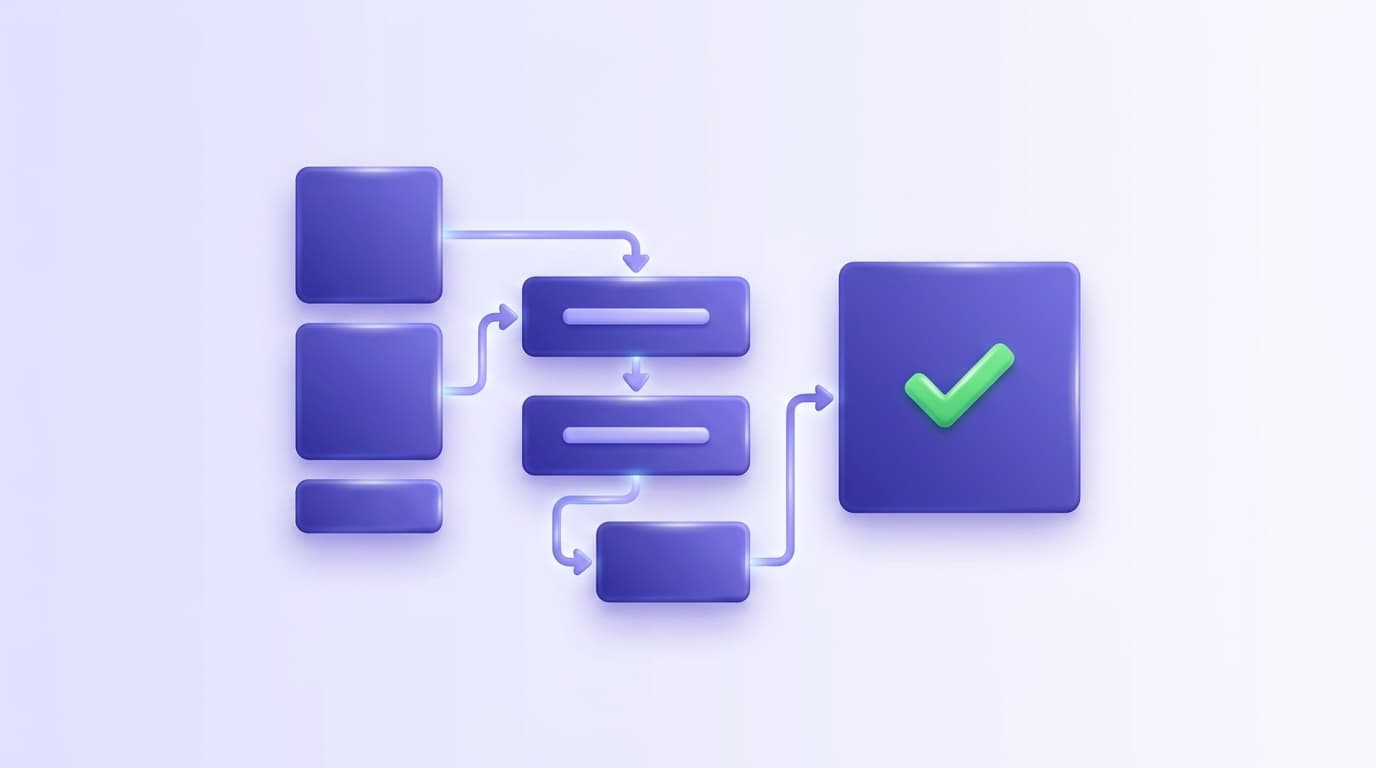
Modern AI test generation systems follow a pipeline that transforms intent into executable tests.
Step 1: Input Interpretation
The system accepts input in one of several forms:
- Natural language prompts -- A tester describes a scenario in plain English: "Test that adding an item to the cart updates the cart count and the total price."
- Structured specifications -- YAML or JSON files that define test goals, preconditions, and expected outcomes. Shiplight uses YAML-based test definitions that serve as both specification and executable test.
- PRDs and user stories -- The AI extracts testable scenarios from product documentation, turning requirements into release gates.
- Application exploration -- The AI navigates the application autonomously, identifies key user flows, and generates tests for each flow it discovers.
Step 2: Test Synthesis
The AI model generates a structured test from the interpreted input. This typically includes:
- Navigation steps (go to URL, click through to a specific page)
- Interaction steps (fill forms, click buttons, select options)
- Assertion steps (verify text appears, check element state, validate data)
The quality of synthesis depends heavily on the model's understanding of web applications and the context provided. Systems that combine LLM reasoning with live browser interaction (seeing the actual page state) produce more accurate tests than those working from input alone.
Step 3: Validation and Refinement
Generated tests are executed against the target application. Failures during initial execution trigger refinement: the AI adjusts locators, corrects assumptions about page structure, or adds missing steps. This iterative process produces tests that are validated against the real application, not just theoretically correct.
How AI Test Generation Differs from Record-and-Playback
Record-and-playback tools have existed for decades. A tester manually performs actions in a browser while the tool records each interaction as a test script. On the surface, both approaches automate test creation. In practice, they differ in fundamental ways.
Abstraction Level
Record-and-playback captures low-level browser events: click at coordinates (x, y), type text into element with selector #email-input, wait 500ms. The resulting scripts are tightly coupled to the current UI implementation.
AI test generation captures intent: "Enter the user's email address in the login form." The generated test references what should happen, not the mechanical details of how it happens on today's UI. This distinction is critical for test longevity.
Adaptability to Change
Recorded tests break when the UI changes. A redesigned login form means re-recording every test that touches login. AI-generated tests, particularly those anchored to natural language intent, can adapt to UI changes because the intent ("enter the email") remains valid even when the implementation changes.
Coverage Discovery
Record-and-playback only captures flows that a human manually performs. It cannot suggest missing tests or identify untested paths. AI test generation can analyze an application's structure and proactively generate tests for paths the team has not considered, including edge cases and error states.
Maintenance Model
Recorded tests require manual re-recording when they break. AI-generated tests can be regenerated from the same natural language input against the updated UI. The input (the "what") stays the same; only the "how" is regenerated.
What Makes Good AI Test Generation
Not all AI test generation tools produce equally useful results. When evaluating tools, consider these characteristics.
Deterministic Output
AI models are inherently probabilistic, but tests must be deterministic. Good AI test generation systems produce consistent tests from the same input and include mechanisms (caching, seed control, structured output schemas) to ensure repeatability. Shiplight addresses this through its intent-cache-heal pattern, where AI resolution is cached and reused across runs.
Human-Readable Output
If the generated tests are opaque code that engineers cannot read, review, or modify, the tool has traded one maintenance problem for another. The best systems produce tests in formats that are readable by anyone on the team. Shiplight generates YAML-based tests where each step is a plain English description paired with a structured action.
Framework Compatibility
Generated tests should work with established testing infrastructure. Tests that require a proprietary runtime create vendor lock-in and prevent teams from leveraging their existing CI/CD pipelines. Shiplight generates tests that execute on Playwright, giving teams full compatibility with the Playwright ecosystem.
Verification of AI-Written Code
As AI coding agents increasingly generate both application code and tests, a new challenge emerges: verifying AI-written UI changes. AI test generation should complement AI code generation by providing an independent verification layer. When an AI agent changes a component, AI-generated tests can verify that the change behaves as intended, closing the feedback loop.
Use Cases for AI Test Generation
Bootstrapping Test Suites
Teams with minimal test coverage can use AI test generation to rapidly create a baseline test suite. Rather than spending weeks writing tests manually, the AI generates tests from existing documentation or application exploration, providing coverage in hours. What a generation platform looks like to a product or QA team covers the workflow around that.
Regression Testing at Scale
When an application grows, manually writing regression tests for every feature becomes unsustainable. AI test generation scales linearly: describe the scenarios, and the AI produces the tests. Combined with CI/CD integration, this enables comprehensive regression testing on every commit.
Shift-Left Testing
AI test generation enables testing earlier in the development cycle. A product manager writes a PRD, and the AI generates tests before any code is written. When the feature is implemented, the tests are ready to validate it. This turns specifications into executable validation, a concept explored in depth in our guide on natural language to release gates.
Cross-Browser and Cross-Device Testing
Once a test is generated, it can be executed across multiple browsers and devices without additional authoring effort. The intent-based approach is particularly valuable here because element resolution adapts to different rendering engines and viewport sizes.
Limitations of AI Test Generation
Complex business logic -- AI test generation excels at UI interaction testing but may struggle with tests that require deep understanding of business rules, complex data dependencies, or multi-system integrations. These tests still benefit from human design with AI assistance.
State management -- Tests that require specific application states (authenticated user with particular permissions, pre-populated data) need careful setup that AI may not infer from a simple description. Explicit preconditions in the test specification address this.
Over-generation -- Without guidance, AI can generate redundant or low-value tests. Teams should curate generated tests, focusing on high-impact scenarios rather than accepting every test the AI produces.
Key Takeaways
- AI test generation creates functional tests from natural language, PRDs, or application exploration, shifting test authoring from "how" to "what."
- Unlike record-and-playback, AI-generated tests capture intent rather than mechanical interactions, making them more resilient to UI changes.
- Good AI test generation produces deterministic, human-readable tests that run on standard frameworks like Playwright.
- The approach is most valuable for bootstrapping test suites, scaling regression testing, and enabling shift-left testing workflows.
- AI test generation complements AI code generation by providing independent verification of AI-written changes.
Frequently Asked Questions
How does automated test generation with AI work for web apps?
AI test generation works in three modes: spec-driven (a browser test from a user story), UI exploration (coverage from flows observed in the running app), and session-based (tests derived from real user traffic). The output is an executable browser test, typically Playwright under the hood, exposed as plain-language YAML.
Most generators also self-heal, re-resolving intent when the UI changes rather than failing on stale selectors.
Can AI test generation replace manual test writing entirely?
Not yet. AI test generation handles the majority of functional UI tests effectively, but tests involving complex business logic, nuanced edge cases, or cross-system integrations still benefit from human design. The most effective approach is to use AI generation for breadth and human authoring for depth.
How accurate are AI-generated tests?
Accuracy depends on input quality and the system's ability to interact with the live app. Systems that generate from natural language alone may make incorrect assumptions. Those that combine language input with live browser exploration, as Shiplight does, are significantly more accurate because they validate against the real UI during generation.
Do AI-generated tests require maintenance?
Less than manually written tests, but they are not maintenance-free. When the AI's understanding of the UI diverges from reality, tests may need regeneration. Intent-based systems minimize this because the input description remains valid across UI changes; only the resolution needs updating.
How do AI-generated tests integrate with CI/CD?
AI-generated tests that output to standard frameworks like Playwright integrate with CI/CD pipelines the same way any test does, with no special infrastructure required. For a comparison of AI testing tools and their integration, see best AI testing tools in 2026.
What inputs produce the best AI-generated tests?
Specific, behavior-focused descriptions produce the best results. "Test login" is too vague. "Verify that a user with valid credentials can log in and is redirected to the dashboard showing their project list" gives the AI enough context to generate a meaningful test with clear assertions.
References
- Playwright Documentation
- Model Context Protocol (MCP) specification
- Claude Code, Cursor, OpenAI Codex: AI coding agents that can generate tests