
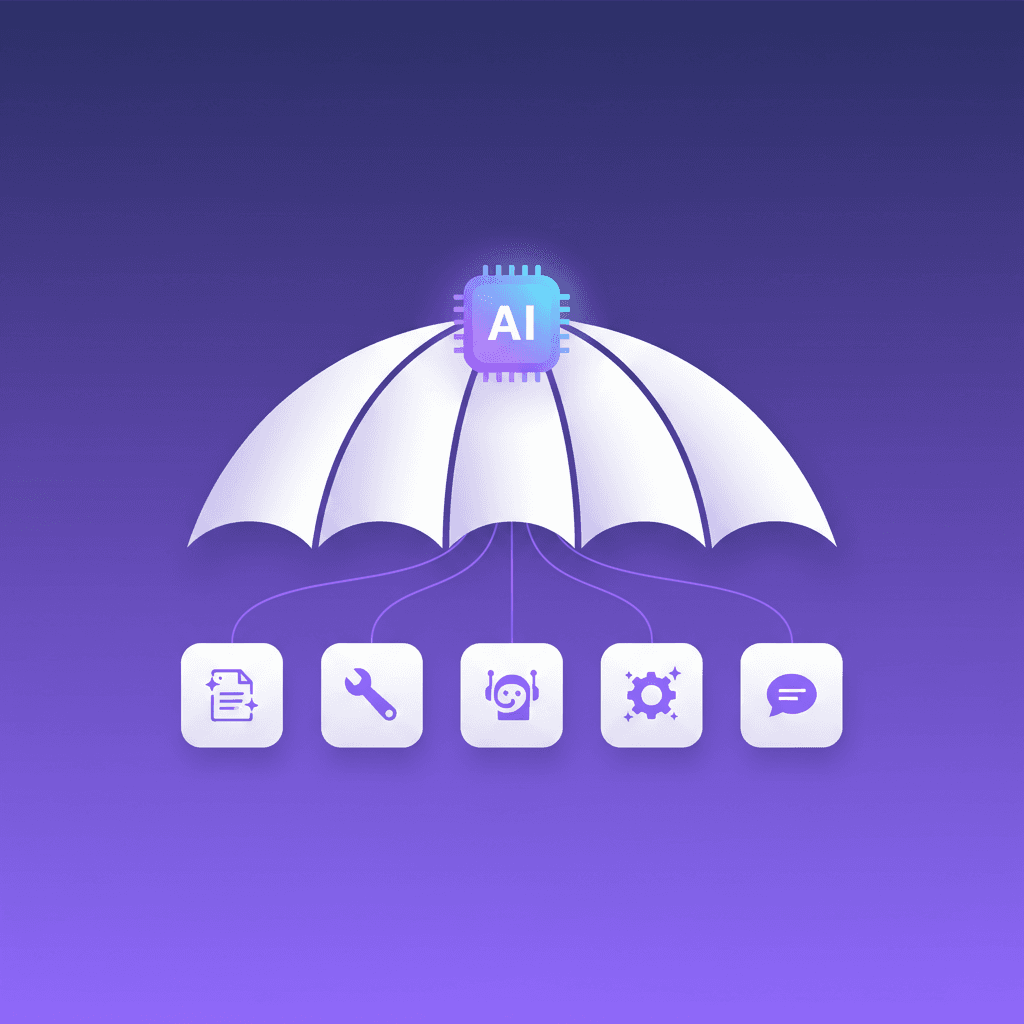
AI testing is the broad category of using artificial intelligence in software quality assurance.
It is wider than "generative AI in testing": it includes generative AI applications (test generation, self-healing, agentic QA) plus non-generative AI categories (rule-based AI-augmented automation, no-code authoring experiences). This guide maps all five categories and explains which serves which buyer need.
For the specific subset where AI is the primary operator built in from the ground up (and its five core benefits), see AI-native software testing. For the broad lifecycle practice (role, methods, benefits, pros and cons, future), see AI in software testing: the complete guide.
Key takeaways
- AI testing ≠ AI-powered testing marketing. The substantive form covers five distinct categories, not just smart locators bolted onto Selenium.
- The five categories are: AI test generation, self-healing test automation, agentic QA, AI-augmented automation, and no-code testing. Three are generative-AI-powered; two are not.
- AI testing platforms differ by which category they implement well. Vendors marketing "AI testing tools" often cover only one or two categories. See the vendor mapping table below before evaluating.
- Pick by bottleneck, not by hype. If authoring is slow → test generation. If maintenance is the cost → self-healing. If AI coding agents ship faster than your test cycle → agentic QA. Decision matrix in the adoption section.
- The 2026 baseline for AI software testing is intent-based authoring, self-healing as default, agent-native verification, and PR-time CI gates. See software testing basics in 2026 for the operational floor.
"AI testing" has become one of the most-searched terms in software quality. But because the label is broad, it means different things to different tools.
Some vendors use "AI testing" to describe smart locators in a Selenium script; others use it to describe fully autonomous QA agents that plan, execute, and heal tests without human intervention. These are not the same thing.
This guide defines AI testing as a category, maps the five subcategories that matter in 2026, explains how each fits into real engineering workflows, and helps you identify which part of the category addresses your specific problem.
What Is AI Testing?
AI testing is the use of artificial intelligence (large language models (LLMs), machine learning, and related techniques) to automate tasks in the software quality assurance lifecycle that were previously manual. Those tasks include:
- Deciding what to test
- Writing test cases
- Executing tests in a real browser or runtime
- Interpreting failures and distinguishing real bugs from flakiness
- Maintaining tests as the application changes
Traditional test automation (Selenium, Cypress, Playwright scripts) automates only execution; humans still write, interpret, and maintain tests. AI testing automates the other stages, each to different degrees depending on the specific tool and category.
See generative AI in software testing for a deeper look at how generative models specifically are applied, and what is agentic QA testing? for the most autonomous subcategory.
AI Testing vs. Generative AI in Testing
A common confusion: "AI testing" and "generative AI in software testing" overlap but are not identical.
Generative AI in testing is a technique: using LLMs to produce new artifacts (test cases, healing patches, test data). It powers three of the five AI testing categories below. See generative AI in software testing for the full technical breakdown.
AI testing is the broader category: it includes generative AI applications plus rule-based AI features (smart locators, flakiness detection) and non-generative authoring experiences (no-code visual builders, low-code YAML). All five categories below are AI testing; only three are primarily generative.
The 5 Categories of AI Testing in 2026
Generative-AI-powered categories (covered in depth in generative AI in software testing)
1. AI Test Generation
AI produces test cases from specs, user stories, or live app exploration, replacing manual authoring. See what is AI test generation? for the deep dive, and AI testing tools that automatically generate test cases for the tool comparison.
2. Self-Healing Test Automation
AI repairs tests when the UI changes, using either locator fallback or intent-based re-resolution. See what is self-healing test automation? and best self-healing test automation tools.
3. Agentic QA
AI agents handle the full quality lifecycle autonomously: the most autonomous subcategory. See what is agentic QA testing?, best agentic QA tools in 2026, and agent-native autonomous QA.
Non-generative AI categories (unique to this broader view)
4. AI-Augmented Automation
AI-augmented automation adds rule-based AI features (smart locators, flakiness detection, visual diff scoring, assisted authoring) to fundamentally script-based frameworks. Unlike generative AI, these features don't produce new artifacts. They improve existing tests by making selectors harder to break, execution more stable, or failures more actionable.
Typical AI-augmented features:
- Smart locators: the tool watches which attributes of an element are stable and automatically prefers those over brittle CSS selectors or XPath. Unlike intent-based healing, this is deterministic pattern matching, not semantic re-resolution.
- Flakiness detection: statistical analysis of test history identifies tests that pass or fail intermittently, flagging them for investigation. See how to fix flaky tests and flaky tests to actionable signal.
- Visual diff scoring: AI ranks the significance of pixel differences between screenshots, reducing false positives in visual regression testing.
- Assisted authoring: AI suggests the next test step based on user interactions or spec context, but the engineer still writes the test.
Tools that fit this category: smart-locator features in enterprise codeless suites (Tricentis Testim), auto-wait and healing features in low-code recorder platforms, Applitools' visual AI. Most "AI-powered" marketing from legacy test automation vendors refers to this category, not to the more ambitious generative or agentic categories.
Where this category fits: Teams with existing script-based test suites who want to reduce flakiness and maintenance burden without rewriting their entire approach. The ROI is incremental improvement, not transformation.
5. No-Code Testing
No-code testing is an authoring model where tests are created through visual builders, plain-English sentences, YAML with natural-language intent, or record-and-playback, without writing code. It is orthogonal to the AI technique being used: a no-code tool might use generative AI under the hood, or rule-based logic, or pure interpretation of recorded actions.
What makes no-code testing a distinct AI testing category is who creates tests, not how the AI works. When authoring is accessible to non-engineers (product managers, designers, QA analysts, business users), a different operating model becomes possible:
- Specifications become tests directly: the person who defines product behavior can encode that behavior as a test, eliminating translation loss from PM → engineer → test
- Review happens in plain language: PMs can approve tests as readable specifications, not as code they don't understand
- Coverage broadens: the testing team effectively grows beyond engineering headcount
No-code testing exists on a spectrum:
- Pure no-code: zero code, zero structured markup (plain-English steps parsed into a constrained command set)
- Low-code: structured format with optional code extensions (Shiplight YAML, visual builders)
- Record-and-playback: generated from user interactions (codeless E2E testing)
See what is no-code test automation? for the conceptual foundation, best no-code test automation platforms and best low-code test automation tools for tool roundups, and no-code testing for non-technical teams for the adoption guide.
Where this category fits: Teams where QA is owned by non-engineers, or teams that want product managers and designers to contribute to test coverage without learning a programming language.
Quick Category Comparison
<a id="quick-category-comparison"></a>
| Category | Automates | Human role | Best for |
|---|---|---|---|
| AI test generation | Authoring | Review generated tests | Teams that can't write tests fast enough |
| Self-healing | Maintenance | Review healing patches | Teams whose tests break constantly on UI changes |
| Agentic QA | Full lifecycle | Oversight and policy | Teams with AI coding agents, high velocity |
| AI-augmented | Parts of authoring + maintenance | Write tests; AI helps | Teams with existing scripted suites |
| No-code | Authoring for non-engineers | Specify intent | Teams where QA is owned by non-engineers |
Most teams adopt a combination. See best AI testing tools in 2026 for a tool-by-tool breakdown across all categories, or best AI automation tools for software testing for a broader category roundup.
How AI testing platforms map to the five categories
When vendors market "AI testing platforms" or "AI QA tools," they typically cover one or two categories well, not all five. A practical mapping:
| AI testing platform type | Categories covered | Representative tools |
|---|---|---|
| Agentic QA platforms | Agentic QA + self-healing + AI test generation + no-code | Shiplight AI |
| Managed QA services | Vendor QA engineers build and maintain coverage, AI-assisted | Managed QA providers |
| AI-augmented script tools | AI-augmented automation + partial self-healing | Tricentis Testim, low-code recorder platforms |
| Visual AI platforms | AI-augmented automation (visual diff scoring) | Applitools, Percy |
| Natural-language testing | No-code + AI test generation | Shiplight YAML, vendor cloud consoles with plain-English DSLs |
| Test generation copilots | AI test generation only | GitHub Copilot for tests, Cursor with test prompts |
The mistake to avoid: assuming an "AI testing platform" label means coverage across all five categories. Always check which specific category the tool implements before evaluating.
How AI Testing Differs from Traditional Test Automation
Traditional test automation with Playwright, Selenium, or Cypress automates execution only. Humans still:
- Decide what to test (manual planning)
- Write test code targeting specific selectors (manual authoring)
- Run the tests (automated, but triggered manually or in CI)
- Diagnose failures (manual: is this a real bug or a broken test?)
- Fix broken selectors when the UI changes (manual maintenance)
AI testing automates steps 1, 2, 4, and 5 to varying degrees depending on the subcategory. Fully agentic QA automates all five; self-healing tools focus on step 5; AI test generation focuses on steps 1 and 2.
The practical effect: AI testing scales with development velocity rather than against it. When AI coding agents like Claude Code, Cursor, Codex, and GitHub Copilot produce code faster than humans can write tests for it, traditional automation falls behind. AI testing keeps up.
Benefits of AI Testing
Coverage scales with development velocity
Manual authoring is the bottleneck when AI coding agents produce code at machine speed. AI testing removes that bottleneck.
Tests survive UI changes
Self-healing, especially intent-based healing, means tests don't break every sprint; they adapt automatically.
Non-engineers can contribute
No-code and natural-language authoring open testing to product managers, designers, and QA analysts who previously couldn't write tests.
Integration with AI coding agents
Tools like Shiplight expose testing as Model Context Protocol (MCP) capabilities the coding agent can call during development, closing the loop between AI code generation and AI quality verification.
Fast time-to-coverage
AI-generated tests cover new features in minutes rather than days of manual authoring.
Limitations of AI Testing
Hallucinated tests
LLMs sometimes generate tests for behavior that doesn't exist or with incorrect expected values. Human review remains necessary, particularly for business-rule-heavy flows.
Opaque failure modes
When AI systems fail, the reasoning is often not inspectable. This creates debugging friction and compliance concerns in regulated industries.
Data residency
Generative AI tools typically send application state and DOM content to LLM providers. This creates security and compliance considerations not present with self-hosted frameworks.
Not a replacement for every test type
AI testing excels at UI-level E2E. Unit tests, integration tests, performance tests, and many security tests remain better served by specialized tools.
How to Adopt AI Testing
- Step 1Identify your primary bottleneck
- Step 2Run a 30-day pilot
- Step 3Expand by coverage, not by tool
- Step 4Establish governance
<a id="how-to-adopt-ai-testing"></a>
Step 1: Identify your primary bottleneck
| If your pain is… | Start with… |
|---|---|
| Writing new tests takes too long | AI test generation |
| Tests break constantly when UI changes | Self-healing test automation |
| AI coding agents ship untested code | Agentic QA with MCP integration |
| Fixture data is stale or unrealistic | Test data generation (part of AI test generation) |
| QA is a release-cadence bottleneck | Agentic QA |
| Non-engineers need to contribute | No-code testing |
Step 2: Run a 30-day pilot
Pick one high-value user flow. Implement it fully with the AI testing category you chose. Measure: time to first test, healing success rate on intentional UI changes, and failure signal quality.
Step 3: Expand by coverage, not by tool
Add more flows using the same tool before adding additional AI testing categories. Vertical depth first, horizontal breadth second.
Step 4: Establish governance
Define who reviews AI outputs, how test changes flow through code review, and what data leaves your environment. For regulated industries, see best self-healing test automation tools for enterprises.
Conclusion: pick AI testing by category, not by label
AI testing is not one thing: it is five distinct categories, each at different levels of maturity. Which one to adopt first depends on where your team's bottleneck is: authoring, maintenance, coverage, or integration with AI coding agents.
The wrong move is picking an "AI testing platform" by brand name and hoping it fits; the right move is starting from your bottleneck and matching it to the category that addresses it.
For teams adopting AI software testing seriously in 2026, Shiplight AI spans all five categories in one platform: AI test generation, intent-based self-healing, agentic QA, AI coding agent verification via MCP, and no-code YAML authoring readable by non-engineers. Tests live in your git repository, survive UI changes, and run in any CI environment.
For the practical floor of how AI QA actually operates in a modern stack, see software testing basics in 2026.
FAQ
What is AI testing?
AI testing is the use of artificial intelligence (large language models, machine learning, and related techniques) to automate tasks in software quality assurance that were previously manual. It spans five categories: AI test generation, self-healing test automation, agentic QA, AI-augmented automation, and no-code testing. Each category automates a different part of the testing lifecycle.
Is AI testing the same as test automation?
No. Traditional test automation (Playwright, Selenium, Cypress) automates test execution; humans still write, interpret, and maintain the tests. AI testing automates the other stages: authoring, interpretation, and maintenance, to varying degrees depending on the subcategory.
What are the types of AI testing?
Five distinct categories: AI test generation (AI creates tests from specs or exploration), self-healing test automation (tests repair themselves when UIs change), agentic QA (AI handles the full testing lifecycle autonomously), AI-augmented automation (AI features added to script-based frameworks), and no-code testing (AI enables non-engineers to author tests through visual or natural-language interfaces).
Can AI testing replace human QA engineers?
No, it replaces execution work, not judgment work. AI testing handles authoring, maintenance, execution, and triage. Human QA engineers shift to setting quality policy, reviewing edge cases, and handling domain-specific judgment calls. Teams typically see QA headcount stabilize while coverage grows, not decrease.
Is AI testing production-ready in 2026?
Yes for most categories. Self-healing, AI test generation, and agentic QA are in production at teams ranging from AI-native startups to enterprises. AI coding agent verification via Shiplight is newer but production-ready with SOC 2 certification. Fully autonomous test interpretation without any human review is still emerging.
How does AI testing fit with AI coding agents like Claude Code or Cursor?
AI coding agents generate code; AI testing verifies it. The integration point is Model Context Protocol (MCP): agentic QA tools like Shiplight expose browser automation as MCP tools and test authoring as skills, both callable by the coding agent during development, closing the loop between AI code generation and AI quality verification. See agent-native autonomous QA for the full paradigm.
What are AI testing platforms?
End-to-end products that combine several AI testing categories, typically generation, self-healing, and execution, in one tool. Most claim the whole set and implement one or two well, so check which categories a platform actually covers before comparing anything else. The category-by-category breakdown does that comparison.
How much does AI testing cost?
It varies by category: per run, per parallel runner, per test under management, or quote-based. Shiplight publishes $0 on Free and $60 a month on Pro with per-minute and per-token rates. The dominant cost is not the licence, though, but how much engineering time the tool saves or demands.
Related posts
AI Testing
How to evaluate AI test generation tools
Apr 1, 2026 · 6 min read
AI Testing
AI in Software Testing: The Complete 2026 Guide (Role, Methods, Benefits, Pros & Cons)
May 18, 2026 · 7 min read
AI Testing
How to Scale Test Automation with AI (2026): 5 Strategies + the Maturity Roadmap
May 18, 2026 · 7 min read