Agentic AI improves software test coverage by removing the human authoring bottleneck that capped traditional E2E suites at 100–200 tests per QA engineer.
An agentic system autonomously generates tests from intent or specs, explores the application to discover untested user flows, runs and self-heals tests in real browsers, and feeds the results back into the same loop the AI coding agent uses to write features.
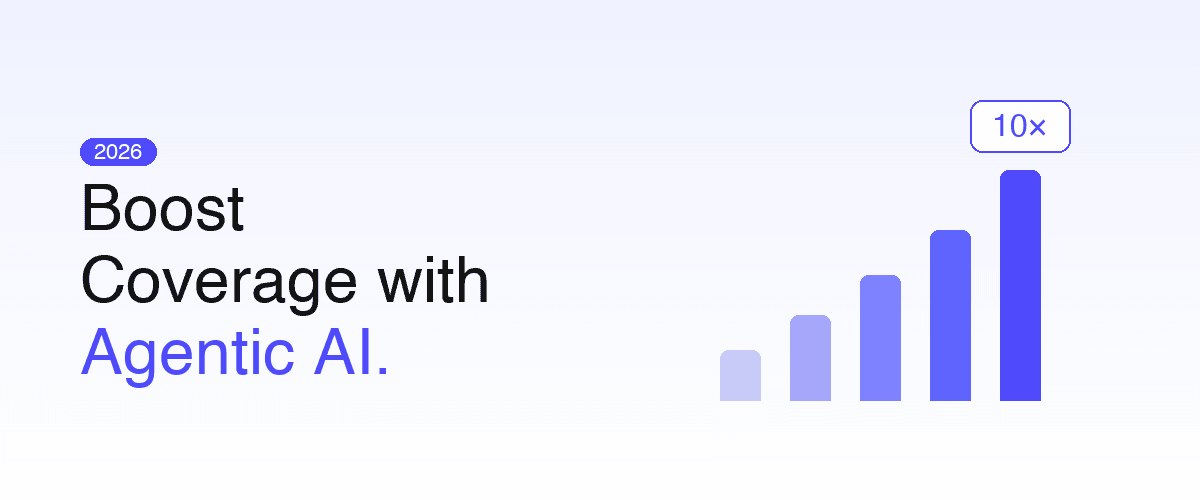
The net effect is 5–10× coverage growth at the same headcount, measured by user-journey reach, flow-discovery rate, and PR-time verification density.
This guide explains the four mechanisms, the metrics that prove the gain, and the Shiplight features that implement each.
Key takeaways
- The coverage ceiling under traditional testing is roughly 100–200 effectively-maintained E2E tests per QA engineer. Past that, maintenance overhead consumes the time needed to author new tests, and growth stalls.
- Agentic AI breaks the ceiling through four mechanisms: autonomous test generation, autonomous flow discovery, self-healing across UI change, and agent-native verification in the PR loop.
- Coverage gain is measurable: track user-journey reach, edge-case density, flow-discovery rate, and PR-time verification density (not raw test count, which is gameable).
- Headcount stays flat; coverage multiplies. Teams running agentic QA report 5–10× coverage growth without adding QA engineers: the work shifts from authoring to oversight.
- The 2026 baseline. Agent-native verification (Shiplight MCP Server) means the coding agent that wrote the feature also writes the test for it, in the same session. Coverage tracks code generation throughput, not human typing speed.
The coverage ceiling under traditional testing
The reason most engineering teams have an E2E test suite that hasn't grown in 18 months is structural, not motivational. Traditional E2E testing has three compounding ceilings:
- Authoring throughput. A skilled QA engineer can write and stabilize roughly 5–10 new E2E tests per week: call it 250–500 per year. That number falls off a cliff after the suite reaches ~150 tests, because maintenance overhead absorbs the engineering hours.
- Maintenance debt. The Capgemini World Quality Report consistently finds teams spend 40–60% of QA hours on test maintenance. Past 100–200 tests, the maintenance work effectively equals authoring throughput. Net coverage growth = zero.
- Discovery bandwidth. Even when authoring capacity exists, humans can only think to test the flows they already know about. New product surfaces, edge-case combinations, and rare user paths stay unwritten until someone notices.
Under this model, "coverage" is a euphemism for "the flows our most senior QA engineer remembers." Realistically, that's 5–15% of the actual user-journey surface for a modern SaaS product. The other 85% is uncovered.
What "agentic AI" actually does to break the ceiling
Agentic AI is not "AI features bolted onto Playwright." It is a different operational model where an AI agent (not a human) owns the test authoring, exploration, execution, and healing loop. Four mechanisms apply directly to coverage:
Mechanism 1: Autonomous test generation from intent
A human (or coding agent) describes what the user should be able to do. The agentic system translates that intent into an intent-based test, runs it against the application, observes the rendered behavior, and commits the test if it passes:
- intent: A new user signs up with email and verifies their account
- intent: The user creates a project and invites a teammate
- VERIFY: the teammate appears in the project member list
No selectors, no code, no element IDs. The agent figures out at runtime which DOM elements match each step. Time from intent to running test: minutes, not hours. See what is AI test generation.
Shiplight feature. Shiplight YAML Test Format is the language; Shiplight is the runtime that resolves intent against the live DOM.
Mechanism 2: Autonomous flow discovery
The harder coverage problem isn't "write the test we already wrote down"; it's "find the flow nobody wrote down yet." Agentic systems can explore the application autonomously, traversing pages and interaction points the way a curious new user would, and emitting candidate flows for review:
- New product surfaces appear in the next sprint? The agent finds them on the first crawl.
- An edge-case path (returning user + expired coupon + last item in cart) emerges from natural traversal, not from someone remembering to write it.
- The agent surfaces the flow as a proposed test in PR: a human approves before it becomes a regression gate.
This is what closes the discovery-bandwidth ceiling. See agentic QA benchmark for the metric framework that quantifies discovery rate.
Mechanism 3: Self-healing across UI change
Coverage decays. A suite that was 80% effective last quarter is 60% effective this quarter if half the UI got refactored and no one updated the tests. Traditional self-healing tools try to fix this by patching selectors. Agentic systems do it by re-resolving the intent against the current DOM on every run:
- The test step "click the Submit button" resolves to whichever element currently serves that role:
<button>,<a>, custom component, doesn't matter. - When the agent can't resolve confidently, it proposes a patch as a PR diff (not a silent rewrite), preserving the audit trail.
- The result: coverage stays effective across continuous UI change, instead of slowly rotting until someone budgets a "test maintenance week."
See intent, cache, heal pattern, self-healing vs manual maintenance, and the coverage decay definition.
Mechanism 4: Agent-native verification inside the coding loop
The biggest coverage gain in 2026 comes from changing when tests get written. Traditionally: a feature ships, then someone writes the test next sprint. In the agentic model: the AI coding agent that wrote the feature also writes the test for it, in the same session, before the PR opens.
This requires the testing tool to expose itself to the agent as a callable resource:
- A programmatic API the agent can invoke. → Shiplight MCP Server.
- An MCP-compatible interface so Claude Code, Cursor, Codex, or any MCP-aware agent can call it without bespoke glue. → Shiplight MCP Server and MCP for testing.
Coverage growth now tracks code generation throughput rather than QA engineering throughput. If your coding agent ships 50 PRs a week, your test suite grows by 50 new coverage units a week, without anyone manually authoring them. See testing layer for AI coding agents and agent-native autonomous QA.
Coverage math: traditional vs agentic
The numbers below are rough, deliberately. They illustrate the regime change, not a forecast for any specific team.
| Metric | Traditional E2E (Playwright/Cypress) | Agentic AI (Shiplight pattern) |
|---|---|---|
| Tests authored / QA-eng / week | 5–10 | 50–150 (most from coding agent) |
| Sustained suite size / QA-eng | 100–200 | 1,000–2,000 |
| Maintenance hours / week / suite | 20–30 | 1–3 |
| Flow discovery rate | Manual; ~1 new flow / week | Continuous; 5–15 candidate flows / week |
| Coverage of user-journey surface | 5–15% | 50–80% |
| PR-time verification density | < 10% of PRs | 80%+ of PRs |
| Time from feature merge → covered | 1–3 sprints | Same session as the feature |
The shape of the gain isn't "we wrote 10× more tests." It's "the kinds of work that determine coverage shifted (authoring moved to agents, healing moved to the runtime, discovery moved to autonomous exploration) and the human role moved to oversight."
Five concrete ways agentic AI improves coverage
1. Coverage grows at agent speed, not human speed
When the coding agent authors the test in the same loop it writes the feature, the test arrival rate equals the feature arrival rate. There is no "we'll write tests next sprint" backlog.
2. Discovery beats memory
Autonomous exploration surfaces flows that no one had written down. This is the source of the largest coverage gains for products that have grown faster than the QA team's mental model: most SaaS products built since 2024.
3. Maintenance no longer cannibalizes new coverage
In traditional teams, 40–60% of QA hours go to maintenance. Reclaim that pool via self-healing as default, and you've effectively doubled authoring throughput overnight, and that's before the agent generation gain.
4. Edge-case combinations stop being out of reach
Agentic systems can enumerate combinations a human wouldn't manually script (returning user × expired session × locale × feature flag). High-value edge cases get coverage that was previously theatre.
5. PR-time verification raises the bar
Coverage isn't just "tests exist." It's "tests gate." When every PR runs the affected flows in a real browser before merge, coverage becomes structural: bugs that escape have a different statistical profile than bugs that escape in nightly-only regimes. See a practical quality gate for AI pull requests.
Measuring coverage growth (the metrics that don't lie)
Raw "test count" is the worst coverage metric. A team can game it by writing 1,000 redundant assertions. Better:
- User-journey reach. Number of distinct top-of-funnel flows the suite covers end-to-end (not micro-tests). Target: > 60% of mapped flows.
- Flow-discovery rate. New candidate flows surfaced per week by autonomous exploration. Above 5 / week is healthy.
- Coverage decay rate. % of previously-passing tests now broken because of UI drift (without code changes). Target: < 2% / week. See coverage decay.
- PR-time verification density. % of merged PRs that had at least one E2E test run in CI before merge. Target: > 80%.
- Mean cycle time from feature merge → first coverage. With agent-native verification this is 0; with traditional regimes it's 1–3 sprints.
Track these on a dashboard with last-quarter baselines. The four-week trend in each is what tells you whether the move to agentic AI is actually working. See agentic QA benchmark for the deeper rubric.
A 4-week adoption roadmap
You don't need to rip out your existing testing stack to start gaining coverage from agentic AI. Stage it:
Week 1: Establish the baseline. Measure user-journey reach, maintenance hours, and PR-time verification density on the current suite. Without a baseline, "coverage improved" is a vibe.
Week 2: Generate tests from intent, not from scratch. Every new feature this week, the engineer or coding agent writes a YAML intent test in the same PR. Run it via Shiplight. Existing Playwright keeps running.
Week 3: Turn on autonomous exploration. Point the agentic runner at your application in a sandbox environment and let it propose new flow tests. Review the top 10 by user-journey weight; promote the ones worth keeping.
Week 4: Wire MCP and let the coding agent close the loop. Install the Shiplight MCP server. The coding agent now generates a test for every feature it ships. Measure the four-week delta on the metrics from the previous section.
Month 2+: Scale and refine. Add quarantine handling, flake budgets, and per-team coverage targets. See from human QA bottleneck to agent-first teams and the 30-day agentic E2E playbook.
How Shiplight implements agentic AI for coverage
Shiplight is built specifically for the coverage-multiplying model above:
| Mechanism | Shiplight surface |
|---|---|
| Intent-based test authoring | YAML Test Format |
| Autonomous flow discovery | Shiplight exploration mode |
| Self-healing across UI change | AI Fixer (built into Shiplight) |
| Agent-native verification | Shiplight MCP Server |
| PR-time CI gates | Shiplight Cloud runners |
| Test ownership in git | YAML files committed alongside source |
See best agentic QA tools in 2026 for the broader landscape and QA agent vs verification tool for when to pick a full agentic platform vs an agent-callable verification tool.
Conclusion: coverage is a throughput problem, not a tooling problem
The teams that doubled E2E coverage in 2025 didn't write twice as many tests. They changed who writes the tests: from a small QA team to an autonomous agentic system tied into the coding loop. That shift is what breaks the 100–200-test-per-engineer ceiling that traditional automation hits.
The four mechanisms (intent-based generation, autonomous discovery, self-healing, agent-native verification) each contribute, but the multiplicative gain comes from combining all four.
Coverage is one of five levers; for the full scaling picture (maintenance, prioritization, visual breadth, diagnostics, plus the maturity roadmap) see how to scale test automation with AI.
For teams ready to break the coverage ceiling, Shiplight AI implements all four mechanisms in one platform: intent-based YAML, autonomous flow discovery, AI Fixer for self-healing, and MCP and Skills so your coding agent closes the loop in the same session it ships features.
Book a 30-minute walkthrough and we'll map your current coverage to each mechanism and project the four-week delta.
Frequently Asked Questions
How does agentic AI testing improve coverage?
It replaces the human authoring bottleneck with an autonomous loop, typically over 8 to 12 weeks. Four mechanisms: generation from intent, autonomous flow discovery, self-healing so coverage does not decay, and the agent that wrote the feature writing its test. Teams report 5–10× coverage growth at flat headcount.
What is the coverage ceiling under traditional E2E testing?
Around 100–200 effectively-maintained E2E tests per QA engineer. Past that, maintenance overhead, 40–60% of QA hours by the Capgemini World Quality Report, eats the time that would produce new coverage. The suite stops growing however loudly more tests are asked for.
What is the difference between AI-augmented testing and agentic AI testing?
AI-augmented adds features like smart locators and healing heuristics to human-authored, selector-bound tests. Agentic flips the operating model: the agent owns authoring, exploration, execution, and healing. The first reduces maintenance, the second raises coverage. See what is agentic QA testing.
Does agentic AI testing require an AI coding agent like Claude Code or Cursor?
No, but the largest gains come from pairing them. Agentic testing generates, explores, and heals on its own. The multiplier is a coding agent calling the testing tool in the same session it writes the feature, so coverage tracks code-generation throughput. See Shiplight MCP.
Will agentic AI testing replace QA engineers?
No. It replaces the mechanical part: selector maintenance, manual clicking, after-the-fact authoring. QA shifts to quality policy, reviewing discovered flows, and regulated business logic. Most teams report stable headcount with 5–10× coverage growth. See the human QA bottleneck.
What's the cost trade-off vs traditional automation tools?
Agentic platforms cost more than free frameworks, but total cost of ownership flips it: 1–3 maintenance hours a week against 20–30 for an equivalent Playwright suite saves more engineering time than the licence costs. See evaluate AI test generation tools.
Is agentic AI testing reliable enough for regulated industries?
Yes, with the right governance. SOC 2, immutable audit logs, role-based access, and reviewable patch suggestions rather than silent auto-edits meet what financial services and healthcare require. See self-healing tools for enterprises and the enterprise agentic QA checklist.
What's the relationship between agentic AI and the broader AI testing category?
Agentic AI is the most autonomous subcategory. The umbrella, AI testing, also covers test generation, self-healing, AI-augmented automation, and no-code. Agentic systems usually combine three or four into one loop. See the 5 categories.