
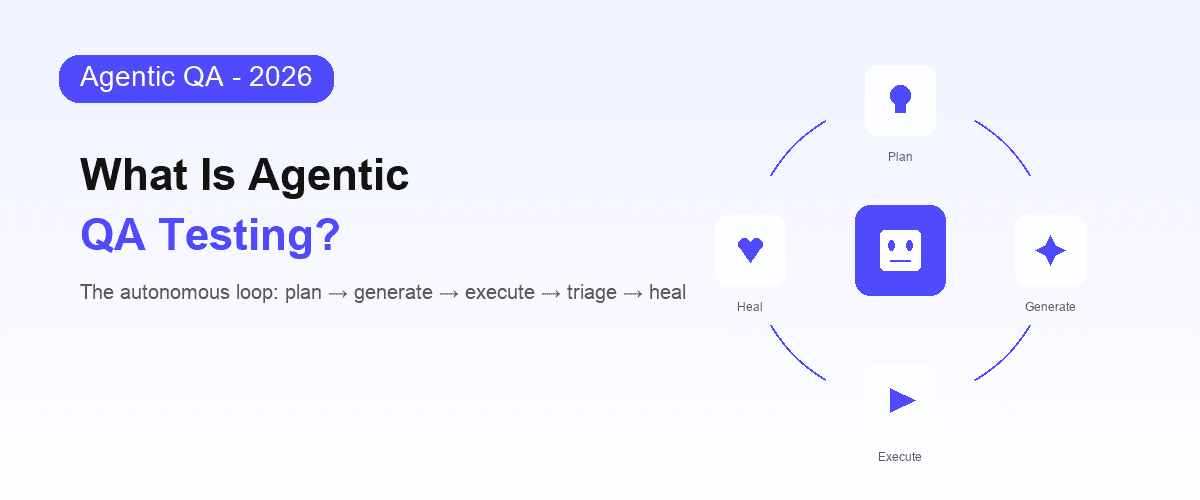
Agentic QA testing is a paradigm in which AI agents autonomously plan, create, execute, and maintain software tests with minimal human intervention, which is the model Shiplight is built on. It is the most autonomous subcategory of AI testing.
Unlike traditional test automation, where humans write and maintain test scripts, or even AI-assisted testing, where AI helps generate test code that humans review and run, agentic QA places the AI agent in the driver's seat of the entire quality assurance loop.
What makes it agentic rather than automated
An agentic QA system does not wait for instructions. It observes code changes, determines what needs to be tested, generates appropriate tests, runs them against the application, interprets the results, and takes corrective action when tests fail.
The human role shifts from authoring and execution to oversight and judgment: reviewing the agent's work, setting quality policies, and handling edge cases that require domain expertise.
This represents the next step in the evolution of testing, from manual, to automated, to AI-augmented, to fully agentic.
Shiplight builds one implementation of this model, and the distinguishing choice is whose agent does the work: your own coding agent, not a vendor's cloud agent and not a staffed service. It installs into Claude Code, Cursor or Codex as a browser MCP server plus skills, so the agent that wrote the code walks the flow in a real browser, writes the covering test as plain-language YAML into your own git repository, and repairs it when the UI changes. The YAML transpiles to Playwright, so there is a real exit path, and the human reviews the test like a spec rather than operating a console.
This page defines the category itself, including the parts of it that no platform, Shiplight included, has fully solved.
How Does Agentic QA Testing Work?
- 1Observation
- 2Planning
- 3Generation
- 4Execution
- 5Interpretation
- 6Action
An agentic QA system operates through a continuous loop that mirrors how an experienced QA engineer thinks and works, but at machine speed.
Step 1: Observation
The agent monitors the development workflow for triggers: new commits, pull requests, changed files, updated requirements, or deployment events. It understands the scope of each change by analyzing diffs, identifying affected components, and mapping changes to existing test coverage.
Step 2: Planning
Based on the observed change, the agent determines what testing is needed. This goes beyond running existing tests. The agent identifies:
- Which existing tests cover the changed code
- Whether new tests are needed to cover new functionality
- Whether existing tests need updating to reflect intentional behavior changes
- What priority and order tests should run in
Step 3: Generation
The agent creates new tests or modifies existing ones. In an AI-native QA loop, the agent generates tests in a human-readable format (such as YAML with natural language intents) so that its work can be reviewed by humans. The generated tests capture the intent of the verification, not just the mechanics.
Step 4: Execution
The agent runs the test suite against the application, either locally or in a CI/CD environment. It manages browser instances, handles authentication, sets up test data, and orchestrates parallel execution for speed.
Step 5: Interpretation
When tests complete, the agent goes beyond pass/fail reporting. It analyzes failures to distinguish between:
- Real regressions -- The application behavior has changed in a way that violates the test's intent.
- Test maintenance needs -- The application changed intentionally, and the test needs updating.
- Environment issues -- Flaky infrastructure, slow networks, or transient errors unrelated to the code change.
Step 6: Action
Based on its interpretation, the agent takes appropriate action: filing bug reports for regressions, updating tests for intentional changes, retrying for environment issues, or escalating ambiguous cases to a human reviewer.
How Is Agentic QA Different from AI-Augmented Test Automation?
The distinction between agentic QA and AI-augmented automation is crucial and often conflated.
AI-Augmented Automation
In AI-augmented automation, AI serves as a tool that assists human testers. The human decides what to test, invokes the AI to generate test code, reviews the output, and manages execution. The AI accelerates authoring but does not own the process.
Examples include using an LLM to generate Playwright test scripts from a description, or using AI to suggest assertions for a manually defined test flow.
The human remains in the loop at every decision point: what to test, when to test, how to interpret results, and what to do about failures.
Agentic Automation
In agentic automation, the AI operates as an autonomous agent with its own planning, execution, and decision-making capabilities. It determines what to test based on code changes and coverage analysis. It generates, runs, and maintains tests without waiting for human instruction. It interprets results and takes action.
The human role becomes supervisory: setting policies ("all new API endpoints must have tests"), reviewing agent decisions ("the agent updated this test -- does the update look correct?"), and handling cases the agent escalates.
| Aspect | AI-Augmented | Agentic |
|---|---|---|
| Decision-making | Human-driven | Agent-driven |
| Test creation trigger | Human request | Code change detection |
| Execution management | Human-managed | Agent-managed |
| Failure interpretation | Human analysis | Agent analysis with escalation |
| Maintenance | Human updates tests | Agent updates tests |
| Human role | Practitioner | Supervisor |
Where the loop actually runs differs by implementation, and that is the part worth checking before buying:
| Implementation shape | Who runs the agent loop | Where tests live | Can you review what the agent changed |
|---|---|---|---|
| Shiplight | Your own coding agent, over MCP | Your git repo, as readable YAML | Yes, as a pull request diff |
| Vendor-cloud agent platform | The vendor's agent, in their console | The vendor's database | Varies; often applied in-platform |
| Managed QA service | The vendor's engineers, AI-assisted | The vendor's infrastructure | Through the service relationship |
How Do Coding Agents Verify Their Own Work? (MCP Integration)
The Model Context Protocol (MCP) is a key enabler of agentic QA testing. MCP provides a standardized interface through which AI coding agents can interact with external tools, including browsers, test runners, and development environments.
In the context of agentic QA, Shiplight lets a coding agent (such as Claude, Cursor, or any agent that speaks MCP) directly launch a browser, walk through the application it just modified, interact with UI elements, take screenshots, and verify that its changes work as intended, all within the same workflow that produced the code change.
This creates a closed loop that was previously impossible:
- The coding agent receives a task ("add a search feature to the dashboard").
- The agent writes the code.
- Through MCP, the agent launches a browser and navigates to the dashboard.
- The agent interacts with the search feature it just built, verifying it works.
- The agent generates a structured test capturing this verification.
- The test becomes a permanent regression test for the feature.
Shiplight enables this workflow. Any MCP-compatible agent connects to Shiplight's MCP server, gaining browser control, element interaction, screenshot capture, and network observation capabilities. The agent can even attach to an existing Chrome DevTools session to test against a running development environment with real data.
For a deeper exploration of how QA adapts to the AI coding era, see our article on QA for the AI coding era.
What Does Agentic QA Testing Enable?
Continuous Verification
Rather than testing at discrete points (before release, after merge), agentic QA enables continuous verification. Every code change is tested immediately, with the agent generating targeted tests for the specific change rather than running the entire suite. Agentic QA testing in practice walks the same loop through a working platform.
Coverage That Grows Automatically
In traditional automation, test coverage grows only when humans write new tests. In agentic QA, coverage grows automatically as the agent generates tests for new features and code paths. The test suite evolves with the application.
Teams report 5–10× user-journey reach at the same headcount - see how agentic AI improves test coverage for the coverage math, mechanisms, and named metrics.
Faster Feedback Loops
Coding agents that can verify their own work through Shiplight, catch issues during development, not after. A developer using an AI coding agent gets immediate feedback: "The button I added works, but the form validation has a bug." This is the tightest possible feedback loop, and it is explored in detail in our article on the AI-native QA loop.
Democratized Quality
When QA is agentic, quality is no longer bottlenecked on a specialized team. Every developer with access to an AI coding agent has access to QA capabilities. The QA team's role evolves from executing tests to defining quality standards and reviewing agent behavior.
What Are the Challenges of Agentic QA Testing?
Trust and Transparency
Agentic systems make decisions autonomously, which requires trust. Teams need visibility into what the agent decided, why it decided it, and what evidence supports its decisions. Shiplight addresses this by producing human-readable test artifacts and detailed execution evidence (screenshots, network logs, step-by-step traces) that anyone on the team can review.
Boundary Setting
Agents need clear boundaries. Without constraints, an agentic QA system might generate thousands of low-value tests, consume excessive CI resources, or make incorrect assumptions about intended behavior. Policy-based guardrails (test budget limits, required human approval for certain actions, escalation thresholds) keep agents productive without being wasteful.
Integration Complexity
Agentic QA requires integration with multiple systems: version control, CI/CD, browser automation, project management, and notification systems. MCP standardizes much of this integration, but teams still need to configure and maintain the connections.
Shiplight simplifies this by providing a unified interface with built-in agent skills that encode testing expertise - so the agent knows how to verify, review, and generate tests without being explicitly programmed for each scenario.
Evolving Skill Requirements
As QA becomes agentic, the skills required of QA professionals shift. Writing test code becomes less important. Defining quality policies, evaluating agent behavior, designing test strategies, and understanding system architecture become more important. This is not a reduction in skill requirements; it is a transformation.
Key Takeaways
- Agentic QA testing uses AI agents that autonomously plan, create, execute, and maintain tests, shifting the human role from practitioner to supervisor.
- It differs from AI-augmented automation in that the agent drives decision-making, not the human. The human sets policies and reviews the agent's work.
- Shiplight enables coding agents to verify their own changes by controlling browsers and running tests within the same workflow that produces code.
- Agentic QA enables continuous verification, automatic coverage growth, and faster feedback loops.
- Trust, transparency, and boundary setting are critical challenges that require human-readable evidence and policy-based guardrails.
Frequently Asked Questions
What are the best agentic QA tools?
The strongest tools cluster into four models: agent-integrated platforms that plug into coding agents via MCP (Shiplight, with YAML tests in your git repo and heals proposed as PR diffs), managed QA services, low-code plain-English platforms, and spec- or traffic-driven generators.
Which wins depends on whether your team builds with coding agents and wants to own its tests; our best agentic QA tools in 2026 comparison ranks each.
What is agent-first approach in software quality assurance?
An agent-first approach to QA treats AI agents as the primary authors, executors, and maintainers of quality work, with humans supervising rather than operating.
Instead of adding AI features to a human-driven workflow, the workflow is designed around what agents do well: continuous verification during development, test generation as a byproduct of shipping, and failure triage that escalates to humans only for judgment calls.
Is agentic QA testing ready for production use?
Agentic QA is emerging and maturing rapidly. Tools like Shiplight provide the infrastructure (MCP server, browser automation, structured test formats) that makes agentic workflows practical today. Teams typically start supervised: agents generate and run tests, but humans review results before they affect deployments.
How does agentic QA handle flaky tests?
A well-designed agentic QA system tells genuine failures from flaky behavior by analyzing failure patterns across runs, checking for flakiness indicators (timing, network, state leakage), and auto-retrying or quarantining accordingly. Its ability to reason about failure context makes it more effective than static retry logic.
Do I still need a QA team with agentic QA?
Yes, but the team's focus shifts. QA professionals become quality architects: they define what quality means, set policies that guide agent behavior, review edge cases, and do exploratory testing that needs human creativity. The team works at a higher level of abstraction, not a lower level of importance.
Can agentic QA work with existing test suites?
Yes. Agentic QA systems can execute and maintain existing tests while also generating new ones. Shiplight works alongside existing Playwright test suites, so teams can adopt agentic workflows incrementally without discarding their current test infrastructure. Request a demo to see how this works in practice.
What is the relationship between agentic QA and agentic coding?
They are complementary halves of an autonomous development workflow: agentic coding produces code changes, agentic QA verifies them. Connected through Shiplight, the coding agent and QA operate as one system: write code, verify it, fix issues, verify again.
- Google Testing Blog: https://testing.googleblog.com/
References
Related posts
AI Testing
What is agent-native?
Aug 10, 2026 · 9 min read
AI Testing
Agentic QA testing solution for autonomous software test automation
Apr 6, 2026 · 11 min read
Guides
Best agentic QA tools in 2026
Apr 6, 2026 · 18 min read
AI Testing
Agent-native autonomous QA
Apr 6, 2026 · 10 min read
Engineering
Planner, Generator, Evaluator multi-agent QA architecture
Apr 8, 2026 · 8 min read