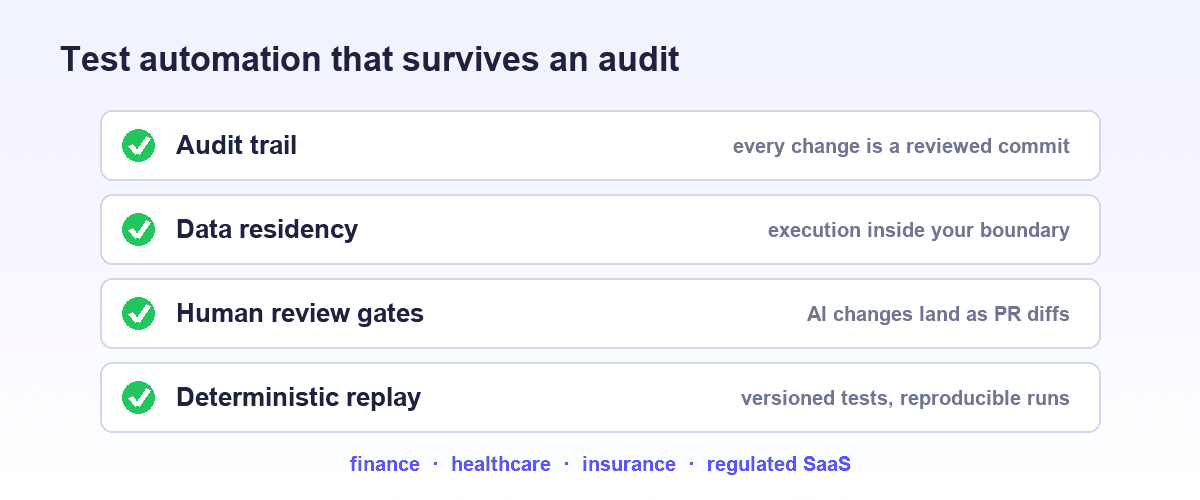
The best test automation tool for regulated industries is the one whose evidence survives an audit: every test traceable to a requirement, every change reviewed by a named human, every run reproducible, and no regulated data leaving environments you control.
Shiplight is built that way by default: tests are readable YAML in your own git repository, AI repairs arrive as pull requests a named person approves, and execution is deterministic in your CI.
Speed and coverage still matter, but in finance, healthcare, insurance, and other supervised sectors they are table stakes; the deciding criteria are evidentiary.
That reframes tool selection. Instead of asking which platform generates tests fastest, a regulated team asks which architecture produces audit artifacts as a byproduct of normal work.
This guide lays out the six requirements that regulators and internal compliance teams actually probe, then maps the major tool categories against them, including where AI-powered testing helps and where it introduces new questions an auditor will ask.
Why regulated teams evaluate testing tools differently
| Tool model | Where tests live | Audit trail | Human gate on AI changes | Deterministic replay |
|---|---|---|---|---|
| Open-source framework | Your repo | Git history | No AI changes to gate | Yes |
| Vendor-cloud platform | Vendor database | Platform history, export varies | Varies by vendor; some apply repairs in-platform | Varies with run-time AI behavior |
| Managed QA service | Provider's systems | Provider documentation | Provider staff review | Depends on provider tooling |
| Shiplight | Your repo, readable YAML | Git history plus per-run artifacts | Every repair is a pull request diff | Versioned tests, pinned execution |
If you are already scoping a vendor review, the fastest path is a technical walkthrough against your own audit checklist, and pricing is published rather than quoted.
In an unregulated product, a failed release costs money. In a regulated one, it can cost the license to operate. Frameworks such as SOX for financial reporting controls, HIPAA for health data, PCI DSS for payment flows, GDPR for personal data, and FDA software guidance for clinical systems all reach into how software changes are validated.
None of them names a testing tool, but all of them create the same downstream demands:
- Prove that critical workflows were tested before release.
- Prove who changed what, when, and who approved it.
- Prove the test evidence is authentic and reproducible.
- Prove that patient, cardholder, or customer data was not exposed in the process.
A testing tool either produces that proof naturally or forces your team to manufacture it manually every audit cycle. That difference dwarfs most feature comparisons.
The six requirements
Requirement 1: Auditability: tests and changes as reviewable records
Auditors want a chain: requirement, test, change history, approval, run result. Tools that store tests as opaque records in a vendor database make this chain expensive to reconstruct.
Tools that store tests as readable files under version control get the chain from git for free: every edit is a commit, every approval is a pull request review, every version is retrievable years later.
Human-readable test formats matter here too, because an auditor, or a compliance officer who does not write code, has to be able to read what the test claims to verify.
Requirement 2: Data residency and flow control
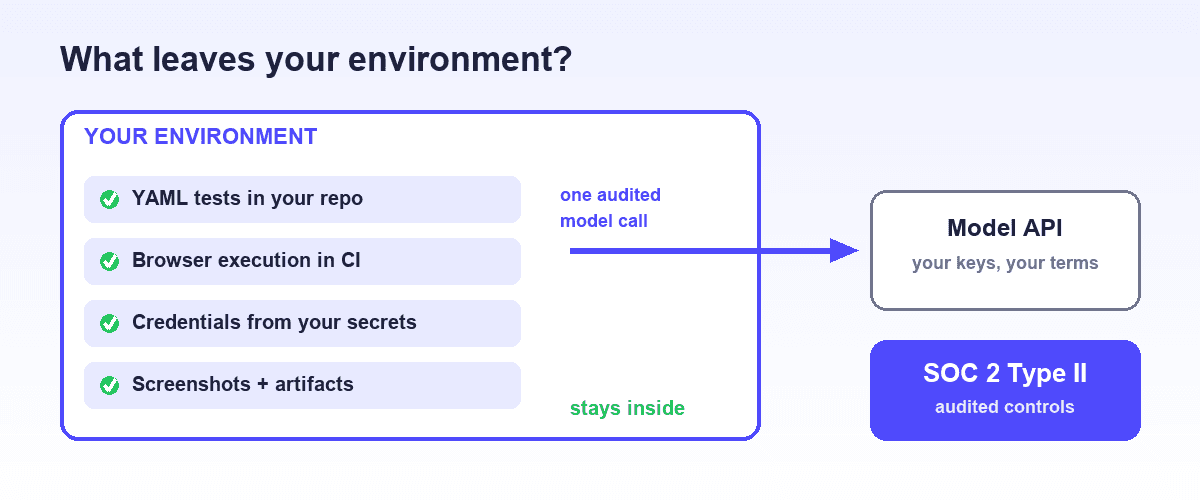
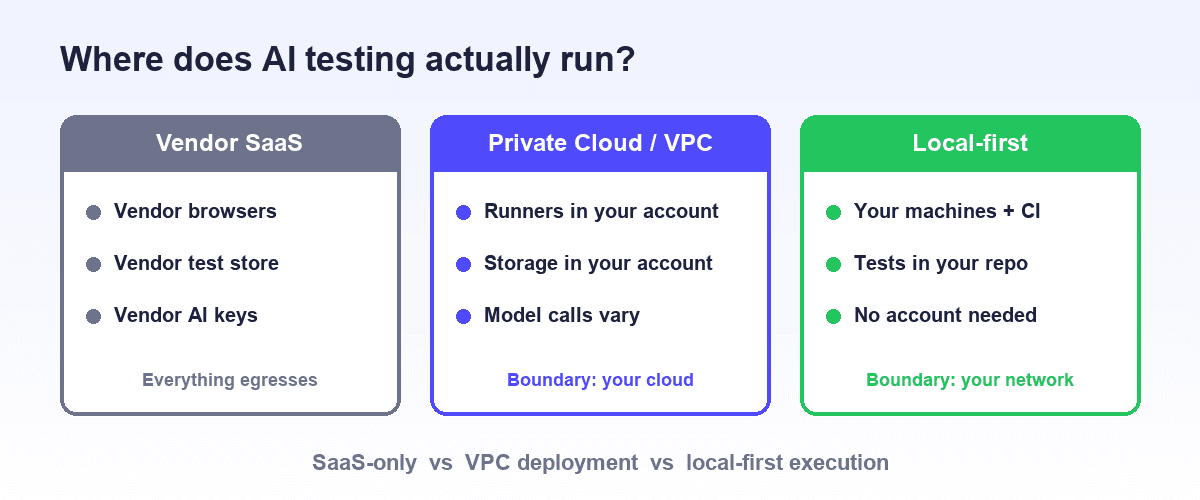
Regulated data attracts location and handling rules: where it may be stored, which processors may touch it, what agreements must cover them. Testing intersects this the moment tests run against realistic data or capture screenshots of real interfaces. The requirement translates to: know exactly what the tool transmits and store artifacts only where policy allows.
Our guides to AI testing data security and SOC 2 and on-premise and private cloud deployment cover the mechanics; the regulated-industry summary is that both a compliant SaaS with the right agreements and a self-controlled execution model can work, but "we are not sure what it sends" cannot.
Requirement 3: Human review gates
AI can author and repair tests, but supervised industries require accountable humans in the loop for changes to controlled systems. Concretely: no test enters the suite, and no automated repair to a test takes permanent effect, without a named person approving it.
Tools differ sharply here. Some apply AI fixes silently inside their platform; others surface every AI-proposed change as a diff a human approves or rejects.
For a regulated team the second model is not a preference, it is the requirement, because "the vendor's AI modified our control evidence without review" is a finding waiting to happen.
Requirement 4: Deterministic replay and reproducible evidence
When a regulator or internal audit asks "show us this control operating on March 3rd," you need the run to be reconstructible: which test version ran, against which build, with what result, with artifacts to match. AI-driven testing complicates this, since model outputs vary run to run.
The resolution is architectural: use AI at authoring and maintenance time, where its output is captured as a fixed, versioned test, and keep execution deterministic, the same versioned steps replayed the same way, with logs, screenshots, and traces persisted per run.
Tools where an agent improvises through the app at run time produce weaker evidence than tools that execute pinned test definitions.
Requirement 5: Access control and environment separation
Production data must not seed test environments without sanitization; test credentials must be scoped and rotated; who can run what, where, must be controlled.
Practical checks: does the tool integrate with your SSO and secret manager, can it run entirely inside your network segments, and does it keep any credential store of its own that becomes a new system to certify.
Requirement 6: Vendor compliance posture
Any vendor touching in-scope systems joins your compliance surface: SOC 2 or ISO 27001 attestation, willingness to sign a business associate agreement in healthcare, a current subprocessor list including AI model providers, and enterprise support with real uptime commitments, since a testing outage the week before a regulatory deadline is its own risk.
How tool categories measure up
| Requirement | Open-source frameworks | Low-code / no-code SaaS platforms | Managed QA services | AI-native, repo-based tools |
|---|---|---|---|---|
| Audit trail of tests and changes | Strong (git), but code-only readability | Platform history, varies in exportability | Vendor-held documentation | Strong (git) with human-readable tests |
| Data residency and flow control | Full control, self-hosted | Vendor cloud; enterprise tiers add residency options | Data shared with service provider | Local execution by default; VPC options for managed parts |
| Human review gates | PR review, no AI changes to gate | AI heals often applied in-platform | Provider staff review changes | AI changes surfaced as PR diffs for approval |
| Deterministic replay | Strong | Varies with AI run-time behavior | Depends on provider tooling | Versioned tests, deterministic execution, per-run artifacts |
| Ops and authoring cost | High: you build and maintain everything | Low authoring cost, per-seat or usage pricing | Lowest internal effort, premium cost | Low authoring cost via agents; engineering-owned |
| Vendor compliance posture | No vendor to assess | Established vendors carry SOC 2 or ISO | Contract and staffing review needed | Check per vendor; enterprise tiers carry attestations |
Reading the table honestly:
- Open-source frameworks remain the most defensible baseline for auditability and residency, which is why regulated enterprises have run them for years. Their cost is authoring and maintenance labor, the largest line in any honest test automation cost comparison, and that cost is what pushes teams toward AI. See our comparison of Playwright and Selenium for enterprise browser automation for that baseline.
- Low-code and no-code SaaS platforms excel at letting non-engineers author tests, and mature vendors have real compliance programs. The friction points are test portability, evidence exportability, and AI behavior that changes tests without an approval gate.
- Managed QA services outsource the labor, which some regulated teams value, but the audit chain now runs through another company's staff and systems, and the service becomes a vendor-management exercise.
- AI-native, repo-based tools aim to combine the open-source evidence model with AI economics: tests as versioned readable files, AI proposals gated by human review, deterministic execution. The category is newer, so vendor compliance posture must be checked case by case.
Where AI helps regulated teams, and where to be careful
The genuine wins: AI collapses the cost of building the broad regression coverage that auditors like to see, keeps tests current as the product changes instead of letting coverage decay, and produces documentation-quality test descriptions as a side effect of intent-based authoring.
The cautions: run-time improvisation undermines reproducibility, silent self-healing undermines change control, and model data flows need the same residency scrutiny as any other processor. None of these is disqualifying; all of them are answerable with the right architecture and the checklist above. What disqualifies a tool is refusing to answer.
Where Shiplight fits for regulated teams
Shiplight's architecture lines up with the evidence-first requirements without a compliance mode bolted on. Tests are readable YAML in your own git repository, so the audit trail is the repo history and every change, human or AI-proposed, lands as a pull request a named person approves.
Execution is deterministic: versioned tests run locally or in your CI with npx shiplight test, on infrastructure inside your boundary, with artifacts stored where you choose.
When the AI heals a broken test, the heal is surfaced as a reviewable diff rather than applied silently, which is exactly the human gate requirement 3 describes.
On vendor posture: Shiplight carries SOC 2, offers private cloud and VPC deployment, runs either on hosted CI runners or on your own, accepts your own LLM provider keys, and gives enterprise customers a dedicated customer success manager.
Shuo Yang, Co-founder and CTO at Daffodil, put the operating result this way: "Test coverage across our critical AI driven flows expanded within the first month, catching multiple regressions before they reached staging. We now ship AI driven updates much more frequently without slowing engineers down."
Two practical next steps for a regulated evaluation: bring the six requirements above to a technical walkthrough and score them live, and read the published pricing rather than waiting for a quote, since procurement in supervised sectors tends to stall on undisclosed cost.
Honest scope: Shiplight covers web applications. Regulated teams validating native mobile apps, medical devices, or desktop software need additional tooling, and organizations that want testing fully outsourced should weigh managed services despite the vendor-management overhead.
Frequently Asked Questions
What is the best test automation tool for regulated industries?
There is no single best tool, only a best-fit architecture that produces audit evidence as a byproduct of normal work. Score candidates on six requirements: auditability, data residency, human review gates on AI changes, deterministic replay, access control, and vendor posture such as SOC 2.
Open-source and repo-based AI-native tools score strongest here; low-code and managed services trade that for lower effort.
What is the best AI testing platform for finance or healthcare teams?
For finance and healthcare, prefer platforms where AI authors and maintains while execution stays deterministic and versioned, so every run is reproducible for auditors. Require human-readable tests under version control, AI changes gated by human approval, execution in environments you control or a VPC, SOC 2 with subprocessors listed, and a BAA in healthcare. Shiplight fits this for web apps.
Do auditors accept AI-generated tests as compliance evidence?
Generally yes, when the process is controlled. Auditors evaluate the control, not the authorship: a test is acceptable evidence if a human approved it, its history is traceable, and its runs are reproducible.
AI-generated tests that flow through pull request review with named approvers meet that bar like human-written ones. What draws findings is uncontrolled change, such as AI silently rewriting tests.
How do human review gates work with self-healing tests?
When the AI detects a test broke because the UI changed, it proposes a repair rather than applying one: the change appears as a diff, usually a pull request, an engineer approves, amends, or rejects. The suite's permanent state changes only with named human approval, preserving change control. Avoid tools that rewrite tests without review; see self-healing versus manual maintenance.
What is deterministic replay and why does it matter for compliance?
Deterministic replay means a given test version runs the same steps the same way every time, so you can rerun the exact test behind a past result and show an auditor the steps, the build, and persisted artifacts.
Compliance evidence must be reproducible: "an agent explored the app and it seemed fine" isn't reconstructible six months later. Use AI to author, pinned tests to execute.
Can regulated companies use cloud-based testing tools at all?
Yes, and many do. Cloud platforms work when the vendor's attestations cover your framework, regulated data never enters test environments unmasked, and the model-provider chain is documented. The alternatives are VPC deployment or local-first tools where execution never leaves your environment. It's a data-flow decision, not a category ban: trace what the tool transmits using our data security guide.