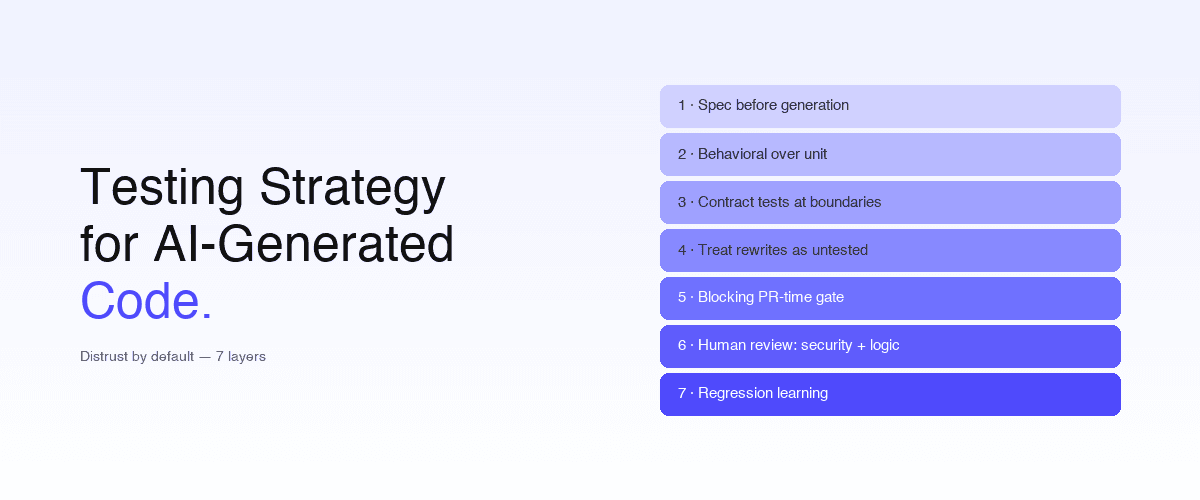
Teams should test AI-generated code by distrusting it by default and verifying behavioral intent at every layer, not by trusting green unit tests.
AI-generated code tends to be plausible but wrong: it compiles, it passes type checks, it reads correctly, and it often passes the structural unit tests that were written against it. So the strategy must specifically target the three failure modes AI introduces: hidden logic errors, hallucinated APIs, and missing edge cases.
Research and industry guidance consistently point the same direction: shift from reactive testing to spec-driven, layered validation with strong automation gates.
This guide gives you the 7-layer model, the false-green problem it solves, the metrics that prove it works, and the Shiplight features that implement it.
Key takeaways
- Distrust by default is the organizing principle. Treat every AI-generated diff as unverified until a behavioral test proves intent, not structure; browser-level verification layers such as Shiplight exist to make that gate automatic.
- AI code fails differently than human code. Less syntactic failure (the code is competent), far more behavioral failure (the intent was lost between prompt and implementation).
- Three failure classes to target explicitly: hidden logic errors ("works but wrong"), hallucinated APIs (calls to packages/methods that don't exist or changed), and missing edge cases (the prompt described the happy path only).
- The false green is the central enemy. Tests pass, behavior is wrong. Unit tests written against AI output inherit the AI's blind spots.
- The strategy is layered, not single-gate. Spec before generation → behavioral tests over unit tests → contract tests at boundaries → treat AI-rewritten files as untested → PR-time automation gates → human review for security/logic → regression learning.
Why AI-generated code needs a different testing strategy
A traditional test suite is written against a contract that reflects the developers' mental model: the edge cases they thought to handle, the behaviors they thought to verify. AI-generated code breaks that contract in a specific way: it does not break the structure your tests check; it breaks the intent your tests assumed.
Three properties make the defect profile different from human-written code:
- The code is syntactically competent. AI rarely produces code that fails to compile or lint. The structural defects traditional QA was built to catch are now rare.
- The behavioral defects are more common. The intent gets lost in translation from prompt to implementation. A discount applied in the wrong order. A permission check returning
truewhere it should returnfalse. An aggregation that sums the right column but groups by the wrong key. - Tests map to the old implementation. When an AI assistant rewrites a service, the new implementation may behave differently in paths the original tests never exercised. Coverage numbers don't drop. The tests still pass. The new behavior is simply untested.
For the data behind this, see AI-generated code has 1.7× more bugs. For the broader operating-model shift, see AI-native test strategy in 2026.
The three failure classes your strategy must target
Failure class 1: Hidden logic errors ("plausible but wrong")
The hardest class to detect because nothing breaks visibly. The user flow completes. The API returns 200. The data saves. But a calculation rounds incorrectly, a filter includes records it shouldn't, a notification fires at the wrong time. The test suite has no assertion that catches the deviation because the deviation is in business logic, not in structure.
A unit test that verifies a function returns a UserProfile does not catch a function that returns the wrong user's profile.
Strategy response: behavioral assertions on computed outcomes with real inputs ("a user who applies a valid promo code to a $100 cart checks out paying $80"), not structural assertions ("applyDiscount returns a number"). See detect bugs in AI-generated code.
Failure class 2: Hallucinated APIs
AI models suggest packages, methods, and signatures that match their training-data priors, which may be six to eighteen months stale, or invented outright. The result: a call to a method that doesn't exist in the installed version, an import of a package that was renamed, a dependency version that conflicts with the lockfile or carries a known CVE.
Strategy response: dependency and API-contract validation in the automation gate (Layer 5 below): type checks against the actual installed dependency tree, plus contract tests at every service boundary the AI touched.
Failure class 3: Missing edge cases
The prompt described the happy path. The AI built the happy path. Empty states, malformed inputs, expired sessions, the back button mid-flow, returning users, locale variants: none were prompted, so none were built or tested.
Strategy response: AI-generated edge-case tests authored in the same session as the feature (the agent knows what it skipped), plus exploratory testing on staging to find the flows nobody specified. See how to test vibe-coded applications for reliability.
Risk-based concentration: where to spend the testing budget
Not all AI-generated code deserves equal scrutiny. A useful mental model: treat AI-generated code like a junior developer's PR: full review, explicit test-expectation check, and active skepticism toward clean-looking logic, because readability ≠ correctness. Concentrate the heaviest testing where an AI mistake is most expensive and least visible:
- Heavy scrutiny: business-logic calculations, security-sensitive code (auth, access control), parsing/validation layers, external API integrations: the places false greens cluster and cost the most.
- Lighter (still tested): UI glue code and boilerplate CRUD scaffolding: lower blast radius, more obviously wrong when broken.
This is risk-based testing applied to the AI defect profile: spend the budget where "plausible but wrong" does the most damage, not uniformly across the diff.
The false-green problem
Green CI is the signal teams trust. It is also the signal AI-generated code most reliably fakes.
A realistic scenario: an AI assistant refactors a checkout service. The refactored code handles the same inputs, returns the same types, satisfies every existing test assertion. Tests pass, PR merges.
Three days later a customer reports their promo code didn't reduce the total: the rewritten promotion integration now passes the discount as a string instead of a number, the downstream calculation silently coerces it, the result is wrong.
No test caught it because no test asserted on the final calculated total with a specific promo code applied.
This is a false green: tests pass, behavior is wrong. False greens cluster predictably:
- Integration boundaries: where one service's output becomes another's input, AI gets the contract slightly wrong in ways that only surface at runtime.
- Business-logic calculations: unit tests check structure, not computed values against real inputs.
- Security boundaries (the most dangerous): an AI-generated auth middleware that skips authorization on one request path passes every happy-path test.
The entire 7-layer strategy below is organized around eliminating false greens.
The 7-layer testing strategy for AI-generated code
- 1Spec / contract before generation
- 2Behavioral testing over unit testing
- 3Contract tests at every integration boundary
- 4Treat AI-rewritten files as untested until proven otherwise
- 5Strong automation gates at PR-time
- 6Human review for security and business-logic correctness
- 7Regression learning, every escaped bug becomes a permanent test
Layer 1: Spec / contract before generation
Distrust starts before the AI writes a line. Define, in advance, the verifiable contract the implementation must honor: API shapes and error codes, data schema and nullability, behavioral rules (what the system must and must not do), performance budgets, and security requirements (auth boundaries, input validation, parameterized queries).
Without a pre-defined spec, the AI fills ambiguity with its training-data priors, and you have nothing objective to test the output against. The spec is the source of truth the later layers verify against. See requirements to E2E coverage and tribal knowledge to executable specs.
The TDD-for-AI pattern: write tests before prompts
The most disciplined form of Layer 1 is test-driven:
- Prompt the AI with the detailed requirements.
- Ask it to generate the test suite first, and run it to confirm the suite fails, because the feature does not exist yet.
- Then have it generate the implementation.
- The tests passing is now meaningful evidence the code meets the defined scope, not just that it compiles.
This shift-left ordering turns the spec into executable failing tests before any implementation exists, so the AI is generating against a target rather than inventing the target. It is the single most valuable discipline for AI-generated code because it removes the "AI wrote both the code and the test, so they trivially agree" failure mode.
Layer 2: Behavioral testing over unit testing
The answer is not "write more unit tests": unit tests written against AI-generated code inherit the same blind spot (you're asserting what the AI produced, not what the application was supposed to do). Shift the weight of the test suite upward: test complete user-facing scenarios end-to-end with real inputs and assertions on computed outcomes.
A behavioral test for checkout does not test the applyDiscount function; it tests that a user who adds a valid promo code to a $100 cart checks out paying $80. That assertion survives refactors, catches the wrong-type bug, and validates intent rather than implementation. The testing pyramid doesn't disappear, but the weight shifts up when AI generates the implementation layer.
Add property-based testing for invariants. Behavioral tests check specific scenarios; property-based tests check rules that must always hold (a discount can never make the total negative; a user can never see another tenant's data; a sorted list is always ordered).
Property-based tools generate hundreds of randomized inputs and try to falsify the invariant, catching the edge cases you never thought to prompt for, which is exactly the class AI-generated code misses most.
Pair property-based tests with the behavioral suite: invariants for the rules, behavioral tests for the journeys.
Shiplight surface: Shiplight YAML Test Format authors behavioral, intent-based tests that assert on observed outcomes, not internal structure.
Layer 3: Contract tests at every integration boundary
AI-generated code is most likely to break at integration points. Every service boundary (especially any interface touched by AI-assisted refactoring) needs contract tests that verify the shape, type, and valid range of data crossing it. A type mismatch that would cause a silent coercion in production fails immediately in a contract test.
This is the layer that catches the promo-code-as-string failure before deployment. See E2E testing vs integration testing.
Layer 4: Treat AI-rewritten files as untested until proven otherwise
When an AI assistant rewrites or refactors a file, treat the entire surface area of that file as untested, not just the diff. The old tests map to the old implementation's behavior; the new implementation may differ in paths the old tests never exercised. Behavioral tests covering every flow that touches the modified code must run before merge.
This is the shift-left argument applied specifically to AI code generation: the earlier you catch AI-introduced regressions, the lower the cost. See verify AI-written UI changes.
Layer 5: Strong automation gates at PR-time
The strategy's enforcement layer. Every AI-generated PR runs a blocking gate before merge:
- Behavioral + contract tests for all affected flows (< 10-minute latency)
- Type checks against the actual installed dependency tree (catches hallucinated APIs)
- Security scanners (SAST, dependency CVE scan) on the diff
- Static analysis (lint, type) for the rare structural defect
Blocking means failure prevents merge. Nightly regression supplements but does not replace this: the 16-hour gap between merge and nightly is incompatible with AI-coding-agent throughput. See a practical quality gate for AI pull requests and E2E testing in GitHub Actions: setup guide.
Shiplight surface: Shiplight Cloud runners + CI integration produce structured failure output (replay video, DOM snapshot, per-step diff) so reviewers act on signal, not stack traces.
Layer 6: Human review for security and business-logic correctness
Two defect categories are not reliably catchable by automated tests alone:
- Security patterns (input validation, authorization checks, SQL parameterization): benefit from a human reviewer who understands the threat model.
- Business-logic correctness (pricing, permissions, data-access rules): benefit from a product owner or domain expert who can read test output and say "that number is wrong."
The reviewer's job is not to catch every bug (Layers 2–5 do that); it's to verify intent match and approve self-healing patch suggestions (emitted as PR diffs, never silent rewrites). See self-healing vs manual maintenance.
Adversarial LLM review (the cheap force-multiplier). Before human review, run an adversarial pass: ask a different model, or the same model with an attacker prompt ("find the missing edge cases, incorrect assumptions, and deprecated/hallucinated APIs in this diff"), to critique the generated code.
A second model doesn't share the first's exact blind spots, so it surfaces hallucinated functions and unhandled cases cheaply.
Critical caveat: adversarial review is good at surfacing candidates, not at confirming deep logical correctness; it augments Layers 2–5 and human review, it never replaces them. Treat its output as leads for tests to write, not as a pass/fail gate.
Layer 7: Regression learning, every escaped bug becomes a permanent test
The loop-closing discipline. Every production bug traced to an AI-generated change becomes a permanent behavioral regression test, landed in the same PR as the fix. Without this, the same false-green pattern ships again.
With it, the suite gets smarter with every incident, and the AI coding agent can author the regression test from the bug report via MCP. See postmortem-driven E2E testing and Shiplight MCP Server.
Regression learning is not only about tests. Track the failure patterns themselves: which kinds of AI bug recur (off-by-one, hallucinated APIs, wrong grouping key), which modules are most fragile under AI edits, and which prompt patterns produce bad code.
Feed that back into two places: stricter test coverage in the fragile modules, and improved prompt/spec templates so the AI stops making the same class of mistake. This closes the loop at the source, not just the symptom.
Specialized AI testing tools for verifying AI-generated code
Several purpose-built tools use AI to verify AI-generated output. Honest positioning of the main options, by operating model:
- Shiplight AI: intent-based YAML tests committed in your git repo, self-healing, MCP-callable so the coding agent generates and runs the test in the same session it writes the code (Layers 2, 4, 7). See agent-first testing.
- Spec-driven generation tools: generate tests from a written spec, with execution on the vendor's hosted cloud.
- Vendor cloud consoles: tests authored in a constrained plain-English command set or low-code editor, living as suites in the vendor's cloud on metered runs; built for manual-QA-heavy organizations where non-technical staff own verification.
- Managed QA services: the vendor's engineers, assisted by AI tooling, write and maintain tests that live and run on their infrastructure; testing knowledge accumulates outside your walls.
The selection rule: a tool only helps Layer 4 if it can verify behavioral outcomes against the spec, not just confirm the AI's code matches the AI's own tests. Prefer tools where the test definition is reviewable by a human against the Layer-1 spec. See the false-green problem above and coding-agent plugins for automated test generation for the full landscape.
For a direct treatment of whether the generator can also be the verifier, see can coding agents test their own code?
Summary checklist by phase
| Phase | Action |
|---|---|
| Preparation | Define clear success criteria and measurable accuracy targets; write the Layer-1 spec/contract |
| Pre-generation | Provide rich context (docs, requirement snippets, examples); generate failing tests first (TDD-for-AI) |
| Verification | Test happy paths AND edge cases (empty inputs, special characters, expired sessions); run behavioral + property-based + contract tests; static + dependency security scan |
| Review | Human audit for logic (the missing 1%), security patterns, and maintainability before merge |
| Gate | Blocking PR-time CI gate: no merge on failure |
| Post-deploy | Monitor production for anomalies tests missed; turn every escaped bug into a regression test (Layer 7) |
Reactive testing vs spec-driven layered validation
| Dimension | Reactive testing (the default that fails) | Spec-driven layered validation (the strategy) |
|---|---|---|
| Trust posture | Trust AI output; test if time permits | Distrust by default; prove intent before merge |
| Spec timing | Inferred after the fact, if at all | Defined before generation (Layer 1) |
| Primary test type | Unit tests on structure | Behavioral tests on computed outcomes |
| Integration boundaries | Assumed correct | Contract-tested explicitly (Layer 3) |
| AI-rewritten files | Coverage % looks fine, ship it | Treated as untested until re-verified (Layer 4) |
| Gate | Nightly or none | Blocking PR-time gate (Layer 5) |
| Security / logic | Hope the tests catch it | Explicit human review (Layer 6) |
| Escaped bugs | Fixed, then forgotten | Become permanent regression tests (Layer 7) |
| Dominant failure | False greens reach production | False greens caught before merge |
If your process is mostly the left column, AI-generated code is shipping behavioral defects your green CI is actively hiding.
Metrics that prove the strategy works
If your quality metric is "CI passes," you're measuring the floor. A more honest picture for AI-assisted codebases:
- Behavioral coverage: % of user-facing flows with end-to-end assertions on computed outcomes. Far more honest than line coverage. A codebase with 85% line coverage and 20% behavioral coverage has a lot of tested code that verifies nothing meaningful.
- Regression rate by commit source: % of production bugs tracing to AI-assisted commits vs human commits. A disproportionate AI share is the leading indicator of the false-green gap.
- False-green incidents per quarter: bugs that reached production despite passing CI. Target: trending to zero.
- Mean time from AI-generated regression to detection: PR-time gate (Layer 5) should make this minutes, not the 1–3 sprints reactive testing produces.
See the agentic QA benchmark for the full metric rubric.
Adoption roadmap
You don't need a rewrite. Layer the strategy in over 4–6 weeks:
- Week 1: Layer 1. Add a spec/contract section to ticket and PR templates. No tooling change. Highest ROI per minute.
- Week 2: Layer 2. New features get behavioral intent-based YAML tests asserting computed outcomes, committed in the same PR.
- Week 3: Layers 3 + 5. Add contract tests at the boundaries AI touches; wire the blocking PR-time gate.
- Week 4: Layer 4. Establish the "AI-rewritten file = untested" rule; behavioral tests for the whole touched surface run before merge.
- Week 5: Layer 6. Formalize the security/business-logic review checklist for AI diffs.
- Week 6+: Layer 7. Every escaped bug yields a regression test; the AI coding agent authors it from the report via Shiplight MCP. See the 30-day agentic E2E playbook.
Related: verification-driven development
Conclusion: distrust by default is what lets you scale safely
A complete strategy answers one question: "What mistakes can still pass all my tests?" If you can't answer that, the strategy is incomplete: the 7 layers exist precisely to keep shrinking that set.
The teams that scale development with AI-generated code safely are not the ones that trust the AI more; they're the ones that built a strategy that distrusts it by default and verified intent at every layer.
AI code is plausible but wrong often enough that "the tests pass" is the least trustworthy signal in an AI-assisted codebase. The 7-layer model replaces that single, fakeable signal with spec-driven, behavioral, contract-verified, human-reviewed, regression-learning validation, strong enough to let AI-coding-agent velocity compound instead of accumulating hidden behavioral debt.
For teams operationalizing this, Shiplight AI implements the layers that automate: YAML Test Format for behavioral intent-based tests, the Plugin with self-healing for the AI-rewritten-file problem, MCP Server for agent-authored tests against the spec, and Cloud runners for the blocking PR-time gate.
Book a 30-minute walkthrough and we'll map your current process to the 7 layers and find where false greens are getting through today.
Frequently Asked Questions
How should teams test AI-generated code?
Distrust it by default and verify behavioral intent, not structure. Seven layers, from a spec before generation through behavioral and contract tests to a blocking PR-time gate. Shiplight covers the behavioral UI layer; unit logic, security scans, and human review of business rules are still yours.
Should I use TDD (write tests before prompts) for AI-generated code?
Yes, it is the most valuable discipline here. Give the AI detailed requirements, have it write the test suite first and confirm those tests fail, then have it write the implementation. That removes the dominant failure mode: the AI writing both code and test so they trivially agree.
What tools help test AI-generated code?
Shiplight AI (intent-based YAML in git, MCP-callable so the agent verifies in-session), spec-driven generators, vendor consoles, and managed QA services. The selection rule: it must verify behavior against your spec, not confirm the AI's code matches the AI's own tests. See coding-agent plugins for test generation.
Why do my existing tests miss AI-generated bugs?
Your suite was written against your developers' mental model. AI-generated code does not break the structure your tests check; it breaks the intent they assumed. And when the AI rewrites a service, the tests still map to the old implementation: coverage holds, tests pass, the new behavior is untested.
What are the failure modes specific to AI-generated code?
Three. Hidden logic errors: the flow completes but a calculation, filter, or permission is subtly wrong. Hallucinated APIs: calls to packages or methods that never existed or have changed. Missing edge cases: the prompt described the happy path, so empty states and malformed inputs were never built.
Should I write more unit tests for AI-generated code?
No. Unit tests written against AI-generated code inherit its blind spots: you assert what the AI produced, not what the application was meant to do. Shift from structural verification (does this return the right type?) to behavioral (does a $100 cart with a valid promo pay $80?).
Should I use adversarial AI review to test AI-generated code?
Yes, as a cheap pre-review pass, never as a gate. Ask a different model to critique the diff for missing edge cases and hallucinated APIs; it does not share the first model's blind spots. The limit: it surfaces candidates, not correctness, so treat the output as tests to write.
How is this different from a general AI-native test strategy?
An AI-native test strategy is the operating model for shipping at agent speed: authoring, gates, ownership, coverage. This one is narrower, targeting the defect profile of code an AI wrote. Use the first to organize how QA runs, this one to decide what to verify.