
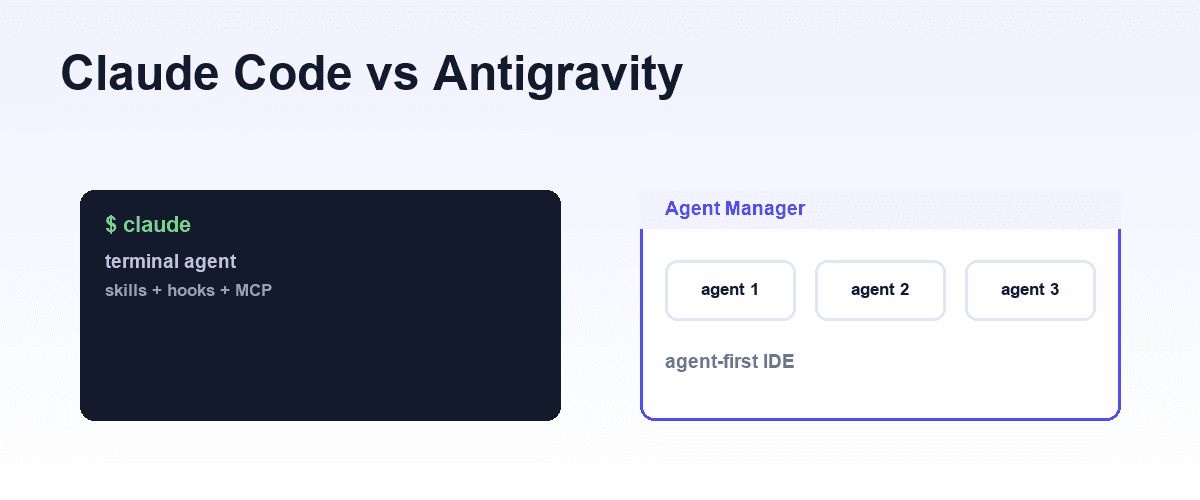
Claude Code and Google Antigravity are both coding agents, but they answer a different design question: Claude Code puts one agent in your terminal and lets you compose everything else around it, while Antigravity builds an entire surface, an IDE, a CLI, and a manager view, around running agents as the primary unit of work.
Neither is a stripped-down version of the other, and picking between them is less about model quality than about where you want the agent to live and how much of the workflow you want the vendor to own.
The axes that actually differ
The honest way to compare them is mechanism by mechanism. Both tools now speak the same two open standards, MCP for tools and Agent Skills for reusable instructions, so the extension story overlaps more than most head-to-head posts admit.
The real differences sit elsewhere: model access (one vendor's models vs a multi-model picker), configuration surface (a small set of files you own vs a platform with a store and a shared config directory), the multi-agent story (composed subagents vs a built-in manager), and what each agent can actually see when it claims a change works.
That last one matters more than it first appears.
An agent that edits code all day needs a way to check its own work, and the two tools ship very different answers: one ships none and expects you to bring your own, the other ships per-task browser demonstrations that do not persist as tests. We will get to that, including where a browser MCP layer fits both.
One scope note before the details: Antigravity moved fast through 2026, absorbing Google's previous terminal agent along the way. Where a detail is version-specific we say so; everything else here is the stable mechanism you can plan around.
Where the agent lives
Claude Code is a terminal program. You run claude in a repo, it reads the project, edits files, and runs shell commands in a permission-gated loop.
Everything else, the VS Code and JetBrains extensions, the GitHub Actions integration, the Agent SDK for building your own agents, wraps that same core loop. The terminal is the primary surface, and your editor stays whatever it already was.
Antigravity inverts this. It started as an agent-first IDE (a VS Code-derived editor where the agent panel, not the buffer, is the center of gravity) and has grown into a four-surface platform: the IDE, an Agent Manager command center for running multiple local agents in parallel, a closed-source Go CLI (agy), and an SDK.
The CLI matters historically: Google deprecated the older Gemini CLI on June 18, 2026, and Antigravity CLI is its designated successor, keeping skills, MCP servers, and subagent configs through a migration rather than a rename.
So both tools now have a terminal story and an editor story. The difference is emphasis: Claude Code treats the terminal as home and the IDE as a viewport; Antigravity treats the managed, graphical agent workspace as home and the CLI as an outpost.
Model access
Claude Code runs Anthropic's Claude models only: Opus, Sonnet, and Haiku tiers, selected per session or per subagent, billed through a Claude subscription or API key (with Bedrock and Vertex AI as enterprise routes). You do not get a cross-vendor picker; you get one vendor's models tuned for the harness they ship in.
Antigravity is multi-model by design. The picker includes Google's Gemini 3-series models as defaults, Anthropic's Claude models, and OpenAI's open-weight GPT-OSS models, with some Claude tiers gated behind your own Anthropic API key. Google has kept the base product available at no charge with usage caps (the CLI uses a weekly compute cap rather than the old per-day request count).
The trade is straightforward. Antigravity lets you route a refactor to one model and a review to another inside one product. Claude Code gives you a single-vendor stack where the model, harness, and training loop co-evolve. Which you value depends on whether you see the model as an interchangeable engine or as the product itself.
Extension model: Skills, MCP, hooks
This is where the two tools have converged, because both adopted open standards.
Agent Skills (a folder with a SKILL.md of instructions the agent loads when relevant) work in both. Claude Code, where the format originated, reads them from .claude/skills/; Antigravity reads the same format from .agents/skills/ in the workspace, the vendor-neutral path shared with several other agents, plus a global directory under ~/.gemini/.
A skill you write for one can generally be dropped into the other with a path change, which is a genuinely new situation for this product category.
MCP servers also work in both. Claude Code configures them in .mcp.json (project) or user scope; Antigravity manages them through an in-IDE MCP Store or a raw mcp_config.json under ~/.gemini/, and its 2.x releases share one MCP config across IDE, CLI, and SDK.
Same protocol, same servers, different management surface: Claude Code assumes you will edit JSON; Antigravity assumes you will browse a store.
Claude Code layers two more mechanisms on top: hooks, deterministic shell commands bound to lifecycle events in settings.json (block an edit, run a formatter, gate a commit), and a plugin system that bundles skills, hooks, and MCP servers into installable units.
Antigravity's equivalent control points exist but are younger and more platform-mediated. If you want guaranteed, scriptable checkpoints around every agent action, hooks are the more mature primitive.
Context and config files
Both tools read a persistent instruction file from the repo root: Claude Code reads CLAUDE.md, Antigravity reads AGENTS.md. Same job, project conventions and constraints the agent loads every session, different filename. Teams running both tools tend to keep one canonical file and reference it from the other.
Beyond that, Claude Code's configuration is a handful of files you version: CLAUDE.md, .mcp.json, settings.json, .claude/agents/, .claude/skills/. Antigravity splits configuration between repo files (AGENTS.md, .agents/skills/) and a per-user platform directory under ~/.gemini/.
The practical difference shows up in code review: with Claude Code, essentially all agent behavior is diffable in the repo; with Antigravity, some of it lives on the machine.
The multi-agent story
Claude Code composes multi-agent work from primitives: subagents defined as markdown files with their own prompts, tools, and model choice, spawned in parallel with isolated context windows, plus background tasks and experimental agent teams. You wire the topology yourself, which means you can also constrain it precisely.
Antigravity ships the topology as a product. The Agent Manager is a mission-control view: assign tasks to multiple agents across workspaces, watch progress, review outputs, schedule recurring runs. Google calls the intended posture the manager mindset, and the UI is built for it in a way a terminal fundamentally is not.
If your team wants five agents on five branches with a supervisor view today, Antigravity ships that experience out of the box. If you want two precisely-scoped subagents whose permissions and prompts live in version control, Claude Code's primitives are the sharper tool.
Side by side
| Mechanism | Claude Code | Google Antigravity |
|---|---|---|
| Primary surface | Terminal agent (IDE extensions optional) | Agent-first IDE + Agent Manager (CLI agy secondary) |
| Lineage | Anthropic CLI-first agent | Successor platform to Gemini CLI (deprecated June 2026) |
| Models | Claude only (Opus/Sonnet/Haiku) | Gemini 3-series, Claude, GPT-OSS via picker |
| Agent Skills | Yes; .claude/skills/ (origin of the standard) | Yes; .agents/skills/ + global dir |
| MCP | Yes; .mcp.json, edited directly | Yes; MCP Store + mcp_config.json under ~/.gemini/ |
| Persistent context file | CLAUDE.md | AGENTS.md |
| Deterministic hooks | Yes; lifecycle hooks in settings.json | Limited; platform-mediated |
| Multi-agent | Subagents, background tasks, composed teams | Built-in Agent Manager, parallel agents, scheduled tasks |
| Browser access | None built in; via MCP server | Chrome extension; walkthrough artifacts per task |
| Pricing model | Claude subscription or API billing | No-charge tier with compute caps; BYO keys for some models |
The verification story
Here the designs split in an instructive way.
Claude Code, out of the box, verifies with the tools a terminal has: it runs your test suite, type checker, and linters. It cannot see a rendered page. If an agent-written change breaks a flow visually or behaviorally in the browser, nothing in the default loop catches it.
Anthropic's answer is the extension model: give the agent eyes by installing a browser layer over MCP.
Antigravity ships browser access natively. Through its Chrome extension, agents drive a real browser, and each completed task produces a Walkthrough artifact: screenshots and recordings of the agent clicking through the change it just made. That is a real advantage for reviewing a single task, and it deserves credit as the most complete built-in verification loop in this product category.
But notice what it is: a demonstration, not a test. Walkthroughs verify the task at hand, once. They do not persist as a regression suite, do not run in CI, and do not protect last month's flows from this week's agent. Neither tool ships a managed verification layer, meaning durable tests that accumulate, self-heal, and gate future changes.
That gap is the same shape on both sides, which is why an MCP browser verification layer fits either one.
Shiplight (our product) installs into Claude Code or Antigravity as a browser MCP server plus Skills: the agent gets hands in a real browser, and each verification becomes an intent-based YAML test committed to your repo, self-healing, and transpilable to standard Playwright so there is no lock-in.
The same flow the agent checked once becomes a check that runs every time. Setup for each side is covered in our Claude Code testing guide and, for teams arriving from Google's terminal lineage, the Gemini CLI testing guide.
Which team picks which
Neither tool wins outright, and the deciding factors are organizational as much as technical.
Pick Claude Code if your team lives in the terminal, wants agent behavior fully versioned in the repo (skills, hooks, subagents, MCP config all diffable), needs deterministic hooks around agent actions, or is standardizing on Claude models and wants the harness built for them.
It is not the right fit if your developers want a graphical review surface for parallel agents or need to mix model vendors in one tool.
Pick Antigravity if you want multi-model flexibility without running multiple products, your workflow benefits from a built-in manager view over parallel agents, or you value per-task browser walkthroughs as a review artifact at a no-charge entry price.
It is not the right fit if you need every piece of agent configuration in version control, or if a closed-source CLI in the loop is a procurement problem.
Running both is legitimate: the shared Agent Skills and MCP standards mean your invested tooling, including a verification layer, moves with you rather than resetting at the product boundary.
Frequently Asked Questions
Is Antigravity the replacement for Gemini CLI?
Yes. Google deprecated the original Gemini CLI on June 18, 2026 and positions Antigravity CLI (agy) as its successor. The migration preserves skills, MCP servers, and subagent configurations, but it is a new Go-based binary with different defaults, not a renamed build of the old tool.
Can Antigravity use Claude models?
Yes. Antigravity's model picker includes Anthropic's Claude models alongside Gemini and GPT-OSS, with some Claude tiers requiring your own Anthropic API key. Claude Code, by contrast, runs Claude models only.
Do Claude Code skills work in Antigravity?
Generally yes, because both implement the Agent Skills open standard (a folder with a SKILL.md). Claude Code reads .claude/skills/, Antigravity reads .agents/skills/, so moving a skill is usually a copy plus a path change. Skills that depend on Claude Code-specific hooks or tools may need edits.
Can Claude Code do browser verification like Antigravity's walkthroughs?
Not out of the box; Claude Code has no built-in browser. It gains browser access through an MCP server, which is how tools like Shiplight give it eyes in a real browser. The difference is persistence: MCP-based verification layers can save checks as durable tests, while Antigravity walkthroughs document one task once.
Which is better for testing agent-written code?
Neither ships a managed testing layer. Antigravity verifies per task with browser walkthroughs; Claude Code runs whatever test suite your repo already has. For regression protection in either tool, you add a verification layer over MCP that turns agent checks into tests that live in your repo and run in CI.
Is Antigravity free?
Google offers Antigravity at no charge with usage caps (the CLI uses a weekly compute-based cap), and some models require your own API keys. Claude Code is billed through a Claude subscription or API usage. Verify current limits on each vendor's pricing page, since caps have changed several times.
References
antigravity.google, Antigravity MCP docs, Claude Code docs, Google Developers Blog: Antigravity.
Related posts
AI Testing
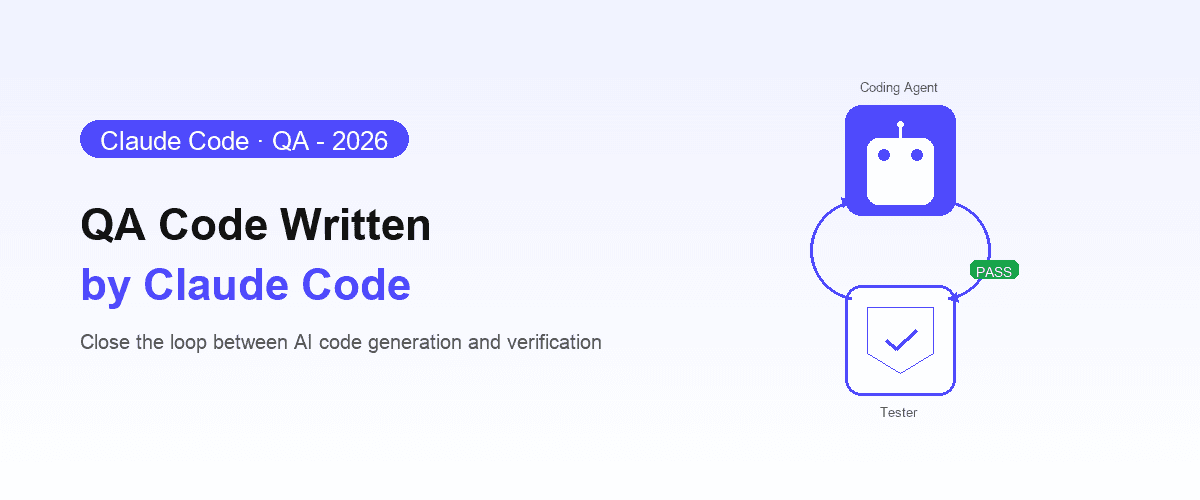
Claude Code testing guide
Apr 10, 2026 · 10 min read
AI Testing
Gemini CLI testing guide
Jul 14, 2026 · 10 min read
Guides
Claude Code skills
Jul 30, 2026 · 7 min read
Guides
Codex vs Claude Code
Jul 30, 2026 · 7 min read
Guides
Claude Code vs Cursor
Jul 30, 2026 · 6 min read
Guides
OpenCode vs Claude Code
Jul 30, 2026 · 6 min read