
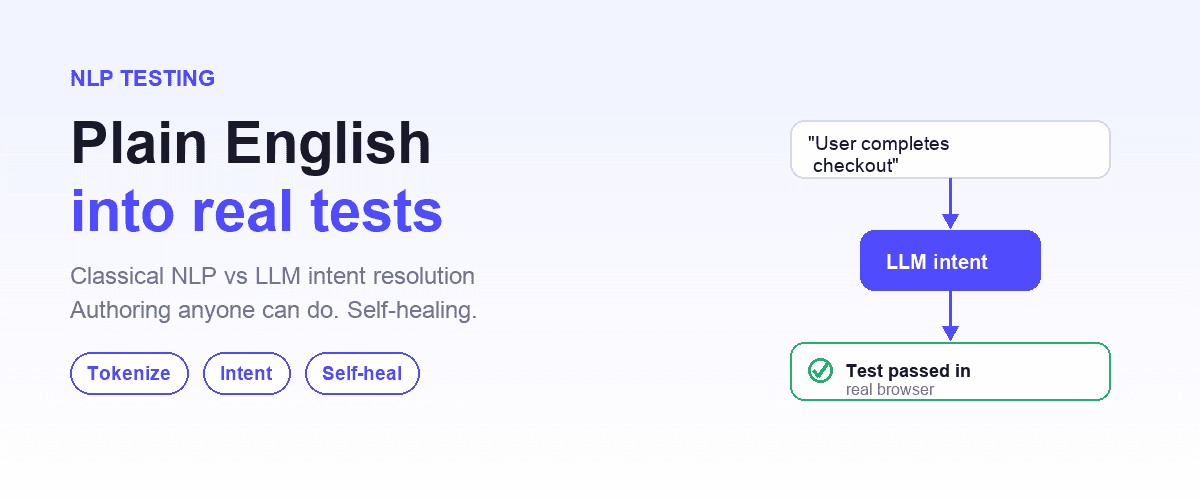
NLP testing is the use of natural language processing to turn plain-English descriptions of behavior into executable automated tests, so anyone, not just engineers, can author and maintain coverage.
Classical NLP testing parses the sentence with tokenization, stemming, part-of-speech tagging, and entity/intent extraction to map words to UI actions. Modern NLP testing replaces that brittle pipeline with large language models that resolve intent against the live application, which survives rephrasing and UI change far better.
Shiplight represents the modern approach: tests authored as structured natural-language intent, resolved by an LLM agent at runtime, run in a real browser, and self-healing when the UI changes.
Why plain English became viable
For two decades, automated testing meant code: Selenium, then Cypress and Playwright, all written by engineers and bound to brittle selectors. NLP testing changes the input. Instead of await page.click('#submit-btn'), you write "click the Submit button", or, in modern systems, you describe the goal: "the user completes checkout." Natural language processing turns that sentence into an executed test.
This guide covers what NLP testing actually is, the classical NLP techniques that power the first generation of tools, the shift to LLM-based intent resolution that defines the second, the honest limitations of both, and how to choose. It is deliberately not a sales page: NLP testing has real failure modes, and a guide that hides them isn't useful.
What is NLP testing?
NLP testing is automated software testing where the test is authored in natural language and a natural-language-processing system converts it into machine-executable steps. The defining property is the input: a human (or an AI coding agent) expresses what should happen in words, and the platform (not the human) produces and maintains the executable test.
It matters for three structural reasons:
- Accessibility. QA analysts, product managers, and support staff can write tests without learning a framework: testing stops being engineer-only.
- Maintenance. A natural-language instruction can outlive a UI change that would break a hard-coded selector, if the resolution layer holds up.
- Speed. Authoring a flow in a sentence is minutes, not the hours a scripted equivalent takes.
NLP testing is a subcategory of AI test generation; the distinguishing trait is specifically the natural-language authoring surface.
How NLP testing works: the classical pipeline
First-generation NLP testing tools process the sentence with a classical NLP pipeline. Understanding it explains both the appeal and the brittleness:
| Technique | What it does | Role in a test |
|---|---|---|
| Tokenization | Split text into words/units | "click the login button" → [click][the][login][button] |
| Stop-word removal | Drop low-information words | drops "the" |
| Stemming / lemmatization | Reduce to root form | "clicking", "clicked" → "click" |
| Part-of-speech tagging | Label grammatical roles | "click" = verb (action), "button" = noun (target) |
| Intent recognition | Map to a test action | verb "click" → a click interaction |
| Entity extraction | Identify the UI target | "login button" → the element to act on |
The output is a structured action (click → element matching "login button"). This works, but it is fragile: synonyms, rephrasing, ambiguous targets ("the button": which one?), and any UI change that alters the element the entity resolves to all break it. Classical NLP is rules- and statistics-based; it does not understand the application.
The modern shift: LLM-based intent resolution
The second generation replaces the classical pipeline with a large language model that resolves intent against the live application state, not against parsed grammar. The difference is categorical:
- Phrasing-tolerant. "Click Submit," "press the submit button," "confirm the form" all resolve to the same action: the LLM understands meaning, not just tokens.
- Context-aware. It disambiguates "the button" using the actual rendered page, not a guess.
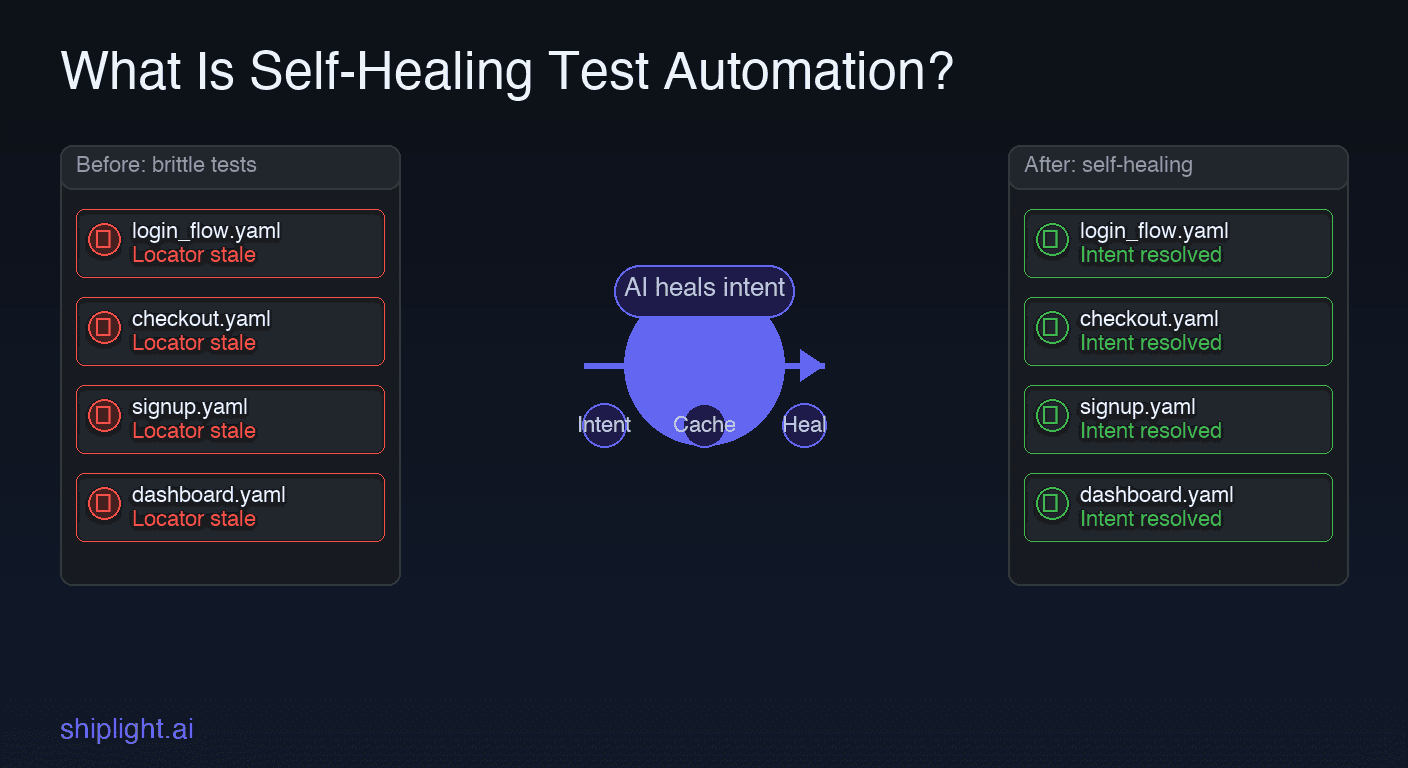
- Change-tolerant (self-healing). When the UI changes, the model re-resolves the intent against the new DOM instead of failing on a stale entity match. See what is self-healing test automation.
- Goal-level, not step-level. You can describe an outcome ("the user completes checkout") and let the agent determine the steps: closer to intent-based testing than scripted NLP.
This is why "NLP testing" in 2026 increasingly means LLM/agent-based intent resolution, not tokenization and POS tagging. The classical techniques still run under some tools, but the reliability comes from the model layer above them.
Benefits of NLP testing
- Human-first authoring: tests read like requirements; non-engineers contribute coverage.
- Broader participation: QA, PM, and support can all write and review tests.
- Faster test creation: a flow is a sentence, not a scripting task.
- Higher coverage: lower authoring cost means more of the app gets tested.
- Engineer time reclaimed: engineers stop hand-writing and repairing selector scripts.
- Lower maintenance: with the modern intent-based approach, tests survive UI churn instead of breaking on every refactor.
Honest limitations and challenges
NLP testing is not magic. The real failure modes:
- Ambiguity. Vague instructions ("test the page") produce vague or wrong tests. Specific, behavior-focused phrasing is still required.
- Classical-NLP brittleness. Tools still relying on tokenization/entity-matching break on synonyms and UI change: the thing they were supposed to fix.
- Non-determinism. LLM-based resolution can vary run to run; this must be controlled (cached resolution, deterministic replay) or it becomes a new flakiness source. See from flaky tests to actionable signal.
- Verification gap. Generating a test from a sentence is not the same as the test being correct. Human review of generated tests remains necessary.
- Edge cases. Complex business logic and genuine edge cases still need human-defined critical flows; NLP expands coverage around them, it does not replace QA judgment.
The mature pattern is human-defined critical flows + NLP/AI expansion, with generated tests reviewed, not "describe everything and trust it."
Classical NLP vs LLM intent-based: which to choose
| Dimension | Classical NLP testing | LLM intent-based testing |
|---|---|---|
| Phrasing flexibility | Low (synonyms break it) | High (understands meaning) |
| Survives UI change | No (entity match breaks) | Yes (re-resolves intent, self-heals) |
| Goal-level authoring | No (step-level only) | Yes |
| Determinism | High (rules-based) | Needs control (caching/replay) |
| Best fit | Stable UI, simple flows | Fast-changing/AI-built UIs, complex flows |
If your UI is stable and flows are simple, a classical NLP tool may suffice. If the UI changes often (especially if AI coding agents generate it), the LLM intent-based approach is the one that actually delivers the maintenance promise.
How Shiplight implements modern NLP testing
Shiplight is built on the LLM intent-based model, designed for AI-native teams:
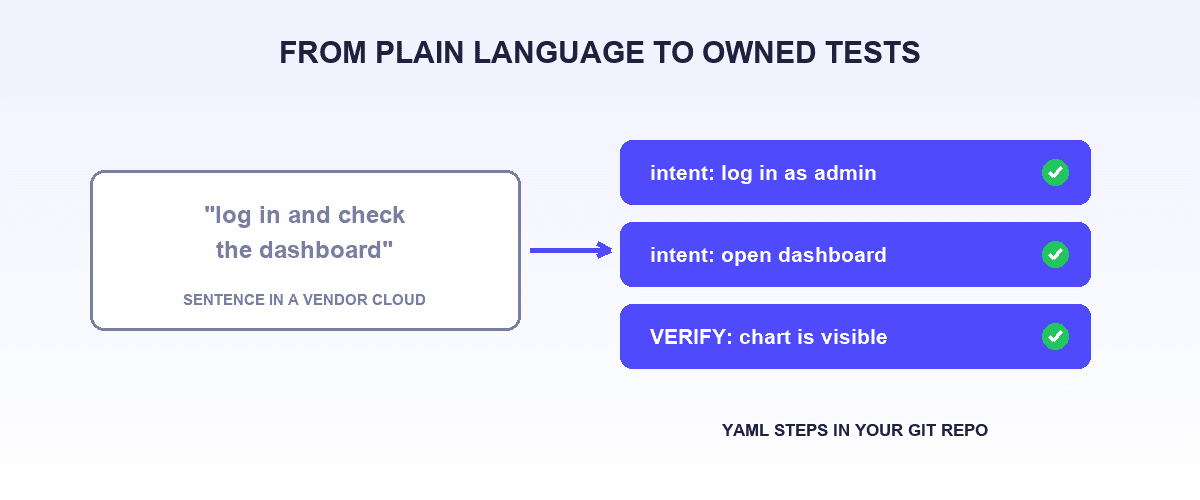
- Structured natural-language authoring. Tests are written as intent (no selectors, no scripting) and committed as readable YAML in your git repo: natural-language authoring without vendor lock-in.
- LLM intent resolution + self-healing. Steps resolve to the element that currently serves the user's intent, so tests survive UI refactors instead of breaking. See intent, cache, heal pattern.
- Real-browser execution. Tests run in a real browser in CI, so the result reflects real rendering and timing, not a parser's approximation.
- Agent-authored via MCP. Through the Model Context Protocol, the AI coding agent that built a feature also writes its natural-language test in the same session: coverage scales with code generation. See from natural language to release gates.
Honest scope: Shiplight targets the end-to-end/UI layer. It does not replace unit testing, and like all NLP testing it benefits from human-defined critical flows and reviewed generation. It is the right tool when natural-language authoring needs to survive fast UI change, not a no-review autopilot.
Frequently Asked Questions
What is NLP testing?
NLP testing is automated software testing where the test is authored in natural language and a system converts it into executable steps. Classical NLP uses tokenization, stemming, POS tagging, and intent/entity extraction to map words to UI actions; modern NLP uses large language models to resolve the intent against the live application, which survives rephrasing and UI change far better.
How does natural language processing turn plain English into automated tests?
Classically, the sentence is tokenized, stripped of stop words, lemmatized, POS-tagged, then mapped to an action (verb → interaction) and a target (entity → UI element). Modern systems skip the brittle parse: a large language model reads the instruction and the live page, infers the action and target semantically, executes it in a real browser, and re-resolves on UI change.
Is NLP testing the same as AI test generation?
NLP testing is a subcategory of AI test generation. AI test generation is the broad category of creating tests automatically (from requirements, recordings, exploration, or natural language). NLP testing specifically denotes the natural-language authoring surface: you write the test in words. Most modern NLP testing is also intent-based and self-healing, but those are additional properties, not the definition.
What are the limitations of NLP testing?
Vague instructions produce wrong tests, so specific phrasing is still required; classical-NLP tools stay brittle to synonyms and UI change; LLM-based resolution can be non-deterministic unless controlled with cached replay; and generating a test isn't the same as the test being correct, so human review is still needed. Complex business logic still needs human-defined critical flows.
Classical NLP or LLM intent-based testing: which is better?
For a stable UI with simple flows, a classical NLP tool can suffice and is more deterministic.
For fast-changing or AI-generated UIs and complex flows, LLM intent-based testing is better: it understands meaning, disambiguates against the live page, and re-resolves on UI change, delivering the low-maintenance promise classical NLP can't keep. Shiplight uses the LLM intent-based model with cached resolution for deterministic runs.
Related posts
Testing Concepts
What Is AI Test Generation?
Apr 1, 2026 · 9 min read
Intent-Based Testing
Testing Concepts
What Is Self-Healing Test Automation
Apr 1, 2026 · 10 min read

Engineering
From Natural Language to Release Gates
Mar 25, 2026 · 10 min read
Guides
AI Testing Tools That Automatically Generate Test Cases
Apr 6, 2026 · 14 min read
Guides
Best testRigor Alternatives
Jul 12, 2026 · 12 min read