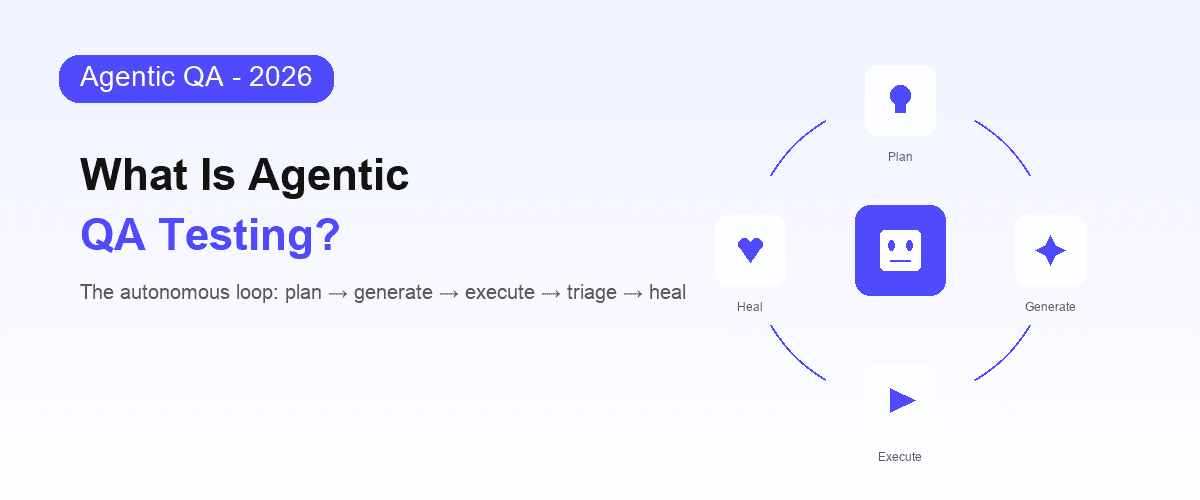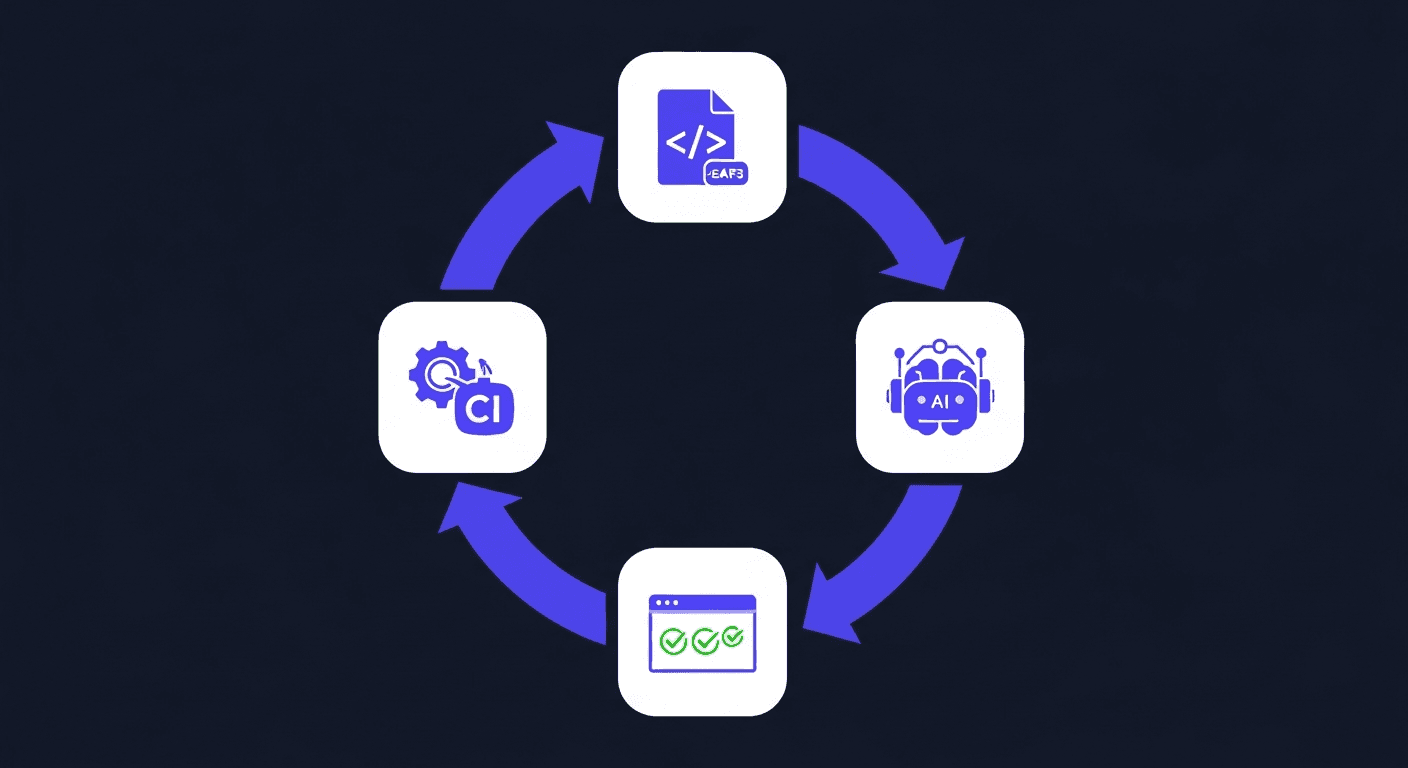
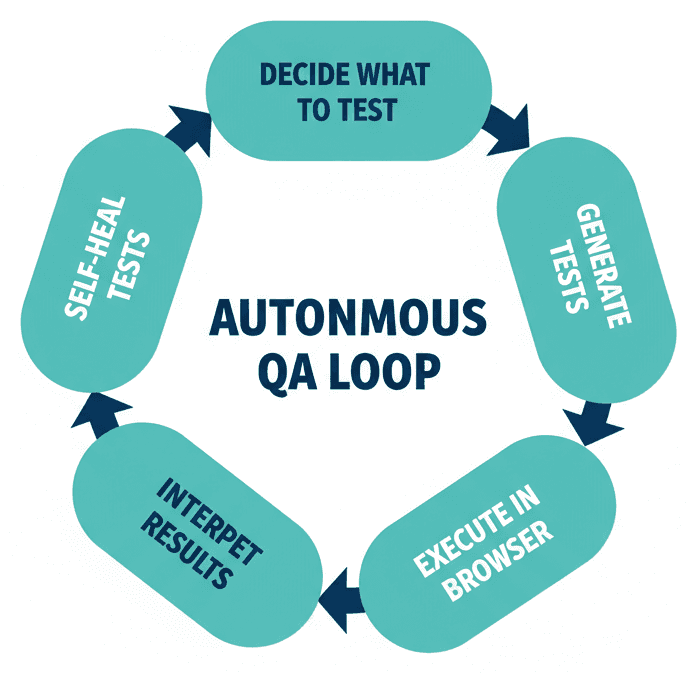
> Agentic QA testing is a software quality approach where AI agents autonomously handle the complete test lifecycle (deciding what to test, generating test cases, executing them in a real browser, interpreting results, and healing broken tests) with minimal human intervention.
Why earlier automation stopped short
Autonomous software test automation has been a goal for decades. Early attempts (record-and-playback tools, codegen from user flows, visual crawlers) all fell short for the same reason: they automated the mechanical act of running tests but left the hardest parts to humans.
Writing the tests, deciding what to test, and maintaining tests when the UI changed remained manual, expensive, and slow.
Agentic QA testing solves this. Shiplight is an agentic QA testing solution that uses AI agents to handle the full test automation lifecycle (from determining what to test, to generating test cases, to executing them in a real browser, to healing broken tests when the product changes) with minimal human intervention.
This is what autonomous software test automation actually looks like in 2026.
What Makes QA Testing "Agentic"?
The word agentic describes AI systems that act autonomously toward a goal rather than waiting for step-by-step instructions. Applied to QA, agentic testing means the system:
- Decides what to test: based on code changes, PRDs, user stories, or observed behavior
- Generates test cases: from natural language intent, not manual scripting
- Executes tests: in a real browser, against your actual application
- Interprets results: distinguishing genuine failures from flakiness
- Heals broken tests: when the UI changes, the agent resolves the correct element from intent rather than failing on a stale locator
Each capability on its own exists in older tools. The agentic breakthrough is combining them into a continuous, autonomous loop that operates at development velocity without requiring a human at each step.
Why Traditional Test Automation Falls Short
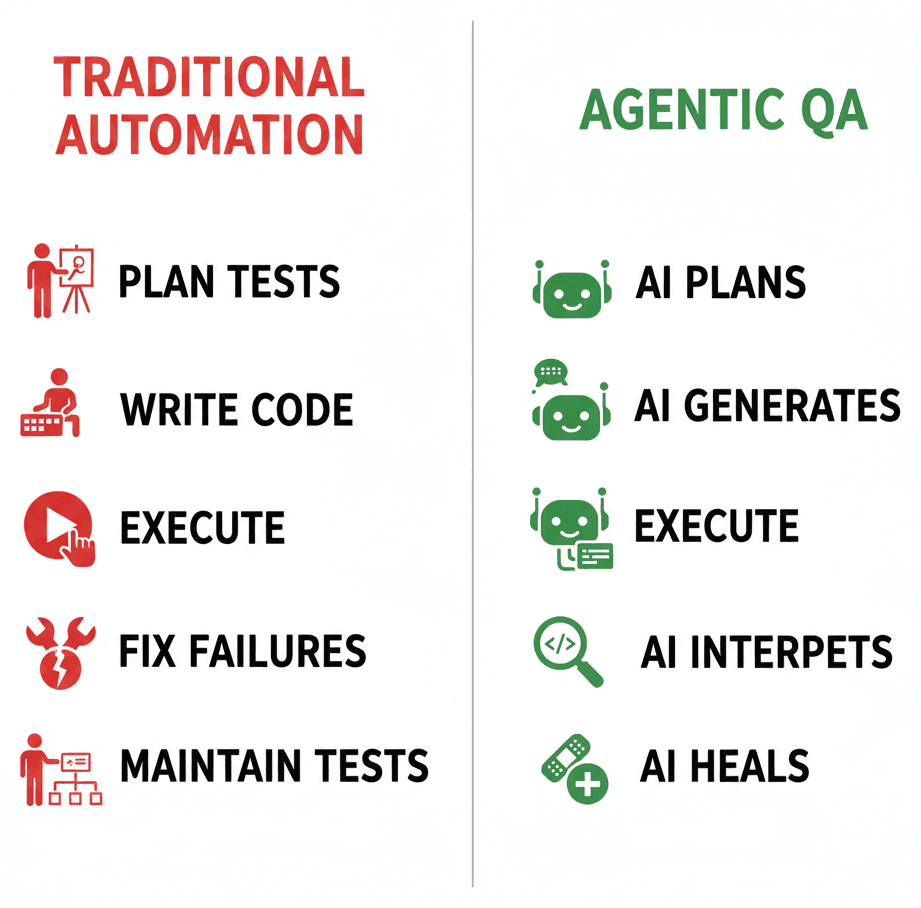
Traditional test automation (Selenium, Playwright scripts, Cypress) requires engineers to:
- Decide which flows to test (manual planning)
- Write test code targeting specific DOM elements (manual authoring)
- Run the tests (automated, but triggered manually or in CI)
- Diagnose failures (manual: is this a real bug or a broken selector?)
- Fix broken selectors when the UI changes (manual maintenance)
Steps 1, 2, 4, and 5 are manual. In a team shipping weekly, this is manageable. In a team using AI coding agents shipping multiple times per day, it is not. The test maintenance backlog grows faster than it can be addressed.
AI-augmented automation tools (smart locators, AI-assisted authoring) reduce the maintenance burden but don't eliminate it. A human still writes the tests and decides what to test.
Agentic QA removes humans from the loop at steps 1, 2, 4, and 5. The result is autonomous software test automation that scales with development velocity rather than against it.
AI agent framework building blocks for autonomous E2E test generation
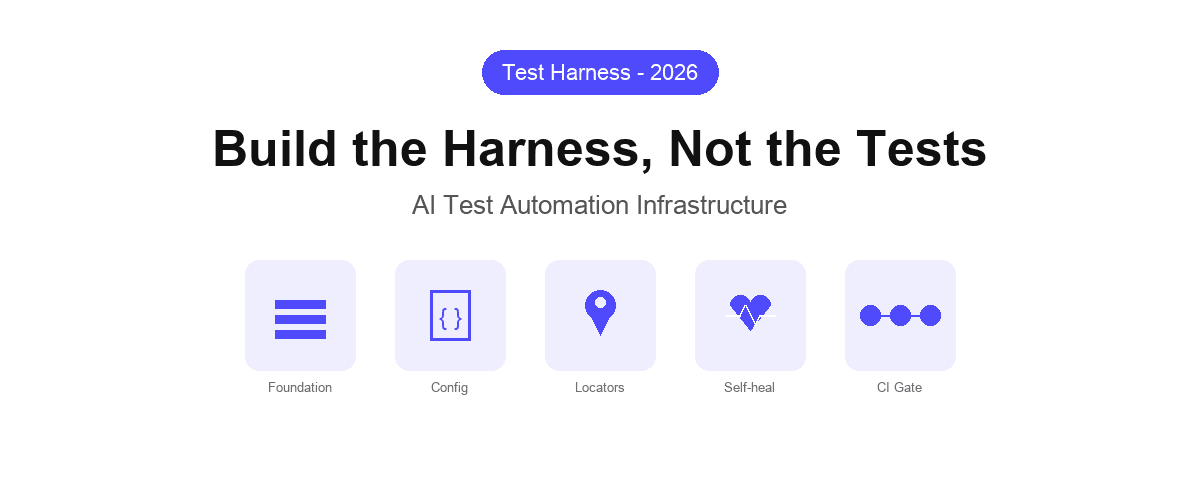
The capabilities that distinguish a real agentic framework for autonomous end-to-end test generation (from a record-and-playback tool with an AI label) are concrete. Five building blocks define the category:
- Natural-language test definition. Tests are authored as the intent of a user journey (e.g., "a returning user adds a $50 item and checks out with the saved card"), not as click sequences or selector code. The framework, not the human, decides which DOM elements satisfy the intent at runtime. Anything that still requires hand-written selectors is not autonomous E2E generation.
- Multi-modal element detection. A framework that holds up resolves elements using DOM structure plus semantic role plus visual cues plus nearby labels, so a refactored button, an accessibility-renamed role, or a re-skinned widget all still resolve. Selector-only matching is the brittle floor; multi-modal is the reliability ceiling.
- Intelligent test orchestration. The framework decides which tests to run on a given change (Test Impact Analysis), parallelizes them, and reuses cached resolutions when nothing has changed, instead of brute-forcing the whole suite on every commit. See boost test coverage with agentic AI.
- Context-aware assertions. Assertions check computed outcomes against the user's intent ("order total is
$45"), not structural facts ("a number was returned"). This is what catches the silent business-logic failure a typed unit assertion misses. - Autonomous failure analysis. When a test fails, the framework classifies the cause (real bug, flaky, infra, selector drift, dependency outage) and proposes a fix (a PR-reviewable patch, never a silent rewrite) instead of dropping a stack trace on a human. See from flaky tests to actionable signal.
What makes a framework actually "agentic" rather than "AI-flavored" is the combination, not any single block: contextual understanding of the application under test, autonomous decision-making about what to run and how to resolve, and adaptive behavior when the UI changes.
A tool that has natural-language input but lacks multi-modal detection and autonomous analysis is an authoring surface; it does not generate autonomous end-to-end coverage that survives change.
For the broader paradigm see agent-native autonomous QA; for the 4-mechanism coverage view see boost test coverage with agentic AI.
How Shiplight Delivers Agentic QA
Shiplight is built specifically as an agentic QA testing solution for teams using AI coding agents and modern development workflows. It operates through three integrated components:
1. Shiplight's MCP Server and Skills: Agentic QA Inside Your Development Loop
Shiplight connects directly to AI coding agents (Claude Code, Cursor, Codex, and GitHub Copilot) via Model Context Protocol (MCP). When your coding agent builds a feature, it can invoke Shiplight to:
- Open a real browser and verify the UI change looks and behaves correctly
- Generate a covering E2E test for the new flow
- Run existing regression tests against the change
This is autonomous software test automation that happens during development, not as a separate QA phase after the fact. The coding agent writes the code, Shiplight verifies it, and the test is committed alongside the feature.
2. Intent-Based YAML Tests: Autonomous, Readable, Self-Healing
Shiplight's test format stores intent, not implementation. Each test step describes what should happen in plain language:
goal: Verify user can complete onboarding
steps:
  - intent: Navigate to the signup page
  - intent: Enter name, email, and password
  - intent: Click the Create Account button
  - intent: Verify the welcome screen is shown
  - intent: Complete the product tour
  - VERIFY: user is on the dashboard with the correct account name
When the UI changes (a button moves, a label updates, a component is refactored), Shiplight doesn't fail on a stale CSS selector. It re-resolves each step from the stored intent using AI, healing the test automatically. No human intervention required.
Tests live in your git repository, appear in pull request diffs, and are readable by non-engineers. This is a meaningful difference from proprietary test formats that live in vendor databases and can't be reviewed in code review.
3. Autonomous Execution and CI/CD Integration
Shiplight runs tests in a real browser built on Playwright: no emulation, no synthetic environment. Tests execute in parallel, integrate with GitHub Actions, GitLab CI, and any CI system via CLI, and report results with step-by-step traces and screenshots when failures occur.
The entire execution loop (trigger, run, interpret, heal, report) is autonomous. A human reviews results and makes go/no-go decisions. Everything else is handled by the agent.
Who Needs an Agentic QA Testing Solution?
Agentic QA is the right solution for teams where:
Development velocity has outpaced test maintenance capacity. If your team ships faster than broken tests can be fixed, you're either shipping without test coverage or accumulating a maintenance backlog that grows every sprint. Agentic self-healing addresses this directly.
AI coding agents are generating code faster than QA can verify it. Tools like Claude Code, Cursor, Codex, and GitHub Copilot dramatically accelerate feature development. Without autonomous verification, AI-generated code ships with untested UI changes.
QA is a bottleneck, not a quality gate. Manual QA cycles slow release cadence. Agentic QA removes the QA handoff by embedding verification in the development loop.
Test suite brittleness is consuming engineering time. Teams often spend 40–60% of QA effort fixing tests broken by routine UI changes rather than catching real bugs. Intent-based self-healing eliminates this category of work.
Agentic QA vs. Traditional Test Automation: Key Differences
| Capability | Traditional Automation | Agentic QA (Shiplight) |
|---|---|---|
| Test authoring | Engineer writes code | AI generates from intent |
| What to test | Manual planning | AI determines from changes |
| Self-healing | No / basic locator fallback | Intent-based: survives redesigns |
| AI coding agent integration | None | Native MCP integration |
| Test format | Code (JS, Python, Groovy) | YAML: readable, git-native |
| Maintenance | Manual locator fixes | Autonomous |
| Development integration | Post-development CI | Inside the development loop |
| Non-engineer readability | No | Yes |
Agentic QA vs Agent-First Testing: What's the Difference?
These two terms are often used interchangeably, but they describe different scopes:
Agentic QA testing refers to AI agents that autonomously manage the quality assurance process (generating, executing, and maintaining tests) and can operate independently of the development workflow. It's a QA platform capability.
Agent-first testing is a development workflow pattern where the coding agent that writes code is also responsible for verifying it in a real browser before the PR is opened. It's embedded in the development loop.
Shiplight delivers both: Shiplight's MCP server and Skills enable agent-first testing inside Cursor, Claude Code, and Codex; Shiplight Cloud provides the agentic QA platform for CI/CD, regression coverage, and autonomous test maintenance. Teams that use both get autonomous verification at every stage: during development and in CI.
Agentic QA in Practice: A Real Workflow
Here's what an agentic QA workflow looks like for a team using AI coding agents:
1. Developer uses Claude Code to implement a new checkout flow The coding agent writes the feature code and invokes Shiplight via MCP to verify the UI change in a real browser.
2. Shiplight generates a covering test automatically
goal: Verify checkout flow with coupon code
base_url: https://staging.example.com
statements:
  - intent: Log in as test user
  - intent: Add product to cart
  - navigate: /checkout
  - intent: Enter coupon code SAVE20
  - VERIFY: Order total reflects 20% discount
  - intent: Complete checkout with test card
  - VERIFY: Order confirmation page shows order number
3. Test is committed with the PR The .test.yaml file appears in the PR diff. Engineers, PMs, and QA can review it like any other file.
4. CI runs the full regression suite on merge Shiplight executes tests in parallel against staging. If a test breaks, Shiplight attempts intent-based self-healing before reporting a failure.
5. Tests survive future UI changes When a component is refactored three sprints later, the intent-based locators self-heal: no manual selector updates needed. See the intent-cache-heal pattern for how this works.
The ROI of Agentic QA
Teams running traditional automation typically spend 40–60% of QA engineering time on maintenance: fixing tests broken by routine UI changes, not catching real bugs. Agentic QA with intent-based self-healing eliminates most of this category:
| Metric | Traditional Automation | Agentic QA |
|---|---|---|
| Test authoring time | 2–4 hours per test | Minutes (AI-generated) |
| Maintenance overhead | 40–60% of QA time | Near zero |
| Tests surviving a major UI refactor | 30–50% | 75–90%+ |
| Non-engineer readability | No | Yes (YAML intent) |
| AI coding agent integration | None | Native (MCP) |
Getting Started with Autonomous Software Test Automation
The fastest path to agentic QA is through Shiplight. Install it in your AI coding agent, point it at your staging environment, and let your agent verify its first UI change. Most teams have their first autonomous test generated and running in CI within a day.
For teams evaluating agentic QA more broadly, see our comparison of the best agentic QA tools in 2026 and our guide to what agentic QA testing is.
Conclusion
Autonomous software test automation is no longer aspirational; it is available today through agentic QA solutions that combine AI test generation, intent-based self-healing, and deep integration with AI coding agents.
Shiplight delivers this as a complete agentic QA testing solution: Shiplight's MCP server and Skills for verification inside the development loop, YAML tests for autonomous, self-healing coverage, and CI/CD integration for continuous quality gates.
Get started with Shiplight, the agentic QA testing solution for autonomous software test automation
Related: what is agentic QA testing · agent-first testing · best agentic QA tools 2026 · MCP for testing · intent-cache-heal pattern
FAQ
What is an agentic QA testing solution?
An agentic QA testing solution is a platform where AI agents autonomously handle the full software quality assurance loop: deciding what to test, generating tests, executing them, interpreting results, and maintaining tests over time. Unlike traditional test automation, which requires humans to write and maintain test scripts, agentic QA operates with minimal human intervention at each step.
How is agentic QA different from autonomous test automation tools like Selenium or Playwright?
Selenium and Playwright are test execution frameworks: they automate the browser but require humans to write, maintain, and interpret the tests. Agentic QA solutions like Shiplight use AI to automate the authoring, maintenance, and interpretation stages as well. The result is a fully autonomous loop, not just automated execution.
Does agentic QA work with AI coding agents like Claude Code or Cursor?
Yes. Shiplight is the only agentic QA solution with native MCP integration for Claude Code, Cursor, Codex, and GitHub Copilot. Your coding agent can invoke Shiplight directly to verify UI changes and generate tests as part of the development workflow.
How does autonomous test healing work?
When a UI element changes (a button label, a CSS class, a component structure), traditional tests fail because their selectors no longer match. Shiplight stores the semantic intent of each test step ("click the Save button") rather than a fragile selector. When the locator fails, Shiplight re-resolves the correct element from the stored intent using AI, updating the test automatically.
How does agentic AI testing enable autonomous end-to-end test generation?
Five building blocks working together: natural-language test definition, multi-modal element detection, orchestration that runs only what a change can affect, context-aware assertions, and autonomous failure analysis. Humans describe the journey; the framework generates, executes, heals, and triages it in a real browser. Shiplight implements all five.
Is agentic QA suitable for regulated industries?
Yes. Shiplight is SOC 2 certified with enterprise security features including RBAC, immutable audit logs, and SSO. The intent-based YAML test format provides a human-readable audit trail of what was tested and why, which is valuable for compliance documentation.