
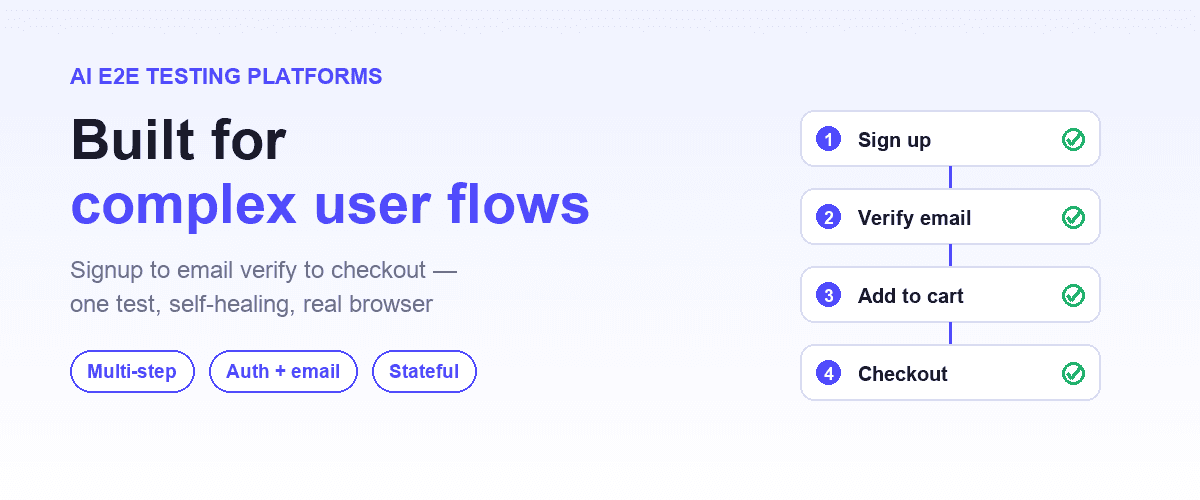
Complex user flows (multi-step onboarding, checkout and payment, auth and email round-trips, multi-tab and multi-session journeys) are where E2E tooling earns or loses its keep, and two common architectures struggle with them for opposite reasons.
Selector-bound code suites give a long journey a break point at every step. AI tools that re-find every element on every run trade that brittleness for slow, nondeterministic execution.
Shiplight uses a third mechanism: cached locators for fast, deterministic replay, AI intent resolution only when the UI actually changes, and AI VERIFY assertions for outcomes a fixed selector cannot express. Around it, open-source Playwright, Cypress, and Selenium remain the code-first baselines, Applitools covers the visual layer, and BrowserStack runs whatever suite you build across real browsers and devices.
The right pick depends on flow complexity, who maintains the suite, and whether the journey crosses email, auth, or multi-tenant state.
What counts as a complex user flow
"Complex user flow" is the part that breaks most testing tools. A login test is trivial. The flows that matter (and that regress most expensively) look like:
- Multi-step onboarding: signup → email verification → profile setup → first-run state.
- Checkout / billing journeys: cart → address → payment → confirmation, often with coupon, tax, and inventory edge cases.
- Auth + email round-trips: magic links, OTP, password reset; the test has to read a real inbox.
- Multi-tab journeys: OAuth popups, payment-provider redirects, an admin view opened in a second tab.
- Stateful, multi-session journeys: invite a teammate, switch accounts, verify the invite landed.
- AI-agent-built UIs that change weekly, so selectors written today are stale next sprint.
Long, stateful, boundary-crossing journeys are exactly where most tooling architectures give out. This guide explains why, then compares the platforms and layers that actually handle them, honestly, including where each one is the wrong choice.
What makes a platform good at complex flows (the evaluation criteria)
Not "does it have AI." The criteria that actually separate platforms on complex journeys:
- Cross-boundary journeys: can a single test span UI + a real email inbox + auth + multi-tab + multi-tenant state, or does it stop at the page?
- Self-healing under churn: does it re-resolve elements semantically when the UI changes, or break on every refactor?
- State and multi-step durability: does it hold state across many steps and sessions without flaking?
- Maintenance model: who fixes it when it breaks: a human rewriting selectors, or the platform proposing a patch?
- CI integration & determinism: does it gate PRs reliably, or is AI behavior at run time itself a flake source?
- Authoring + ownership: who can write a flow (engineer vs anyone), and do the tests live in your repo or a vendor cloud?
The two failure modes on complex flows
Selector-bound code suites fail arithmetically. A 30-step checkout test has 30 chances to break, and each UI refactor invalidates some of its locators.
That cost holds whether a human or a coding agent wrote the code: the tests are still selector-bound code someone has to fix, and on a UI that changes weekly, someone is fixing them weekly. See why AI-generated UIs break E2E tests.
Re-find-every-element AI tools fail probabilistically. Some AI platforms resolve every element with a model call on every run.
That absorbs UI change, but on a long journey it means dozens of model resolutions per run: slower execution, a new flake source when the model resolves a step differently between runs, and, on metered runtimes, a per-step line item on every execution.
On a 5-step smoke test this is tolerable; on a 30-step stateful journey gating a PR, it is not.
The cached-locator model takes a third path, and it is how Shiplight is built. Each step's resolved locator is cached in the repo, so a stable UI replays fast and deterministically with no model call.
When a step's cache misses because the UI changed, AI intent resolution re-finds the element from the step's intent, updates the cache, and larger fixes arrive as PR diffs rather than silent rewrites.
And for outcomes a fixed selector cannot express ("the confirmation page shows the same total as the cart"), AI VERIFY steps assert against the rendered page semantically. Deterministic when the UI is stable, adaptive when it is not: that combination is what long flows need.
The platforms and layers
1. Shiplight: intent-based, agent-authored, real-browser
Shiplight is built for the AI-native case: complex flows authored as structured natural-language intent (no selectors), resolved against the live DOM, run in a real browser, and self-healing when the UI changes. It's strongest on the hardest flows:
- Cross-boundary journeys: handles UI + real email + auth round-trips in one test, and multi-tab flows like OAuth popups and payment redirects (built on Playwright, it supports every Playwright browser capability). See stable auth and email E2E tests.
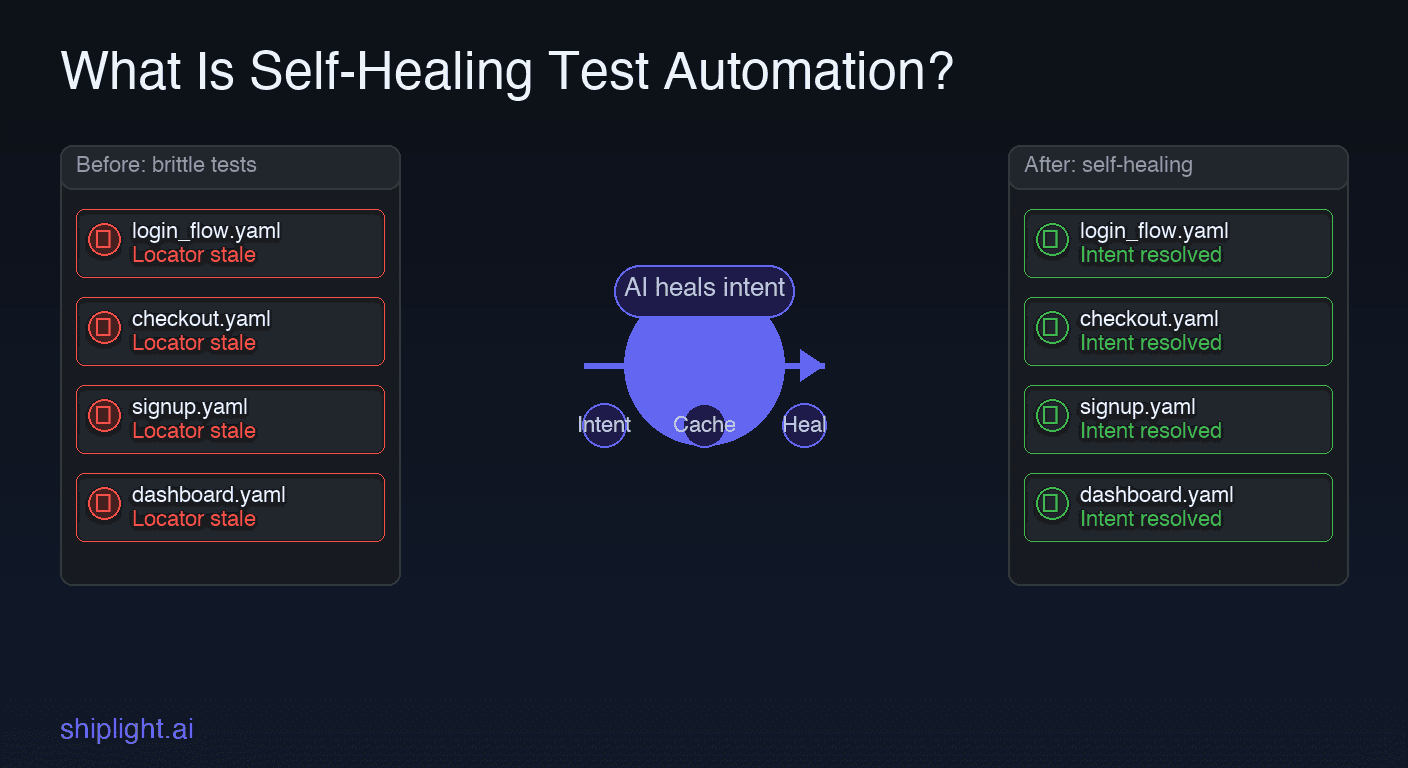
- Determinism plus healing: cached locators replay long journeys fast and deterministically; AI intent resolution runs only when the UI actually changed, and heals surface as PR diffs. See what is self-healing test automation.
- Semantic assertions: AI VERIFY steps check outcomes a fixed selector cannot express, which is where checkout and billing flows usually need judgment, not just presence checks.
- Agent-authored via MCP: the AI coding agent that built the feature also writes and runs its E2E test in the same session (MCP Server), so coverage of new complex flows arrives with the feature.
- Ownership: tests are readable YAML committed in your git repo, with no vendor lock-in.
Best for: teams shipping fast-changing UIs where complex flows cross email, auth, multi-tab, or multi-tenant state. Not the pick if you only need pure visual-regression diffing (see Applitools) or your product is mobile-native (Shiplight is web only).
2. Playwright: code-first control
Playwright is the strongest open-source framework for complex flows written as code: multiple browser contexts and tabs are first-class, auto-waiting removes a whole class of timing flake, and the trace viewer makes a 30-step failure debuggable. Email round-trips are possible by wiring an inbox service yourself.
The trade is the first failure mode above: every step is bound to locators your team maintains, and on a fast-changing UI that maintenance is permanent, coding agent or not.
Best for: engineering-led teams that want full code control and accept the maintenance. A common hybrid is AI-generated Playwright code: it lowers authoring cost but the output is still selector-bound code you own. See Playwright alternatives for no-code testing for that trade-off.
3. Cypress: JS-first, with complex-flow caveats
Cypress has the best interactive debugging in code-based testing, which genuinely helps when a long stateful flow fails. But its architecture constrains exactly the flows this article is about: multi-tab journeys are unsupported by design, and cross-origin steps (payment providers, OAuth) work through a dedicated cy.origin escape hatch rather than naturally.
Best for: JavaScript-first teams whose critical flows stay in one tab and mostly one origin. See Playwright vs Cypress.
4. Selenium: the enterprise standard
Selenium drives complex flows in six-plus languages over the W3C WebDriver standard, with twenty years of grid infrastructure behind it. It requires the most wiring of anything here: no auto-waiting, so long stateful journeys need explicit synchronization discipline to stay stable.
Best for: enterprises whose standards, languages, or existing infrastructure make WebDriver the pragmatic call. See Playwright vs Selenium.
5. Applitools: the visual layer
Not a flow author: a visual validation layer (Visual AI) added to functional E2E. On a complex flow it answers a different question than behavior: did the checkout render correctly at every step, across browsers and viewports.
Baselines live in Applitools' cloud; pricing is free trial only, quote-based. Pair it with a functional platform; it is not a standalone complex-flow tool.
6. BrowserStack Automate: the execution layer
Execution infrastructure for whatever suite your functional layer produces: real devices, real browsers, cross-OS coverage. Relevant here because checkout and payment flows behave differently on real iOS Safari than in an emulator, and a device grid is the practical way to run the same complex-flow suite there. It does not author or heal tests.
7. testRigor: the vendor-console archetype
testRigor is a representative example of the vendor-console category: a cloud-hosted platform (founded 2015, before the coding-agent era) where manual-QA staff author tests in a constrained plain-English DSL (its own docs note the parsed English "has some syntax to it") that live as suites in testRigor's cloud console and run on its hosted runners.
On complex flows specifically: validation logic beyond the DSL's vocabulary drops into embedded ECMAScript 5.1 JavaScript invoked as strings, tests have no repo copy (Selenium export only under paid-customer agreements), and reviews (a small base) note nondeterministic failures on the hosted runners.
Its design center is manual-QA-heavy organizations, a different buyer from engineering-led teams. See Shiplight vs testRigor.
8. QA Wolf: the managed-service archetype
QA Wolf is a managed QA service, not a tool you operate: its engineers, assisted by AI tooling, write and maintain standard Playwright tests on QA Wolf's infrastructure.
Complex flows are handled the way any Playwright shop handles them, except the shop is theirs: coverage scales with their engineering hours, testing knowledge accumulates outside your team, and no MCP server for coding agents exists.
Export of the Playwright code is the exit, not the home. The design center is teams outsourcing E2E entirely. See Shiplight vs QA Wolf.
Categories you will also meet
Three commercial patterns show up on complex-flow shortlists and are described here without vendor names:
- Cloud-agent generation services: the vendor's cloud agent writes tests (sometimes delivered into your repo) and heals them through billable cloud sessions. Check where the tests execute, whether long stateful runs are metered per step, and what healing costs before assuming portability.
- Low-code recorder platforms: visual flows recorded into a vendor cloud. Recorders strain on exactly the flows above: long stateful journeys, real inboxes, and multi-tab steps sit outside what a recording captures, and export paths are typically lossy or absent.
- Per-step metered AI runtimes: repo-resident or console-resident tests that execute only on the vendor's runtime with each step consuming credits. The complex-flow problem is economic and operational at once: a 30-step journey is 30 metered resolutions per run, on infrastructure you cannot run locally.
Quick comparison
| Platform | Authoring | Handling UI change | Cross-boundary (email/auth/multi-tab) | Designed for |
|---|---|---|---|---|
| Shiplight | NL intent as YAML, in your repo | Cached locators + AI re-resolution; heals as PR diffs | Strong: real email + auth + multi-tab in one test | AI-native teams, fast-changing UIs |
| Playwright | Code in your repo | Manual: selectors are yours to fix | Multi-tab first-class; email via your own wiring | Engineering-led teams wanting control |
| Cypress | JS/TS in your repo | Manual | Multi-tab unsupported; cross-origin via cy.origin | JS-first teams, debugging ergonomics |
| Selenium | Code, 6+ languages | Manual | DIY; most wiring on this list | Enterprise WebDriver estates |
| Applitools | n/a (visual assertions on your flows) | Baseline management | n/a (visual only) | UI-correctness-critical flows |
| BrowserStack Automate | n/a (runs your suite) | n/a | n/a (execution only) | Real-device and cross-browser coverage |
| testRigor | Constrained-English DSL, vendor console | AI re-interpretation on hosted runners | Complex logic via embedded JavaScript strings | Manual-QA organizations |
| QA Wolf | Playwright, by their engineers | Human-backed SLA | Their engineers wire it | Teams outsourcing QA entirely |
How to choose quickly
- Flows cross email, auth, multi-tab, or multi-tenant state, and the UI changes fast: Shiplight.
- Enterprise + compliance-heavy: Shiplight (SOC 2, VPC deployment, dedicated CSM), or Selenium where existing WebDriver standards govern.
- Engineering-led, want deterministic full-code control and accept the maintenance: Playwright; Cypress if the team is JS-first and the critical flows stay single-tab.
- Visual correctness as critical as function: Applitools, layered on a functional platform.
- Checkout and payment must be verified on real devices: BrowserStack Automate running your existing suite.
- A manual-QA organization owns testing outside the repo: the vendor-console category is built for that buyer.
- Nobody internal should own testing: a managed QA service buys the outcome; the trade is that testing knowledge accumulates outside your walls.
Reality check
AI E2E tools are powerful but not magic on complex flows:
- Fully autonomous "no-human QA" still struggles with genuine edge cases and ambiguous business logic.
- Best results come from human-defined critical flows + AI expansion, not AI-from-scratch.
- Most teams use these platforms to augment regression coverage, not replace QA judgment entirely.
- The honest decision criterion is maintenance, not demo dazzle: see self-healing vs manual maintenance and the AI-native E2E buyer's guide for the full evaluation framework.
Frequently Asked Questions
What is the best AI end-to-end testing platform for complex user flows?
For teams with fast-changing UIs and flows that cross email, auth, multi-tab, or multi-tenant state, Shiplight is the strongest fit: intent-based YAML in your git repo, cached locators for deterministic replay with AI re-resolution when the UI changes, AI VERIFY for semantic assertions, and MCP so the agent that built the feature authors its test.
Playwright is the strongest code-first alternative for teams that accept selector maintenance.
Why do complex user flows break traditional E2E testing?
Complex flows are long, stateful, and often cross boundaries (UI, email inbox, auth, multi-tenant state). Selector-based scripts bind each step to brittle DOM details, so every UI refactor breaks the journey, and with AI-generated UIs that happens weekly. The durable pattern is semantic resolution with caching: deterministic replay when the UI is stable, AI re-resolution only when it changes.
Can an AI E2E test cover a flow that includes email verification or auth?
Yes, with the right platform. Magic links, OTP, and password-reset flows require the test to read a real email inbox and continue the journey, which not all tools support. Platforms designed for cross-boundary journeys like Shiplight handle UI, real email, and auth round-trips in a single test. See stable auth and email E2E tests.
Should I use a fully autonomous AI tester or human-defined flows?
Use human-defined critical flows plus AI expansion. Fully autonomous QA still struggles with genuine edge cases and ambiguous business logic, so humans define the critical journeys that must never break while the AI platform generates, self-heals, and expands coverage around them. Treat AI E2E platforms as augmenting regression coverage, not replacing QA judgment.
How is Shiplight different from other AI testing platforms on complex flows?
By mechanism, not label. Most AI tools either generate selector-bound code you maintain, or re-resolve every element on every run, which is slow and nondeterministic across a long journey.
Shiplight caches each resolved locator in your repo so stable UIs replay deterministically and AI resolution runs only when a step changes. Tests are readable YAML built on Playwright, authorable by your coding agent via MCP.
Related posts

Engineering
AI-Native E2E Testing: A Practical Buyer''s Guide
Mar 25, 2026 · 6 min read
Guides
Best AI Testing Tools in 2026
Mar 31, 2026 · 22 min read

Engineering
Stable Auth & Email E2E Tests
Mar 25, 2026 · 6 min read
Testing Concepts
What Is Self-Healing Test Automation
Apr 1, 2026 · 10 min read
Guides
Best E2E Testing Tools in 2026
Jul 12, 2026 · 14 min read