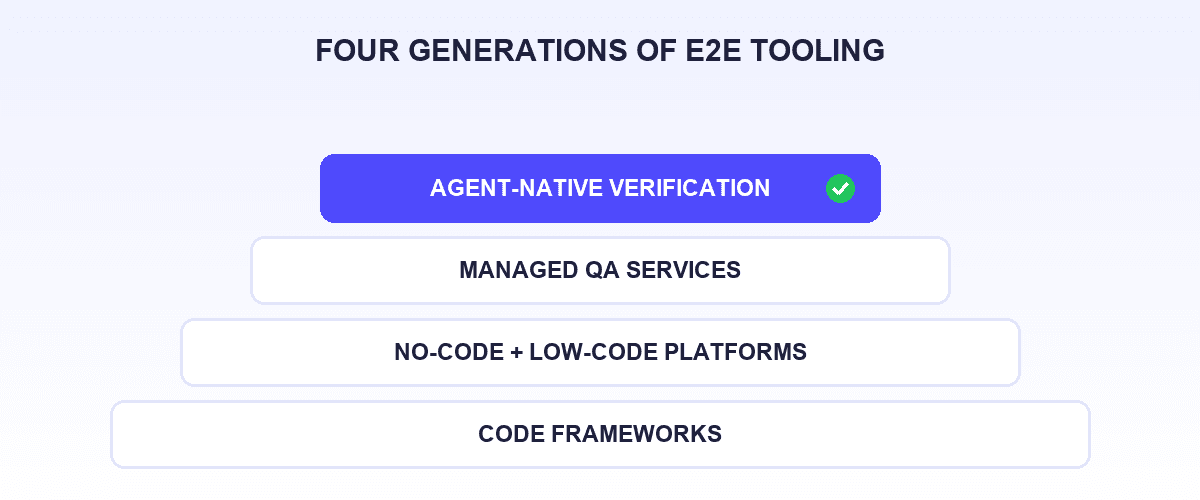
If your real cost is writing and maintaining tests, the strongest BrowserStack alternative is Shiplight AI: your coding agents author intent-based YAML tests that live in your git repo, and the tests heal themselves when the UI changes.
That is the layer a device grid never touches. BrowserStack executes a suite you already wrote; it does not author, interpret, or fix your tests.
If instead you genuinely need pure cross-browser and real-device execution, BrowserStack and Sauce Labs are the right grid answer. Self-hosted Playwright and Cypress run that execution yourself for free, and Percy or Applitools cover the visual-diff layer. Pick by the job you are actually hiring for.
BrowserStack sells execution, not test authoring
Before you shop for a BrowserStack alternative, name the job. BrowserStack sells execution infrastructure: a real-device cloud, manual testing tools, and Automate for running an existing Selenium or Playwright suite across browsers. It runs the tests you already have.
It does not write them, does not interpret intent, and does not repair a broken test at the source, that all happens somewhere else, in a different layer.
That matters because most teams typing "BrowserStack alternatives" are not actually unhappy with the machines. The pain is upstream: the tests themselves are selector-bound code that is expensive to author and breaks every time the UI shifts, no matter which cloud executes them.
A faster or cheaper grid does nothing for that. Swapping BrowserStack for another grid moves the same maintenance burden to a new vendor.
So the useful question is not "which grid is cheaper" but "which layer is my bottleneck." The alternatives below are grouped by that answer. We build Shiplight, which lives in the authoring-and-maintenance layer, so it leads the list, and we are direct about where a grid or a visual tool is genuinely the better buy.
Quick Comparison
The axes that decide this are which layer solves your bottleneck: who authors the tests, whether they heal themselves, whether your coding agent can drive them, and where the test lives. A grid answers none of these; it runs whatever you feed it.
| Tool | Layer | Who authors the tests | Self-healing at the source | Coding-agent native | Tests in your git repo |
|---|---|---|---|---|---|
| Shiplight AI | Authoring + maintenance | Your coding agent, in intent-based YAML | Yes, surfaced as PR diffs | Yes (MCP + Skills) | Yes, plain YAML |
| Playwright | Framework you run yourself | Your engineers, in code | No (manual locator upkeep) | No | Yes, code |
| Cypress | Framework you run yourself | Your engineers, in code | No (manual locator upkeep) | No | Yes, code |
| BrowserStack / Sauce Labs | Execution grid | You author elsewhere; the grid only runs it | Cloud-only, runtime locator retry | No (console-wrapping MCP) | No, suite runs against their cloud |
| Visual layer (Percy or Applitools) | Visual assertion over your suite | You add snapshot calls to tests you already wrote | n/a (it compares images) | No | Baselines in the vendor cloud |
The 5 Best BrowserStack Alternatives in 2026
1. Shiplight AI: The Authoring and Maintenance Layer a Grid Never Touches
Best for: Teams building with AI coding agents whose real cost is authoring and maintaining tests, not running them.
Shiplight operates in the layer BrowserStack leaves untouched. A grid takes a suite you already wrote and runs it across browsers.
Shiplight is where the suite comes from and how it stays alive: your AI coding agents like Claude Code, Cursor, Codex, and GitHub Copilot author the tests as intent-based YAML in the same session they write the feature, and those tests heal themselves when the UI changes.
Tests are plain YAML, readable by anyone who can follow a bulleted list, committed in git next to your source, and self-healing via the intent-cache-heal pattern:
goal: Verify user can complete checkout
steps:
  - intent: Log in as a test user
  - intent: Add the first product to the cart
  - intent: Proceed to checkout
  - intent: Complete payment with test card
  - VERIFY: order confirmation page shows order number
Strengths:
- Shiplight authors and maintains the tests; a grid does neither. Your coding agent writes the intent-based YAML and the triage agent proposes fixes as reviewable PR diffs when the UI shifts. BrowserStack executes whatever suite you hand it; its self-healing runs only inside its own cloud at runtime, patching a locator for that session rather than repairing the test in your repo.
- Your own coding agents own the loop, agent-natively. Claude Code, Cursor, Codex, and Copilot read, write, and edit the YAML directly through MCP and Skills, so the agent that shipped the feature also covers it. BrowserStack's MCP wraps its cloud console, so an agent drives the grid but does not own or edit the tests.
- Tests live in your git repo as plain YAML: diffable, PR-reviewable, portable. BrowserStack's low-code authoring lives in its console, and its own docs note the AI element-selection and healing logic and several step types are not exported, so leaving is lossy.
- Built on Playwright, so no vendor lock-in. The YAML transpiles to Playwright at run time and supports every Playwright browser; you can run alongside an existing Playwright suite and eject anytime. Local runs with no account need no account.
- Both infrastructure modes, your choice. Hosted CI runners, dashboards, and an LLM proxy for zero setup, or your own CI runners with your own Anthropic, OpenAI, or Google keys (Azure, Bedrock, Vertex included); cached deterministic steps call no LLM.
- Full platform, not just a tool: SOC 2, VPC, RBAC, dedicated CSM, and first-party support.
Tradeoffs:
- Web only: no native mobile app or real-device cloud. If you must certify on physical devices, keep a grid for that.
- Assumes a repo workflow with an engineer or coding agent in the loop.
- Free is $0 forever and Pro is $60/month; the MCP server, Skills, and local runs need no account.
Leave BrowserStack for Shiplight if: your bottleneck is writing and maintaining the tests, you are building with AI coding agents, and you don't need a managed mobile device cloud.
2. Playwright (Self-Hosted): Best for Cost-Conscious Engineering Teams
Best for: Teams with engineering capacity who want full control and zero per-parallel-test pricing.
Playwright is the open-source browser automation framework from Microsoft. It's free, self-hosted, and widely considered the most capable modern alternative to Selenium. When teams leave BrowserStack purely for cost reasons, moving test execution to self-hosted Playwright in CI is often the right answer.
Strengths:
- Free and open source
- Cross-browser (Chromium, Firefox, WebKit) natively
- Excellent developer experience: traces, video, step-by-step debugging
- Massive ecosystem and active community
Tradeoffs:
- No managed device cloud: you run it yourself in CI
- Tests are selector-bound TypeScript/JavaScript/Python code, costly to maintain even when a coding agent writes them
- Self-healing is limited: manual locator maintenance when UI changes
- Requires engineering time to set up and maintain
Leave BrowserStack for Playwright if: You have engineering capacity to run it yourself, don't need real mobile devices, and want to eliminate per-parallel-test pricing.
3. Cypress: Best Local Development Loop
Best for: JavaScript-heavy teams that want a fast, interactive local testing experience without a vendor cloud.
Cypress is the other major open-source E2E framework. Its distinguishing strength is the developer experience during authoring: tests run in an interactive app with time-travel debugging, so you watch each step execute and inspect the DOM at any point. Execution is local by default; the optional paid Cypress Cloud adds parallelization, recordings, and flake analytics.
Strengths:
- Free, open-source core with a strong interactive runner
- Fast feedback loop while writing and debugging tests
- Large plugin ecosystem and community
- No vendor account required to write and run tests
Tradeoffs:
- Browser coverage is narrower than Playwright's (WebKit support is limited)
- In-browser architecture constrains some multi-tab and cross-origin scenarios
- Tests are selector-bound JavaScript that the team maintains by hand when the UI changes
- No device cloud; mobile coverage is viewport emulation only
Leave BrowserStack for Cypress if: your team lives in JavaScript, values the interactive local loop, and your browser matrix doesn't require Safari or real devices. For the framework decision itself, see Playwright vs Cypress.
4. Sauce Labs: Enterprise Cloud + Mobile Device Coverage
Designed for: BrowserStack's scope (web + mobile + manual testing) under different commercial terms and support models.
Sauce Labs is BrowserStack's longest-running enterprise competitor and the most direct like-for-like replacement in this list: if you want to keep the cloud-grid model and change vendors, this is the lateral move. It offers real-device cloud, automated and manual testing, visual testing, and API testing under one platform.
Teams often pick Sauce Labs over BrowserStack for specific enterprise requirements: data residency, private device clouds, or existing procurement relationships.
Strengths:
- Broad product suite (automated, manual, visual, API)
- Mature enterprise features and support
- Private device cloud options for regulated industries
- Strong integrations with enterprise CI/CD and Jira
Tradeoffs:
- Pricing is enterprise-only; not cost-friendly for small teams
- Not AI-native; test authoring remains script-based
- A lateral move: your tests stay selector-bound code, and the maintenance burden moves with them
Leave BrowserStack for Sauce Labs if: You are an enterprise that needs a direct peer of BrowserStack with different commercial terms or private device cloud requirements.
5. The Visual Layer: Applitools or Open-Source Screenshot Diffing
Designed for: Teams whose BrowserStack usage includes Percy, BrowserStack's visual testing product, and who need a visual replacement when they leave.
If visual regression coverage is part of what you are replacing, that is its own layer, separate from execution. Applitools is the established commercial option: a visual-assertion layer you add to a test framework you already run, with baselines and match settings managed in its cloud.
Note its pricing is quote-based (billed in test units) with a free trial only, no free plan. On the open-source side, Playwright's built-in toHaveScreenshot() assertions and BackstopJS cover basic page diffing at zero license cost, with baselines in your repo and triage on you.
On this layer:
- Visual tools assert how the UI looks; they don't replace functional E2E coverage
- Commercial services add cross-browser rendering and team review workflows; open-source options trade that for zero cost
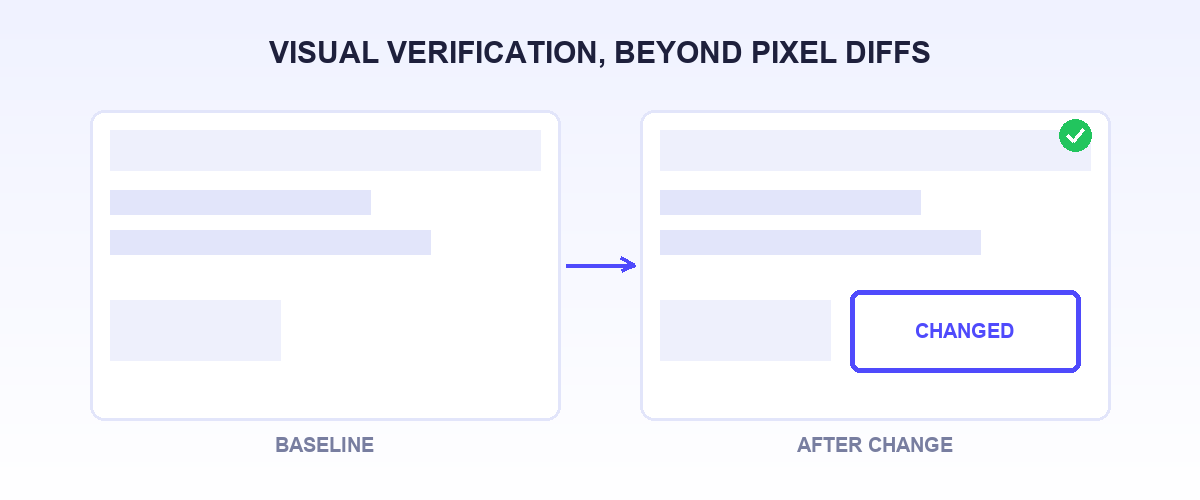
- Shiplight covers visual correctness functionally (the page renders, the button is clickable, the flow completes) via AI verification, but it is not a pixel-diff engine
For a full breakdown of this layer, see best Applitools alternatives.
How to Choose a BrowserStack Alternative
By your reason for leaving
| Reason for leaving BrowserStack | Best alternative |
|---|---|
| Pricing too high at scale | Playwright or Cypress (self-hosted) |
| Test maintenance burden, not execution | Shiplight AI |
| Want AI-native / coding agent integration | Shiplight AI |
| Need tests in your git repo, not a vendor platform | Shiplight AI or Playwright |
| Want visual authoring in a vendor console | A low-code vendor-console platform |
| Need enterprise peer with different terms | Sauce Labs |
| Need private device cloud for compliance | Sauce Labs |
| Only used it for Percy / visual testing | Applitools or open-source diffing |
By team profile
| Team profile | Best fit |
|---|---|
| Engineers using AI coding agents | Shiplight AI |
| Engineers with capacity to self-host | Playwright or Cypress |
| Tests authored visually in a vendor console, no repo workflow | A low-code vendor-console platform |
| Private device cloud or data-residency requirements | Sauce Labs |
| Same cloud-infrastructure model as BrowserStack | Sauce Labs |
By what BrowserStack feature you rely on
| BrowserStack feature you rely on | Closest alternative |
|---|---|
| Automate (Selenium/Playwright cloud) | Sauce Labs or self-hosted Playwright |
| Low Code Automation | Shiplight AI or a low-code vendor-console platform |
| Live (manual testing) | Sauce Labs |
| App Live (mobile manual) | Sauce Labs |
| Percy (visual regression) | Applitools or open-source screenshot diffing |
| Accessibility Testing | Shiplight /shiplight review or dedicated tools |
Conclusion
BrowserStack is a capable platform, but it answers only the execution half of the testing problem. Engineering teams building with AI coding agents want tests in their repos, intent-based self-healing, and tools their agents can call during development, none of which a device grid provides.
If the tests themselves are your bottleneck, Shiplight AI is the clear first choice: MCP integration, intent-based YAML tests, git-native storage, and self-healing that survives UI redesigns. If execution cost is the bottleneck, self-hosted Playwright or Cypress eliminates per-parallel-test pricing entirely. If you simply want a different grid vendor, Sauce Labs is the lateral move.
Start with a 30-day pilot on your most critical user flow. Measure coverage, flakiness, and maintenance burden: the numbers will tell you which alternative fits your team.
FAQ
What is the best BrowserStack alternative in 2026?
It depends on why you are leaving. If the real cost is authoring and maintaining tests, Shiplight targets that, with tests owned as YAML in your repo. If it is purely cost, self-hosted Playwright or Cypress removes per-parallel pricing. If you want the same grid model elsewhere, another device cloud is the lateral move.
Is there a free alternative to BrowserStack?
Yes, Playwright and Cypress are the primary free alternatives. Both are open source and self-hosted, so you eliminate BrowserStack's per-parallel-test pricing entirely. The tradeoff is you run them yourself in CI (GitHub Actions, GitLab CI, etc.) and maintain the infrastructure. You also lose BrowserStack's real-device mobile cloud.
Which BrowserStack alternative is best for AI coding agents?
Shiplight AI is built specifically for AI coding agent workflows. Its browser MCP server and Skills expose browser automation and test generation, so Claude Code, Cursor, Codex, and GitHub Copilot can invoke testing capabilities directly during development.
With the other alternatives here, a coding agent can write Playwright or Cypress code for you, but the result is still selector-bound code your team maintains when the UI changes.
Can I migrate from BrowserStack to Playwright?
Yes, and it's a common migration path. Playwright has a codegen tool that records interactions and generates Playwright tests. Most BrowserStack Automate test suites using Playwright or Selenium can be migrated with limited changes: the main work is moving from BrowserStack's cloud runners to self-hosted execution in CI.
Does Shiplight work with mobile device testing like BrowserStack?
Not at present, Shiplight focuses on web E2E testing with real browser execution built on Playwright. For mobile device testing, you would pair Shiplight with a dedicated mobile testing tool or keep a BrowserStack or Sauce Labs account for mobile flows.