End-to-end testing answers the only question users care about: does the whole flow work? Not the unit, not the API in isolation, but the real path a person takes through a real browser.
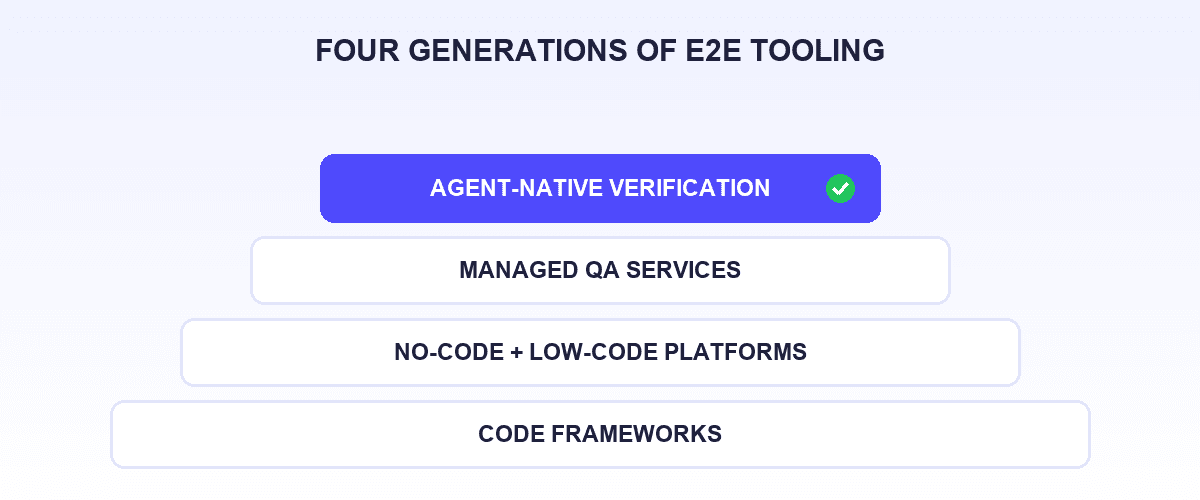
The tools that answer it have gone through four distinct generations, and in 2026 all four are still on the market, which is exactly why choosing one is confusing.
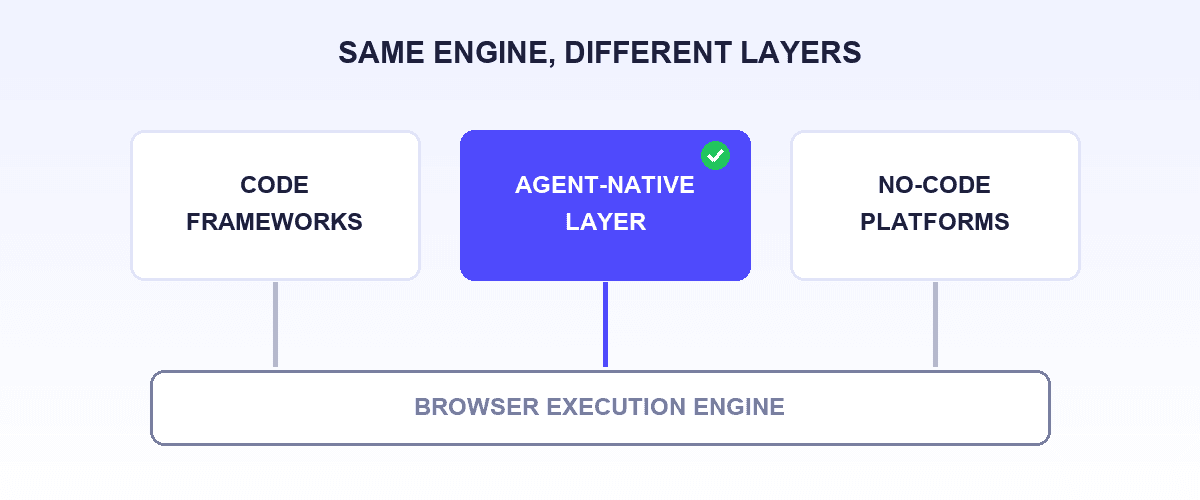
Code frameworks give engineers full control and a permanent maintenance tax. No-code and low-code platforms open authoring to non-engineers and move tests into vendor clouds. Managed services sell the outcome instead of the tool. And the newest generation plugs into AI coding agents, so tests are authored and maintained by the same agents that write the application code.
The verdict, by who authors the tests
The best E2E testing tools in 2026 split by who authors the tests: Playwright and Cypress for engineer-owned code suites, Shiplight for teams whose coding agents author and maintain intent-based tests in the repo.
Vendor no-code consoles serve non-engineers, and managed services fit when nobody in-house owns the suite. Startups without dedicated QA usually land on the agent-native or no-code end.
They are the best tool per situation, defined by three variables: who authors the tests (engineers, mixed-skill QA, non-engineers, nobody), what your development workflow looks like (especially whether coding agents write meaningful code), and what surfaces you cover (web only, or mobile and desktop too).
This guide profiles eight tools and layers: the four functional generations, plus the visual and execution layers that pair with whichever functional tool you pick. Each entry gets an at-a-glance summary and a direct answer on when it wins. A comparison table, a decision framework, and startup-specific guidance follow.
The 8 best E2E testing tools in 2026
Disclosure up front: we build Shiplight, so it is listed first, and we are explicit about the teams that should pick something else. Pricing notes reflect what each vendor publishes as of this writing; where a vendor does not publish numbers, we say so.
1. Shiplight AI
Shiplight is the agent-native generation: a verification platform that plugs into your coding agent and gives it eyes and hands in a real browser.
As the agent builds, /shiplight verify confirms UI changes look right; /shiplight create-yaml-tests has the agent walk the app and write E2E regression tests; /shiplight fix reproduces failures and diagnoses root cause, reporting app bugs instead of editing tests when the app itself is broken.
Tests are readable YAML authored from intent, living in your git repo, run locally with npx shiplight test. The MCP server and Skills install into Claude Code, Cursor, Codex, VS Code, and more in one line; the local MCP needs no account.
Maintenance is where the model pays off: set-of-marks visual prompting resolves stabler locators than accessibility-tree reads, a vision fallback clicks what locators cannot reach, and locators are a step-level cache in the repo that heals at run time, with larger fixes proposed as PR diffs. Coverage grows as a byproduct of shipping. See near-zero maintenance E2E testing.
At a glance
- Approach: Agent-native verification and E2E testing
- Test format: YAML in your git repo
- Pricing note: Local runs need no account; Free $0, Pro $60/mo
- Setup effort: One-line plugin install; first suites of a few hundred tests typically land within the first weeks
- Best for: Teams shipping with AI coding agents that want coverage without a maintenance tax
Pros:
- The coding agent authors and maintains tests through MCP, so coverage scales with shipping speed
- Tests in git, reviewed in PRs; heals arrive as PR diffs, never silent rewrites
- Playwright-compatible: runs alongside an existing suite, no rip-and-replace
- Enterprise: SOC 2, VPC, hosted CI runners
Cons:
- Web only: no mobile or desktop testing
- Assumes a repo workflow with an engineer or coding agent in the loop
- Younger vendor than the framework incumbents
When to choose Shiplight: AI coding agents write a meaningful share of your code, or your team is drowning in test maintenance and wants regression coverage to come from the dev loop itself.
2. Playwright
Playwright is the reference code-first framework: fast, cross-browser, multi-language (TypeScript, JavaScript, Python, Java, C#), with auto-waiting, parallelism, and a first-class trace viewer. For engineering-led teams it is the open-source default, and it is the foundation Shiplight is built on.
At a glance
- Approach: Code-first open-source framework
- Test format: Code in your repo
- Pricing note: Free, open source
- Setup effort: Quick install; real cost is ongoing authoring and locator maintenance
- Best for: Engineering teams that want maximum control at zero license cost
Pros:
- Best open-source execution engine: speed, reliability, tooling
- No seats, no vendor, tests versioned like code
- Huge community, backed by Microsoft
Cons:
- Locator-bound tests break on UI change; maintenance falls on engineers, and that holds whether a human or a coding agent wrote the code
- Excludes non-technical contributors
- No native AI-agent authoring loop or self-healing
When to choose Playwright: strong engineers own testing and have the time to maintain a suite. When its limits bite, see best Playwright alternatives.
3. Cypress
Cypress pairs an MIT-licensed runner with the best interactive debugging in code-based testing, plus a paid cloud for parallelization and flake analytics. Where Cypress excels and where teams outgrow it is the longer version of this entry.
At a glance
- Approach: Code-first framework plus optional cloud
- Test format: JavaScript/TypeScript in your repo
- Pricing note: App is free open source; Cloud free tier covers 500 test results/month, Team plan $67/month billed annually
- Setup effort: Quick for JS teams
- Best for: JavaScript-native teams that prioritize debugging experience
Pros:
- Time-travel debugging and readable failures
- Mature ecosystem and documentation
- Cloud analytics without changing test code
Cons:
- JavaScript only; weaker multi-tab and cross-origin support
- Same locator maintenance model as every code framework
- Cloud costs scale with volume
When to choose Cypress: your stack and team are JavaScript-first and debugging ergonomics drive productivity. Trade-offs in detail: Playwright vs Cypress.
4. Selenium
Selenium remains the enterprise standard: the W3C WebDriver protocol, six-plus languages, and twenty years of grid infrastructure, vendor integrations, and institutional knowledge. When Selenium is still the right answer covers the cases where none of the newer options improve on it.
At a glance
- Approach: Code-first framework, WebDriver standard
- Test format: Code in your repo, broadest language support
- Pricing note: Free, open source
- Setup effort: Heavier than modern runners; grids add operational work
- Best for: Enterprises with WebDriver standards or non-JS language requirements
Pros:
- Unmatched language, grid, and vendor ecosystem
- Standards-based and battle-tested at scale
- Free with no vendor dependency
Cons:
- No auto-waiting; more boilerplate and flake management
- Dated ergonomics slow iteration
- Highest-maintenance model on this list
When to choose Selenium: existing infrastructure, standards, or language needs make WebDriver the pragmatic call. See Playwright vs Selenium.
5. testRigor
testRigor represents the pre-agent no-code generation, and it is a representative example of the vendor-console category: a cloud-hosted platform (founded 2015) designed to make manual QA productive without engineers.
Tests are written in a constrained plain-English DSL (its own docs note the parsed English "has some syntax to it"; free-form phrasing is LLM-translated into its command set), stored as suites in testRigor's cloud console, and run on its hosted runners. Element location uses visible-attribute matching with an AI screenshot fallback.
At a glance
- Approach: Constrained plain-English DSL in a hosted cloud platform
- Test format: Structured English steps in testRigor's cloud console
- Pricing note: Quote-based; free sign-up advertised
- Setup effort: Cloud sign-up, then author in the web console
- Designed for: Manual-QA-heavy organizations where non-technical QA staff own testing, a buyer profile distinct from engineering-led teams
Honest limitations:
- Tests live in the vendor cloud with no repo copy; Selenium export is available only under paid-customer agreements, so there is no self-serve migration path
- Complex validation logic falls back to embedded ECMAScript 5.1 JavaScript invoked as strings
- Its MCP server wraps the cloud console, so it is agent-integrated, not agent-native
- Reviews (a small base) note nondeterministic failures on the hosted runners and limited test management
testRigor's design center is testing owned by staff who do not write code, with broad surface coverage; tests living in a vendor console rather than your git repo is the structural trade. See Shiplight vs testRigor and best testRigor alternatives.
6. QA Wolf
QA Wolf is the managed-service generation: their engineers build and maintain a Playwright suite for you, run it on their infrastructure, and triage failures before you see them.
At a glance
- Approach: Managed QA service
- Test format: Standard Playwright and Appium, written and maintained by QA Wolf's engineers
- Pricing note: Self-serve tier is usage-priced (per AI credit plus per runner-minute); coverage-as-a-service is quote-only
- Setup effort: A handoff; their team learns your product
- Designed for: Teams outsourcing E2E testing entirely, with no internal QA ownership planned
Honest limitations:
- Tests run on QA Wolf's infrastructure; the code is standard Playwright the customer can export, but export is the exit, not the home
- Maintenance is a human-backed SLA, not a self-healing runtime, so coverage scales with their engineering hours, not your shipping speed
- No MCP server for coding agents exists (verified 2026-07-13): neither agent-integrated nor agent-native
- Reviews cite cost versus self-serve alternatives, a ramp-up period, and delivery expectations set ahead of what the sales cycle promised; testing knowledge accumulates outside your team
QA Wolf's design center is coverage-as-a-service: human QA engineers, AI-assisted, building and triaging a Playwright suite on their platform. Moving testing ownership outside the team is the structural trade against building agent-native testing capability in-house. See Shiplight vs QA Wolf.
7. BrowserStack Automate
BrowserStack Automate is execution infrastructure, not an authoring tool: it runs your existing Playwright, Cypress, or Selenium suite across a cloud grid of browsers, OS versions, and real devices. It does not author, heal, or interpret tests; it pairs with whichever functional tool produces the suite.
BrowserStack's Percy product adds visual snapshot review over the same runs, with a genuine free tier on the visual layer. Where the grid is the cost under review rather than the authoring tool, BrowserStack alternatives has the field.
At a glance
- Approach: Cross-browser and real-device execution layer
- Test format: n/a (runs your existing suite; tests stay in your repo)
- Pricing note: Per-parallel pricing, published on their site
- Setup effort: Point your CI at the grid
- Designed for: Teams that need real iOS Safari and Android coverage for an existing suite
Pros:
- The practical path to real-device coverage without a device lab
- Works with whatever functional framework you already run
Cons:
- Solves execution coverage only; authoring and maintenance stay yours
8. Applitools
Applitools is a visual-testing specialist: its Visual AI detects layout shifts, visual bugs, and cross-browser inconsistencies while tolerating antialiasing noise that pixel-exact comparison would flag. It integrates with Selenium, Cypress, and Playwright as an assertion layer; your tests stay in your repo while baselines and match settings live in Applitools' cloud.
Teams pricing the visual layer on its own usually shortlist from Applitools alternatives rather than from a functional roundup like this one.
At a glance
- Approach: Visual-regression layer over functional E2E
- Test format: n/a (asserts on your existing tests)
- Pricing note: Free trial only; plans are quote-based
- Setup effort: SDK added to an existing suite
- Designed for: Teams where rendering and layout correctness matter as much as behavior
Pros:
- Visual-testing specialization, broad framework integrations, long track record
Cons:
- Focused on the visual layer only; not a full E2E testing solution. You still need a functional tool for behavior. If visual testing is your primary need, compare the best Applitools alternatives
Other categories worth knowing
Two vendor categories appear on most long shortlists and are described here without names, because the pattern matters more than the logo:
- All-in-one vendor suites: web, mobile, API, and desktop testing in one commercial product, with recorder authoring for manual testers and scripting for engineers. Tests live in a proprietary project structure only the vendor's runtimes execute, and licensing typically stacks per-seat fees with paid execution engines for headless CI runs. The design center is mixed-skill QA organizations covering many surfaces, not engineering-led web teams.
- Low-code recorder platforms: visual authoring in a vendor cloud with AI-assisted healing, aimed at dedicated QA teams. Tests are proprietary cloud objects rather than files in git, cloud runs are typically credit-metered, and export paths are lossy or absent, so leaving is a rewrite. Check where tests execute and what a run costs before assuming portability.
Comparison table
| Tool | Generation | Test format | Tests in your repo? | Self-healing | AI-agent native (MCP)? | Pricing note |
|---|---|---|---|---|---|---|
| Shiplight | Agent-native | YAML in git | Yes | Yes, heals as PR diffs | Yes | Local runs need no account; Free $0, Pro $60/mo |
| Playwright | Code framework | TS/JS/Python/Java/C# | Yes | No | No | Free, open source |
| Cypress | Code framework | JS/TS | Yes | No | No | OSS; Cloud free tier, Team $67/mo |
| Selenium | Code framework | 6+ languages | Yes | No | No | Free, open source |
| testRigor | No-code platform | Constrained English DSL, vendor cloud | No | AI re-interpretation, hosted | MCP wraps the cloud console | Quote-based |
| QA Wolf | Managed service | Playwright (managed) | Export possible | Human-maintained | No | Quote-only |
| BrowserStack Automate | Execution layer | n/a (runs your suite) | Yes (your suite) | n/a | MCP wrapper over the grid | Per-parallel, published |
| Applitools | Visual layer | n/a (assertion layer) | Yes (baselines in their cloud) | Baseline management | MCP (Playwright JS/TS only) | Free trial only; quote-based |
How to choose an E2E testing tool
Start with where tests live and who authors them. Tests as code in your repo, authored by engineers or coding agents: Shiplight, Playwright, Cypress, or Selenium. A vendor console with visual or structured-language authoring: vendor-console platforms serve that design center. Nobody internal: managed QA services exist for exactly that.
Then check your development workflow. If Claude Code, Cursor, or Codex writes meaningful application code, verification belongs in the same loop; a tool the agent cannot call will always lag the rate of change. That is the agent-native generation's whole argument. See agent-first testing.
Then confirm surfaces. Mobile or desktop coverage in one tool: a multi-surface vendor platform. Web-only teams can optimize for depth instead of breadth, and add a device grid like BrowserStack for real-browser coverage of the web suite they already have.
Finally, weigh total cost honestly. Free frameworks are free at the license line and expensive at the engineering-hours line; QA leads commonly report the majority of automation time going to maintenance. Platforms move cost to seats, credits, or quotes. Managed services price the outcome.
The cheapest tool is the one whose maintenance model your team can actually sustain. See the complete guide to E2E testing for the strategy layer.
Where Shiplight is not the right fit
Shiplight is web only, so mobile-first teams should shortlist a multi-surface platform. Teams with no engineers and no repo workflow are better served by plain-English or recorder platforms. And teams with heavy, working Playwright investment and very strong engineers are often not bottlenecked by testing at all; if that is you, keep the suite.
Shiplight runs alongside Playwright by design, so the honest entry point there is new and hard tests, not a migration.
The bottom line
Four generations of E2E tooling coexist in 2026, and each is the best answer to a different situation. Code frameworks win on control and price for engineering-led teams. Vendor platforms win on accessibility for non-engineers. Managed services win when nobody should own testing.
The agent-native generation wins where development itself has changed, where coding agents write the code and verification has to keep pace.
The visual and execution layers pair with any of them. Pick by who authors, how you ship, and what you must cover, then let the comparison table settle the shortlist. For adjacent decisions, see best AI testing tools in 2026 and the AI-native E2E buyer's guide.
Frequently Asked Questions
What are the best tools for end-to-end testing?
Shiplight (agent-native, YAML in git via MCP), Playwright (the strongest open-source framework), Cypress (best interactive debugging for JavaScript teams), and Selenium (the WebDriver standard), paired where needed with Applitools for visual regression and BrowserStack for cross-browser runs. Choose by who authors tests.
What tools test both frontend and backend flows together?
Any tool driving a real browser exercises the full stack: every click travels through frontend, API, and database. Shiplight verifies those journeys from stated intent, including flows that cross into email and authentication. Playwright covers the same ground in code, with API fixtures alongside browser steps.
What is the best testing tool for a team that ships multiple times a day?
At that cadence the maintenance model matters more than any feature list. Shiplight fits it: agents author and update tests as part of each change, cached steps keep CI fast, and heals arrive as reviewable diffs rather than broken builds. See E2E testing in CI/CD.
What are the best E2E testing tools for startups?
Optimize for coverage per engineering hour. If you ship with AI coding agents, Shiplight installs in one line, needs no account locally, and lands a first regression suite within weeks. Without an agent workflow, Playwright is free and excellent. See the 30-day agentic E2E playbook.
What is the difference between E2E testing tools and unit testing tools?
Unit tests exercise functions in isolation; E2E drives a real browser through complete flows across the full stack. E2E catches integration failures unit tests cannot see, at the cost of slower runs and historically higher maintenance. See E2E vs integration testing.
Which E2E testing tool works with AI coding agents like Claude Code or Cursor?
Shiplight is built for that loop: installed into Claude Code, Cursor, or Codex as MCP, the agent verifies UI changes in a real browser while building, then authors YAML tests in your repo. Code frameworks accept agent-written tests but add no verification loop. See MCP for testing.
What is the best free E2E testing tool?
Playwright, if you have engineers to write and maintain code, with Cypress the strong alternative for JavaScript-first teams. Shiplight's authoring runs through your coding agent's own subscription and needs no Shiplight account; executing a test file needs an LLM key, ours or your own. Free at the license line still costs engineering hours in maintenance.
Do E2E tests replace manual QA?
They replace repetitive regression checking, not exploratory judgment. A few hundred core-flow tests remove the release-blocking manual pass. Humans stay for exploration, UX judgment, and reviewing what the automation reports. See how to reduce manual testing effort.