
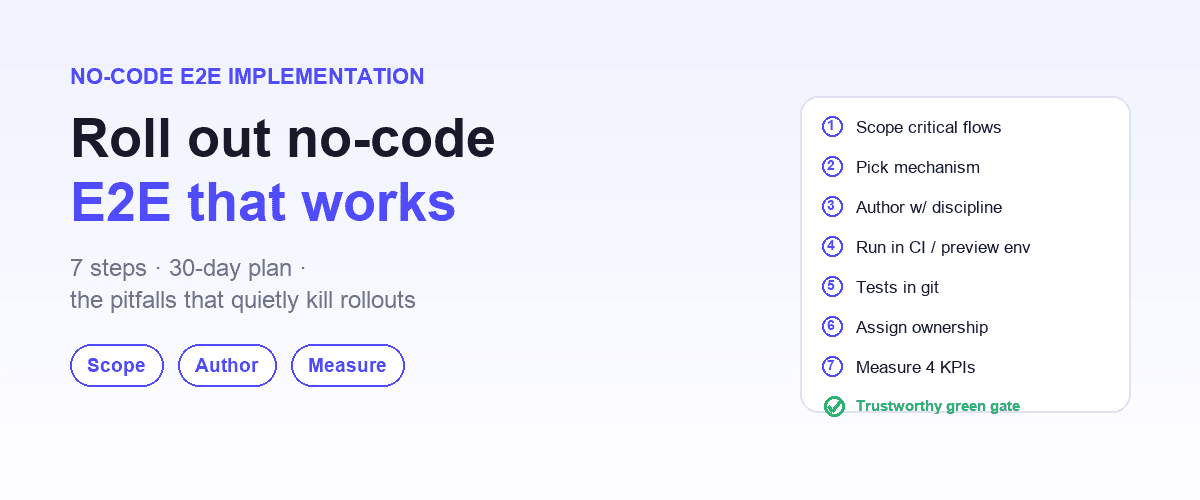
To implement no-code end-to-end testing effectively, follow seven steps in order.
- Scope first: your top 5–10 critical user journeys, nothing else.
- Pick the mechanism that matches your team, not the loudest demo: intent-based and self-healing for fast-changing UIs, plain-English or recorder for stable ones.
- Author with discipline: specific behaviors, real assertions, no recorded waits.
- Run in CI on every PR, in real ephemeral environments where possible.
- Keep tests in version control so they are reviewable and portable.
- Assign explicit ownership.
- Measure flake rate, user-journey reach, and PR-time verification density.
The dominant failure mode is buying a no-code tool and skipping these: the tool is necessary, the discipline is what makes it effective.
No-code end-to-end testing fails for the same reason most automation initiatives fail: the team adopts a tool, automates everything possible in the first week, and then discovers six months later that the suite is flaky, half-quarantined, and no one trusts the green. The tool is rarely the root cause; the rollout is.
This guide is the implementation playbook: the seven decisions that decide whether your no-code E2E suite delivers, the pitfalls that quietly defeat them, and a 30-day plan.
The 7 steps to an effective no-code E2E implementation
For background concepts before implementation, see what is no-code test automation and codeless E2E testing: how it works. For tool selection, see best no-code test automation platforms & tools and no-code alternatives to traditional testing frameworks. This page is what you do after picking a tool.
1. Scope to the critical journeys first
Do not try to cover the app on day one. Identify the 5–10 user journeys that, if broken, cost the most: signup, login, checkout, the core product action, any flow that touches billing or auth. These are the smallest set that protects the most value.
Coverage of less-important paths comes later; the first sprint's win is "we cannot ship a broken checkout."
Pitfall: starting with the easy flows (a settings page) instead of the expensive ones (multi-step checkout) because they're faster to automate. Easy flows produce green dashboards while real risk stays uncovered.
2. Pick the mechanism that matches your team and your UI
Not all "no-code" is equivalent. Match the mechanism to reality:
| Your situation | Best mechanism | Why |
|---|---|---|
| Stable UI, simple flows, non-technical authors | Plain-English / NLP | Lowest setup; classical-NLP maintenance acceptable when UI is stable |
| Stable UI, visual workflow preference | Visual flow builder | Reviewable, but still typically selector-bound |
| Fast-changing or AI-generated UI | Intent-based + self-healing | Survives UI refactors; the only mechanism that removes both authoring and maintenance cost |
| Mixed team that needs an audit trail | Intent-based with version-controlled tests | Tests live in git, readable by reviewers, no vendor lock-in |
Pitfall: choosing record-and-playback because it's fastest to a first test. Recordings are the most brittle mechanism and the most expensive to maintain at scale.
3. Author with discipline: vague intent produces flaky tests
The "no-code" surface still rewards specific phrasing. "Test the checkout page" produces ambiguous, flaky tests. "A returning user adds a $50 item to the cart, applies coupon SAVE10, completes payment with the saved card, and lands on a confirmation page showing order total $45" produces a test that asserts on something real.
Three authoring rules:
- Assert on computed outcomes (the total is
$45), not structural facts (a button exists). Structural assertions pass while behavior silently breaks. - No hard-coded waits. Let the platform's auto-wait do its job; manual waits are a flake source.
- One journey per test. Combining "signup AND first-run AND first-purchase" into one giant test produces giant flake debugging.
This is the same discipline as good code-based tests; no-code authoring doesn't remove the need for it.
4. Run in CI on every PR, in realistic environments
A no-code suite that only runs in the vendor's cloud demo is documentation, not a gate. Wire it into CI on every PR, gating merge. For the wiring specifics, see E2E testing in GitHub Actions.
Environments matter as much as the tool. The most reliable pattern is ephemeral preview environments per PR: a fresh, isolated environment with deterministic data for each change. This eliminates "works on my branch" flakiness and "shared staging is broken again" outages.
Preview environments are arguably the single highest-ROI infrastructure investment for E2E reliability. Stable auth and email flows specifically benefit from this model. See stable auth and email E2E tests.
5. Keep tests in version control, not just the vendor cloud
No-code authoring is no excuse for vendor lock-in. If your test definitions live only in a vendor's UI, you cannot review them in PRs, you cannot diff them, you cannot migrate, and you have no audit trail for compliance.
The mature pattern: test definitions as readable text files committed in your application's git repo, even when authored through a no-code surface. Reviews happen in PRs alongside the code change; rollbacks are git operations; ownership is git history. (Shiplight's YAML test format is built around this property; some other platforms support exports.)
6. Assign explicit ownership
Unowned suites rot. Pick one model up front and commit to it:
- Code-owner routing: when a test for a flow breaks, the owner of that flow's code is auto-assigned the fix.
- Rotating QA warden: one engineer per sprint owns the suite's health and flake budget.
- Definition of done includes the gate: a feature is not "done" if it shipped a test that became flaky in CI within a week.
Without ownership, the third-month state is universal: hundreds of tests, no clear responsibility, slow erosion of trust.
7. Measure the metrics that matter
If "tests exist" is your metric, you're measuring the wrong thing. Measure:
- User-journey reach: % of mapped critical flows covered end-to-end. Target: > 80% within the first quarter.
- Flake rate: % of runs that pass on retry after failing. Target: < 1%, and treat retried passes as flake signal, not silent green.
- PR-time verification density: % of merged PRs that had at least one E2E test run before merge. Target: > 80%.
- Mean time to fix a broken test: under a day is healthy; over a week means ownership has broken.
Track these on a single dashboard reviewed in your team's regular cadence. Without measurement, the suite drifts back to where it started within two quarters.
Common pitfalls (the ones that quietly defeat the rollout)
- Buying the loudest demo, not the right mechanism. Recorder demos look magical; recorded tests are the worst to maintain. Stress-test the maintenance during evaluation by refactoring a page and seeing how many tests break.
- Automating everything in the first sprint. Producing 200 shallow flaky tests is worse than 10 reliable behavioral tests.
- Skipping CI integration. A no-code test that doesn't gate the PR is a screenshot, not a quality gate.
- Blanket retries to make the dashboard green. Hides flake while CI time triples. See the strict retry policy.
- Test definitions trapped in the vendor cloud. No PR review, no audit trail, no portability; exit cost compounds every sprint.
- No flake budget, no quarantine policy. Flaky tests accumulate; the green eventually means nothing. See mitigate test flakiness for fast-paced teams.
A 30-day implementation plan
Week 1: Map and pick. List the top 10 critical user journeys with business impact. Evaluate 2–3 tools end-to-end against the maintenance test (refactor a real page, see what breaks), not just authoring speed. Pick one.
Week 2: Author 5 flows + wire CI. Author the top 5 journeys, with computed-outcome assertions. Stand up the PR-time CI gate (and ephemeral preview environments if available). Commit test definitions to git from day one.
Week 3: Round out + harden. Add the next 5 flows. Set the flake budget, quarantine policy, and ownership model. Add the metrics dashboard.
Week 4: Measure and refine. Review the four KPIs. Promote new flow candidates from autonomous exploration if your tool supports it. Quarantine, fix, or prune anything red. Plan months 2–3.
By the end of the month, the top critical journeys gate every PR, the suite has a measured flake rate under control, and the team trusts the green: the only output that matters.
Where Shiplight fits an effective no-code E2E rollout
Shiplight is built specifically for steps 2, 5, and 7, the decisions that most often defeat a rollout:
- Intent-based + self-healing (step 2): tests resolve user intent against the live DOM, surviving the UI refactors that break recorder and selector-bound tools.
- YAML in your git repo (step 5): no-code authoring without vendor lock-in; PR-reviewable, diff-able, portable.
- Agent-authored via MCP (effective coverage growth): the AI coding agent that wrote the feature also writes its test in the same session, so new critical flows are covered as they ship.
- Real-browser execution in CI: works with any CI (GitHub Actions, GitLab, Jenkins), so the gate enforces the journey, not a recorded approximation.
Honest scope: Shiplight focuses on the E2E/UI layer. Unit/API/contract tests still belong in code frameworks at the base of the test pyramid. Shiplight is the right pick when your real cost is selector-maintenance on a fast-changing UI; for a stable UI with simple flows, a plain-English or visual tool may be sufficient. See the broader landscape.
Frequently Asked Questions
How do I implement no-code end-to-end testing effectively?
Follow seven steps: scope to the top 5–10 critical journeys first; pick a mechanism matching your UI volatility (intent-based and self-healing for fast-changing UIs); author with discipline; run in CI on every PR; keep test definitions in version control; assign explicit ownership; and measure flake rate and journey coverage. The tool is necessary, but the discipline makes the rollout effective.
What's the biggest mistake teams make rolling out no-code E2E?
Two interlocking ones: choosing a recorder-based tool because its demo is fastest to a first test, and automating everything in the first sprint. Recorded tests are the most brittle mechanism, so the suite is flaky by month two, and breadth-first automation produces hundreds of low-value tests. Stress-test maintenance during evaluation, and start with 5–10 behavioral tests on the highest-value journeys.
Should no-code E2E tests run in CI/CD?
Yes, always. A no-code test that only runs in a vendor cloud demo is not a quality gate; it's a screenshot. Wire the suite into CI on every PR with merge-blocking on failure, ideally in an ephemeral preview environment per PR so it runs against a fresh, isolated copy of the app.
Why should no-code tests live in version control instead of the vendor cloud?
Because anything that doesn't live in git can't be PR-reviewed, diffed, rolled back, or audited, and it creates vendor lock-in that compounds every sprint. The mature pattern is no-code authoring with version-controlled artifacts: tests authored through a friendly surface but committed as readable text files in your repo. Treat test-format portability as a hard evaluation criterion, not a nice-to-have.
What metrics prove a no-code E2E implementation is effective?
Four: user-journey reach (% of critical flows covered end-to-end, target > 80%); flake rate (% of runs that pass on retry, target < 1%); PR-time verification density (% of merged PRs with an E2E run before merge, target > 80%); and mean time to fix a broken test (under a day is healthy).
If "tests exist" is your only metric, you're measuring the floor.
Related posts
AI Testing
Best No-Code Test Automation Platforms & Tools
Apr 7, 2026 · 18 min read
AI Testing
Codeless E2E Testing: How It Works
Apr 14, 2026 · 8 min read
Testing Concepts
What Is No-Code Test Automation?
Apr 1, 2026 · 8 min read
AI Testing
No-Code Alternatives to Traditional Testing Frameworks
May 17, 2026 · 8 min read
Guides
Mitigate Test Flakiness: Strategies for Fast-Paced Teams
May 17, 2026 · 9 min read
Guides
E2E Testing in GitHub Actions
Apr 7, 2026 · 11 min read