
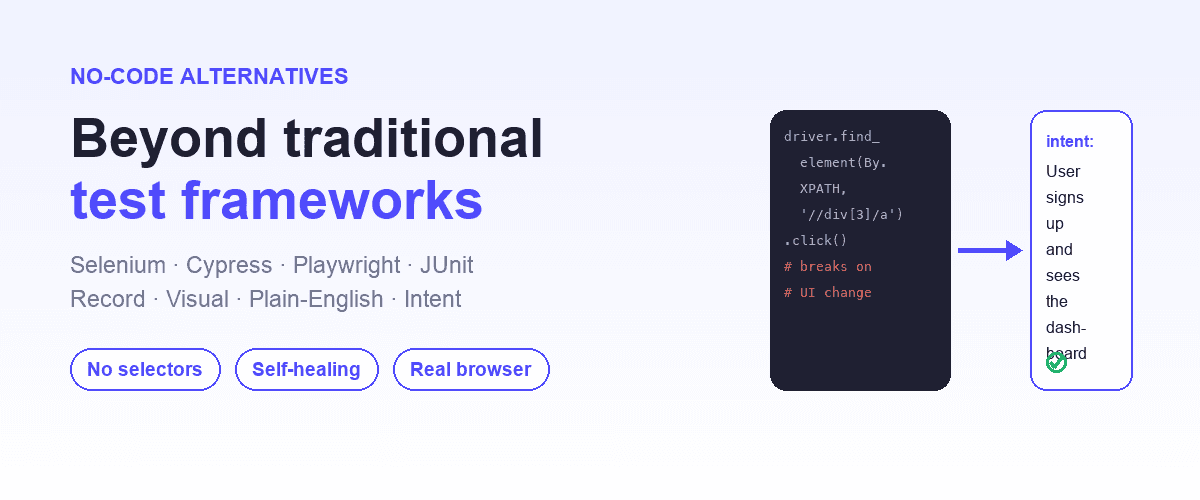
The main no-code alternatives to traditional software testing frameworks (Selenium, Cypress, Playwright, JUnit/TestNG) fall into four mechanisms: record-and-playback, visual flow builders, plain-English/NLP authoring, and intent-based authoring.
They remove the code-authoring barrier so non-engineers can build tests, but only the self-healing, intent-based variants also remove the maintenance cost that is the real reason teams leave traditional frameworks. Shiplight is an intent-based, self-healing alternative: tests are authored in structured natural language, run in a real browser, and resolve elements semantically instead of breaking on selector change.
What "traditional frameworks" means here
"Traditional software testing frameworks" means the code-first stack most teams still run: Selenium and WebDriver for cross-browser automation, Cypress and Playwright for modern web E2E, and JUnit / TestNG / pytest for the unit and integration layers underneath. They are mature, powerful, and free, and for many teams they are also the single largest maintenance line item in engineering.
Why teams move off traditional frameworks
The reason teams look for no-code alternatives is rarely "we can't write code." It's that code-first frameworks couple every test to implementation details (CSS selectors, XPaths, DOM structure), so the suite breaks every time the UI changes, and a QA team that should be finding bugs spends 40–60% of its hours repairing tests instead.
No-code alternatives attack the authoring barrier; the best of them also attack the maintenance barrier. This guide separates the two, because most "no-code" tools only solve the first.
| Pain with traditional frameworks | What no-code alternatives change |
|---|---|
| Only engineers can author tests | Non-engineers (QA, PM, support) can build coverage |
| Selectors break on every UI refactor | Self-healing variants re-resolve elements automatically |
| Setup is heavy (drivers, CI, harness) | Hosted runners; little or no infrastructure |
| Authoring a flow takes hours | Record/describe a flow in minutes |
| Maintenance grows faster than coverage | Intent-based variants keep tests valid across UI change |
The critical distinction: removing the coding barrier (anyone can author) is not the same as removing the maintenance barrier (tests survive change). A record-and-playback tool removes the first and often makes the second worse: recorded selectors are even more brittle than hand-written ones.
Keep that split in mind through the rest of this guide. (For the concept itself, see what is no-code test automation.)
The four no-code mechanisms
Every no-code alternative uses one of these four authoring models. They are not equivalent in maintenance cost.
1. Record-and-playback
You click through the app; the tool records actions and replays them. Fastest to a first test, but recorded steps bind to brittle selectors, so maintenance is the worst of the four. Examples: Selenium IDE and the recorder modes in commercial low-code platforms.
2. Visual flow builder
You assemble a test as a flowchart of steps/blocks. More structured and reviewable than raw recordings, but still typically selector-bound under the hood. Example: Leapwork and similar enterprise codeless suites.
3. Plain-English / NLP authoring
You write steps in natural language ("click the Submit button"); the tool interprets them at runtime. In practice these are constrained plain-English command sets rather than free English (testRigor's own docs note the parsed English "has some syntax to it"), and the tests typically live in the vendor's cloud.
Lower maintenance than recordings because the instruction survives some UI change, but ambiguous phrasing can produce flaky resolution. Example: testRigor and similar vendor cloud consoles.
4. Intent-based authoring (structured natural language)
You describe what the user is trying to accomplish, not which element to click. The runtime resolves the right element semantically on every run and self-heals when the UI changes. This is the only mechanism that removes both the coding barrier and the maintenance barrier. Example: Shiplight. See codeless E2E testing for how this differs from recording.
No-code alternatives, by traditional framework
Replacing Selenium / WebDriver
Selenium's pain is brittle locators plus heavy driver/grid infrastructure. The no-code replacement most teams want is a hosted, self-healing platform so neither the locators nor the grid is your problem. See the full breakdown in best Selenium alternatives for AI-native testing.
Replacing Cypress
Cypress is pleasant to write but still code-first and JavaScript-bound, and its same-origin/iframe constraints push teams toward a no-code tool when non-engineers need to own coverage or cross-origin flows matter. See best Cypress alternatives for modern E2E testing.
Replacing Playwright
Playwright is the strongest traditional framework, so the reason to move is usually who authors and maintains, not capability: teams want non-engineers to contribute and want self-healing to kill the maintenance tax. See best Playwright alternatives for no-code testing.
Replacing JUnit / TestNG / pytest at the E2E layer
These are unit/integration frameworks; the no-code conversation only applies to the end-to-end layer above them. The right model is the test pyramid: keep code-based unit tests where they belong (fast, developer-owned) and replace only the slow, brittle UI/E2E layer with a no-code or intent-based alternative. Do not try to no-code your unit tests.
Traditional vs no-code: the honest trade-offs
No-code is not strictly better; it's a different trade. Be clear-eyed:
| Dimension | Traditional frameworks | No-code alternatives |
|---|---|---|
| Authoring skill required | Engineer | Anyone (with intent-based, still benefits from QA judgment) |
| Setup / infrastructure | Heavy (drivers, CI harness) | Minimal (hosted) |
| Maintenance cost | High (selector-bound) | High for record/playback; low for intent-based + self-healing |
| Flexibility / escape hatch | Total (it's code) | Bounded by the platform |
| Vendor lock-in | None (open source) | Varies: check test-format portability |
| Best fit | Complex custom logic, teams with QA engineers | Fast-moving UIs, mixed-skill teams, AI-generated code |
The decisive question is not "code vs no-code"; it's "does the alternative also remove maintenance?" A no-code tool that still binds to selectors has traded an authoring problem for a worse maintenance problem. Only the self-healing, intent-based category removes both. (See self-healing vs manual maintenance: the ROI case.)
Where Shiplight fits
Shiplight is an intent-based, self-healing alternative to traditional frameworks, built for AI-native teams where code (and UI churn) is increasingly produced by AI coding agents (Cursor, Claude Code, GitHub Copilot, OpenAI Codex):
- No-code on the surface, structured under the hood. Tests are authored as structured natural-language intent (no selectors, no scripting) but version-controlled as readable files, so you get no-code authoring without the usual no-code lock-in.
- Self-healing by design. Steps resolve to the element that currently serves the user's intent, so tests survive the UI refactors that break Selenium/Cypress/Playwright suites. (See what is self-healing test automation.)
- Real-browser verification. Tests run in a real browser in CI, so the green signal reflects real rendering and timing, not a recorder's approximation.
- Agent-authored via MCP. Because Shiplight is callable through the Model Context Protocol, the coding agent that writes a feature also writes its test in the same session, closing the coverage gap traditional frameworks leave when QA authors tests a sprint later.
Honest scope: if your need is unit/integration testing or you require an unbounded code escape hatch for highly custom logic, a traditional framework is still the right tool: keep it at the bottom of the pyramid. Shiplight replaces the slow, brittle E2E/UI layer where maintenance cost is highest.
For the ranked landscape of all no-code options, see best no-code test automation platforms & tools.
How to choose a no-code alternative
- Identify which traditional framework you're replacing and why: authoring barrier, maintenance cost, or both. If it's "both," only intent-based + self-healing qualifies.
- Match the mechanism to your team. Mixed-skill team that changes UI often → intent-based. Non-technical team, stable UI → plain-English or visual builder may suffice.
- Stress-test maintenance, not authoring. In a pilot, refactor a page and see how many tests break. Authoring speed dazzles in demos; maintenance is where tools separate.
- Check format portability. Can you export/version the tests, or are you locked into the vendor's cloud? Traditional frameworks have zero lock-in; hold no-code to a reasonable bar.
- Keep the pyramid. Replace the E2E/UI layer, not your unit tests.
Frequently Asked Questions
What are the no-code alternatives to traditional software testing frameworks?
They fall into four mechanisms: record-and-playback, visual flow builders, plain-English/NLP authoring, and intent-based authoring like Shiplight. All four remove the code-authoring barrier, but only intent-based, self-healing tools also remove the maintenance cost, the real reason most teams leave traditional frameworks. The no-code conversation applies to the E2E/UI layer only; keep code-based unit tests at the base of the pyramid.
Are no-code testing tools a real replacement for Selenium, Cypress, or Playwright?
For the end-to-end/UI layer, yes: a self-healing, intent-based platform replaces what most teams use Selenium, Cypress, or Playwright for, without the brittle-selector maintenance tax. For unit and integration testing, no: those stay in code frameworks. The honest test is maintenance: a tool that still binds to recorded selectors isn't a real replacement, because it makes maintenance worse.
Why do teams switch from traditional testing frameworks to no-code alternatives?
Rarely because they can't write code. The dominant reasons are maintenance (selector-bound suites break on every UI change, consuming 40–60% of QA hours), participation (only engineers can author, so QA, PM, and support can't contribute), and speed (setup and authoring are heavy). No-code alternatives address participation and speed; only self-healing, intent-based ones also address maintenance.
Do no-code testing tools have more vendor lock-in than traditional frameworks?
Often, yes, and it's the main thing to check. Open-source frameworks (Selenium, Playwright, Cypress) have zero lock-in: the tests are code you own. No-code tools vary widely: some store tests only in the vendor cloud (high lock-in), others keep tests as exportable, version-controlled files (low lock-in). Treat test-format portability as a hard evaluation criterion, not a footnote.
Is Shiplight a no-code alternative to traditional testing frameworks?
Yes, for the E2E/UI layer. Tests are authored in structured natural language (no selectors or scripting), run in a real browser in CI, and self-heal across UI change, so it removes both the coding barrier and the maintenance barrier.
Via MCP, the AI coding agent that writes a feature also authors its test. It does not replace unit or integration frameworks.
Related posts
AI Testing
Best No-Code Test Automation Platforms & Tools
Apr 7, 2026 · 18 min read

Testing Concepts
What Is No-Code Test Automation?
Apr 1, 2026 · 8 min read
AI Testing
Codeless E2E Testing
Apr 14, 2026 · 8 min read

Guides
Best Selenium Alternatives
Apr 1, 2026 · 11 min read

Guides
Best Cypress Alternatives
Apr 1, 2026 · 11 min read

Guides
Best Playwright Alternatives for No-Code Testing
Apr 1, 2026 · 9 min read

AI Testing
Self-Healing Tests vs Manual Maintenance
Apr 1, 2026 · 5 min read