
Self-healing test automation works only when you implement it as a multi-layered, AI-augmented system rather than bolting one feature onto a brittle suite.
The teams that get 70–90% maintenance reduction follow the same pattern: a fallback locator chain (primary → multi-attribute → heuristic → AI/visual) anchored to intent, gradual rollout starting in high-churn areas, audited healing events surfaced as reviewable diffs, and stable foundations (data-testid, visual regression) that reduce how often healing has to fire in the first place.
This guide is the implementation playbook: the order to roll it out, what to put under version control, where humans stay in the loop, and where each capability fits in CI/CD.
The four-tier locator resolution stack
If you're earlier in the cycle, start with what self-healing test automation actually is for the concepts, then return here for the rollout.
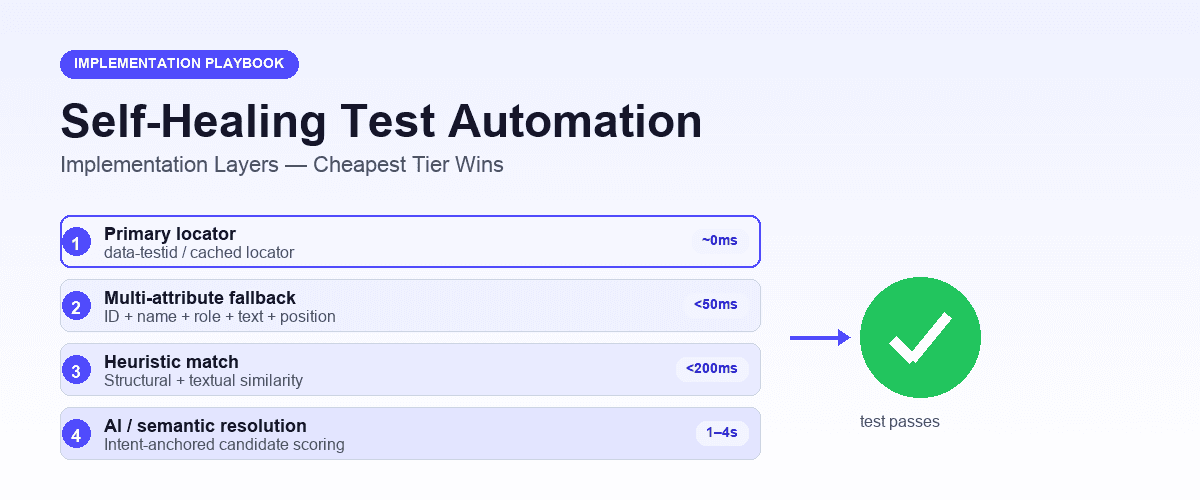
Effective self-healing does not replace your locator strategy: it layers fallbacks behind it so a single broken selector never fails an entire test:
| Tier | What runs | Cost | When it fires |
|---|---|---|---|
| 1. Primary locator | data-testid, semantic role, stable ID, or cached locator | ~0ms | Default path. 90%+ of executions should resolve here. |
| 2. Multi-attribute fallback | Compare candidates by ID + name + class + visible text + role + DOM position | <50ms | Primary missing or returns 0/many matches. |
| 3. Heuristic match | Structural and textual similarity scoring against the recorded "snapshot" of the element | <200ms | Multi-attribute scoring ambiguous. |
| 4. AI / semantic resolution | LLM or vision model evaluates the candidate set against the intent of the step ("click the primary submit button on the checkout form") | 1–4s | Heuristic confidence below threshold; element moved across components. |
Three rules govern this stack:
- Cheapest tier wins. Never skip to AI when a
data-testidwould resolve it deterministically. AI is the safety net, not the default. - Intent is the tiebreaker. Tiers 3 and 4 must evaluate against the test's purpose (e.g., "primary submit button on checkout"), not raw attribute similarity. Attribute-only fallbacks silently click the wrong element when the UI has multiple visually-similar candidates: that's how self-healing masks real bugs. Shiplight's intent-cache-heal pattern is the canonical implementation.
- Heals are diffs, not silent updates. When tier 2–4 resolves, the system records what it healed, the candidate set considered, and the confidence score: surfaced as a reviewable artifact, not a quiet rewrite.
Implementation: new framework vs. existing suite
The rollout path depends entirely on whether you're greenfield or retrofitting. Pick the column that matches your situation:
| New test framework | Existing suite | |
|---|---|---|
| Step 1 | Pick a tool with built-in healing at tier 2–4 (Shiplight; enterprise codeless suites like Virtuoso also ship healing). Don't roll your own. | Audit which tests break most often. Tag the top 20% by maintenance frequency: that's where healing pays back first. |
| Step 2 | Author tests as intent statements from day one. Avoid bare CSS/XPath selectors except where the framework offers explicit deterministic syntax. | Replace high-maintenance tests' element lookups with the healing-enabled locator function. Leave low-churn tests untouched. |
| Step 3 | Standardize data-testid (or data-cy / data-qa) attributes in the application code itself. Self-healing should be the safety net, not the primary locator path. | Drive a developer-side initiative to add data-testid on the most-changed components. Every stable attribute reduces the heal rate. |
| Step 4 | Wire CI before the suite is more than 20 tests. Tests that aren't gating PRs decay fast. | Run healed test results in a non-blocking lane first for 2–3 sprints. Move to a gating lane only after heal accuracy is verified. |
| Step 5 | Configure failure summarization and heal-diff review from week one. Make every heal event reviewable in the PR. | Backfill the heal-diff review workflow before you scale healing to a second team. Without review, you accumulate silent bugs. |
| Step 6 | Add visual regression in parallel: pixel/layout drifts catch what element-level healing misses (CSS-only regressions). | Pair visual diffing with healing as soon as healing covers >50% of the suite. Element + visual is the complete safety net. |
For new frameworks the focus is architecture; for existing suites it's risk-managed migration: never flip the whole suite to healing-enabled at once.
Five practices that determine whether healing actually works
1. CI/CD integration: heal in CI, not just locally
Healing that only runs in a developer's IDE is theatre. The economic value of self-healing comes from CI runs not blocking merges on locator drift. Your CI configuration must:
- Run the healing-enabled engine on every PR (not nightly)
- Cache healed locators per branch so subsequent runs are deterministic
- Annotate the PR with heal events (which element, what changed, confidence)
- Fail the PR if healing confidence is below threshold or if 3+ heals occurred in one test (signal that the test needs human attention)
See how to integrate self-healing into your AI-native pipeline for pipeline patterns.
2. Human oversight: heals are PRs, not facts
Treat every heal as a proposed change, not a successful run. The review workflow:
- Tester or engineer reviews the heal-diff during PR review (same lane as code review)
- Approves → cached locator updates and propagates to the suite
- Rejects → original test fails and engineer investigates whether the application actually regressed
This is where most self-healing implementations silently fail. Tools that mutate tests without a review step accumulate technical debt that surfaces as production bugs months later. Reject any platform that doesn't expose heals as reviewable diffs.
3. Prioritize high-risk, high-churn areas first
Don't enable healing uniformly. Prioritize:
- Components changed in the last 90 days (highest break risk)
- Critical user paths (checkout, signup, payment, auth) where heal accuracy matters most
- Tests with 3+ recent maintenance commits (the suite is telling you where the cost is)
Low-churn, stable tests don't benefit from healing. Don't pay the AI-tier latency cost where you don't need it.
4. Stable foundations: data-testid reduces heal frequency
Self-healing is a safety net, not a substitute for stable test attributes. Application-side practices that reduce how often healing has to fire:
- Add
data-testid="checkout-submit"to every interactive element a test touches - Treat
data-testidas part of the component contract: they don't change when the visual design changes - Lint test attributes in PRs: removing a
data-testidis a breaking change - Use semantic HTML (
<button>,<a>, ARIA roles): role-based selectors are inherently more durable than CSS class selectors
Teams that skip foundations end up paying the healing tax forever. Teams that invest in foundations have healing fire on <5% of test runs.
5. Combine with visual regression: element healing isn't enough
Element-level healing finds the right button when the DOM shifts; it does not catch layout regressions where the right element is in the wrong place, overlapping another component, or styled to be invisible. A complete safety net layers:
- Element-level healing for locator/structural drift
- Visual regression for CSS/layout/positioning regressions
- Functional assertions for behavioral correctness
Setups that combine both (Applitools layered over a healing engine, Shiplight + visual plugins) catch failure classes neither layer catches alone.
Recommended tooling
Implementation choice depends on whether you want a full platform or a layer on top of an existing framework:
| Tool | Healing model | Authoring | Best fit |
|---|---|---|---|
| Shiplight | Intent-anchored, intent → cache → heal | YAML in your git repo, MCP-callable from Claude/Cursor | Teams that want tests in source control with reviewable heal diffs; compatible with existing Playwright suites |
| Low-code recorder platforms | Multi-attribute + ML resolution | Visual recorder in a vendor console | Dedicated QA teams authoring visually; tests live in the vendor cloud |
| Vendor cloud consoles (plain-English DSL) | Built-in healing on hosted runners | Constrained plain-English steps in a web console | Manual-QA-heavy organizations where non-technical QA staff author tests |
| Virtuoso | NLP-based steps with healing locators | NLP/low-code editor | Enterprise QA in Salesforce, SAP, and D365 verticals |
For a deeper feature/price comparison see best self-healing test automation tools; for enterprise security/SLA requirements see the enterprise self-healing guide.
Honest scope: what self-healing won't fix
Effective implementation means knowing where the tool stops:
- It won't fix bad test design. A test that validates the wrong behavior continues to validate the wrong behavior after healing. Healing repairs locators, not intent.
- It can mask real bugs. When an attribute-only heal picks a similar-looking element that is not the intended one, the test passes against the wrong button. Intent-anchored healing reduces this risk but doesn't eliminate it. Review heal events.
- It's not free at runtime. Tier 3–4 healing costs 200ms–4s per heal. Suites with high heal rates run measurably slower in CI. Fix foundations, don't lean on AI tier.
- It doesn't replace humans on novel UX. First-time flows, redesigned components, and entirely new pages need human-authored tests. Healing extends a test's life; it doesn't generate new tests for new behavior.
- It needs your application to expose stable signals. Pages built purely from anonymous
<div>elements without semantic roles or test attributes are unhealable in the long run, no matter how good the AI tier is.
The mature pattern is foundations + element healing + visual regression + intent anchoring + reviewable heals: five layers, not one feature.
A 30-day implementation roadmap
| Days | Action |
|---|---|
| 1–3 | Pick a tool (see table above). Set up authentication and a sandbox project. |
| 4–7 | Migrate 3 critical-path tests (signup, checkout, primary user flow) to the healing-enabled framework. Author as intent statements. |
| 8–10 | Add data-testid attributes to the components those tests touch. |
| 11–14 | Wire CI in a non-blocking lane. Verify heal events surface in PR comments. |
| 15–21 | Expand to 10–20 high-churn tests. Measure heal rate, false-positive rate, and runtime delta. |
| 22–25 | Add visual regression to the same lane. Configure heal-diff review in PR workflow. |
| 26–28 | Move CI lane from non-blocking to gating for the migrated tests. |
| 29–30 | Audit metrics: maintenance hours saved, heal accuracy, suite stability. Plan the next 30 tests. |
The pattern: small surface area first, instrumented, reviewed, then scaled; never enable healing across the whole suite on day one.
Get Started
Try Shiplight's intent-anchored self-healing on your Playwright suite: the plugin installs in minutes and surfaces every heal as a reviewable diff. Or book a demo to walk through a migration plan against your existing suite.
References: Playwright Documentation, Google Testing Blog, GitHub Actions documentation
Frequently Asked Questions
How do I implement self-healing test automation effectively?
Implement it as a layered system, not a single feature: a four-tier locator stack where the cheapest locator wins and intent breaks ties, heal events surfaced as reviewable PR diffs rather than silent mutations, and data-testid foundations so healing fires on under 5% of runs. Roll it out gradually, high-churn tests first, and maintenance drops 70 to 90%.
Should I roll out self-healing across my entire suite at once?
No. Enable healing first on the top 20% of tests by maintenance frequency, run it in a non-blocking CI lane for two to three sprints to verify heal accuracy, then expand. Enabling it uniformly on day one accumulates silent bugs from miss-targeted heals that pass while validating the wrong thing.
Can self-healing tests mask real bugs?
Yes, and it is the most under-discussed risk: an attribute-only heal can pick a different button with similar attributes and pass against the wrong element. Mitigate it by anchoring heals to the test's intent so candidates are judged by purpose, and by reviewing every heal as a PR diff. Platforms that mutate tests silently are not safe in production.
What's the difference between self-healing and Playwright's auto-waiting?
Auto-waiting retries a locator until the element appears or a timeout hits: it handles timing. Self-healing finds the element by other means when the locator no longer matches anything: it handles structural change. Both are needed, and modern Playwright-based stacks like Shiplight layer healing over auto-waiting.
Do I still need data-testid if I have self-healing?
Yes, more than ever. data-testid is the primary tier of the locator stack; without it, every run falls back to slower, more error-prone tiers. Teams with strong data-testid discipline see healing fire on under 5% of runs. Treat it as part of the component contract: removing one is a breaking change.
How do I measure whether self-healing is working?
Track four metrics: maintenance hours saved versus a pre-rollout baseline, heal rate (share of runs invoking fallback tiers), heal accuracy (share of heals humans approve), and suite runtime delta. A healthy implementation shows 60%+ maintenance reduction, under 10% heal rate, over 95% accuracy, and under 15% runtime overhead.
Related posts
Testing Concepts
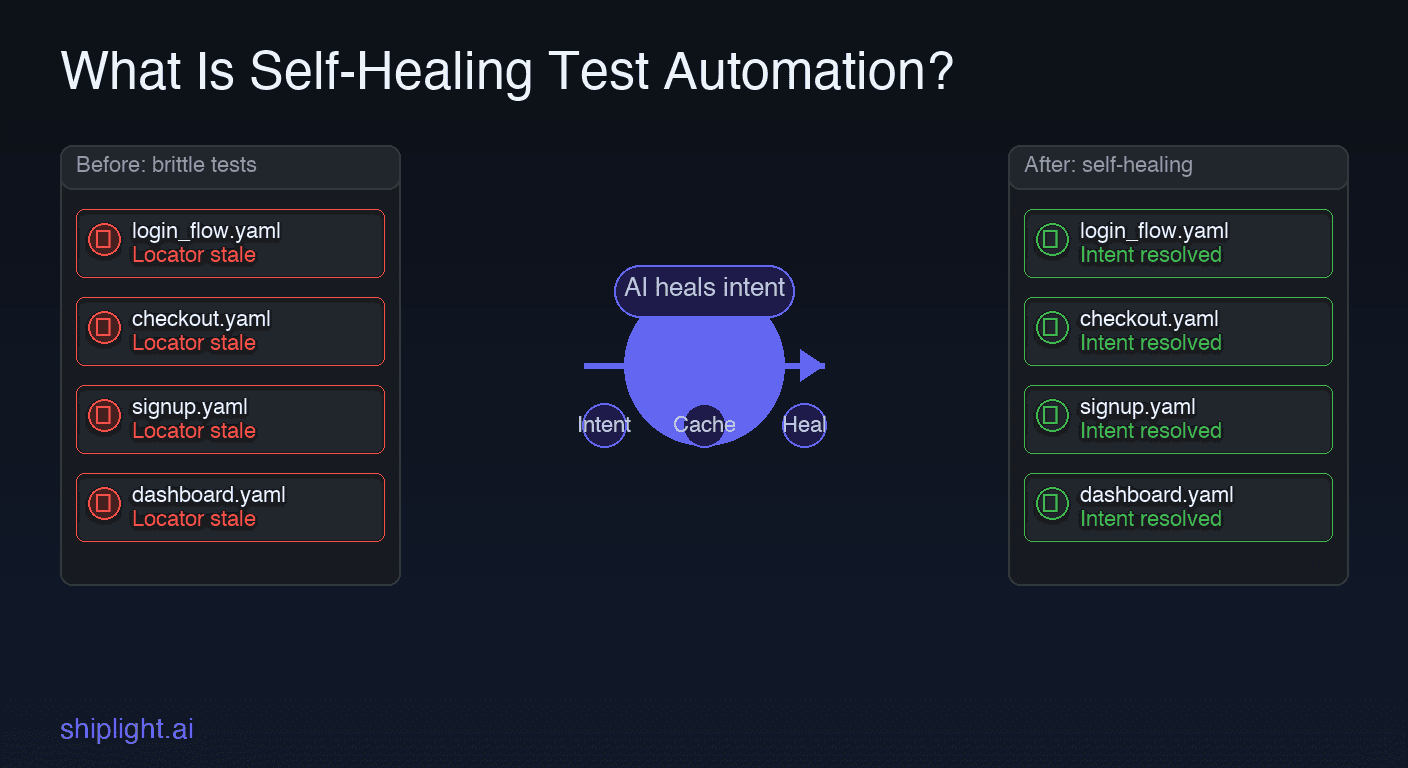
What is self-healing (auto-healing) test automation?
Apr 1, 2026 · 10 min read

Engineering
Intent, cache, heal pattern
Mar 25, 2026 · 7 min read

AI Testing
Best self-healing test automation tools 2026
Apr 7, 2026 · 12 min read

AI Testing
Self-healing vs manual maintenance ROI
Apr 1, 2026 · 5 min read
Guides
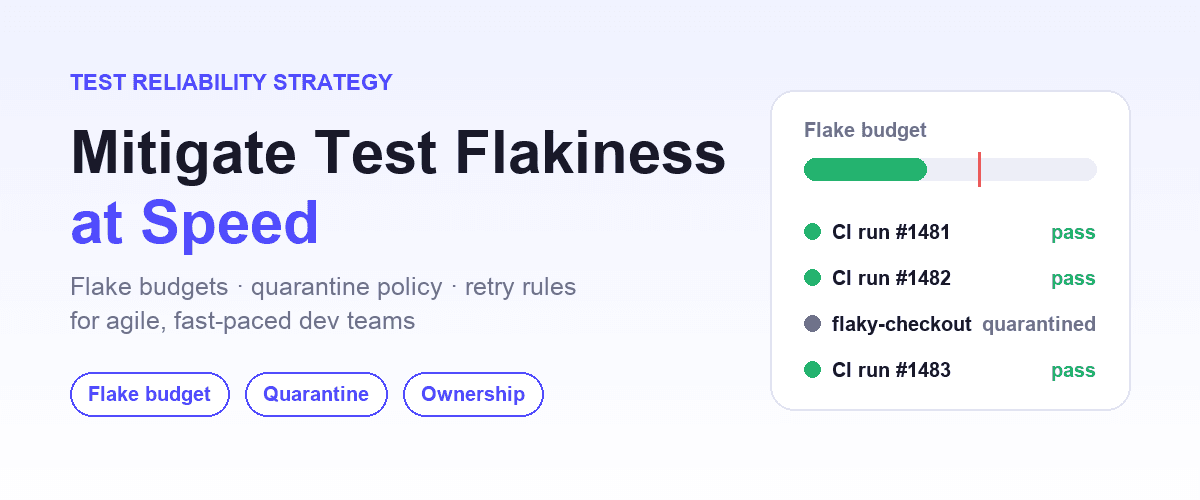
How to mitigate test flakiness for agile teams
May 17, 2026 · 9 min read