Automating testing in AI-native development pipelines requires a multi-layered approach that moves beyond traditional script-based tests to include autonomous agents, model-driven validation, and intelligent orchestration.
An AI-native pipeline has failure surfaces a conventional pipeline doesn't: embedding drift, retrieval-quality regressions, non-deterministic model outputs, and UI built by AI coding agents that changes weekly.
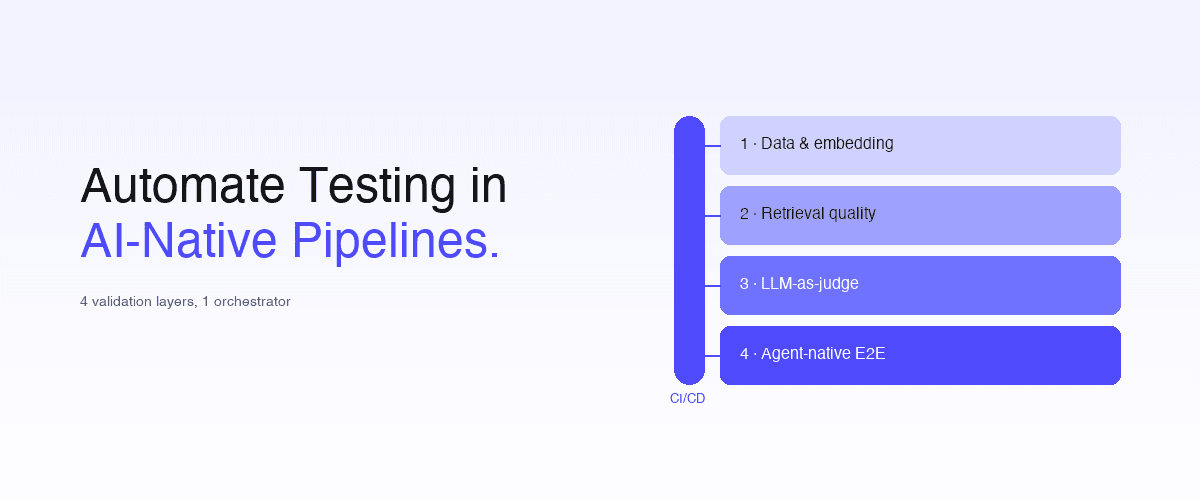
The strategy is four validation layers: data/embedding validation, retrieval quality, LLM-as-judge output scoring, and agent-native end-to-end verification, wired into intelligent CI/CD that selects tests by code change and runs adversarial checks as a required stage.
This guide covers each layer, the tooling, and where Shiplight fits the application/E2E layer.
Key takeaways
- AI-native pipelines fail in four distinct places, not one: the data/embedding layer, the retrieval layer, the model-output layer, and the application/UI layer. Each needs its own automated validation.
- Script-based E2E alone is insufficient, but so is model-eval alone. You need both, plus orchestration that knows which to run when.
- Autonomous, intent-based test agents replace brittle scripted assertions at the application layer because AI-built UIs change too fast for selector-bound tests.
- Intelligent CI/CD is the connective tissue: test selection by code change, root-cause triage, and adversarial checks as a required pipeline stage.
- Prompt regression and production observability close the loop. Version prompts as Git artifacts gated by golden-dataset evals (LangSmith / W&B Weave); feed live failures (Arize Phoenix / Helicone / LangFuse) back into those eval sets. AI-native testing is less about proving correctness once than continuously measuring reliability under uncertainty.
- Tooling is layer-specific. Great Expectations / Pinecone for data; RAGAS / DeepEval for retrieval and model eval; LLM-as-judge for output scoring; Shiplight / Playwright for E2E; Garak / Lakera Guard for adversarial; Harness / GitHub Actions for orchestration.
Why AI-native pipelines need a different testing approach
A conventional CI pipeline tests deterministic code: same input, same output, assert equality. AI-native pipelines (RAG apps, LLM features, agent products, AI-coded UIs) break that assumption on four axes:
- Non-determinism. The same prompt can produce different outputs. Equality assertions don't work; you need rubric-based scoring.
- Data dependence. The system's behavior depends on the embedding model, the vector store, and the chunking strategy: none of which a code test exercises.
- Retrieval fragility. A RAG system can return the wrong documents while every unit test passes.
- AI-built UI churn. When an AI coding agent generates the front end, selectors and structure change weekly, breaking selector-bound E2E tests.
Automating testing in this environment means validating each axis with the right layer. See testing strategy for AI-generated code for the application-code angle and AI-native test strategy in 2026 for the operating model.
Layer 1: Data & embedding validation
Before the model ever runs, the data feeding it has to be correct. Automate validation of:
- Chunk-size distributions: chunks that are too large or too small degrade retrieval silently.
- Embedding drift: when the embedding model or its version changes, vector representations shift; old and new embeddings become incomparable.
- Vector-store schema mismatches: dimension changes, metadata-field renames, index config drift.
Tooling: Great Expectations for data-quality assertions; Pinecone / Chroma store-level validation; custom Python checks in CI for chunk and embedding distribution. Run these as a pre-model pipeline stage that blocks on drift beyond a threshold.
Layer 2: Retrieval quality validation
For any retrieval-augmented system, the retrieval step is a top failure source, and one that passes every traditional test. Automate measurement of retrieval stability with standard IR metrics:
- Recall@5: does the relevant document appear in the top 5?
- Precision@3: how many of the top 3 are actually relevant?
- MRR (Mean Reciprocal Rank): how high does the first relevant result rank?
Maintain a labeled query→expected-doc set as a fixture; run the metrics on every pipeline change touching retrieval, embeddings, or chunking; gate on regression beyond a tolerance. Tooling: RAGAS and DeepEval both ship retrieval-quality metrics suitable for CI integration.
Layer 3: LLM-as-judge output scoring
Model outputs are non-deterministic, so you can't assert equality. Instead, integrate a judge layer: a strong model (GPT-4-class, Claude-class) scores each output against a predefined rubric for factual correctness, clarity, and safety/compliance.
Practical discipline:
- Define the rubric explicitly and version it alongside the code.
- Run the judge on a representative eval set on every model/prompt change.
- Gate on aggregate score regression, not per-output pass/fail (non-determinism makes single-output gating flaky).
- Periodically human-audit a sample of judge scores: the judge is itself an AI system and can drift.
Tooling: DeepEval and RAGAS provide LLM-as-judge harnesses; custom rubric scoring via the model APIs works for bespoke criteria. Treat the judge eval as a required, score-gated pipeline stage.
Prompt & model regression testing (the artifact discipline)
Layer 3 scores whether an output is good. Prompt regression testing answers a different question: did this PR make the system behave worse than the last known-good baseline? In an AI-native pipeline, prompts and model configurations are versioned artifacts, not loose strings, and they regress as silently as code.
The standard pattern:
- Store prompts in Git alongside the code that uses them: every prompt change is a reviewable diff.
- Maintain golden/benchmark datasets: representative inputs with known-good reference behavior.
- Run evaluations on every PR that touches a prompt, model, or model config.
- Compare outputs against the baseline on a fixed metric set.
- Block the merge when scores regress beyond tolerance: the same gate discipline as a failing unit test.
The metric set to track per prompt/model change:
- Accuracy / task success rate
- Hallucination rate
- Toxicity / safety violations
- Instruction adherence
- Tool-call correctness
- Cost (tokens) and latency
Tooling: DeepEval and RAGAS for the eval harness; LangSmith and Weights & Biases Weave for prompt/dataset versioning, baseline tracking, and PR-comparison dashboards. Prompt regression remains one of the largest under-tested reliability blind spots in agent systems: treat it as a required, baseline-gated stage, not an ad-hoc notebook check.
Layer 4: Agent-native end-to-end validation (the application layer)
The first three layers verify the model and data. Layer 4 verifies what the user actually experiences, and it's where AI-native pipelines diverge most from conventional ones, because the UI is often AI-generated and changes weekly.
Traditional scripted E2E (selector-bound Playwright/Cypress) is too brittle here: every AI-coding-agent UI refactor breaks the selectors. The AI-native approach is autonomous, intent-based agents:
- Intent-based authoring. Author tests as natural-language user intent ("verify the user can complete checkout"), resolved to the live DOM at runtime. This survives the constant UI churn. See intent, cache, heal pattern.
- Autonomous browsing. Agents explore the application like a real user, adapting to UI changes instead of failing on a broken selector. See agent-native autonomous QA.
- Auto-healing. When the UI changes, the test re-resolves and proposes a PR-reviewable patch rather than failing. See self-healing vs manual maintenance.
Shiplight surface: Shiplight YAML Test Format for intent-based authoring, the Plugin's AI Fixer for auto-healing, and the MCP Server so the AI coding agent that generated the feature also generates and runs the Layer-4 test in the same session. This is the layer where coverage scales with code generation throughput. See boost test coverage with agentic AI.
Orchestrate with intelligent CI/CD
The four layers are connected by orchestration. Standard CI/CD struggles with non-deterministic AI code; enhance GitHub Actions, GitLab CI, or Jenkins with:
- Intelligent test selection. Analyze the code/data change and run only the relevant layer subsets: a prompt change runs Layers 2–3; a UI change runs Layer 4; an embedding change runs Layers 1–2. Cuts pipeline duration substantially.
- Root-cause triage. Automatically distinguish environment hiccups from genuine logic/model regressions on failure (test-observability tooling does this for the E2E layer; score-trend analysis does it for the model layers).
- Adversarial checks as a required stage. Automate generation of "abuse" queries (cross-tenant data-leak probes, prompt-injection attempts, jailbreak patterns) and gate on them. In an AI-native pipeline, adversarial testing is not optional. Tooling: Garak for automated jailbreak/probe generation, Lakera Guard and Protect AI for runtime prompt-injection and model-security defense. See detect bugs in AI-generated code.
Agent products add a further class of failure that even Layer 4 scripted intent can miss: reasoning failures such as infinite tool-call loops, wrong tool selection, unsafe actions, state corruption, and goal deviation.
Automate these with simulated-task agent tests that assert on behavior, not output: e.g. goal "book the cheapest flight under $500" with assertions "uses the search tool," "avoids restricted actions," "returns a valid itinerary," "stays under the cost budget." This is behavioral testing, closer to an eval than a unit test, and belongs in the pipeline as its own job.
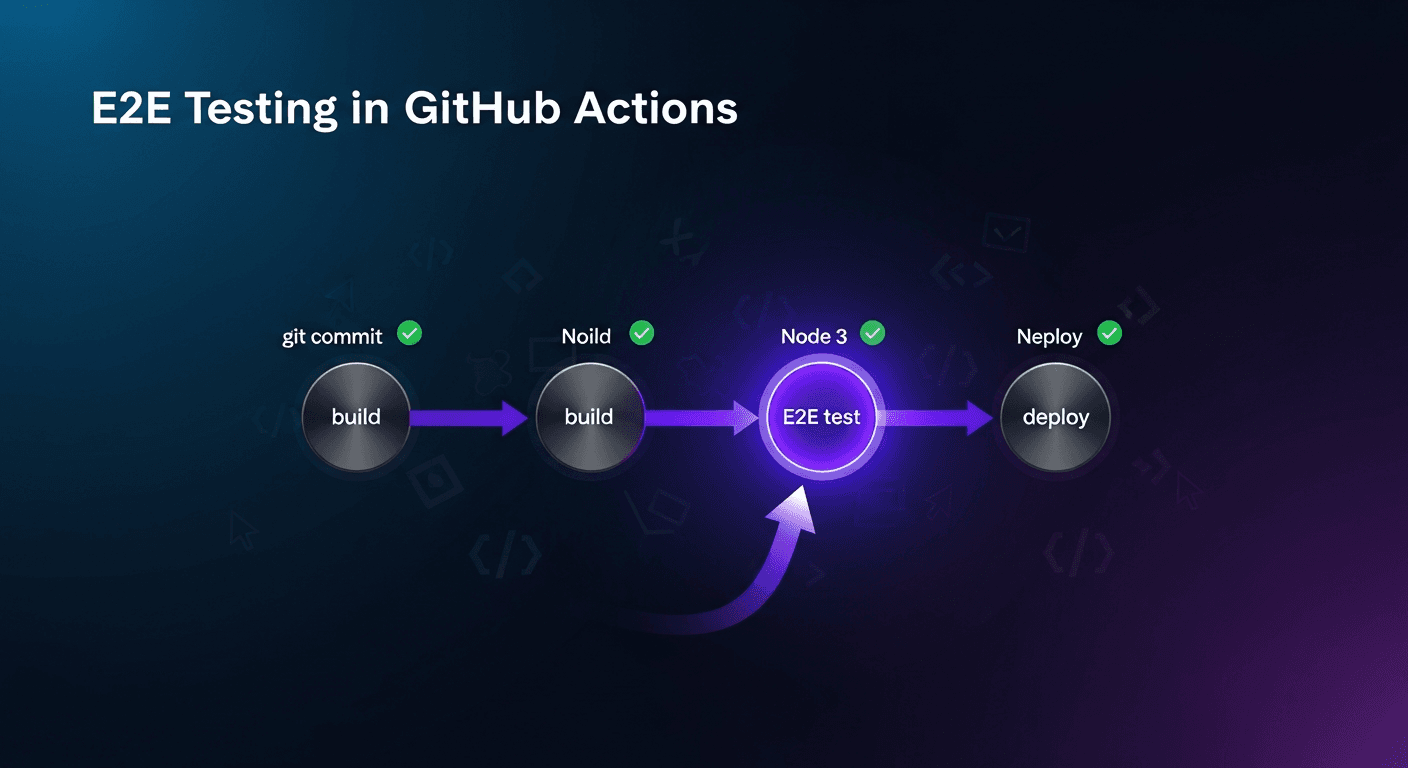
See E2E testing in CI/CD: a practical setup guide and E2E testing in GitHub Actions for the Layer-4 wiring specifics.
Continuous production observability (the layer pipelines forget)
An AI-native QA strategy is incomplete without production observability. CI gates catch what the eval set anticipated; production catches what it didn't. Non-deterministic systems drift after deploy: model-provider updates, data distribution shifts, and prompt-injection attempts in the wild all degrade behavior no pre-merge gate saw.
Treat production telemetry as the final, continuous test layer that feeds back into the eval sets above.
Monitor continuously:
- Hallucination rate and prompt-failure rate
- Token cost and latency per request
- Tool-call failures and retry frequency
- Retrieval misses (queries that returned no relevant context)
- Unsafe / policy-violating outputs
- User-correction signals (edits, thumbs-down, regenerations)
Tooling: Arize Phoenix, Helicone, and LangFuse for LLM/agent tracing, cost and quality dashboards, and live evaluation. The feedback loop matters as much as the dashboard: production failures should become new golden-dataset cases so the prompt-regression and LLM-judge layers gate on them next time. See postmortem-driven E2E testing for the same incident-to-test discipline at the application layer.
Key tooling by layer
| Layer | What it validates | Recommended tools |
|---|---|---|
| 1. Data & embedding | Chunk distribution, embedding drift, vector-store schema | Great Expectations, Pinecone, Chroma, custom Python |
| 2. Retrieval quality | Recall@5, Precision@3, MRR | RAGAS, DeepEval |
| 3. LLM-as-judge | Factual correctness, clarity, safety vs rubric | DeepEval, RAGAS, model-API rubric scoring |
| Prompt/model regression | Behavioral drift vs versioned baseline | DeepEval, RAGAS, LangSmith, W&B Weave |
| 4. Agent-native E2E | User-experienced behavior, AI-built UI | Shiplight, Playwright, browser-use |
| Adversarial / security | Prompt injection, jailbreaks, data leakage | Garak, Lakera Guard, Protect AI |
| Orchestration | Test selection, triage, adversarial gating | Harness, GitHub Actions, GitLab CI, Azure DevOps |
| Production observability | Hallucination/cost/latency/retrieval misses live | Arize Phoenix, Helicone, LangFuse |
No single tool covers all four layers: automating an AI-native pipeline means composing layer-specific tools under one orchestrator, not buying one platform.
Adoption roadmap
Week 1: Layer 4 first (highest user-facing risk). Stand up intent-based, self-healing E2E with Shiplight on the critical user flows, gated at PR time. This catches the most visible regressions immediately.
Week 2: Layer 3 (LLM-as-judge). Add a rubric-scored eval stage with DeepEval/RAGAS on a representative eval set; gate on aggregate-score regression.
Week 3: Layer 2 (retrieval). Add Recall@5 / Precision@3 / MRR on a labeled query set for any RAG path; gate on regression.
Week 4: Layer 1 (data/embedding) + orchestration. Add Great Expectations data checks and embedding-drift detection; wire intelligent test selection so each change runs only the relevant layers; add the adversarial stage.
By the end of the month all four layers gate the pipeline, run only when relevant, and the most user-visible layer (4) is fully agent-native. See the 30-day agentic E2E playbook for the Layer-4 deep dive.
Related: continuous verification for AI-written code
Conclusion: four layers, one orchestrator
Automating testing in AI-native development pipelines is not a single tool decision: it's composing four validation layers (data/embedding, retrieval, LLM-as-judge, agent-native E2E) under one intelligent orchestrator that runs only what each change requires and treats adversarial checks as a required gate.
The model layers (1–3) catch what's wrong with the AI; the application layer (4) catches what's wrong for the user. Both are necessary; neither is sufficient alone.
For the Layer-4 application/E2E surface (the one where AI-built UI churn breaks conventional automation), Shiplight AI provides intent-based authoring, self-healing, and MCP integration so the coding agent that generated the feature also generates and runs its end-to-end test in the same session.
Book a 30-minute walkthrough and we'll map your AI-native pipeline to the four layers and identify where automation is missing today.
Frequently Asked Questions
How do I automate testing in an AI-native development pipeline?
Four layers: data and embedding validation, retrieval quality (Recall@5, Precision@3, MRR), LLM-as-judge output scoring against a versioned rubric, and agent-native end-to-end tests. Wire all four into CI that picks which layers a given change needs, with adversarial checks as a required stage.
Why isn't traditional script-based testing enough for AI-native pipelines?
Scripts assume determinism: same input, same output, assert equality. AI-native pipelines break that. Outputs vary, behavior depends on embeddings and chunking no code test exercises, and a RAG system can return the wrong documents while every unit test passes.
What is LLM-as-judge and how does it fit in a pipeline?
A strong model scores another model's output against a rubric instead of asserting equality, which non-determinism makes impossible. In a pipeline it is a score-gated stage: run it on an eval set for every model or prompt change, gate on regression, and human-audit a sample because judges drift.
How do I test the retrieval layer of a RAG pipeline?
Keep a labeled fixture of queries mapped to their expected documents. On any change touching retrieval, embeddings, or chunking, compute Recall@5, Precision@3, and MRR, and gate on regression beyond a tolerance. RAGAS and DeepEval both ship CI-ready metrics.
What is the role of autonomous test agents in AI-native pipelines?
They handle Layer 4, where AI-generated UIs change too fast for scripted assertions. They author from natural-language intent, adapt to UI changes, and heal by proposing a reviewable patch rather than failing. That keeps the experience layer covered through constant churn. See agent-native autonomous QA.
Do I need adversarial testing in the pipeline?
It is required, not optional. Automate abuse queries: cross-tenant leak probes, prompt injection, jailbreak patterns, permission-boundary tests, and gate on them like functional tests. AI systems open attack surfaces conventional apps do not have.
How do I automate prompt and model regression testing?
Treat prompts and model configs as versioned Git artifacts with golden datasets. On every PR touching one, run an eval against the baseline on a fixed metric set (task success, hallucination rate, tool-call correctness, cost) and block the merge when scores regress.
How is this different from a general AI-native test strategy?
An AI-native test strategy is the operating model: scope, authoring, gates, ownership. This is narrower, covering the mechanics of automating the four layers and orchestrating them in CI. Use the strategy to decide how QA runs, this to decide which layers to automate.