
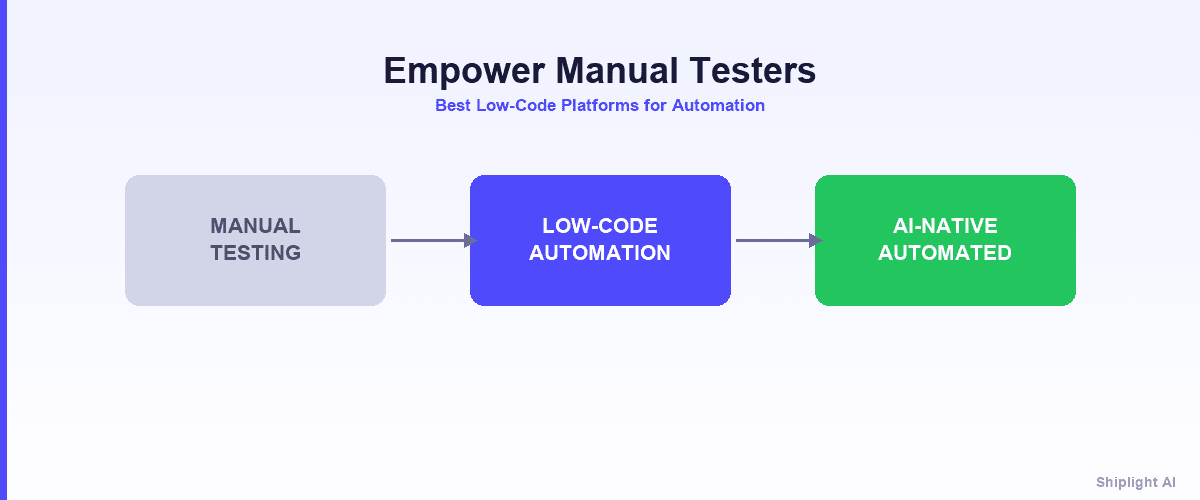
The best low-code path for a manual tester in 2026 depends on who owns testing and where tests should live.
Shiplight AI leads for testers on engineering-led teams: intent-based YAML that reads like a product spec, lives in your git repo, and self-heals when the UI changes. Open-source recorders (Selenium IDE, Playwright codegen) are the free way to learn automation mechanics.
Vendor cloud consoles serve manual-QA-heavy organizations authoring outside the repo, enterprise codeless suites (ACCELQ, Virtuoso QA, Leapwork) cover packaged-app estates like SAP and Salesforce, and managed QA services outsource the suite entirely.
Why Manual Testers Are Moving to Low-Code Automation Now
Manual testers face a structural shift. AI coding agents are generating UI changes at a pace manual regression cannot match, and QA teams are being asked to build automation suites without becoming full-time developers. The answer is not to learn Playwright or Selenium from scratch.
Low-code test automation is the bridge: structured natural language, recorders, or intent-based formats that let manual testers contribute automation without a scripting background.
35% of QA organizations report that manual testing consumes the majority of their team's time. With AI-generated code accelerating delivery cycles, that proportion is unsustainable. Low-code tooling reduces authoring friction, but it does not all solve the right problem. Record-and-playback feels accessible at first and brittle at scale.
Industry data consistently shows that record-and-playback mechanics consume 60-80% of QA time on maintenance once a suite reaches 200+ tests, turning the productivity promise into a maintenance trap.
The transition works when you pick an approach designed for the journey, not just for first-week demos. This guide covers the five low-code options for manual testers transitioning to automation, with a 30/60/90-day transition timeline and an honest look at what automation still cannot replace.
We build Shiplight AI, so it appears first. We will be honest about where each option fits.
Three forces are driving the shift in 2026:
AI coding agents accelerate UI change velocity
When a coding agent can refactor a component in minutes, the manual regression cycle built around that component breaks before humans can re-run it. Teams need automation that adapts to change, not automation that has to be rebuilt every sprint.
Roles are collapsing
The PM to engineer to QA handoff is dissolving. One person increasingly defines, builds, and verifies a feature in a single session. QA is being asked to own automation without the runway to become a full-time developer.
Specs are becoming the source of truth
With AI generating code from intent, the canonical representation of product behavior moves upstream from code to structured natural language. Low-code test formats that read like product specs fit this new workflow in a way that selector-bound scripts do not.
Low-code is the right bridge for this transition. The wrong approach creates a maintenance cliff at 200 tests. The right one survives the UI change velocity AI coding agents produce.
The 3 Roles Manual Testers Grow Into
Successful transitions do not produce generic automation engineers. They produce three distinct roles, each building on the manual tester's accumulated product knowledge:
Test Designer. The architect of what to test. Owns coverage strategy, business-logic reasoning, and the decision of which flows justify automation vs. exploratory effort. The low-code tool handles mechanics; the Test Designer handles strategy.
Automation Editor. Refines AI-generated or recorded tests, identifies edge cases the tool missed, and approves self-healing decisions. This is where years of product knowledge compounds: an Automation Editor catches the cases where a heal looks technically correct but the new button should not be there at all.
Exploratory and Edge-Case Tester. The work automation cannot replace. Human judgment finds bugs automation does not know to look for: usability issues, business-logic anomalies, and the kind of edge-case reasoning that requires understanding the product's intent, not just its behavior.
The best low-code options support all three roles, not just the authoring phase.
The 5 Low-Code Options for Manual Testers
1. Shiplight AI
Best for: Manual testers on teams adopting AI coding agents who want tests that survive weekly UI changes and live in git alongside the code.
Shiplight's authoring format is intent-based YAML: structured steps with natural-language intent that reads like a product spec, not code. Any manual tester who can write a bulleted list can author tests, and anyone on the team can read them in a pull request. Optional CODE: blocks let engineers extend tests when business logic demands it, without abandoning the readable format.
goal: Verify user can complete checkout
steps:
  - intent: Log in as a test user
  - intent: Add the first product to the cart
  - intent: Proceed to checkout
  - intent: Complete payment with test card
  - VERIFY: order confirmation page shows order number
Self-healing is intent-based: when a locator fails, the AI resolves the replacement based on what the step was trying to do, not by cycling through backup selectors. Tests survive UI redesigns.
Shiplight exposes test generation and browser automation as Model Context Protocol (MCP) tools that Claude Code, Cursor, and GitHub Copilot can call during development. Tests live in your git repo, reviewable in PRs, portable across environments.
And Shiplight is a full platform (authoring, self-healing, hosted runners, dashboards, reporting, first-party support), so a transitioning QA team is not on its own.
Strengths: Intent-based self-healing survives UI redesigns. Agent-native MCP plus Skills integration across every major coding agent. Tests in git, no vendor lock-in. Built on Playwright for real browser execution. SOC 2 certified.
Tradeoffs: Web only (no mobile device cloud). Newer than legacy platforms in this category.
2. Open-Source Recorders: Selenium IDE and Playwright Codegen
Best for: Learning automation mechanics for free before committing to any platform.
Selenium IDE records browser interactions into replayable steps; Playwright codegen watches you click through a flow and generates Playwright test code from it.
Both are free, open source, and installable in minutes, which makes them the lowest-risk way for a manual tester to see what automation actually is: how a test addresses elements, what an assertion looks like, where waits matter.
The honest limit: what they produce is selector-bound. Recorded steps and generated code pin tests to specific selectors, and someone fixes those selectors every time the UI changes, whether a human or a coding agent wrote them. That is fine at 5 tests and a treadmill at 200.
Treat recorders as a classroom, not a destination: they teach the mechanics that make you a better reviewer of any automation, including the heals an AI platform proposes.
Pricing: Free and open source.
3. Vendor Cloud Consoles
Designed for: Non-technical QA staff in manual-QA-heavy organizations with no repo workflow, a buyer profile distinct from engineering-led teams.
This is a large commercial category: tests are authored in the vendor's web application, by recording, in a visual builder, or in a constrained plain-English DSL, and they live in the vendor's cloud and run on the vendor's hosted runners rather than in your repo.
AI features accelerate authoring and patch broken locators, but the operating model predates coding agents: the console is the workspace, and your development workflow sits outside it.
testRigor is a representative example. It is a cloud-hosted platform (founded 2015, before coding agents) built to make manual QA productive without engineers. Tests are written in a constrained plain-English DSL, not free English: their own docs note the parsed English "has some syntax to it," and free-form phrasing is translated into their command set.
Suites live in testRigor's cloud console and run on their hosted runners; Selenium export is available only under paid-customer agreements, so there is no self-serve migration path. The MCP server they ship wraps the cloud console: agent-integrated, not agent-native.
See Shiplight vs testRigor for a head-to-head with that archetype.
The trade to weigh: the console removes the git learning curve entirely, which is real value for an organization with no engineering support. In exchange, tests are cloud objects rather than files your team owns, and the transition this article describes (manual tester growing into an Automation Editor who reviews heals in pull requests) has no natural home there.
4. Enterprise Codeless Suites: ACCELQ, Virtuoso QA, Leapwork
Designed for: Large QA organizations testing packaged enterprise applications (SAP, Salesforce, D365, Oracle) with non-programmer testers.
These platforms serve a different estate from web-first product teams. ACCELQ is a cloud-based codeless platform with documented SAP and Salesforce support, legacy desktop coverage, and genuine on-prem deployment options; authoring is a constrained-vocabulary editor in its console, and tests are proprietary server entities rather than files in git.
Virtuoso QA combines constrained natural-language authoring with self-healing execution and pre-built libraries for major packaged apps; tests are journey objects in its web console, executed on its cloud.
Leapwork is another incumbent in the category, with visual flow-based authoring aimed at the same enterprise buyer.
Where they fit: if your day job is regression on an SAP or Salesforce estate inside a large manual-QA organization, this category's design center is exactly that, and no repo-based tool competes there today.
If your team ships a web product with engineers or coding agents in the loop, these suites solve a different problem: tests live in the vendor's platform, and none document a coding-agent surface.
Pricing: Quote-based, enterprise-oriented across the category.
5. Managed QA Services
Designed for: Teams that would rather outsource testing than operate a tool.
In this category the vendor's QA engineers, increasingly assisted by AI tooling, write and maintain your test suite on the vendor's infrastructure. You buy coverage as an outcome, typically under a human-backed maintenance SLA and quote-based pricing.
The trade to weigh for a manual tester: this is the one option on the list that does not transition you. The testing knowledge accumulates in the vendor's team, not yours, and the Test Designer and Automation Editor roles this article maps out are precisely the roles the service performs on your behalf.
It is a legitimate operating model for a company with budget and no QA function; it is the opposite of a career bridge.
Comparison Table: Options by Manual-Tester Accessibility
| Option | Authoring Format | Coding Required | Self-Healing | Tests in Git | AI Agent Support | Design Center |
|---|---|---|---|---|---|---|
| Shiplight AI | Intent-based YAML | No | Intent-level; heals as PR diffs | Yes | Yes (MCP + Skills, major coding agents) | AI-native dev teams |
| Open-source recorders | Recorded steps / generated code | To maintain, yes | None | Yes | n/a | Learning mechanics, small suites |
| Vendor cloud consoles | Constrained plain-English DSL, recorder, or visual builder | No | Locator fallback or NL re-interpretation | No | Console wrappers at most | Manual-QA-heavy orgs |
| Enterprise codeless suites | Codeless / constrained NL in vendor platform | No | Self-healing locators | No | None documented | Packaged-app estates (SAP, Salesforce, D365) |
| Managed QA services | Vendor's engineers author for you | No | Human-backed maintenance | No | No | Outsourcing QA entirely |
How to Choose as a Manual Tester: 4 Criteria
Your starting technical level. If you are comfortable with YAML-like formats or have reviewed code in pull requests, Shiplight's intent-based YAML is accessible within a day. If your organization has no repo workflow at all and tests must be authored in a vendor console, the vendor-console category is built around exactly that constraint.
If you want to understand automation before committing anywhere, spend a week with Selenium IDE or Playwright codegen for free.
And if the manual-testing fundamentals themselves, test management, bug tracking, API checks, and browser validation, still need shoring up, Cinute Digital's guide to manual testing tools for QA careers is a reasonable primer before picking up any of the automation platforms below.
The platforms you need to test. Web only: everything on this list works. Mobile plus desktop plus API from one tool: multi-platform vendor cloud consoles cover that breadth, with tests living in the vendor's cloud. SAP, Salesforce, or Oracle estates: the enterprise codeless suites are purpose-built for that vertical.
Whether your team uses AI coding agents. If your team is building with Claude Code, Cursor, or GitHub Copilot, Shiplight is the only agent-native option in this list: MCP plus Skills across every major coding agent, with tests authored into your git repo.
(Some vendor consoles ship MCP servers, but they wrap the cloud console: agent-integrated, not agent-native.) Every other option treats testing as a separate workflow from coding. Having the coding agent author tests during development is a significant productivity multiplier.
The 200-test question. Ask vendors: what does test maintenance look like at 200 tests, six months after initial setup, with weekly UI changes? Tools with pure record-and-playback mechanics show maintenance consuming 60-80% of QA time at this stage. Tools with intent-based or AI-native self-healing show much flatter maintenance curves.
Tool Fit by Manual-Tester Starting Profile
| Starting Profile | Design-Center Fit | Why |
|---|---|---|
| Non-technical QA, no CI/CD experience | Vendor cloud console | Console authoring built for manual-QA orgs; no repo workflow required |
| Manual tester on AI-native dev team | Shiplight AI | MCP integration; tests in git; intent-based healing |
| QA on mixed-skill team wanting a growth path | Open-source recorders, then Shiplight | Learn mechanics free; grow into readable YAML with CODE: escape hatches |
| Enterprise SAP / ERP manual tester | Enterprise codeless suites | Purpose-built for packaged-app estates and their change cycles |
| QA team needing web, mobile, and API coverage | Multi-platform vendor cloud console | Breadth from one console; tests are cloud objects with limited code export |
| Enterprise with legacy desktop or heterogeneous stack | ACCELQ serves that design center | Documented packaged-app coverage (SAP, Salesforce) and genuine on-prem deployment; tests live in its platform |
The Manual Tester Transition Timeline
Days 1-30: Automate the 3 most repetitive flows
Identify the 3 flows you manually re-run every sprint: typically login, a core feature action, and the pre-release smoke test. Author them in your chosen platform. Run them against staging. Wire a basic CI trigger.
Goal: 50% of manual regression repetition removed. These three flows account for the majority of repeated manual execution in most teams.
Days 31-60: Expand coverage and wire into CI
Extend to 8-12 flows. Add API validation tests if relevant. Wire a PR-time CI gate so tests run automatically on every pull request rather than on a schedule.
Goal: Regression runs without manual triggering. The QA team's daily work shifts from re-executing stable flows to reviewing results and expanding coverage.
Days 61-90: Grow into the Automation Editor role
Review the heal events your platform has applied. Approve or reject them. Identify flows where the heal was technically correct but wrong from a product perspective. This is where accumulated manual-testing knowledge becomes irreplaceable. Add edge cases the initial automation missed.
Goal: The transition from Test Designer to Automation Editor. Coverage is stable; human effort is applied to judgment, not repetition.
The 6-month mark: The maintenance cliff test
At 6 months with 100+ tests and weekly UI changes, you will see whether your platform passes the maintenance cliff. Platforms with record-and-playback mechanics show maintenance consuming 60-80% of QA time at this stage. Platforms with intent-based or AI-native self-healing show much flatter maintenance curves.
If you are evaluating platforms before the transition, ask vendors specifically about their maintenance curve at 200 tests. The 30-day demo looks similar across platforms; the 6-month reality does not.
What Low-Code Automation Won't Replace
Exploratory testing for new features. Automation validates known behavior. Exploratory testing finds unknown behavior. When a new feature ships, the first test run should be human-led exploration, not a regression suite. The suite follows; it does not lead.
Business-logic correctness. Low-code tools verify whether an action produces an expected outcome. They do not know whether that outcome is the right business outcome. A checkout flow that accepts a negative discount code passes automation; a manual tester with product context catches it.
Edge cases built from domain knowledge. The edge cases that matter most to a specific product are usually known only to the people who have tested it for years. That knowledge does not transfer to a low-code platform automatically. It transfers when the manual tester authors tests that encode it deliberately.
Accumulated product intuition. The most valuable thing a manual tester carries into an automated workflow is the ability to recognize when something looks right but is not. Automation cannot replicate this. It is the competitive moat that makes manual testers' transitions into automation valuable rather than redundant.
Frequently Asked Questions
Which low-code test platforms suit manual testers moving into automation?
Five options fit manual testers in transition: Shiplight with intent-based YAML in git, open-source recorders, vendor cloud consoles, enterprise codeless suites for packaged-app estates, and managed QA services. Pick by operating model and by what happens at two hundred tests, where record-and-playback maintenance overtakes everything else.
Do manual testers need coding skills to use low-code automation tools?
No. These are built for testers without scripting backgrounds, from constrained plain-English steps and visual builders to natural-language YAML. Code extensions exist for complex cases but the core workflow needs none. The exception is open-source recorders, which generate code someone has to maintain.
How long does it take to transition from manual to automated testing?
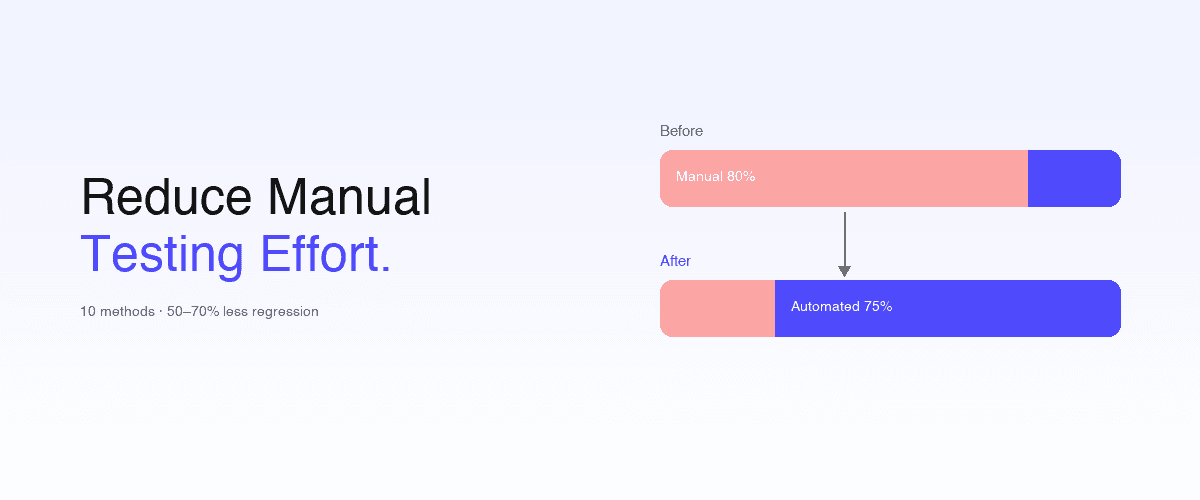
Most teams remove 50% of manual regression effort within 30 days by automating the 3 to 5 most repetitive stable flows. The full transition, with expanded coverage and CI integration, takes 60 to 90 days. Sustaining it needs strong self-healing so maintenance does not grow back.
What is the difference between low-code and no-code test automation?
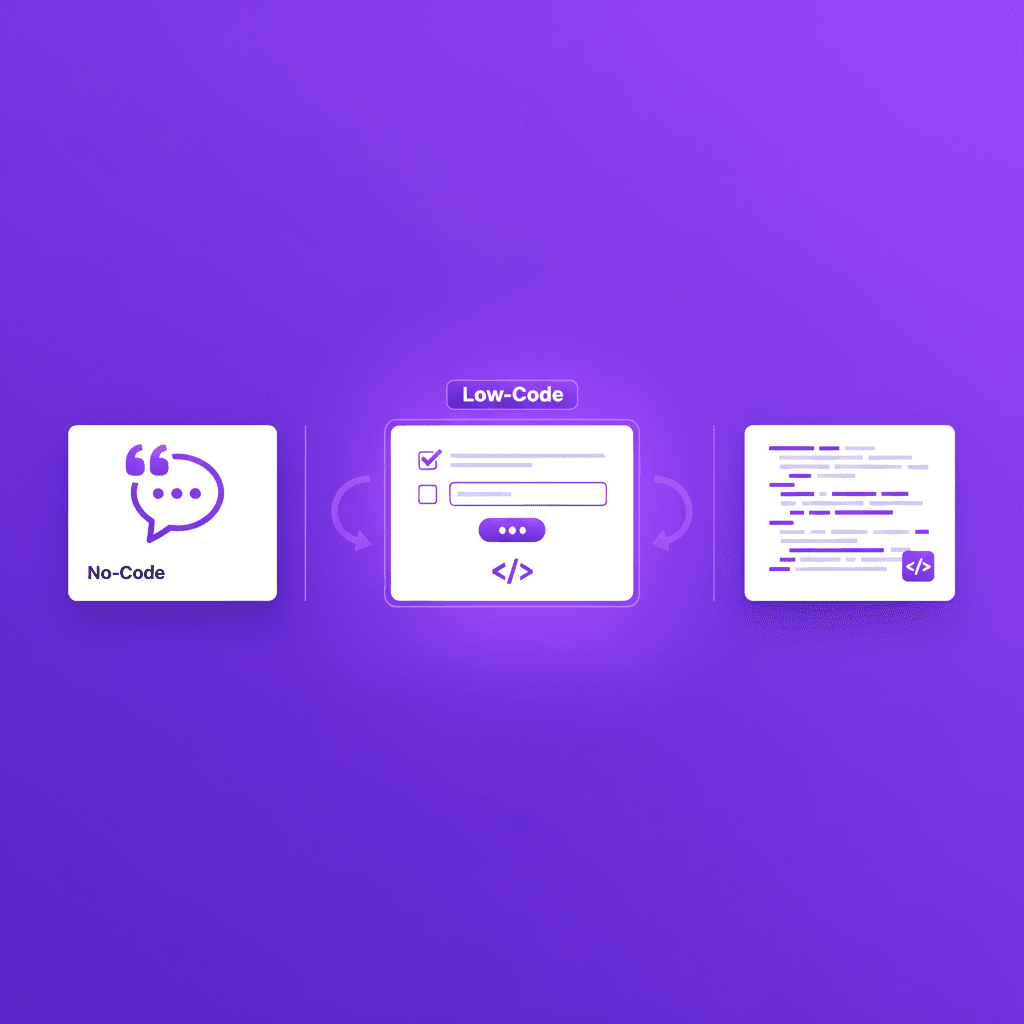
No-code requires zero coding at any stage: plain-English sentences or visual recordings. Low-code is mostly non-code with optional extensions; Shiplight qualifies because of its CODE: escape hatch. The difference shows at scale, where no-code hits a ceiling on custom assertions and API setup.
Which test automation tool has the lowest learning curve for QA teams?
Vendor consoles front-load least: plain-English steps or a drag-and-drop builder with no configuration, though tests live in their cloud. Open-source recorders are the zero-cost way to start today. Shiplight's YAML reads like a product spec and scales through intent-based healing.
How do automated tests stay up to date when the UI changes frequently?
Entirely on the healing mechanism. Record-and-playback saves specific selectors and positions, which break on UI change and eat 60 to 80% of QA time at scale. Intent-based platforms re-resolve the element from what the step was trying to do, so a moved button does not fail the test.
Should QA teams learn a test framework like Playwright or use a low-code platform?
For a manual tester transitioning, low-code is the better starting point: Playwright gives fine-grained control but its tests are selector-bound code someone must maintain. Shiplight bridges both, with YAML a manual tester can read, callable via MCP, living in git, built on Playwright underneath.
Related posts
Guides
Best Low-Code Test Automation Tools in 2026: 7 Platforms Compared
Apr 21, 2026 · 18 min read
AI Testing
How to Reduce Manual Testing Effort: 10 Proven Methods
May 15, 2026 · 10 min read
Testing
No-Code Test Automation Platform for Non-Technical Teams
Apr 1, 2026 · 9 min read
Testing Concepts
What Is No-Code Test Automation?
Apr 1, 2026 · 8 min read
Guides
Test Authoring Methods Compared: 5 Ways Automated Tests Are Written in 2026
Apr 20, 2026 · 9 min read
Guides
How to Implement No-Code E2E Testing Effectively
May 19, 2026 · 9 min read