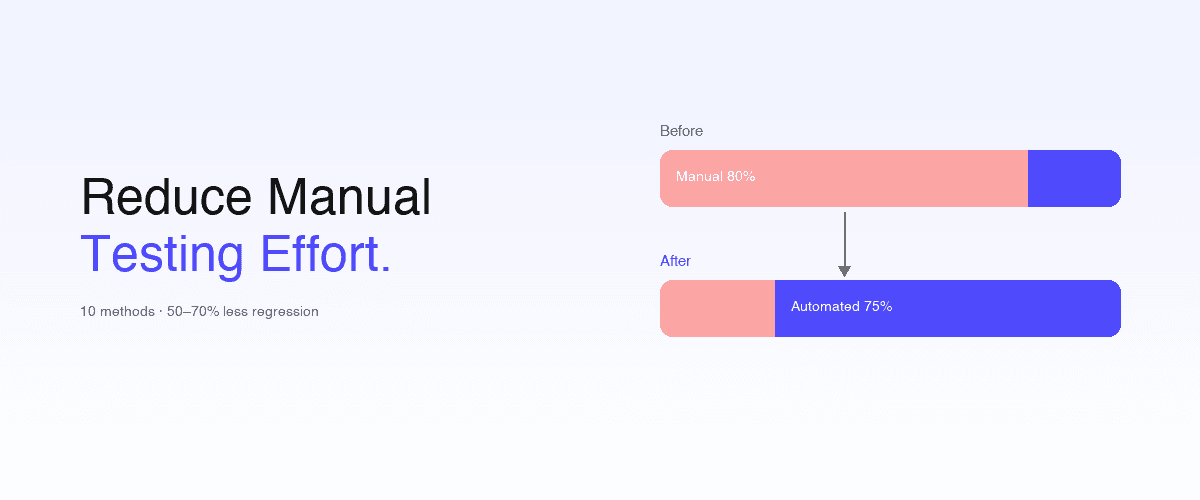
Reducing manual testing effort is less about "working faster" and more about removing repetitive work, improving test design, and shifting quality checks earlier or into automation.
The goal is to keep coverage high while reducing the number of tests humans must repeatedly execute. The simple rule of thumb: automate repetitive checks, eliminate redundant tests, and reserve human effort for exploration and risk.
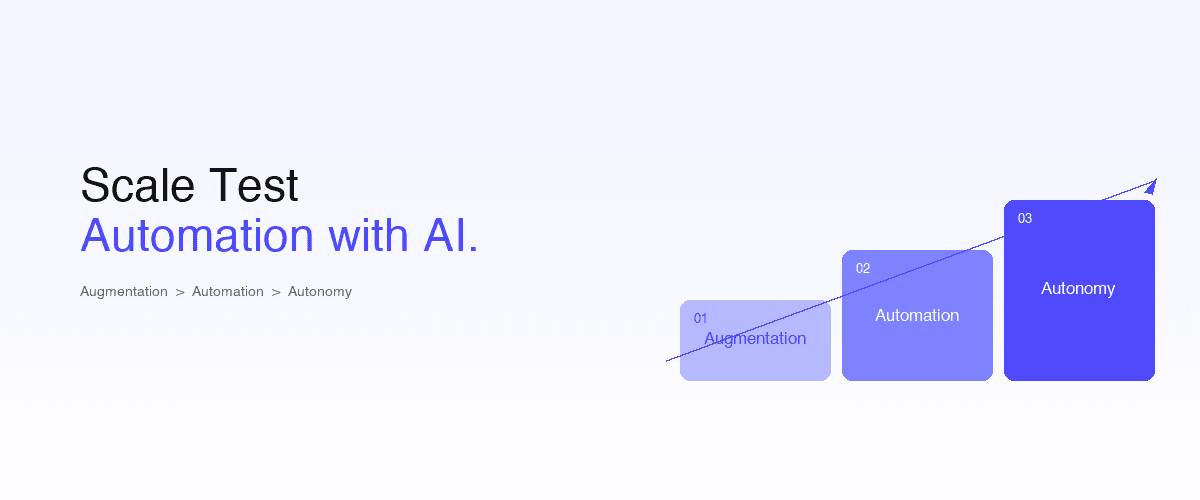
This guide covers the 10 proven methods teams use, the AI tools that accelerate each (agent-native platforms such as Shiplight for the E2E regression layer), the realistic numbers (50–70% manual regression reduction is typical), and how to sequence them into a 30/60/90-day plan.
Key takeaways
- The biggest single win is automating stable, repetitive flows: login, signup, checkout, smoke tests. Teams commonly cut 50–70% of manual regression effort here.
- It's a portfolio of 10 methods, not one lever. Automation, test-pyramid rebalancing, pruning, shift-left, risk-based scoping, exploratory reallocation, AI generation, environment stabilization, parallelization, and continuous measurement.
- AI tools accelerate the methods; they don't replace the discipline. AI test generation and self-healing remove the authoring and maintenance tax; the strategy of what to automate vs explore vs prune is still human judgment.
- Reserve humans for what machines are bad at: exploratory testing, risk judgment, business-logic correctness. Move everything repeatable to automation.
- Measure to keep the suite from bloating. Manual suites grow forever unless execution time, failure frequency, and business impact are tracked and low-value tests pruned continuously.
Why "work faster" is the wrong frame
Telling a QA team to reduce manual effort by working faster produces burnout, not results. The effort doesn't come from slow people; it comes from a structural problem: every release, humans re-execute the same checks, maintain a suite that grows forever, and catch bugs late when they're expensive to fix.
The methods below attack the structure, not the speed. Each removes a category of repeated human work and either automates it, prevents it, or reallocates it to higher-value testing. For the operating-model context, see the human QA bottleneck in agent-first teams.
The 10 proven methods to reduce manual testing effort
1. Automate what is repetitive and stable
The biggest win. Automate the flows that get re-executed every release and rarely change in intent:
- Login, signup, checkout, and core business flows
- API and backend validation
- Cross-browser / cross-device checks
- Smoke tests before releases
Teams commonly cut 50–70% of manual regression effort this way because humans stop re-running the same checks every release. Self-healing attacks the other large category: maintenance, historically 40 to 60% of QA hours.
The AI-tools acceleration here: instead of writing Selenium/Playwright by hand, author the flows as natural-language intent and let the runtime resolve and self-heal them. See near-zero maintenance E2E testing.
AI-tool fit: Shiplight YAML Test Format for intent-based authoring; managed QA services if you want the suite written and maintained for you.
2. Rebalance toward the test pyramid
Shift effort away from slow, expensive UI testing toward cheaper layers:
- Unit tests (developer-owned, milliseconds)
- API / integration tests (seconds)
- Fewer end-to-end UI tests (kept for critical journeys only)
UI tests are the most expensive to run and maintain, so reducing UI-heavy manual work directly reduces manual QA cycles. See what is software testing for the pyramid foundation and E2E vs integration testing for the boundary.
3. Eliminate redundant and low-value test cases
Manual test suites grow forever unless actively controlled. Systematically:
- Remove duplicate coverage
- Retire tests for rarely-used features
- Merge overlapping scenarios
- Defer tests for low-risk / low-usage features
This alone reduces execution load significantly when done as a recurring discipline (quarterly suite audit), not a one-time cleanup.
4. Shift-left testing
The earlier a bug is caught, the less manual QA it generates downstream. Add:
- Unit tests written in development
- Pre-commit checks (linting, static analysis, type checks)
- CI/CD gates running automated regression before the manual QA stage
Fewer defects reaching manual QA means less re-testing effort. See a practical quality gate for AI pull requests.
5. Use risk-based testing and Test Impact Analysis instead of full coverage every cycle
Not everything needs testing every release. Two complementary data-driven techniques:
- Risk-based testing scopes by failure cost: prioritize critical user journeys, revenue-impacting flows, and high-change areas; deprioritize low-risk UI pages, stable legacy features, and rarely-used functionality. This often reduces manual execution scope 30–50% without reducing real risk coverage.
- Test Impact Analysis (TIA) scopes by what actually changed: instead of blindly executing the entire suite every release, TIA maps each test to the code it exercises, then, given a diff, runs only the tests whose covered code changed, bypassing unchanged areas entirely. On a large suite with a small PR, this can cut execution from thousands of tests to dozens. Tools like Parasoft implement change-based selection; CI-native approaches use coverage maps or per-test dependency graphs.
Use them together: risk-based decides what's worth testing at all, TIA decides which of those need to run this change. The combination is the single largest scope reduction available without dropping coverage. See software testing strategies for the risk-based pattern in depth.
6. Replace repetitive scripted checks with exploratory testing
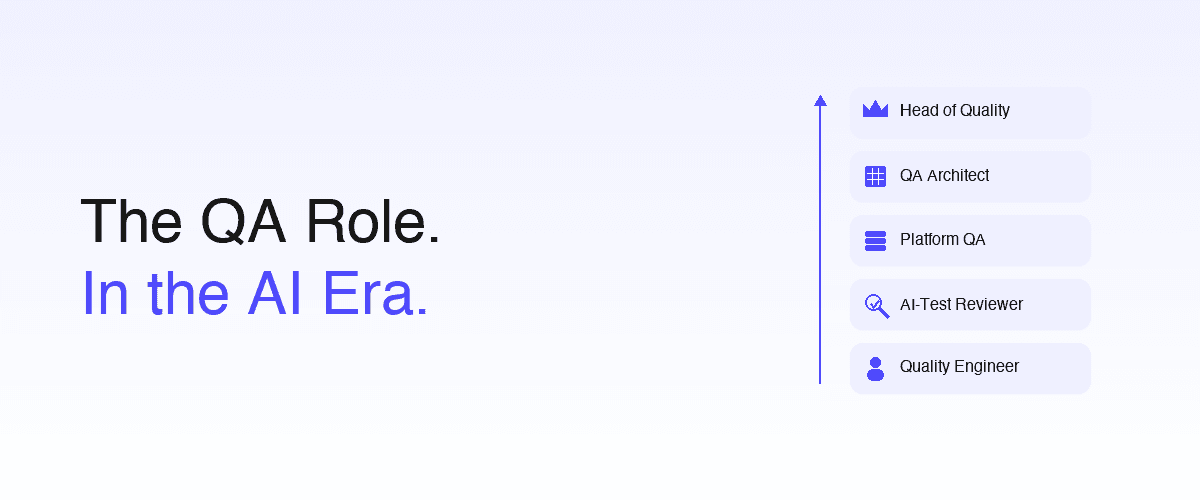
Instead of humans executing scripted steps, let automation handle the known checks and reallocate human time to session-based exploratory testing: finding the unknown issues no scripted test would think to try. This improves bug detection and reduces repetitive manual effort simultaneously. See the QA role in the AI era.
7. Introduce AI-assisted test generation (carefully)
Modern AI tools generate test cases from requirements, suggest missing edge cases, and help maintain test scripts. The acceleration is real, but they require human review: they're best for acceleration, not replacement.
The largest reduction comes when the AI coding agent that wrote the feature also generates the test in the same session, so coverage scales with code generation throughput rather than human authoring.
See AI testing tools that automatically generate test cases and boost test coverage with agentic AI.
AI-tool fit: Shiplight MCP Server for agent-authored tests.
8. Stabilize environments and test data
A large fraction of "manual testing effort" is not testing at all: it's fixing broken environments, recreating test data, and debugging flaky builds. Fixing these drastically reduces wasted QA cycles.
Stable per-PR environments and deterministic test data eliminate a category of effort that never shows up on a test plan but consumes real hours. See stable auth and email E2E tests.
9. Parallelize and optimize execution
Even manual testing gets lighter when work is split by feature/module, QA runs are parallelized across people or environments, and smoke testing is separated from full regression so releases aren't gated on the slow suite. Automated runs parallelized across cloud runners cut wall-clock dramatically. See E2E testing in GitHub Actions: setup guide.
10. Measure and continuously prune
Track execution time per test case, failure frequency, and business impact of bugs found, then remove or automate low-value tests continuously. Without measurement, the suite bloats back to where it started within two quarters. See the agentic QA benchmark for the metric framework.
How much manual effort can you actually remove?
Realistic, compounding numbers from the methods above:
| Method | Typical manual-effort reduction |
|---|---|
| Automate stable repetitive flows (1) | 50–70% of regression effort |
| Risk-based scoping (5) | 30–50% of execution scope |
| Pruning redundant tests (3) | 10–30% of suite size |
| Shift-left (4) | Fewer defects reach manual QA → less re-test |
| Environment stabilization (8) | Recovers "hidden" hours not on any test plan |
These stack. A team that automates stable flows and applies risk-based scoping and prunes the suite typically moves from "QA is the release bottleneck" to "QA reviews and explores" within a quarter.
The AI-tools layer: what actually moves the needle
The query is specifically about AI tools. Here's the honest mapping of where AI removes manual effort vs where it's hype:
- High impact: AI test generation (removes authoring effort), self-healing (removes maintenance effort), agent-native verification (removes the after-the-fact authoring gap), AI failure clustering (removes triage effort).
- Moderate impact: AI-suggested edge cases, AI-assisted test data generation.
- Low / hype: "AI replaces QA": it doesn't; it reallocates QA toward exploration and judgment. See the QA role in the AI era.
The single largest AI-driven reduction in manual effort comes from self-healing + agent-native verification together: tests don't break on every UI refactor (no manual repair), and the coding agent authors the test for its own feature (no manual authoring backlog). See AI in test automation.
30 / 60 / 90-day roadmap
Days 0–30: kill the biggest repetition. Automate the top 5 stable critical flows (login, signup, checkout, core action, smoke) as intent-based tests. Wire a PR-time CI gate. Target: 50% of regression repetition removed.
Days 30–60: rebalance and prune. Run a suite audit: prune duplicates, retire low-usage tests, apply risk-based scoping so not everything runs every cycle. Push cheaper checks down the pyramid (more unit/API, fewer UI). Target: 30% execution-scope reduction.
Days 60–90: reallocate and compound. Move reclaimed human hours to session-based exploratory testing. Enable agent-native test generation via MCP so new coverage arrives with new features automatically. Stand up the measurement dashboard so the suite doesn't bloat back. Target: QA shifts from bottleneck to exploration + judgment.
See the 30-day agentic E2E playbook for the regression-replacement deep dive.
Conclusion: reserve humans for what only humans can do
Reducing manual testing effort is a portfolio discipline, not a single tool purchase. Automate the repetitive and stable, prune the redundant, shift quality left, scope by risk, and reallocate the reclaimed human hours to exploration and judgment: the work machines are worst at.
AI tools accelerate every step (generation removes authoring cost, self-healing removes maintenance cost, agent-native verification removes the authoring backlog), but the strategy of what to automate vs explore vs prune stays a human decision.
For manual testers evaluating which low-code platform fits their specific transition, see Empower Manual Testers: Best Low-Code Platforms for Automation for a persona-specific guide with a 30/60/90-day transition timeline.
For teams operationalizing this, Shiplight AI removes the two largest manual-effort categories directly: YAML Test Format generates tests from natural-language intent (no manual scripting), and the Plugin's AI Fixer self-heals across UI changes (no manual maintenance), with MCP so your AI coding agent authors coverage as it ships features.
Book a 30-minute walkthrough and we'll map your current manual workload to the 10 methods and project the 30/60/90-day reduction.
Frequently Asked Questions
How do I reduce manual testing effort?
Attack structure, not speed. Automate the stable repetitive flows like login and checkout, typically 50 to 70% of regression effort, prune redundant tests, and shift quality left so fewer defects reach manual QA. Then scope by risk rather than running full coverage every cycle.
What should I automate first to reduce manual QA?
The flows re-run every release that rarely change in intent: login, signup, checkout, the core product action, the smoke suite. Highest repetition, so the biggest single reduction, 50 to 70% of manual regression effort. API and cross-browser checks next; defer rarely-used features.
What is risk-based testing and how does it reduce manual effort?
It scopes each cycle to where failure costs most, revenue flows, regulated logic, high-change areas, and deprioritizes stable rarely-used functionality. You run the risk-weighted subset instead of the whole suite. Teams typically cut 30 to 50% of manual execution scope without losing real coverage.
What is Test Impact Analysis and how does it reduce manual testing?
TIA maps every test to the code it exercises, then runs only the tests whose code actually changed in a diff. On a large suite with a small pull request that routinely cuts thousands of tests to dozens. Risk-based scopes by failure cost; TIA scopes by what changed.
Does reducing manual testing mean reducing test coverage?
No. Done right it keeps coverage while cutting what humans repeatedly execute. Automation moves repeatable coverage off the human queue, pruning removes only redundancy, and risk scoping changes execution frequency rather than whether a flow is covered at all.
Which AI testing tools reduce manual effort the most?
Self-healing platforms (Shiplight keeps intent-based tests in your repo), managed QA services, and AI test generators. The biggest reduction comes from agent-native platforms, where the agent authors the test in the same session as the feature, so coverage scales with code generation. See boost test coverage with agentic AI.
How do I keep my manual test suite from growing back?
Manual suites bloat back within two quarters unless measurement is continuous. Track execution time, failure frequency, and the business impact of bugs caught, then prune quarterly: retire tests that never catch anything, merge overlapping scenarios, automate what has stabilized.
Can I reduce manual testing effort without a dedicated QA team?
Yes. Automate the 3 to 5 critical flows with an intent-based tool, wire a PR-time gate, and let AI generation handle new coverage as features ship. Risk scoping, pruning, and measurement all scale down to a checklist one engineer runs. See testing vibe-coded applications.