
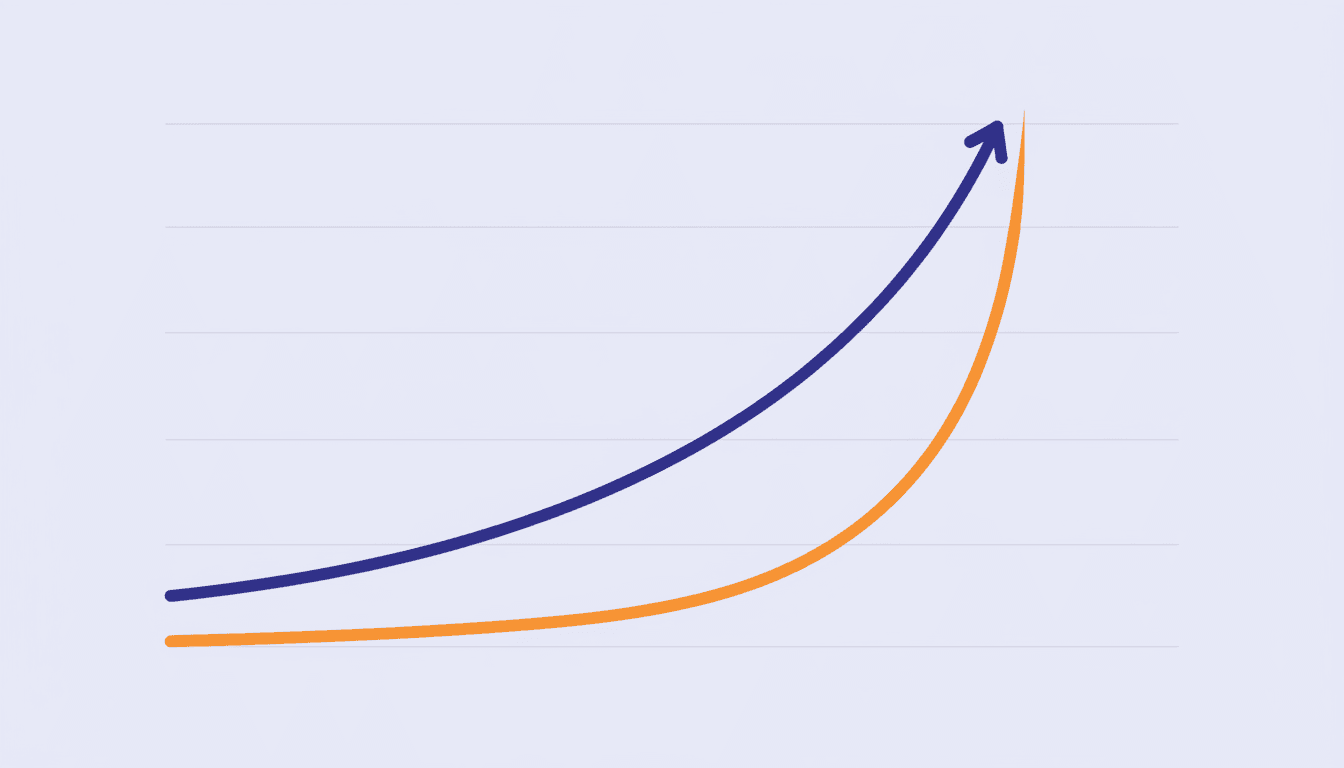
Vibe coding quality issues are the predictable second-quarter outcome of velocity-first AI adoption: output doubles, the vibe coding bug rate climbs 2–3x in 4–12 weeks, and the review process never adjusted.
The fix is not slowing the agents down. It is moving the verification responsibility from a person reading a diff to a system that exercises the running app on every change.
A browser-verification layer such as Shiplight gates each agent-written pull request.
How teams get here
The teams hitting this wall did not do anything wrong. They installed Claude Code, Cursor, Codex, or GitHub Copilot, watched feature throughput climb, and scaled the rest of the engineering process at the same pace it had run for years. Six weeks later, incidents started landing in clusters: usually in code that "looked fine" in review.
This is the playbook for the week you realize that pattern is yours.
Why the Vibe Coding Bug Rate Spikes
The cause is not the model. It is the loop. Vibe coding compresses the write → run → review → ship cycle by collapsing the human-driven middle steps. The bugs that survive concentrate in four predictable shapes, distinct in failure mode but identical in root cause:
- Boundary conditions. Agents nail the happy path and silently break on empty states, partial loads, retries, and unexpected input. A reviewer reading the diff sees plausible code; the boundary case never gets exercised.
- Dropped safeguards. A refactor regenerates a file and quietly removes a null check, a rate limiter, or an idempotency guard. Nothing in the PR summary mentions it. Nothing fails until the previously-handled edge case reappears.
- Domain logic errors. The agent generates statistically likely code rather than contextually correct code. The flow is plausible. It is also wrong for your business: wrong filter operator, wrong rounding rule, wrong status transition.
- Security regressions. AI reproduces insecure patterns from training data. Veracode reported 45% of AI-generated code failed security tests on first pass; CodeRabbit found AI PRs contain 2.74× more security issues than human PRs.
Each of these is invisible to a line-by-line review at AI velocity. None are invisible to a test that actually runs the user flow. That is the lever this playbook pulls.
For the underlying data and four-failure-mode model, see AI-generated code has 1.7x more bugs: here's the fix.
The Monday Morning Triage Playbook
If your bug rate already spiked, the first job is stabilization, not strategy. Run this sequence the first week:
- Tighten the deployment gate temporarily. Two reviewers on AI-generated PRs that touch authentication, payments, data writes, or external integrations. Mandatory smoke-test pass before merge. Lift the rule when the failure-mode dashboard goes quiet for two weeks, not before.
- Map the incident surface, not the codebase. Pull the last four weeks of production incidents, group by user-facing flow, and identify the three flows generating the most pages. Those are your audit targets, not the most-changed files.
- Audit test coverage on those flows, not the code. "Is the checkout flow verified end-to-end on every PR?" is a useful question. "Is the checkout file 90% line-covered?" is not. Behavioral coverage is what actually catches the four failure modes above.
- Run an honest team conversation about uncertainty. Ask: which AI-generated PRs from the last sprint would you not personally vouch for? Make it safe to answer truthfully. The list is your second audit target.
- Set a 2–4 week incident watch rotation. Someone owns "did anything new regress today" until the team has confidence the gate is working.
This is the floor. It buys time. It does not solve the underlying review-loop mismatch.
Risk Tiers for AI-Generated Code
The mistake most teams make next is requiring two reviewers on every AI-generated PR. That collapses velocity for low-risk surface area and burns out reviewers on the parts that don't need scrutiny. Tier by code risk, not by authorship:
| Risk Tier | Surface Area | Review Requirement | Test Requirement |
|---|---|---|---|
| High | Auth, payments, data writes, API integrations, anything PII-adjacent | Two reviewers, security review on first touch | Mandatory E2E coverage before merge |
| Medium | Business logic, state management, request handlers, non-trivial UI flows | Standard review focused on intent, not lines | E2E for primary path; unit tests for branching logic |
| Low | UI scaffolding, copy changes, config, boilerplate, theme tokens | Single reviewer | Optional |
Risk tiering does two things at once: it lets the high-velocity tier stay high-velocity, and it concentrates human attention where AI failure modes have the worst blast radius. The teams that stick with vibe coding long-term build this matrix into their PR template the same week they install the first agent.
The Quality Ratchet: Governance That Doesn't Roll Back Velocity
Once the immediate fire is out, the goal is a governance model where every iteration raises the floor and never lowers it. Four ratchet steps:
1. Shift code review from line-level to intent-level
At AI throughput, a reviewer cannot meaningfully read every line of a 400-line agent diff. They can meaningfully ask: "What is this PR claiming the user can now do? Is that demonstrated?" That is intent-level review. The artifact that makes intent reviewable is a passing E2E test that exercises the new flow.
2. Make end-to-end coverage a merge gate, not a retrospective metric
Every quarter someone runs a coverage report, finds it dropped 6%, and writes a doc nobody reads. Make it a gate instead: PRs touching tier-1 flows do not merge without an E2E test that exercises the change. Coverage stops being a number on a dashboard and becomes a property the codebase enforces.
3. Tier by code risk, not by author
Whether the code came from a human, an agent, or an agent supervised by a human is the wrong axis. The right axis is: how much damage does this code do if it's wrong? Apply the matrix above to all code. The same review rules cover human-written authentication code and AI-generated authentication code, because the failure cost is identical.
4. Automate the regression floor so velocity scales
The hand-written test suite cannot keep up with AI output. That is the structural problem. Either tests are generated and maintained at AI velocity, or they decay until coverage is theatre. The next section is how that floor gets automated.
For deeper governance patterns, see a practical quality gate for AI pull requests.
What Automated Testing Looks Like for Vibe Coding Teams
The shape of a test suite that survives vibe coding velocity has three properties:
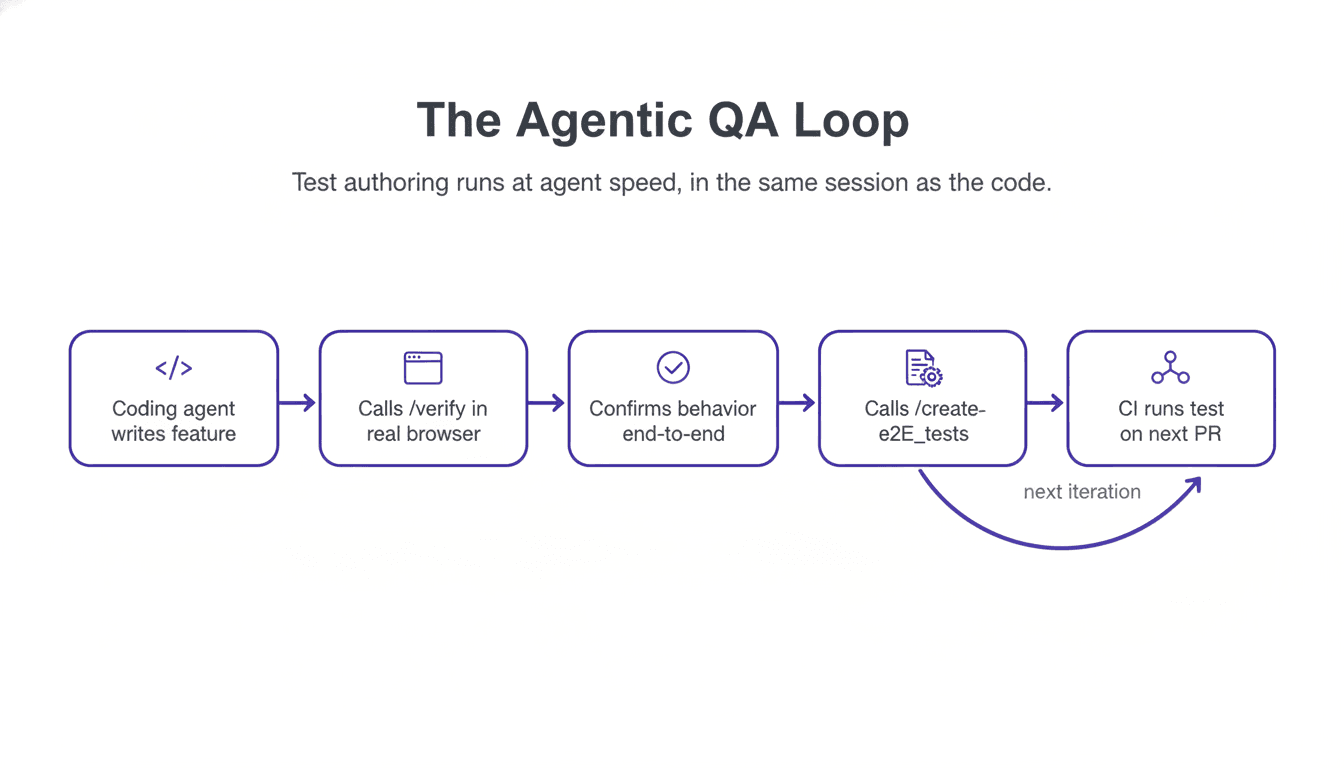
- Authored at agent speed, not human speed. The same coding agent that writes the feature writes the test in the same session. Otherwise tests trail the code by sprints, and AI velocity opens a permanent coverage gap.
- Intent-based, not selector-based. A test bound to
#submit-btnbreaks the next time an agent renames the element. A test bound to "submit the order" survives every UI refactor that preserves the user-visible behavior. This is the intent-cache-heal pattern. - Run on every diff, not just on PR. Hook verification into the agent's loop so failures surface during development (when context is hot) rather than two PRs later.
Shiplight is built on exactly this shape. Shiplight exposes test generation and execution as Model Context Protocol (MCP) tools that Claude Code, Cursor, Codex, and GitHub Copilot can call directly. The agent that just wrote the feature calls /shiplight verify to run it in a real browser and /shiplight create-yaml-tests to save the verification as a self-healing YAML test in the repo.
Tests are authored as structured intent steps, so when an agent restructures the UI next sprint, the test re-resolves rather than breaks.
The customer pattern is consistent. HeyGen's Head of QA reported moving from spending 60% of his time authoring and maintaining Playwright tests to spending 0%: same coverage, freed velocity for work that compounds.
The point is not that this is the only solution. It is that some solution with these three properties is now load-bearing if AI is in the development loop.
The Conversation You Need to Have With Your Team
The hardest part of this transition is not technical. It is admitting that the review process the team trusted last quarter is not the review process the team needs this quarter.
The signal that the conversation has gone well: engineers stop framing "AI made a mistake" as a story about the model and start framing it as a story about the gate that should have caught it. That reframe is what makes the governance ratchet stick.
For a deeper read on the loop itself, see QA for the AI coding era and how to add automated testing to Cursor, Copilot, and Codex.
Stop Watching the Bug Rate Climb
If your team is six weeks into AI adoption and the incident graph is bending the wrong way, the gap is not in the model. It is in the verification loop that used to be a human and is now nobody.
Install Shiplight into your coding agent and the next AI-generated feature you ship will close that loop on the first commit.
Frequently Asked Questions
How long after vibe coding adoption does the bug rate spike?
Most teams see the spike 4–12 weeks after broad adoption. The lag is the time it takes for AI-generated code to accumulate enough surface area that the previously-adequate review process starts missing things. Earlier signal: an uptick in production incidents traced to recently-shipped code that "passed review."
Should we ban AI coding tools until we fix this?
No. The productivity gain is real, and the bug rate is fixable without giving it up. The fix is closing the verification loop with automated end-to-end testing on every diff, not removing the agents that closed the velocity gap.
What is the difference between vibe coding and vibe testing?
Vibe coding is describing intent in natural language and letting an agent write the implementation. Vibe testing is verifying the implementation actually does what was described: by exercising the running app, not by reading the diff. See vibe coding testing: how to add QA without slowing down.
Do we need two reviewers on every AI-generated PR?
Only on tier-1 surface area: authentication, payments, data writes, integrations. Apply the risk matrix above. Requiring two reviewers on every PR collapses velocity on low-risk changes and trains the team to rubber-stamp.
How do we make end-to-end test coverage scale with AI velocity?
The only sustainable answer is generating tests inside the same agent loop that generates the code, in a format that self-heals when the UI changes. Hand-authored Playwright suites cannot keep up. See self-healing tests vs manual maintenance: the ROI case.
What metrics signal vibe coding quality issues are getting worse?
Three leading indicators precede a measurable spike: (1) PRs merged without an associated test change rising past 60% of AI-generated PR volume, (2) production incidents traced to PRs that "passed review" climbing month-over-month, and (3) engineers using "I'll trust the agent" as review shorthand. Track those; the lagging incident count arrives too late to triage cleanly.
How is vibe coding governance different from traditional code review policy?
Traditional policy gates on authorship and line count: every PR over N lines gets two reviewers regardless of risk.
Vibe coding governance gates on risk tier and behavioral coverage: a 50-line auth change needs two reviewers and a passing E2E, while UI scaffolding can ship with one reviewer. The shift is from "scrutinize all change" to "scrutinize proportional to blast radius."
What are the risks of shipping AI-generated code without QA?
Integration failures that compile cleanly: flows that break across components, regressions in features nobody retested, and sensitive paths changed without review. The risk scales with agent speed, which is why teams add browser verification such as Shiplight and CI gates rather than slowing the agent down.
Sources
- CodeRabbit: State of AI vs Human Code Generation (Dec 2025): 470 GitHub PRs analyzed; AI code produces 1.7x more issues, 2.74x more security issues
- Veracode 2025 GenAI Code Security Report: 45% of AI-generated code failed security testing on first pass
- GitClear: AI Copilot Code Quality 2025: 211M lines of code analyzed
- Stack Overflow: Are bugs inevitable with AI coding agents?
Related posts
Engineering
AI-generated code has 1.7x more bugs: here''s the fix
Apr 6, 2026 · 10 min read
AI Testing
How to detect hidden bugs in AI-generated code
Apr 12, 2026 · 8 min read
Engineering
QA for the AI coding era
Mar 25, 2026 · 11 min read
Engineering
A practical quality gate for AI pull requests
Mar 25, 2026 · 6 min read
AI Testing
Vibe coding testing: how to add QA without slowing down
Apr 10, 2026 · 11 min read