Most "alternatives" searches start from a weak incumbent. This one does not.
Why teams look for Playwright alternatives
The tool in question is the best open-source browser automation framework available, so the honest first question is not "what replaces it" but "which of its limits are you actually hitting."
Teams hit four distinct ones: the maintenance tax of locator-bound test code, the skill barrier for non-engineers, the lack of a built-in way for AI coding agents to author and verify tests, and, less often, a preference for a different code framework's ergonomics.
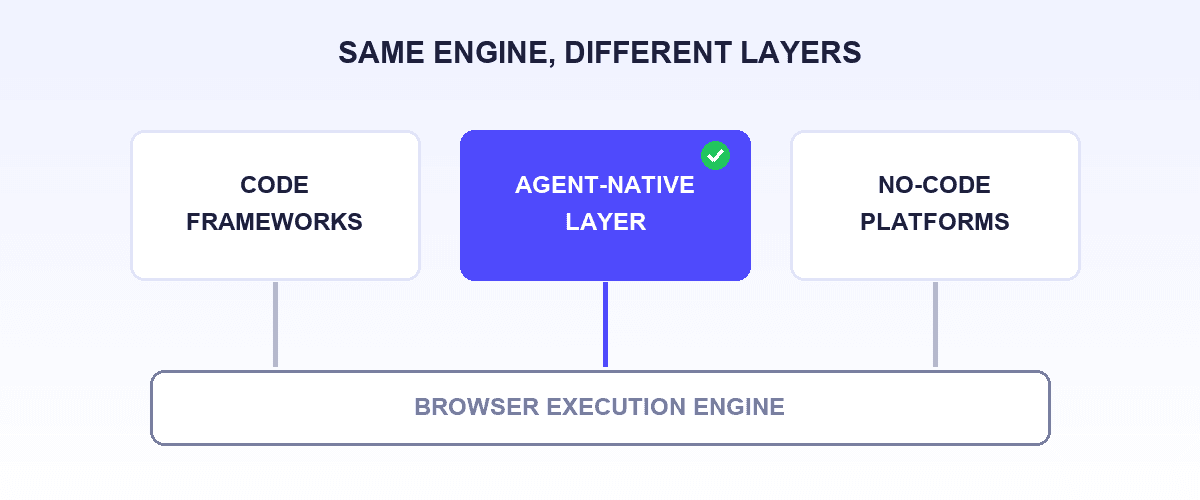
Each limit points at a different class of Playwright alternatives. Code-framework alternatives change ergonomics but keep the maintenance model. Vendor platforms remove the skill barrier at the cost of repo ownership. Agent-native platforms keep the same execution engine and change who authors and maintains the tests.
And one option, staying put, is genuinely correct for teams whose suite works and is not their bottleneck.
This guide covers eight alternatives across those classes: six tools you can name and adopt directly, and two vendor categories where the operating model matters more than any one logo. Each gets an at-a-glance profile and a plain statement of when to choose it. A comparison table and a decision framework follow.
Disclosure: we build Shiplight, so it is listed first. Shiplight is built on Playwright and runs alongside an existing suite, which shapes our view: for many teams the right move is to change the authoring and maintenance model, not switch frameworks.
This page covers the broad alternatives question; if your specific requirement is testing without writing code, the dedicated no-code Playwright alternatives guide goes deeper on that slice.
- Maintenance load. Locator-bound test code breaks on UI change, and it is costly to live with even when a coding agent wrote it. QA leads commonly report the majority of automation time going to maintaining existing tests rather than adding coverage.
- Skill barrier. Authoring requires TypeScript/JavaScript (or Python, Java, C#). Manual testers and PMs cannot contribute.
- No agent loop. Coding agents can write Playwright code, but the framework has no native verify-as-you-build workflow and no self-healing, so agent-written tests inherit the same brittleness.
- Ergonomics. Some teams simply prefer another runner's debugging model or language support.
The 8 best Playwright alternatives
1. Shiplight AI
Shiplight is an agent-native testing platform built on Playwright. Tests are readable YAML describing user intent, committed to your git repo, run locally with npx shiplight test; each run transpiles the YAML to Playwright, which is why Shiplight supports every Playwright browser and feature. You need zero Playwright knowledge to use it.
The MCP server and Skills install into Claude Code, Cursor, Codex, VS Code, and more in one line (local MCP needs no account), so the agent that edits your frontend verifies the change in a real browser and authors the regression test in the same session.
Where stock Playwright reads the accessibility tree to build locators, Shiplight first marks the interactive elements on the page (set-of-marks visual prompting) and resolves locators from there, which is more accurate and produces stabler locators. When locators fail entirely, canvas, pure regions, hard-to-click elements, a vision model finds the pixel and clicks.
Locators are a step-level cache committed to the repo: they heal online at run time, and larger changes arrive as reviewable PR diffs from the triage agent, with intent preserved so steps regenerate from what the test means. See locators are a cache, and for the direct head-to-head, Shiplight vs Playwright.
For teams that already run Playwright, compatibility is a bonus rather than a prerequisite: your existing suite keeps running, your configs and knowledge carry over, and new coverage lands in YAML next to it. And Shiplight is a full platform, not a point tool: authoring, self-healing, hosted CI runners, dashboards, reporting, and first-party support. You are not on your own.
At a glance
- Approach: Agent-native testing platform, built on Playwright
- Test format: YAML in your git repo
- Pricing note: Local runs need no account; Free $0, Pro $60/mo
- Migration effort: None required: runs alongside your existing suite; start with new and hard tests
- Best for: Teams shipping with AI coding agents, and suites where maintenance is the bottleneck
Pros:
- No rip-and-replace: existing Playwright tests keep running while new coverage lands in YAML
- Coding agents author and maintain tests via MCP; coverage grows as a byproduct of shipping
- Self-healing with heals as PR diffs, never silent rewrites
- Vision fallback covers UIs that defeat locator-based automation entirely
- Enterprise: SOC 2, VPC, hosted CI runners
Cons:
- Web only: no mobile or desktop automation
- Assumes a repo workflow; teams that want testing entirely outside the repo should look at the categories below
- Younger ecosystem than the incumbent frameworks
When to choose Shiplight: your team develops with AI coding agents, or your Playwright maintenance load grows faster than your coverage. When neither is true and the suite works, keep it, genuinely.
2. Cypress
Cypress is the closest peer framework: an MIT-licensed open-source runner with in-browser execution, time-travel debugging, and a paid cloud for parallelization, flake detection, and analytics.
At a glance
- Approach: Code-first framework plus optional cloud
- Test format: JavaScript/TypeScript in your repo
- Pricing note: App is free open source; Cypress Cloud free tier covers 500 test results/month, Team plan $67/month billed annually
- Migration effort: Rewrite; concepts map closely but APIs differ
- Best for: JavaScript teams that prioritize interactive debugging
Pros:
- Outstanding developer experience and failure readability
- Mature ecosystem, docs, and community
- Cloud tier adds flake analytics without changing test code
Cons:
- JavaScript only; multi-tab and multi-origin flows are weaker
- Same locator-maintenance model
- Cloud pricing scales with test-result volume
When to choose Cypress: debugging ergonomics matter more to your team than cross-browser breadth or language flexibility. Full comparison: Playwright vs Cypress.
3. Selenium
Selenium is the original browser automation standard: the broadest language support (Java, Python, C#, Ruby, JavaScript, Kotlin), the W3C WebDriver protocol, and two decades of enterprise integration.
At a glance
- Approach: Code-first framework, WebDriver standard
- Test format: Code in your repo, six-plus languages
- Pricing note: Free, open source
- Migration effort: Rewrite; older API style than modern runners
- Best for: Enterprises standardized on WebDriver or non-JS languages
Pros:
- Unmatched language and grid ecosystem support
- W3C standard protocol; every vendor integrates with it
- Massive institutional knowledge base
Cons:
- No auto-waiting; more boilerplate and flake management than modern runners
- Slower iteration and debugging experience
- Same maintenance model, amplified by older ergonomics
When to choose Selenium: organizational standards, existing grids, or language requirements make WebDriver the pragmatic choice. See Playwright vs Selenium for enterprise browser automation.
4. WebdriverIO
WebdriverIO is the Node.js framework that bridges both worlds: WebDriver protocol support for standards-based testing plus Chrome DevTools automation, with strong plugin architecture and native mobile support through Appium.
At a glance
- Approach: Code-first framework on WebDriver/DevTools
- Test format: JavaScript/TypeScript in your repo
- Pricing note: Free, open source
- Migration effort: Rewrite; familiar patterns for JS engineers
- Best for: Teams that want WebDriver standards plus Appium mobile in one JS framework
Pros:
- One framework for web and native mobile (via Appium)
- Standards-based with a rich plugin ecosystem
- Active open-source governance
Cons:
- Setup and configuration are heavier than the modern runners
- Smaller mindshare than the two big frameworks
- Same locator maintenance model
When to choose WebdriverIO: you need web plus native mobile automation in one JavaScript codebase.
5. Puppeteer
Puppeteer is Chrome DevTools automation from the Chrome team. It is a browser automation library more than a test framework: excellent for scraping, PDF generation, and Chrome-focused checks, paired with a separate test runner when used for testing.
At a glance
- Approach: Browser automation library (Chrome-first)
- Test format: JavaScript/TypeScript in your repo
- Pricing note: Free, open source
- Migration effort: Rewrite plus assembling your own test tooling
- Best for: Chrome-centric automation tasks beyond testing
Pros:
- Tight Chrome integration and fast DevTools protocol control
- Great for non-test automation: scraping, screenshots, PDFs
- Minimal dependency footprint
Cons:
- Not a test framework: no runner, assertions, or fixtures built in
- Chrome/Chromium-first; cross-browser support is limited
- You assemble and maintain the surrounding harness
When to choose Puppeteer: your automation need is Chrome-specific tooling rather than a cross-browser test suite.
6. TestCafe
TestCafe is a Node.js E2E framework with a distinctive architecture: it runs through a proxy rather than a browser protocol, so it needs no browser drivers and runs in any browser, including older ones.
At a glance
- Approach: Code-first framework, proxy-based
- Test format: JavaScript/TypeScript in your repo
- Pricing note: Free, open source
- Migration effort: Rewrite; simpler setup than most
- Best for: Teams that need driverless setup across unusual browser targets
Pros:
- Zero driver management; quick start
- Runs in browsers other frameworks cannot reach
- Built-in smart waiting
Cons:
- Proxy architecture can complicate debugging edge cases
- Smaller community and slower feature velocity
- Same locator maintenance model
When to choose TestCafe: driver management is a real operational pain or you target browsers the mainstream frameworks skip.
7. Vendor cloud consoles
The seventh alternative is not one tool but a large category: commercial platforms that replace test code with authoring inside the vendor's own web application. Some use a constrained plain-English command language, others a browser recorder, others a visual editor; enterprise codeless suites extend the same idea across web, mobile, API, and desktop.
testRigor is a representative example of the category: a cloud-hosted platform (founded 2015) built to make manual QA productive without engineers, where tests are written in a structured English DSL (their own docs note the parsed English "has some syntax to it") and live as suites in the vendor's web console, running on the vendor's hosted runners.
Export, where it exists at all, is limited: Selenium conversion only under a paid-customer agreement, with no self-serve migration.
Whichever vendor you pick, the category shares a structural shape:
- Tests live in the vendor's cloud, not your repo. There is no file in git that a developer or coding agent can read, diff, or review in a PR, and leaving usually means re-authoring.
- Execution happens on the vendor's runners, typically quote-based or metered, and reliability depends on their infrastructure.
- The authoring loop is built for QA staff in a console, not for a development workflow. Agent integrations, where offered, drive the vendor's cloud rather than putting tests in the developer's hands: agent-integrated, not agent-native.
- No Playwright compatibility: these are separate stacks, so an existing suite does not carry over.
Where the category fits: manual-QA-heavy organizations, often outside the software industry, where non-engineers own testing and a governed vendor console is the point. That is a genuinely different buyer from an engineering-led team.
If your developers or coding agents are the ones who will create and review tests, tests that live outside the repo put the work outside your workflow. More on this category: best testRigor alternatives and the no-code Playwright alternatives guide.
8. Managed QA services
The eighth alternative is not a tool at all: managed services such as QA Wolf put the vendor's QA engineers (assisted by AI tooling) to work building and maintaining a test suite for you.
The output is often standard Playwright code, which is a genuine plus, but it lives and runs on the vendor's infrastructure, and the operating model is a staffed service: you buy human hours, coverage grows at the pace of their engineers, and testing knowledge accumulates with an external team rather than in your repo and your heads.
There is no MCP loop for your coding agents.
The trade-off is strategic, not just financial. For a team that has decided QA is someone else's job, outsourcing can work. For a team building with AI coding agents, it points the opposite direction: the whole opportunity is that your own development workflow can now own testing, with tests that live next to the code they verify.
Comparison table
| Tool | Class | Test format | Tests in your repo? | Self-healing | AI-agent native (MCP)? | Pricing note |
|---|---|---|---|---|---|---|
| Shiplight | Agent-native platform, built on Playwright | YAML in git | Yes | Yes, heals as PR diffs | Yes | Local runs need no account; Free $0, Pro $60/mo |
| Cypress | Code framework | JS/TS | Yes | No | No | OSS; Cloud free tier, Team $67/mo |
| Selenium | Code framework | 6+ languages | Yes | No | No | Free, open source |
| WebdriverIO | Code framework | JS/TS | Yes | No | No | Free, open source |
| Puppeteer | Automation library | JS/TS | Yes | No | No | Free, open source |
| TestCafe | Code framework | JS/TS | Yes | No | No | Free, open source |
| Vendor cloud consoles (category) | DSL / recorder platforms | Console-native, vendor cloud | No | Vendor-dependent, in their cloud | No | Quote-based or metered |
| Managed QA services (category) | Staffed service | Code on vendor infrastructure | Typically no | Humans maintain the suite | No | You buy hours |
| Playwright (baseline) | Code framework | TS/JS/Python/Java/C# | Yes | No | No | Free, open source |
How to decide
Name the limit you are hitting. Ergonomics or language fit: compare Cypress, Selenium, WebdriverIO, TestCafe; you keep the maintenance model. Skill barrier: either an agent-native platform with readable YAML in your repo, or a vendor cloud console built for non-code authoring; see the no-code alternatives guide for that split.
Maintenance load or an AI-agent workflow: an agent-native platform changes the model instead of the syntax.
Do not switch frameworks to fix maintenance. Every code framework here binds tests to locators; moving between them moves the same tax. If maintenance is the complaint, the fix is a different authoring model (intent-based, self-healing), not a different runner.
And sometimes: stay. Teams with very strong engineers and heavy, working Playwright investment are not bottlenecked by it. If that is you, no alternative on this list earns its migration cost. The relevant question becomes what to add for new, hard, or agent-authored tests, not what to replace.
Where Shiplight is not the right fit
If your Playwright suite works and maintenance is genuinely under control, keep it; Shiplight's value shows up where locator upkeep or agent workflows strain the model, and it runs alongside your suite precisely so you never have to justify a rewrite. Mobile-first teams need WebdriverIO/Appium or a multi-platform vendor suite instead, since Shiplight is web only.
And organizations that want testing to live entirely in a governed vendor console, with no repo involved at all, are the vendor-console category's design center, not ours.
The bottom line
The strongest browser automation framework does not have strong replacements; it has strong complements and strong exits. Teams that want different code ergonomics have four solid frameworks to compare. Teams leaving code behind have vendor categories built for that buyer.
Teams whose real problem is maintenance or agent-speed development should change the authoring model, not the runner, which is why Shiplight, built on Playwright, runs alongside an existing suite while new coverage lands as YAML in your repo.
For the full market picture, see the best E2E testing tools in 2026 and the complete guide to E2E testing.
Frequently Asked Questions
What are the best Playwright alternatives?
It depends on which limit you are hitting. For maintenance load and AI-agent workflows: Shiplight, an agent-native platform built on Playwright with self-healing YAML tests in git that runs alongside an existing suite. For different code ergonomics: Cypress, Selenium, WebdriverIO, or TestCafe. For non-code authoring, a vendor cloud console; to outsource entirely, a managed QA service.
What is better than Playwright for AI coding agents?
Playwright has no native agent loop: an agent can write Playwright code, but the tests bind to locators and break the same way whoever wrote them.
Shiplight installs into Claude Code, Cursor, Codex, and more via MCP and Skills, so the agent verifies UI changes in a real browser as it builds and authors self-healing YAML tests. See MCP for testing.
What are the best no-code Playwright alternatives?
For teams whose requirement is specifically testing without writing code, the options split by mechanism: agent-native intent tests with YAML in your repo (Shiplight), open-source recorders, vendor cloud consoles, and managed services whose engineers write the tests for you. Our no-code Playwright alternatives guide compares those four approaches in depth.
Is Cypress or Selenium better as a Playwright replacement?
Cypress if your team is JavaScript-native and values interactive debugging; Selenium if you need language breadth, WebDriver standards, or existing grid infrastructure. Neither changes the maintenance model: both bind tests to selectors, so a migration buys ergonomics, not lower upkeep. See Playwright vs Cypress and Playwright vs Selenium.
Do I need to replace Playwright to reduce test maintenance?
No, and for most teams replacement is the wrong frame. The maintenance tax comes from locator-bound test code, not the execution engine. Shiplight is built on Playwright and runs alongside an existing suite: existing tests keep running, new and fragile flows move to self-healing YAML, and nothing is rewritten. See self-healing vs manual maintenance.
When should a team stay on Playwright?
When the suite is stable, engineers are not spending disproportionate time on locator upkeep, and no one needs non-code authoring or an agent loop. Playwright with strong engineering discipline is an excellent stack; alternatives earn their cost only when one of its four limits (maintenance, skills, agent workflows, ergonomics) is measurably hurting.