The best testRigor alternative in 2026 depends on the mechanism you need.
Shiplight AI is the agent-native platform that keeps tests where you can own them: readable YAML in your git repo instead of suites in a vendor console, authored by your own coding agents rather than typed into a web app by QA staff, executing on a runtime built on Playwright with deterministic cached replay and local runs with no account.
Playwright and Cypress are the open-source code frameworks with maximum developer control.
Managed QA services put a vendor's human engineers in charge of your suite. And the vendor-cloud-console category testRigor belongs to answers authoring with a governed web app, at the cost of tests living outside your repo.
Why teams look for testRigor alternatives
testRigor comes from the pre-agent generation of no-code testing (founded 2015): a cloud-hosted platform designed to make manual QA staff productive without engineers.
You author in a constrained plain-English command language (per their own docs, the parsed English "has some syntax to it", and free-form phrasing is LLM-translated into a fixed command set), the suites live in testRigor's web console, and they run on testRigor's hosted runners.
That model fit a world where QA was a separate function typing tests into a vendor app. It fits differently now that coding agents write application code and engineers expect tests to live in the repo beside it.
The right testRigor alternative depends on which limit you hit: the constrained format, tests trapped in the console, or the missing coding-agent loop. We build Shiplight, so it is listed first, and we describe every option by its design center. We are equally clear below about the teams that should not pick it.
1. Shiplight AI: tests in your repo, authored by your coding agent
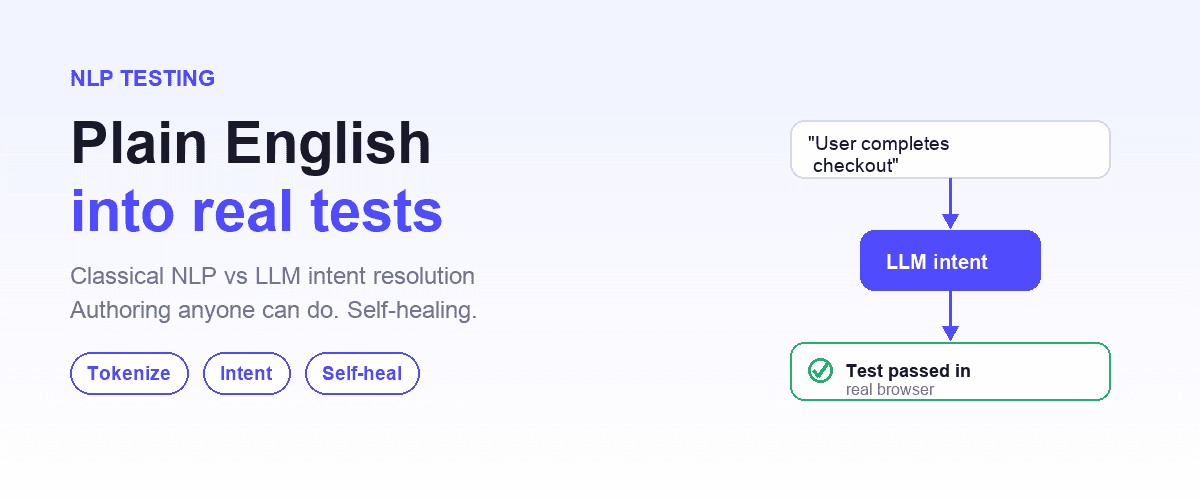
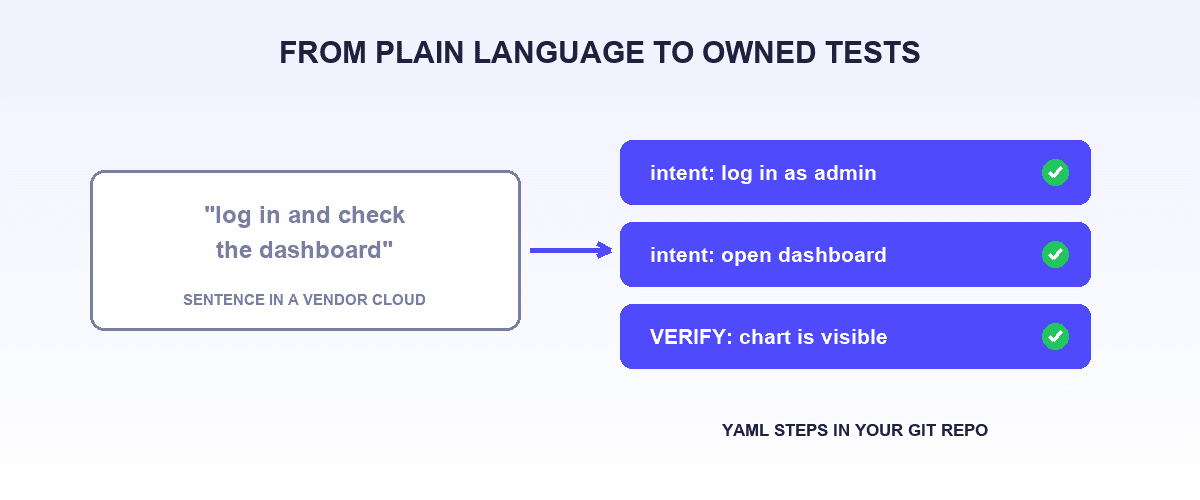
Shiplight AI is an agent-native end-to-end testing platform: tests are natural-language user intent in plain YAML committed alongside source in git, with an MCP server and Skills that install into Claude Code, Cursor, Codex, VS Code, and more in one line.
It delivers what plain-English testing promised, on the opposite architecture bet from a console platform, and that bet decides everything downstream.
Every strength below is a point where Shiplight is built differently from testRigor, with testRigor's position stated right after.
Strengths
- Tests in your git repo, not a vendor console. Shiplight tests are readable YAML committed beside your code, diffable and reviewed in the same PR as the feature. testRigor's suites live in its web console, so there is no repo copy to review, diff, or take with you, and Selenium conversion is available only under paid-customer agreements.
- Your coding agents author and heal, not a console for manual QA. Shiplight installs into the coding agents your team already uses; the agent that builds a feature verifies it in a real browser and writes the regression test in the same session, so coverage tracks code-generation throughput. testRigor is a console authored by QA staff from the pre-agent era; its MCP server wraps that console (agent-integrated), rather than putting tests in your repo where the agent works (agent-native).
- Built on Playwright, no lock-in, deterministic cached execution. The YAML transpiles to Playwright at run time, so it supports every Playwright browser, runs alongside an existing Playwright suite, and you can eject to plain Playwright anytime. Committed locators replay fast and cheap; AI re-resolves only when the UI changes, and cached steps call no LLM. testRigor runs on a proprietary cloud engine whose hosted runners draw recurring reports of nondeterministic failures, tests that fail then pass unchanged on re-run.
- A real code escape hatch when logic gets complex. For conditional, data-driven, or stateful steps, Shiplight drops to inline JavaScript in a YAML step, hand-tuned in a local debugger with screenshots and traces. testRigor's escape hatch is embedded ECMAScript 5.1 JavaScript invoked as strings.
- Real natural-language intent on a modern model. Shiplight tests state user intent and resolve it against a real browser; you are not shaping sentences to fit a grammar. testRigor's plain English, in their own words, "has some syntax to it": a constrained command language you learn, with an LLM translating free phrasing into a fixed set.
- Flexible infrastructure, and local runs with no account. Shiplight ships hosted CI runners, dashboards, and an LLM proxy for zero setup, and it also runs in your own CI with your own Anthropic, OpenAI, or Google keys (Azure, Bedrock, and Vertex included); the local MCP needs no account, so authoring costs nothing. testRigor authors, stores, and runs everything on its hosted infrastructure, one mode, with paid plan pricing you get by contacting sales.
- Enterprise: SOC 2, VPC, hosted CI runners, dedicated CSM.
Tradeoffs
- Web only: no native mobile or desktop testing, which testRigor covers.
- Assumes a repo workflow with at least one engineer or coding agent in the loop.
- Younger vendor with a smaller community.
Where it fits. Web teams shipping with AI coding agents that want tests owned like code, authored in the agent loop, and run on every PR. Full head-to-head: Shiplight vs testRigor. See also agent-first testing and the intent, cache, heal pattern.
2. Playwright: maximum developer control at lowest cost
Playwright is the full-control option: a free, open-source, code-first framework with excellent execution, tracing, and debugging. It is the opposite trade from plain English: maximum precision, engineering-only authoring.
At a glance
- Approach: Code-first open-source framework
- Test format: TypeScript/JavaScript (also Python, Java, C#) in your repo
- Pricing note: Free, open source
- Migration effort: Full rewrite into code; requires engineering ownership
- Designed for: Engineering-led teams that hit the precision ceiling of natural language
Pros:
- Precise, expressive, and free
- Tests in the repo, reviewed like code
- Cross-browser including Safari (WebKit); best-in-class open-source execution engine
Cons:
- Excludes the non-engineers who authored your testRigor suite
- Tests are selector-bound code: every UI refactor can break them, and the maintenance lands on engineers even when a coding agent writes the code
- No built-in self-healing or natural-language authoring
When to choose Playwright: complex validation logic broke the plain-English model and your engineers are ready to own a test codebase. If code itself is the barrier, see best Playwright alternatives.
3. Cypress: developer-friendly JS E2E testing
Cypress is a long-standing open-source E2E framework focused on developer experience: fast local runs, excellent debugging, a strong plugin ecosystem.
At a glance
- Approach: Code-first open-source framework
- Test format: JavaScript/TypeScript in your repo
- Pricing note: Free, open source (Cypress Cloud is a paid add-on)
- Migration effort: Full rewrite into code
- Designed for: JavaScript teams that want developer-friendly browser testing and own the maintenance
Pros:
- Excellent debugging and time-travel; fast local feedback
- Large community and plugin ecosystem
- Tests in the repo, reviewed like code
Cons:
- Same maintenance ceiling as Playwright: selector-bound code that engineers keep current
- Historically Chromium-focused; cross-browser support is improving but not native-parity
- No AI or natural-language authoring
When to choose Cypress: a JavaScript team wants developer-friendly E2E and accepts code ownership. See Playwright vs Cypress and best Cypress alternatives.
4. Managed QA services: outsource the suite entirely
A different answer to the authoring problem is to stop authoring at all. Managed QA services put the vendor's human engineers (assisted by AI tooling) in charge of building and maintaining your test suite, usually with a coverage agreement.
QA Wolf is the archetype: their team writes standard Playwright that lives and runs on their infrastructure, triages failures, and reports results. You buy the outcome, not a tool.
At a glance
- Approach: Fully managed QA service
- Test format: Typically Playwright, maintained by the vendor's team on their infrastructure
- Pricing note: Quote-only, priced as a staffed service
- Migration effort: A handoff; their team learns your product
- Designed for: Organizations that have decided QA is someone else's job
Cons:
- You are buying human hours, priced accordingly; coverage grows at the pace of the vendor's engineers
- Product context and testing knowledge accumulate with an external team, outside your repo and your heads
- No agent-native loop: the vendor's staff authors tests, not your coding agent, which points the opposite direction from an AI-native development workflow
When the managed-service model applies: plain-English authoring was an attempt to avoid owning tests, and you would rather not own them at all. That is a genuinely different buying decision from picking a tool. See Shiplight vs QA Wolf.
5. Vendor cloud consoles: structured authoring in the vendor's app
testRigor's own category has many members: platforms where your QA team builds tests in the vendor's web application via a recorder, a visual editor, or structured low-code steps, sometimes spanning web, mobile, API, and desktop from one console. Moving between them changes the authoring surface, not the ownership model.
At a glance
- Approach: Low-code or structured-step authoring in a vendor console
- Test format: Vendor-proprietary, resident in the vendor's cloud
- Pricing note: Typically quote-based or per-seat; runs metered on vendor infrastructure
- Migration effort: Re-authoring in the new console; formats do not transfer
- Designed for: Manual-QA-heavy organizations where non-engineers own testing and a governed console is the point
Pros:
- Accessible to non-engineers; no repo workflow required
- Often broader surface coverage (mobile, API, desktop) than web-focused tools
- Governed, centralized management for QA organizations
Cons:
- Tests live in the vendor's cloud, not your git repo; export paths are typically limited, lossy, or absent, so the next migration is another re-authoring
- Runs are metered or quote-priced on vendor infrastructure
- Agent integrations, where offered, drive the vendor's console rather than putting tests in your workflow: agent-integrated, not agent-native
When this category applies: authoring must stay accessible to non-engineers and console residency is acceptable. If the reason you are leaving testRigor is ownership, this category does not solve it. See low-code platforms for manual testers.
Comparison table
| Alternative | Tests in your repo? | Vendor lock-in | Whose agent authors tests? | Execution | Best for |
|---|---|---|---|---|---|
| Shiplight AI | ✓ (YAML) | None: YAML transpiles to Playwright, runs alongside an existing suite, eject anytime | Your coding agents (Claude Code, Cursor, Codex) via MCP + Skills | Deterministic cached replay; local runs with no account, hosted or your own CI | AI-coding-agent teams |
| Playwright | ✓ (code) | None (open source) | Your engineers, or agent tooling you assemble | Local or your CI, free | Developer control |
| Cypress | ✓ (code) | None (open source; parallelization via paid cloud) | Your engineers | Local or your CI | JS team E2E |
| Managed QA services | Knowledge lives with the vendor's team | Vendor infrastructure | The vendor's human engineers | Vendor infrastructure | Fully outsourced QA |
| Vendor cloud consoles | ✗ | High: proprietary formats, limited or no export | The vendor's console tooling | Metered runs on vendor infrastructure | Console-authoring QA orgs |
| testRigor (baseline) | ✗; Selenium conversion only under paid agreements | High: constrained DSL in their console | MCP wrapper drives the console, not your repo | Hosted runners; nondeterministic failures reported | Manual-QA-heavy orgs |
How to decide
Diagnose why plain English stopped working. The format got ambiguous: move toward code (Playwright, Cypress) or toward intent-based YAML that stays readable (Shiplight). Tests must live in your repo, reviewable and portable: Shiplight, Playwright, or Cypress. Nobody should own testing internally at all: a managed QA service.
Check your development workflow. If coding agents write meaningful amounts of your application code, test authoring should live in the same loop.
Shiplight is the only option on this list where the agent itself authors and maintains repo-resident tests; the code frameworks wait for an engineer, the managed services wait for the vendor's staff, and testRigor's MCP wrapper drives a console rather than writing files. See boost test coverage with agentic AI.
Confirm your platform surface. If you need mobile or desktop coverage in one tool, the vendor-console category covers those surfaces, with the ownership trade-offs above. Shiplight is web only. Web-only teams can pick from the whole list.
Where Shiplight is not the right fit
testRigor covers mobile and desktop; Shiplight is web only, so mobile-first teams should evaluate multi-platform tools instead of us. Teams with zero engineers should also look elsewhere: Shiplight's YAML is readable by anyone, and PMs review tests routinely, but the workflow assumes tests live in a repo with an engineer or coding agent in the loop.
And if your engineers already maintain a Playwright suite that genuinely works, keep it: Shiplight runs alongside Playwright, and the sensible entry point is new and hard tests, not a rewrite.
The bottom line
testRigor was designed for a specific organization: manual-QA-heavy, often without engineers in the testing loop, in the era before coding agents.
Shiplight is built for the opposite team, and the differences are structural:
- Tests in your git repo, instead of a vendor console.
- Your own coding agents authoring them, instead of QA staff in a web app.
- A runtime built on Playwright, with deterministic cached replay and local runs that need no account, instead of nondeterministic hosted runners.
- A real inline-code escape hatch, instead of ES5.1 strings.
If tests belong in your repo and your team ships with coding agents, evaluate Shiplight first. If accessibility for non-engineers in a vendor console is the constraint, that category exists, with the ownership trade-offs above. If nobody should own testing internally, managed QA services sell the outcome instead of a tool.
For the wider market, see the best E2E testing tools in 2026 and best AI testing tools in 2026.
Frequently Asked Questions
What is testRigor?
A cloud-hosted no-code platform from the pre-agent generation, built to make manual QA staff productive without engineers. Tests use a constrained plain-English command language, live in testRigor's console, and run on its hosted runners. Its MCP server wraps that console rather than putting tests in your repo.
What are the best testRigor alternatives?
Four approaches: Shiplight AI (natural-language YAML in your repo, agent-native, built on Playwright), Playwright and Cypress (open-source code), managed QA services (a vendor's engineers run your suite), and other vendor consoles. Which fits depends on why you are moving: ownership, precision, or an agent workflow.
Why do teams move away from testRigor?
Four patterns: tests live in the vendor's console with no repo copy, the command language gets ambiguous on data-driven logic, pricing is not published, and there is no agent-native workflow, so authoring cannot keep pace with agent-written code.
What is the best testRigor alternative for non-technical teams?
Other vendor consoles are built for that buyer: structured steps or a visual builder keep authoring accessible, and many cover mobile. But they keep tests in a vendor console, the same ownership model you are leaving. With an engineer or coding agent in the loop, Shiplight's YAML stays readable and lives in git.
Which testRigor alternative works with AI coding agents like Claude Code or Cursor?
Shiplight. It installs into Claude Code, Cursor, and Codex as MCP plus Skills, needing no account locally. The agent verifies UI changes in a real browser as it builds, then commits YAML tests to your repo. testRigor's MCP server wraps its console instead. See MCP for testing.
Is there a free testRigor alternative?
Playwright and Cypress are free and open source, at the cost of engineers maintaining selector-bound code. Shiplight runs locally with no account, Free is $0 forever and Pro is $60/month. testRigor advertises a free sign-up tier but does not publish paid pricing.
How does migration off testRigor work?
The format does not export self-serve, so every path re-authors the suite. What differs is who does it: humans re-recording flow by flow, or an agent rebuilding coverage from the app itself. With agentic authoring, teams typically cover core flows within the first weeks.
How does testRigor compare to Playwright or Cypress?
Opposite ends of the authoring spectrum. Playwright and Cypress are code: full control, full maintenance, in your repo. testRigor is plain-English commands in a vendor console: accessible to non-engineers, outside your repo. Shiplight takes both ends, natural-language YAML in git on a Playwright runtime.