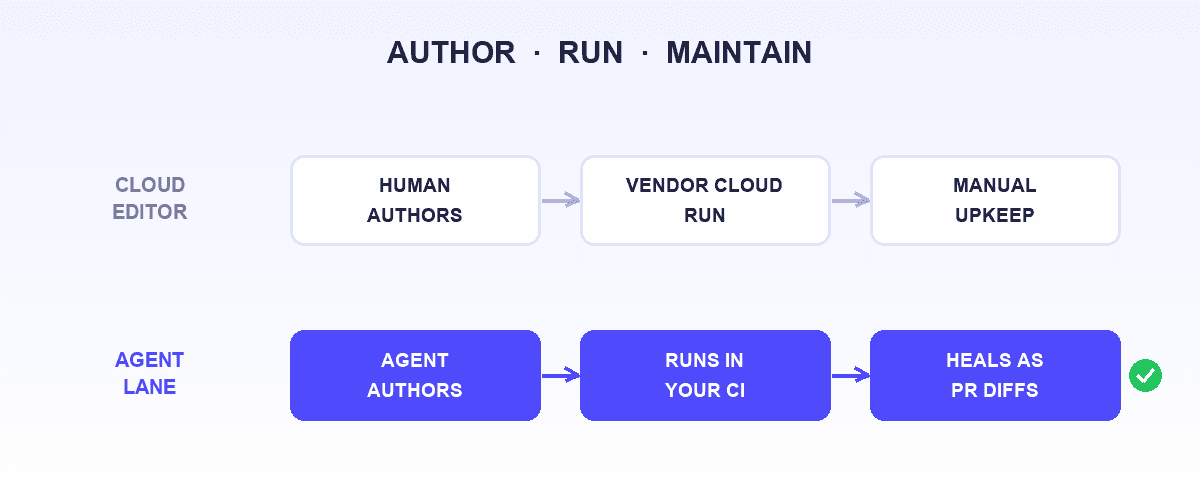
The leading Katalon alternative in 2026 is Shiplight, and four differences decide most evaluations. It runs in CI with no separate execution license, where Katalon gates headless and CI runs behind its separately licensed, paid Runtime Engine.
Its tests are readable YAML your own coding agents author, where Katalon authoring happens in Katalon Studio, a heavyweight desktop IDE built for QA engineers writing Groovy. Its tests are portable YAML that lives in your git repo, where a Katalon project is a proprietary format only Katalon runtimes execute, with no documented export path.
And it is built on Playwright, modern and cloud-native, where Katalon is Selenium-heritage desktop tooling from the pre-agent generation. That alternative is Shiplight, and the open-source frameworks, vendor consoles, and managed services below round out the field.
Why teams look for Katalon alternatives
Katalon is the incumbent all-in-one suite from the pre-agent IDE generation: you author in Katalon Studio, a desktop IDE with a recorder and Groovy/Java scripting, and the resulting project is a proprietary format only Katalon runtimes can execute. That model made sense when one QA team owned every test across web, mobile, API, and desktop.
The biggest shift since then, AI coding agents authoring tests during development, does not fit a studio-based workflow, and the execution license makes CI, the place teams run tests most, a paid add-on.
The four categories of alternative
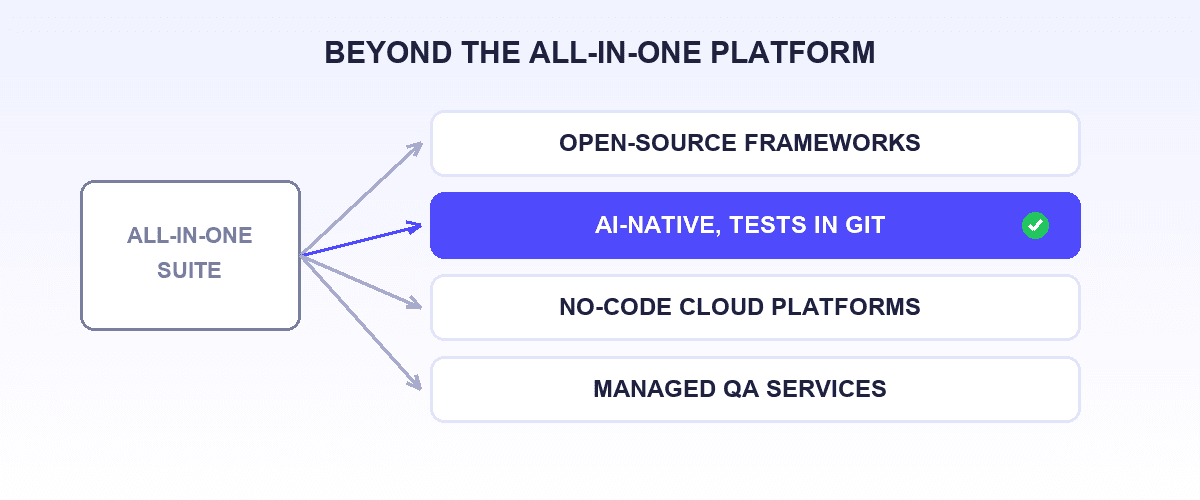
The alternatives fall into four categories: agent-native tools that keep portable tests in your git repo and let coding agents author them, open-source code frameworks that give engineers full control at zero license cost, vendor cloud consoles that keep the accessible studio authoring model with different economics, and managed services that take the whole problem off your plate.
Which category wins depends on who writes your tests, whether your team develops with AI agents, and where you want the tests to live.
This guide covers the approach, the test format, the migration effort, and an honest read on when each is the right choice.
One disclosure up front: we build Shiplight, so it is listed first. We will be honest about where each alternative is the better fit, including where Shiplight is not.
- Execution licensing. Authoring in Katalon Studio is free, but running tests headless or in CI requires the separately licensed, paid Runtime Engine on top of per-seat platform tiers. The cost scales with how much you run, not just how many people author.
- Proprietary project format. Studio projects are Groovy or Java plus recorded objects in Katalon's own layout. You can store them in git, but only Katalon runtimes execute them, so the tests are not portable code and leaving means re-authoring.
- AI-agent workflows. Teams building with Claude Code, Cursor, or Codex want the agent to author and run tests inside the dev session. Katalon's 2026 agent and MCP layer drives their platform instead: agent-integrated, not agent-native. The agent operates the vendor suite; it does not produce portable tests in your repo.
- Maintenance model. Katalon's self-healing is two-stage: fallback locators first, then an LLM pass. That absorbs routine changes, but recorded and scripted tests still bind to the DOM and need hands-on upkeep when the UI moves further.
If none of those apply, Katalon remains a capable multi-platform suite for mixed-skill teams.
The 7 best Katalon alternatives
1. Shiplight AI
Shiplight replaces studio-based authoring with agent-native testing on four axes where Katalon is weaker. Tests are readable YAML files that describe user intent, live in your git repo, and run locally with npx shiplight test, then gate CI with no separate execution license.
The Shiplight MCP server and Skills install into Claude Code, Cursor, Codex, VS Code, and 40+ other agents with one line, and the local MCP needs no account.
Your coding agent gets eyes and hands in a real browser: it verifies UI changes as it builds, then authors the regression tests as a byproduct.
Locators are a step-level cache committed to the repo, resolved through set-of-marks visual prompting with a vision-model fallback; when the UI changes, tests heal at run time and larger fixes arrive as reviewable PR diffs, never silent rewrites. See the intent, cache, heal pattern.
At a glance
- Approach: AI-native, agent-first, intent-based
- Test format: Portable YAML in your git repo
- Pricing note: Local runs need no account; CI runs need no separate execution license; Free $0, Pro $60/mo
- Migration effort: Re-authoring, but agentic: the agent walks your app and writes the suite, so first suites of a few hundred tests land in days to weeks
- Best for: Teams developing with AI coding agents that want tests owned like code
Pros:
- CI execution included, not a paid add-on. Run in your CI with no separate execution license, where Katalon's headless and CI runs require the separately licensed, paid Runtime Engine on top of per-seat tiers
- Your coding agents author readable YAML directly via MCP, where Katalon authoring lives in Katalon Studio, a heavyweight desktop IDE built for QA engineers writing Groovy (reviewers report crashes, lag, heavy memory use)
- Portable YAML in your repo: diffable, PR-reviewable, yours, where a Katalon project is a proprietary format only Katalon runtimes execute, with no documented export path
- Built on Playwright, modern and cloud-native: supports every Playwright browser and runs alongside an existing suite, where Katalon is Selenium-heritage desktop tooling from the pre-agent generation
- Intent-based healing as PR diffs, so you approve the fix, where Katalon's two-stage healing patches inside its own runtime
- Enterprise path: SOC 2, private cloud / VPC, hosted CI runners, dashboards, and first-party support, so you are not on your own
Cons:
- Web only: no native mobile, desktop, or standalone API testing
- Assumes a repo-based workflow; teams that want a pure visual studio will find vendor consoles easier
- Newer vendor with a smaller community than Katalon's
When to choose Shiplight: your team ships with AI coding agents and wants verification and regression coverage inside that loop. Read the direct Shiplight vs Katalon comparison for the head-to-head.
2. Playwright
Playwright is the strongest open-source browser automation framework: fast, cross-browser, with first-class tracing and debugging. Engineers write tests in TypeScript, JavaScript, Python, Java, or C#, and everything lives in the repo at zero license cost.
At a glance
- Approach: Code-first open-source framework
- Test format: TypeScript/JavaScript (also Python, Java, C#) in your repo
- Pricing note: Free, open source
- Migration effort: Full rewrite of Katalon tests into code; needs engineers who own the suite
- Best for: Engineering teams that want full control and no license cost
Pros:
- Excellent execution engine: auto-waiting, parallelism, trace viewer
- No per-seat fees, huge community, active development by Microsoft
- Tests are code in your repo, reviewed like any other change
Cons:
- Locator-bound tests break when the UI changes; the maintenance cost stays even when a coding agent writes the code
- No built-in self-healing loop
- Requires programming skill that manual testers may not have
When to choose Playwright: you have strong engineers, they have time to own a test codebase, and license cost matters more than authoring speed. If the barrier is code itself, see the no-code Playwright alternatives guide.
3. Cypress
Cypress pairs an MIT-licensed open-source test runner with an optional paid cloud for recording, parallelization, and flake analytics. Its in-browser runner and time-travel debugging give one of the best developer experiences in code-based testing.
At a glance
- Approach: Code-first framework plus optional cloud
- Test format: JavaScript/TypeScript in your repo
- Pricing note: App is free open source; Cypress Cloud has a free tier with paid plans above it
- Migration effort: Full rewrite into JavaScript; comparable to a Playwright migration
- Best for: JavaScript-centric teams that value debugging experience
Pros:
- Time-travel debugging and readable failure output
- Large ecosystem and mature documentation
- Cloud tier adds flake detection and analytics without changing the test code
Cons:
- JavaScript only; historically weaker cross-browser and multi-tab support than Playwright
- Same maintenance model as any selector-bound framework
- Cloud costs scale with test-result volume
When to choose Cypress: your app and your team are JavaScript-native and you want the best interactive debugging in the category. See Playwright vs Cypress for that trade-off in detail.
4. Selenium
Selenium is the longest-standing open-source browser automation project and the basis of the W3C WebDriver standard. It has the widest language support in the category (Java, Python, C#, JavaScript, Ruby, and more) and a mature grid ecosystem for distributing runs.
At a glance
- Approach: Code-first open-source framework (WebDriver standard)
- Test format: Code in Java, Python, C#, JavaScript, or Ruby in your repo
- Pricing note: Free, open source
- Migration effort: Full rewrite into code; the broad language support suits teams already invested in Java or Python
- Best for: Teams with existing Selenium skills or grid infrastructure, or language needs beyond the JS/TS mainstream
Pros:
- Open standard with the broadest language and browser coverage
- Enormous ecosystem: grids, wrappers, integrations built up over two decades
- Tests are code in your repo, portable across vendors and clouds
Cons:
- More assembly required than Playwright: waits, runners, and reporting are choices you make and maintain
- Selector-bound maintenance, with no built-in self-healing
- No agent authoring loop
When to choose Selenium: your team already has Selenium expertise or grid infrastructure, or you need a language Playwright and Cypress serve less well, and you accept owning the harness.
5. Appium
Appium is the open-source standard for mobile automation: WebDriver-based testing of native, hybrid, and mobile-web apps on iOS and Android, written as code in the language of your choice.
At a glance
- Approach: Code-first open-source mobile framework
- Test format: Code (WebDriver clients in multiple languages) in your repo
- Pricing note: Free, open source
- Migration effort: Rewrite of mobile flows into code
- Best for: Teams whose Katalon usage is primarily mobile and who want an open-source path for that surface
Pros:
- The de facto open standard for mobile test automation
- Tests are portable code in your repo, runnable on any device cloud
- Active community and broad device/OS coverage
Cons:
- Mobile-focused: it replaces Katalon's mobile surface, not the whole suite
- Code-based, with real setup and maintenance effort
- No self-healing or agent authoring loop
When to choose Appium: mobile is the surface you actually depend on Katalon for. Pair it with a web-testing decision made separately.
6. Vendor cloud consoles
Katalon's commercial rivals mostly answer the same brief with a cloud console: your QA team builds tests in the vendor's web application via a recorder, a visual editor, or a constrained plain-English command language, sometimes spanning web, mobile, and API from one platform.
At a glance
- Approach: Low-code or plain-English authoring in the vendor's web app
- Test format: Proprietary objects or structured steps in the vendor's cloud
- Pricing note: Typically quote-based, with metered or per-parallel runs on vendor infrastructure
- Migration effort: Re-authoring in each vendor's model; conceptually familiar for Katalon users
- Designed for: Manual-QA-heavy organizations where non-engineers own testing and a governed console is the point
Honest limits (our axes):
- Tests live in the vendor's cloud, not your git repo; export paths are typically limited, lossy, or absent, so the lock-in problem that motivated leaving Katalon comes back in a new shape
- Runs are metered or quote-priced on vendor infrastructure
- Agent integrations, where offered, drive the vendor's cloud rather than putting tests in your workflow: agent-integrated, not agent-native
Where they fit: teams that want Katalon's accessible, multi-platform authoring model without the desktop IDE, and accept console-resident tests as the trade.
7. Managed QA services (QA Wolf)
A different answer is to stop operating testing software at all. Managed QA services put the vendor's human engineers, assisted by AI tooling, in charge of building and maintaining your suite. QA Wolf is the archetype: their engineers write standard Playwright that lives and runs on their infrastructure, and triage failures before you see them.
At a glance
- Approach: Staffed service, not software you operate
- Test format: Standard Playwright, written and maintained by the vendor's engineers on their infrastructure
- Pricing note: You are buying human hours; quote-based
- Migration effort: A handoff, not a migration; their team learns your product
- Designed for: Teams outsourcing E2E testing entirely, with no internal QA ownership planned
Honest limits (our axes):
- Coverage grows at the pace of the vendor's engineers, not your shipping speed
- Testing knowledge accumulates outside your walls, in the vendor's team rather than your repo and your heads
- No MCP for coding agents: the loop where your agent authors and runs tests does not exist here
Where it fits: teams that have decided QA is someone else's job and want a staffed service with a human in the loop. See Shiplight vs QA Wolf.
Comparison table
The axes below are the buying criteria where Katalon's design center is weakest: who authors, whether tests are portable in your repo, whether CI needs a paid execution license, and the engine underneath.
| Tool | Who authors, and how | Test format and ownership | CI execution | Engine | Self-healing |
|---|---|---|---|---|---|
| Shiplight | Your coding agents write readable YAML via MCP + Skills | Portable YAML in your git repo | Included, no separate license | Built on Playwright | Yes, heals as PR diffs |
| Playwright | Engineers write code | Code in your repo | Free, open source | Own engine (cross-browser) | No |
| Cypress | Engineers write code | Code in your repo | Free; optional paid cloud | Own runner | No |
| Selenium | Engineers write code | Code in your repo | Free, open source | WebDriver standard | No |
| Appium | Engineers write code (mobile) | Code in your repo | Free, open source | WebDriver standard | No |
| Vendor cloud consoles | QA in a low-code / DSL web app | Proprietary, vendor cloud | Metered runs on vendor infra | Vendor runtime | In their cloud |
| Managed QA (QA Wolf) | The vendor's engineers | Playwright on their infra | On their infra, human hours | Playwright | Human-maintained |
| Katalon (baseline) | QA engineers in Katalon Studio (recorder + Groovy/Java desktop IDE) | Proprietary project, Katalon-runtime-only, no documented export | Requires the paid Runtime Engine on per-seat tiers | Selenium-heritage desktop tooling | Two-stage: fallback locators, then LLM |
How to decide
Work through three questions in order:
1. Who writes and owns the tests, and where do they live? Engineers or coding agents authoring tests that live in your repo: Shiplight, Playwright, Cypress, or Selenium. A vendor console with visual or structured-language authoring: that category serves manual-QA organizations, with console-resident tests as the trade. Nobody internal: a managed QA service.
2. Do you develop with AI coding agents? If Claude Code, Cursor, or Codex is in your stack, Shiplight is the only option here where the agent authors and maintains tests through MCP inside the dev session.
Katalon's own agent layer drives Katalon's platform, which is a different loop. If agents are not in your workflow, weigh cost and skills instead.
3. What platforms must you cover? Web only: any option works. Mobile in the open-source model: Appium. Mobile and web under one commercial roof: a multi-platform vendor console, or keep Katalon for those surfaces and modernize web testing separately.
Where Shiplight is not the right fit
Honest scope, because it matters more on a comparison page than anywhere else. Shiplight is web only, so mobile-first teams should look at Appium or a multi-platform vendor console, or keep Katalon for mobile. Teams that specifically want an all-in-one manual-plus-automation management console are better served by that category.
And if your engineers already run a Playwright suite that genuinely works and is not their bottleneck, you do not need us to replace it; Shiplight is built on Playwright and runs alongside an existing suite, so the sensible entry point is new and hard tests, not a rewrite.
The bottom line
Katalon earned its place as the all-in-one studio for mixed-skill QA teams, and for multi-platform coverage under one roof it still holds up. But the center of gravity has moved: tests as portable code or intent in the repo, and increasingly, AI agents as the authors.
Engineering-led teams should start with Playwright, Cypress, or Selenium if license cost rules, Shiplight if they build with coding agents.
Teams that need the all-in-one model without the desktop IDE should look at a multi-platform vendor console, knowing the tests stay in that vendor's cloud. For the wider market view, see the best E2E testing tools in 2026 and best AI testing tools in 2026.
And if you want to see agent-authored coverage on your own app, book a walkthrough and we will map a migration path from your Katalon suite.
Frequently Asked Questions
What are the best Katalon alternatives?
Shiplight leads for teams shipping with AI coding agents: CI-ready, portable YAML in your repo, authored by your agents via MCP, built on Playwright, with no separate execution license. Playwright, Cypress, and Selenium are the open-source frameworks for engineering-led teams; Appium covers mobile. The right one depends on who authors tests and which platforms you cover.
Why do teams switch away from Katalon?
The most cited reasons: headless and CI execution requires the separately licensed, paid Runtime Engine, so cost scales with how much you run; tests are Groovy/Java in a proprietary format only Katalon runtimes execute, so they are not portable; and Katalon's agent and MCP layer drives their platform rather than letting your agent author portable tests in your repo.
It is agent-integrated, not agent-native.
What is the best free Katalon alternative?
Playwright. It is free, open source, and a stronger execution layer for pure web automation, with no paid engine to run headless or in CI. Cypress, Selenium, and Appium (mobile) are the other strong free options.
Note Katalon's own free tier: authoring in Studio is free, but headless and CI execution is where the paid Runtime Engine license comes in, exactly where open-source frameworks cost nothing.
Which Katalon alternative works best with AI coding agents like Claude Code or Cursor?
Shiplight. It installs into Claude Code, Cursor, Codex, and more as an MCP server plus Skills, and the local MCP needs no account. The agent verifies UI changes in a real browser while building, then authors YAML regression tests committed to your repo. Katalon's agent and MCP layer operates Katalon's platform instead. See MCP for testing.
Can I migrate from Katalon to Playwright?
Yes, but it is a rewrite, not a conversion: Groovy tests and the object repository do not translate mechanically into Playwright. Most teams migrate incrementally, writing new coverage in the new tool and retiring Katalon tests as features change. Agentic authoring shortens this: with Shiplight, the agent rebuilds core-flow coverage from the app itself.
Which Katalon alternative is best for mobile testing?
Appium, if you want the open-source path: it is the WebDriver-based standard for iOS and Android automation. If you want mobile and web under one commercial roof with console authoring, a multi-platform vendor console serves that model. Shiplight, Playwright, and Cypress are web-focused, so mobile-first teams should shortlist the mobile options first.