

AI automates regression testing in five areas:
- Generating regression tests from prompts, specs, or app exploration.
- Self-healing tests when selectors break.
- Intelligent visual regression that ignores harmless noise.
- Risk-based prioritization that runs only the tests a change can affect.
- Autonomous failure triage that classifies real bugs from flaky ones and infrastructure noise.
The highest-ROI move is not "AI replaces QA": it's cutting maintenance and expanding coverage while humans stay on exploratory testing and risk judgment.
Shiplight covers areas 1, 2, and 5 with intent-based, self-healing tests authored by your coding agent and run in a real browser.
Regression testing is where most QA time goes and where most automation rots: a suite that worked last quarter is half-broken this quarter because the UI changed and nobody updated the selectors. AI changes the economics: not by replacing the tester, but by removing the repetitive parts (authoring, repair, triage) so humans do the parts machines are bad at.
This guide is the practical how-to: the architecture, the five areas, the stack by team size, a working Playwright workflow, and an honest account of where AI still fails.
A practical architecture for AI-driven regression testing
Code change / PR
   ↓
CI/CD pipeline (GitHub Actions, GitLab, Jenkins)
   ↓
AI-assisted regression suite
   ├─ Unit tests
   ├─ API tests
   ├─ UI / E2E tests
   ├─ Visual regression tests
   └─ AI-generated edge-case tests
   ↓
AI triage + flaky-test analysis
   ↓
Slack / Jira / GitHub comments
The principle: combine deterministic automation with AI-assisted intelligence. Deterministic tests give you a reliable gate; AI reduces the cost of building and maintaining that gate. Treating AI as the whole pipeline (no deterministic backbone) is the common failure mode.
The 5 ways AI automates regression testing
1. AI-generated regression tests
LLMs generate unit, API, end-to-end, and edge-case tests, plus test data and mock payloads, from a natural-language description:
Generate Playwright regression tests for:
- login
- forgot password
- session expiration
- invalid credentials
- MFA flow
This works best for CRUD apps, dashboards, forms, APIs, and repetitive workflows. 2026 research finds AI-generated tests can reach coverage comparable to human-written tests in many repositories, but generated tests still need human review for correctness and business context. See what is AI test generation and AI testing tools that automatically generate test cases.
2. Self-healing UI tests
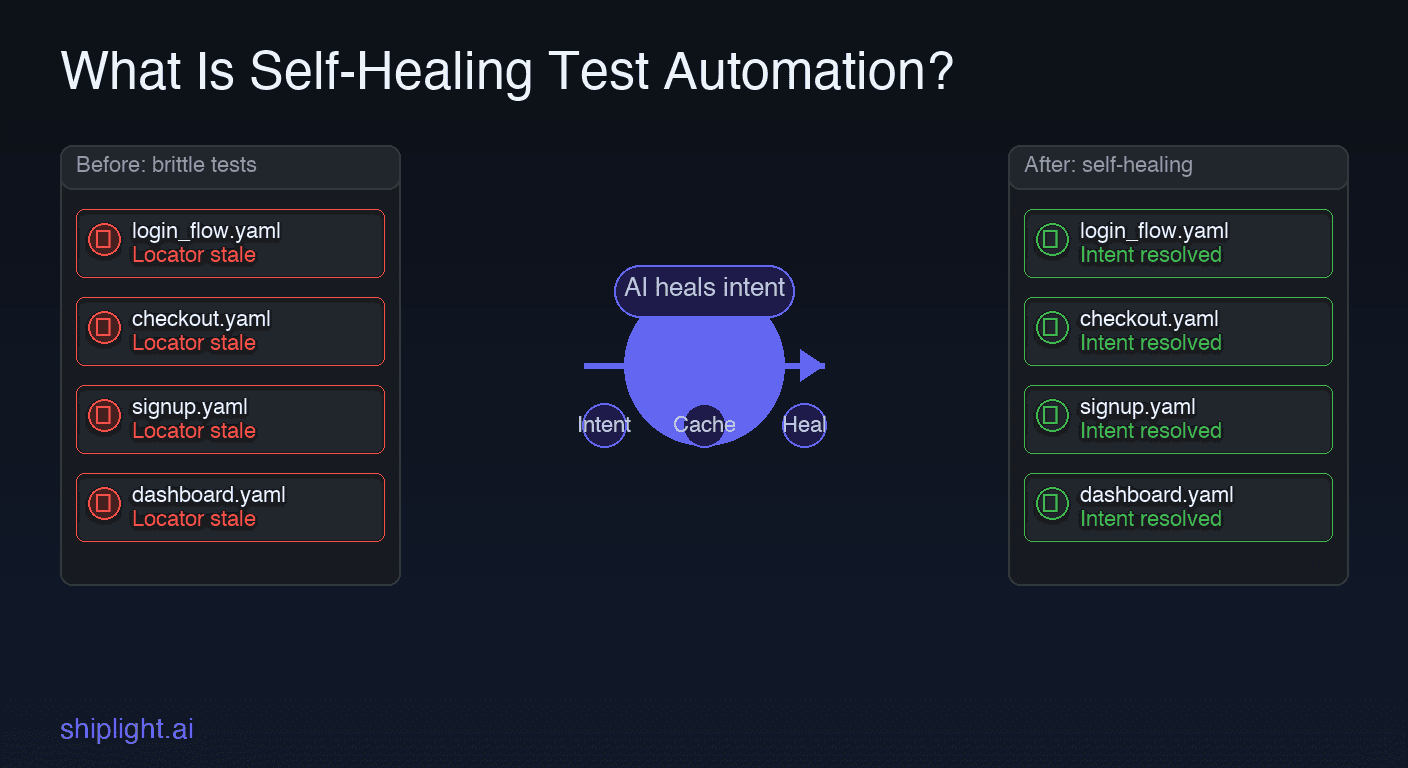
Selector-bound tests break constantly because the DOM changes. AI self-healing infers element intent, recovers broken locators using DOM context and visual matching, and continues instead of failing. Instead of driver.find_element(By.ID, "submit-btn") breaking on a refactor, the system still finds the button by label, nearby semantic structure, or visual similarity.
This is the most mature AI-testing capability today and the single biggest maintenance reducer. See what is self-healing test automation and self-healing vs manual maintenance.
3. Intelligent visual regression
Pixel-diff visual testing drowns teams in false positives. AI visual regression compares semantic appearance: ignoring harmless layout noise while catching broken layouts, missing components, color/font issues, and responsive breakage. Common approaches: Playwright screenshots, Percy, Chromatic, Applitools Eyes. AI-based semantic filtering is becoming standard for frontend-heavy apps.
4. Risk-based test prioritization
Running 5,000 tests on every commit is waste. AI analyzes changed files, historical failures, dependency graphs, and commit patterns, then runs only the most relevant subset (e.g., the 200 tests a change can actually affect). This is the AI form of Test Impact Analysis and the biggest CI-speed lever. Gate the full suite nightly; gate the risk-weighted subset per PR.
5. Autonomous failure triage
After a regression run, AI classifies each failure (real bug, flaky test, infra issue, timeout, selector break, dependency outage) and can generate root-cause summaries, Jira tickets, and suggested fixes. This removes the "investigation tax" that makes red CI expensive. See from flaky tests to actionable signal.
Recommended stack by team maturity
Team size predicts less than development model here: a 30-person team shipping daily with AI coding agents has regression needs closer to a 300-person one than to a 30-person team on quarterly releases. With that caveat:
| Team | Stack | Add |
|---|---|---|
| Small / startup | Playwright + GitHub Actions + LLM-generated tests + visual snapshots | Engineers write tests themselves; keep it lean. Shiplight if the team ships with AI coding agents |
| Mid-size SaaS | Above + AI test maintenance + visual regression + flaky-test detection | Shiplight if tests must live in your repo with agent authoring; vendor-console low-code platforms if QA staff author in a hosted suite; Applitools Eyes for the visual layer |
| Enterprise | Playwright/Cypress + AI visual validation + autonomous triage + risk-based execution + analytics | Agentic workflows, spec-to-test generation, AI coverage analysis. Shiplight runs enterprise deployments (SOC 2, VPC, hosted CI runners, dedicated CSM) |
For AI-native teams (code written by AI coding agents), add an intent-based, agent-authored layer so regression coverage arrives with each feature instead of a sprint later.
An AI-assisted Playwright workflow
Step 1: Generate tests. Use an LLM to scaffold baseline regression tests from a prompt (e.g., checkout: add item, remove item, apply coupon, failed payment, successful order). Review them.
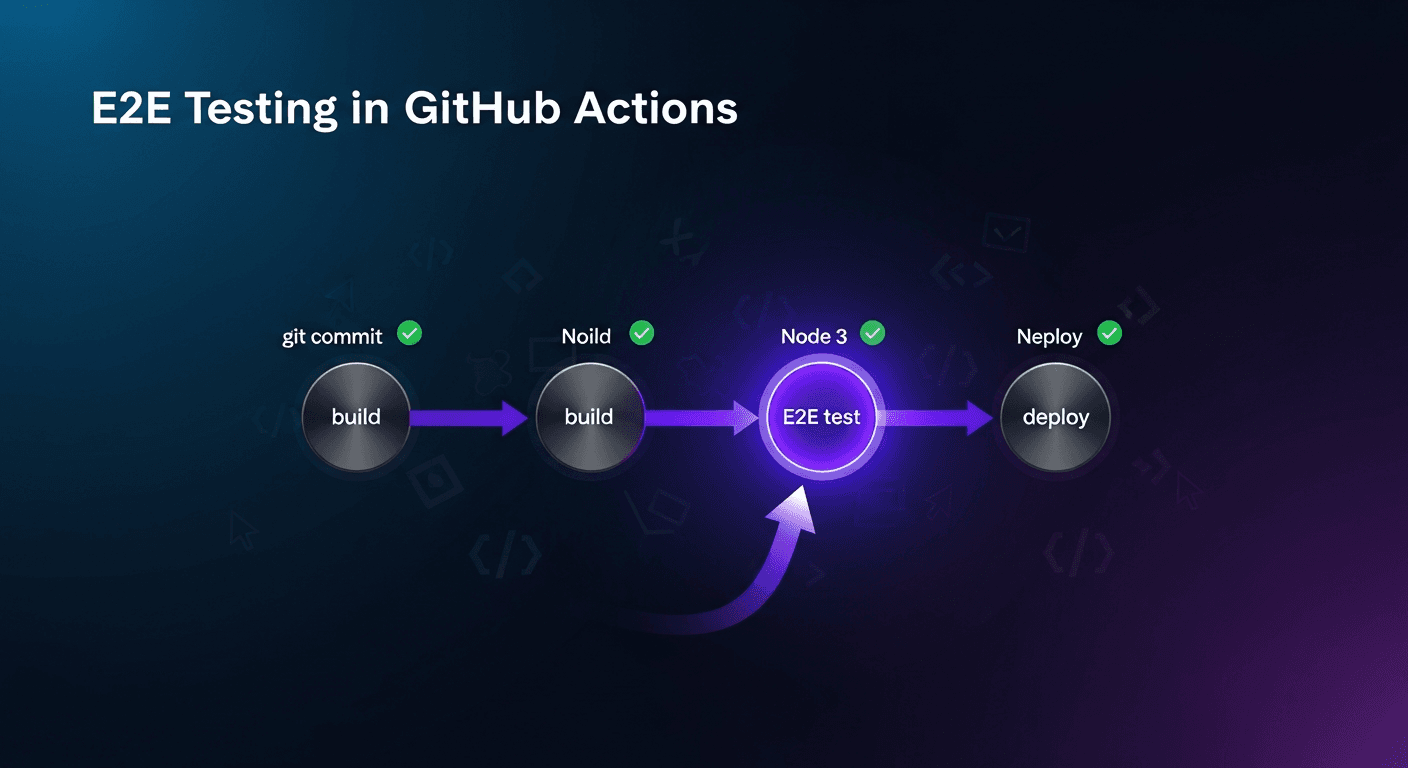
Step 2: Run in CI. A minimal GitHub Actions job:
name: Regression Tests
on: [push, pull_request]
jobs:
  test:
    runs-on: ubuntu-latest
    steps:
      - uses: actions/checkout@v4
      - uses: actions/setup-node@v4
      - run: npm install
      - run: npx playwright test
Step 3: Add visual testing. await expect(page).toHaveScreenshot(); catches visual regressions automatically.
Step 4: AI failure summaries. Send stack traces, screenshots, and logs to an LLM for root-cause explanation, flaky-test detection, and probable-fix suggestions.
See E2E testing in GitHub Actions for the full CI wiring.
What AI does well, and where it still fails
Strong: regression testing, test generation, visual validation, test maintenance (self-healing), failure triage, repetitive workflows.
Weak: exploratory testing, genuinely novel edge cases, business-context validation, UX intuition, security reasoning without guidance.
The consistent finding across teams: the best outcomes come from AI automation + experienced QA, not AI replacing QA. Automate the repetitive regression mass; keep humans on the judgment work. See the QA role in the AI era.
Adoption strategy
Phase 1: Stabilize existing automation. Playwright/Cypress + CI + screenshot testing. Do not jump straight to "fully autonomous QA."
Phase 2: Add AI augmentation. Test generation, self-healing, flaky-test analysis, AI failure summaries.
Phase 3: Add intelligence layers. Risk-based execution, autonomous triage, spec-driven testing, AI-generated edge cases.
This sequence avoids the most common mistake: adopting autonomous AI QA before the deterministic backbone is stable.
Where Shiplight fits
Shiplight implements areas 1, 2, and 5 directly, built for AI-native teams:
- AI-generated, intent-based regression tests: authored as natural-language intent (no selectors), so generation and maintenance are the same artifact. See from natural language to release gates.
- Self-healing in a real browser: tests re-resolve intent against the live DOM on UI change instead of breaking; verification runs in a real browser, not a mock.
- Agent-authored via MCP: the AI coding agent that wrote the feature also writes and runs its regression test in the same session, so coverage scales with code change rather than QA typing speed. See boost test coverage with agentic AI.
Honest scope: Shiplight targets the E2E/UI regression layer. Pair it with unit/API tests (deterministic backbone), and add a dedicated visual tool (e.g., Applitools) if pixel-level visual regression is a primary concern: Shiplight is functional-intent first. It augments QA; it does not remove the need for human exploratory testing and risk judgment.
Frequently Asked Questions
How do I automate regression tests with AI?
Automate across five areas: generate tests from prompts or specs; self-heal so selector changes don't break tests; use AI visual regression that filters noise; apply risk-based prioritization so each PR runs only affected tests; and use autonomous triage to classify failures. Keep a deterministic backbone in CI and layer AI on top, aiming for lower maintenance and higher coverage.
Does AI replace manual regression testing entirely?
No. AI is strong at regression, test generation, visual validation, maintenance, and triage, but weak at exploratory testing, novel edge cases, business-context validation, UX intuition, and unguided security reasoning. The best outcomes come from combining AI automation with experienced QA engineers: AI handles the repetitive regression mass; humans handle judgment. Treat AI as augmentation, not replacement.
What tool should I use to catch frontend regressions automatically?
Use one functional layer and one visual layer. A behavior-level tool like Shiplight replays your critical flows in a real browser on every PR and self-heals as the UI evolves; a visual tool like Percy or Applitools flags rendering changes those flows do not assert on. The full comparison is in Best UI Regression Testing Tools.
What's the biggest ROI use of AI in regression testing?
For most teams, self-healing test maintenance plus AI-generated test scaffolding. Self-healing eliminates the dominant cost (selector-bound tests breaking on every UI change: historically 40–60% of QA effort), and AI generation removes the authoring bottleneck. Risk-based prioritization is the next lever because it cuts CI time by running only the tests a change can affect rather than the entire suite.
How does AI prioritize which regression tests to run?
AI analyzes the change (changed files, dependency graph), historical failures, and commit patterns to estimate which tests a change can affect, then runs that risk-weighted subset on the PR instead of the full suite: the AI form of Test Impact Analysis. The full suite still runs on a schedule so nothing is permanently skipped.
What AI regression testing stack should a small team use?
Playwright for E2E, GitHub Actions for CI, LLM-generated test scaffolding, and screenshot/visual snapshots, with AI failure summarization. This is the highest-ROI lean setup when engineers write their own tests. Add AI test maintenance (self-healing) and dedicated visual regression (Applitools/Percy/Chromatic) as the suite and team grow; add autonomous triage and risk-based execution at enterprise scale.
Can AI regression tests run in CI/CD?
Yes: AI-generated and self-healing tests run in standard CI/CD (GitHub Actions, GitLab, Jenkins) exactly like any other tests when they output to a standard engine. A typical pipeline runs unit/API/E2E plus AI-generated edge cases, then an AI triage step that posts root-cause summaries to Slack/Jira/GitHub. Deterministic tests provide the gate; AI reduces cost around it.
Related posts

Engineering
30-Day Playbook: Replacing Manual Regression with Agentic E2E
Mar 25, 2026 · 6 min read
AI Testing
Boost Test Coverage with Agentic AI
May 12, 2026 · 11 min read
Testing Concepts
What Is Self-Healing Test Automation
Apr 1, 2026 · 10 min read
Engineering
From Flaky Tests to Actionable Signal
Mar 25, 2026 · 8 min read
Guides
E2E Testing in GitHub Actions
Apr 7, 2026 · 11 min read
AI Testing
Test-driven development in the AI era
Jul 14, 2026 · 9 min read
Engineering
Regression risk in AI-generated code
Jul 14, 2026 · 8 min read