

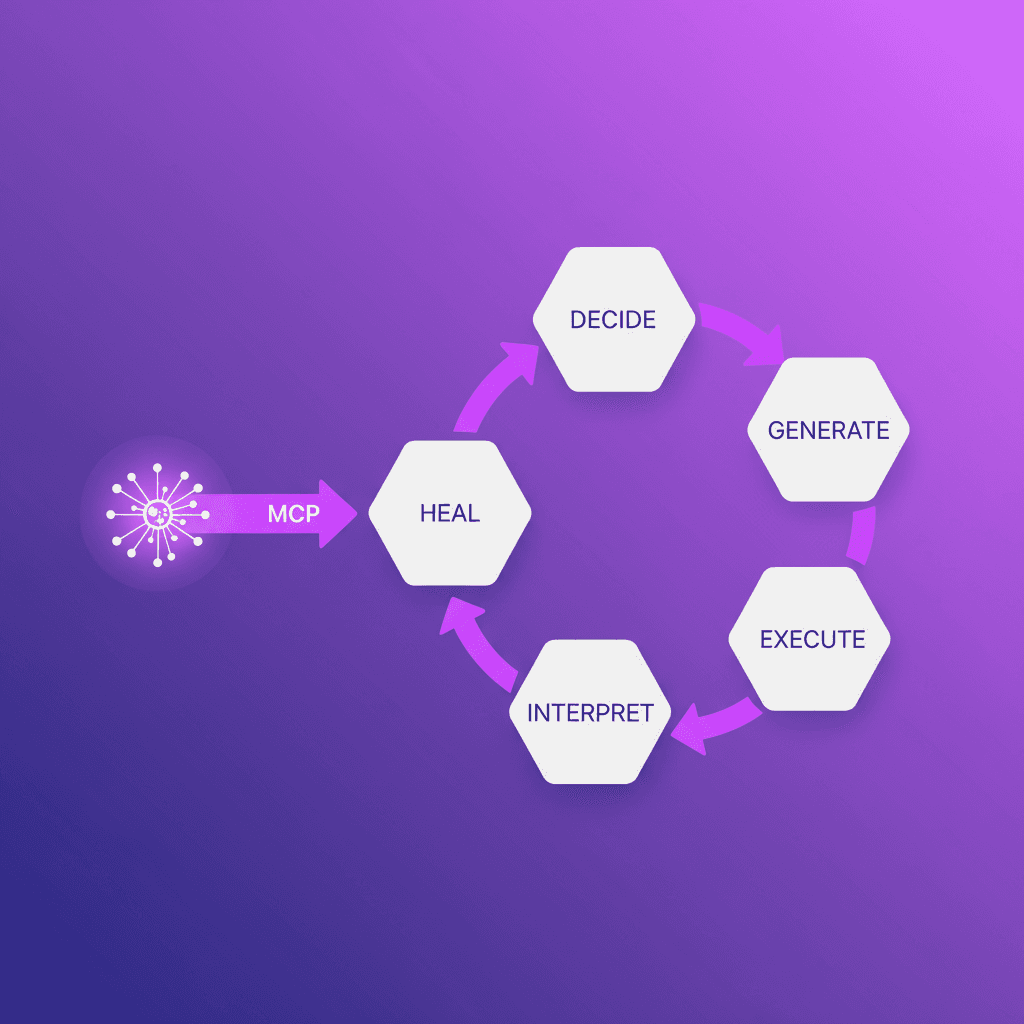
The best autonomous testing tools in 2026 are the ones where the loop actually closes without a human in each step: an agent decides what to test, authors the test, runs it, interprets the failure, and heals or escalates.
Shiplight AI leads that definition for teams shipping with coding agents. The agent authors intent-based YAML tests in your git repo, verifies its own changes in a real browser, and self-healing plus PR-diff triage keeps the suite alive with humans only in review. Playwright's first-party Test Agents bring the same loop shape to open-source code.
Browser-agent frameworks like BrowserUse close exploratory loops but not regression ones. Most other tools using the word autonomous mean AI-assisted steps inside a human-driven or vendor-driven loop, which is a different thing.
What autonomy requires, mechanically
Autonomy is the most abused word in testing right now. The label costs nothing to print, so recorders with AI-suggested locators, consoles that translate English into fixed command sets, and managed services staffed by human engineers all ship the same homepage adjective. Buying on the label gets you AI-flavored tooling with the same old human bottleneck inside.
There is a checkable definition. An autonomous testing system closes the loop: it decides what needs testing, authors the test, executes it, interprets the result, and repairs or escalates, with humans reviewing outcomes rather than performing steps.
An agent without eyes cannot close its own loop, which is why real autonomy always rests on feedback surfaces: a real browser, a verifier, a gate.
That framing, not the adjective, is what this guide compares tools against. We build Shiplight, so it is listed first, and each entry states plainly which parts of the loop it actually closes.
Four capabilities, all checkable in a tool's docs:
- Autonomous authoring. New tests from intent, specs, or observed behavior, not recorded clicks. Teams practicing spec-driven development already hold the input this step wants.
- Grounded execution. A real browser the system drives itself, with artifacts (screenshots, traces) it can read back.
- Failure interpretation. Distinguishing app bug from test drift from environment noise, because the expensive part of a failure is the ambiguity, not the fix.
- Self-repair with human review. Healing that preserves intent, surfaces as reviewable diffs, and never silently rewrites what the test means. What is self-healing test automation? covers the mechanics.
A system with three of the four is a good assistant. All four is autonomy.
The Best Autonomous Testing Tools in 2026
1. Shiplight AI: the closed loop, in your repo
Shiplight closes the full loop with your own coding agents as the driver.
The agent gets eyes and hands in a real browser through Shiplight's MCP server and Skills:
/shiplight verifyconfirms UI changes look right as it builds./shiplight create-yaml-testshas it walk the app and author E2E tests as readable YAML in your repo./shiplight fixreproduces failures, diagnoses root cause, and repairs the test, or reports the bug when the app itself is broken.
That last distinction is failure interpretation working as designed.
Maintenance autonomy is cache-first: deterministic steps replay at full Playwright speed with no model call, misses re-resolve from intent at run time with the fix propagating immediately, and larger changes arrive as PR diffs a human reviews.
Coverage grows as a byproduct of shipping: one Head of QA went from ~60% of time on Playwright authoring and maintenance to about zero in a month, and first suites of ~300 tests typically land within a week.
Tests transpile to Playwright, run beside an existing suite, and eject anytime, so the autonomy never becomes a hostage situation. Free $0 forever with every core feature; Pro $60/month; Enterprise contract with SOC 2, and VPC. Scope: web E2E.
2. Playwright Test Agents: open-source loop on code
Playwright's first-party planner, generator, and healer agents close an authoring-and-repair loop over plain Playwright code, free. The honest trade: the artifact is selector-bound TypeScript, so the maintenance tax that healing does not catch lands on your engineers, and the loop runs where you wire it, not out of the box.
The right baseline for teams that want zero vendors; see Shiplight vs Playwright for where the line falls.
3. Playwright MCP: the autonomy primitive
Playwright MCP gives any MCP-capable coding agent a browser. It is not a testing product, it is the limb the loop needs: no suite, no healing, no verdicts. Teams building custom agent loops start here; teams that want the loop already built buy a platform on top of it.
4. BrowserUse: autonomous exploration, not regression
BrowserUse sends LLM agents after natural-language goals in a browser and genuinely closes exploratory loops: find, attempt, adapt. What it does not produce is a deterministic regression suite; each run re-decides, so it complements a suite rather than being one.
5. Stagehand: AI actions inside deterministic code
Stagehand adds act, extract, and observe primitives to Playwright code, closing small in-test loops where selectors would be brittle while your code keeps the structure deterministic. A strong library for engineers building their own harness; not itself a system that authors or maintains suites.
6. Vendor consoles with autonomous labels: read the loop, not the label
The pre-agent platform generation (plain-English DSLs, recorders, low-code clouds) now markets autonomy widely.
The checkable pattern: authoring happens in their console through a human, tests live on their platform, and the AI assists steps inside that human loop. testRigor is the representative example: a constrained English DSL in a vendor cloud, genuinely accessible to manual-QA teams, and a different architecture from an agent authoring tests in your repo.
If a console fits your team shape, evaluate it as assisted automation on our axes: who authors, where tests live, what exports.
7. Managed services with autonomous labels: humans in the loop by design
Coverage-as-a-service vendors such as QA Wolf deliver real outcomes, but operationally a staffed service is the opposite of autonomy: their engineers, AI-assisted, are the loop. That can be the right purchase; it should not be bought as autonomous testing. The full comparison of that model is in best QA Wolf alternatives.
8. Enterprise agentic add-ons: metered autonomy on incumbent cores
The enterprise incumbents (Tricentis Tosca, ACCELQ, Virtuoso QA) are attaching agentic authoring layers to console-native cores, typically credit-metered and scoped to specific app technologies. For packaged-app estates with manual-QA organizations these platforms remain the realistic option, and their agentic layers are worth a scoped pilot; for product-engineering teams the architecture underneath is still the console.
Quick comparison
| Tool | Authors tests? | Interprets failures? | Heals with review? | Artifact you own |
|---|---|---|---|---|
| Shiplight | Yes, your agent, from intent | Yes, bug vs test vs env | Yes, cache + PR diffs | YAML in repo, transpiles to Playwright |
| Playwright Test Agents | Yes, agent-assisted | Partial | Yes, on code | Playwright code in repo |
| Playwright MCP | No (primitive) | No | No | n/a |
| BrowserUse | Exploratory only | Partial | n/a | No suite artifact |
| Stagehand | No (library) | No | Step-level | Playwright code in repo |
| Vendor consoles | In-console, human-driven | Platform features | Platform features | Console-resident |
Final Verdict
Buy the loop, not the label. If a vendor's autonomy cannot be traced in their docs to autonomous authoring, grounded execution, failure interpretation, and reviewable self-repair, you are buying assistance, which is fine, at assistance prices. If you ship with coding agents and want the loop closed today, start free with Shiplight or book a demo.
Frequently Asked Questions
What are the best autonomous testing tools?
Judged by who closes the loop: Shiplight AI (your coding agent authors, runs, interprets, and heals E2E tests in your repo), Playwright Test Agents for the open-source equivalent on code, and BrowserUse for autonomous exploration. Most other tools using the label mean AI-assisted steps inside a human or vendor loop.
What is the difference between autonomous and agentic testing?
In practice they point at the same bar: an agent, not a human, both authors and maintains the tests. Agentic emphasizes the driver; autonomous emphasizes the closed loop. Our agentic QA tools guide applies the same test to a wider field.
Can testing ever be fully autonomous, with no humans?
The loop can run without humans per step; judgment should stay human. The mature setup keeps people at two points: reviewing healed tests as PR diffs, and deciding what matters enough to gate a release. See the QA role in the AI era.
Is self-healing the same as autonomous testing?
No, it is one quarter of it. Healing repairs known tests; autonomy also authors new ones, runs them, and interprets failures. A tool with healing alone is maintenance automation; see self-healing vs manual maintenance.
How do autonomous tools handle flaky failures?
The good ones treat ambiguity as the product: separate app bugs from test drift from environment noise before anyone looks. Shiplight's fix workflow reproduces the failure first and reports an app bug rather than editing the test around it. Background: how to fix flaky tests.
Do autonomous testing tools work with AI coding agents?
The real ones are built for it, because the coding agent is the natural author: it knows the change it just made. Shiplight installs into Claude Code, Cursor, Codex, and more; see best AI QA tools for coding agents.
Related posts
AI Testing
Agent-native autonomous QA
Apr 6, 2026 · 10 min read
Guides
Best agentic QA tools in 2026
Apr 6, 2026 · 18 min read

Guides
Best AI QA tools in 2026
Aug 3, 2026 · 7 min read
Engineering
Agents with eyes
Apr 10, 2026 · 7 min read

Engineering
The intent cache-heal pattern
Mar 25, 2026 · 7 min read

Engineering
CI/CD for agent-written code
Jul 14, 2026 · 9 min read
Guides
Best Momentic alternatives
May 15, 2026 · 11 min read