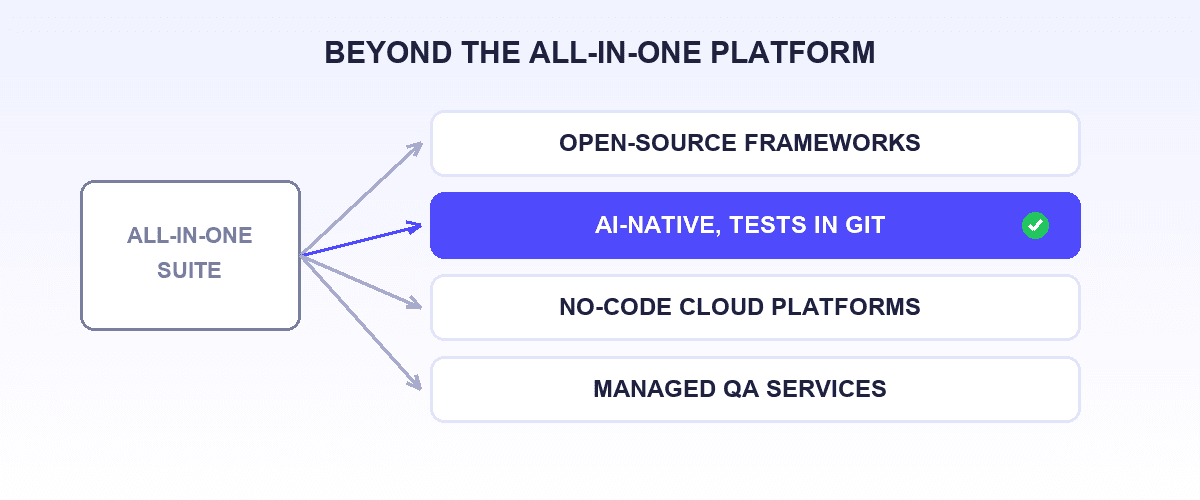
The best Testsigma alternative in 2026 depends on the mechanism you need.
Shiplight AI keeps tests where you can own them: real YAML in your git repo, diffable and PR-reviewable, instead of proprietary cloud objects you can only export to CSV. It is agent-native today, with your own coding agents authoring over MCP, where Testsigma's pricing page lists autonomy as upcoming.
It is built on Playwright, so you keep a structural exit and local runs with no account, and its escape hatch for custom logic is inline JavaScript rather than a Java addon for anything the action grammar cannot express. Playwright and Cypress are the open-source code frameworks with maximum developer control.
Managed QA services put a vendor's human engineers in charge of your suite. Other vendor cloud consoles keep Testsigma's low-code model with the same structural trade-off: tests live in the vendor's cloud, not your repo.
Why teams look for Testsigma alternatives
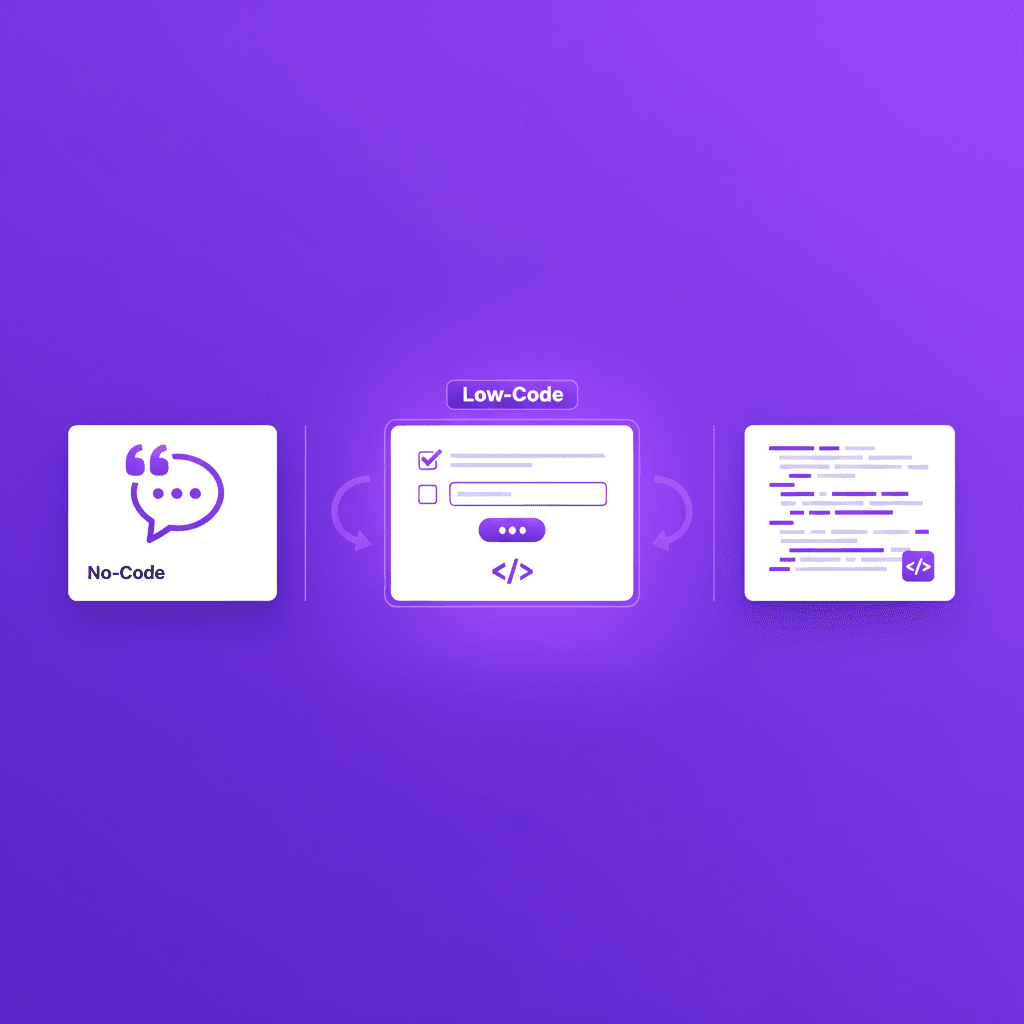
Testsigma is a cloud low-code platform spanning web, mobile, API, and desktop testing. Its design center is a QA organization authoring in a vendor console: you write steps in something close to English, run them in Testsigma's cloud, and let the platform absorb maintenance. That design center is exactly where Shiplight diverges, on four axes that decide the day-to-day.
Testsigma's "plain English" is a constrained template grammar, not free English: steps must resolve to a predefined action vocabulary, and anything outside it requires a Java addon, per Testsigma's own docs.
Its tests are proprietary cloud objects with no git-backed storage, and export is CSV only, with no path to standard framework code. Its own pricing page lists autonomous capabilities as upcoming, and a cloud console has no authoring loop into the coding agents a team now ships with.
And its open-source community edition has had no release since August 2023; the active product is the commercial cloud.
Shiplight is built around the opposite bets: tests in your repo, your coding agents authoring them, an open-source execution engine underneath, and a real code escape hatch. The alternatives below are ordered by design center, including where Shiplight is not the right choice.
If multi-platform low-code coverage authored by a QA organization is the requirement and cloud-hosted tests are a non-issue, Testsigma's model still fits; the alternatives win when one of those bets is what you actually want.
1. Shiplight AI: best for AI coding agent teams using MCP
Shiplight AI moves test automation from a cloud console into the development loop. Tests are readable YAML that describe user intent, live in your git repo, and run locally with npx shiplight test. The MCP server and Skills install into Claude Code, Cursor, Codex, VS Code, and more in one line, and the local MCP needs no account or token.
The agent verifies UI changes in a real browser as it builds (/shiplight verify), authors E2E tests by walking the app (/shiplight create-yaml-tests), and triages failures down to root cause (/shiplight fix).
Everything below is a point where Shiplight's design center is decisively different from a cloud low-code console, in the reader's favor.
Strengths
- Tests in your git repo, owned like code. Shiplight tests are readable YAML committed alongside source: diffable, PR-reviewable, portable, yours. Testsigma stores tests as proprietary cloud objects with no git-backed storage, and the only export is CSV, not code, so leaving means re-authoring.
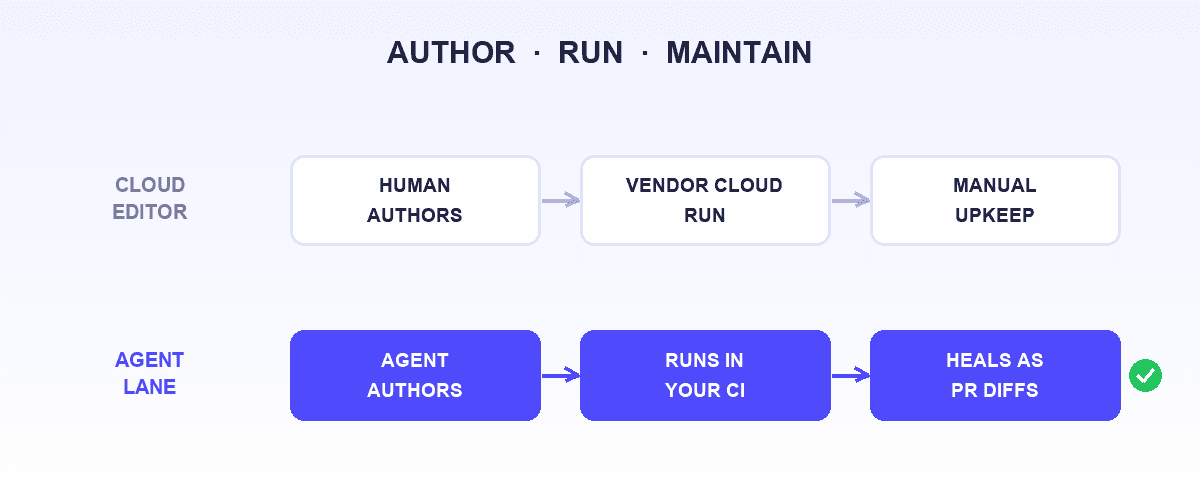
- Agent-native today, not upcoming. Your own coding agents (Claude Code, Cursor, Codex) read, write, and edit the YAML directly through MCP and Skills, so the agent that wrote the feature authors and runs its test in the same session. Testsigma's pricing page lists autonomous capabilities as upcoming, and a cloud console sits outside the agent's loop regardless. See boost test coverage with agentic AI.
- Built on Playwright, no lock-in. The YAML transpiles to Playwright at run time, so the execution layer is the open-source standard: every Playwright browser is supported, Shiplight runs alongside an existing Playwright suite, and you can eject anytime. Testsigma's tests run only on Testsigma's cloud.
- A real code escape hatch. When a step needs logic the natural language cannot express, Shiplight drops to inline JavaScript in the same file. Testsigma's authoring resolves to a predefined action vocabulary, and anything outside it requires a Java addon, per Testsigma's docs, which puts the escape hatch outside most modern web stacks.
- Local runs with no account, infrastructure your choice. Local MCP browser automation and authoring need no account or token. Running a test file needs an LLM key, ours or your own. Shiplight ships hosted CI runners, dashboards, and an LLM proxy for zero setup, and also supports your own CI runners with your own Anthropic, OpenAI, or Google keys (Azure, Bedrock, and Vertex included); cached deterministic steps call no LLM. Testsigma's Pro and Enterprise plans are custom-quoted, and runs happen on its cloud.
- Intent-based self-healing as reviewable PR diffs. Cached locators heal online at run time; larger changes arrive as PR diffs your engineers approve, never silent cloud rewrites. See intent, cache, heal pattern.
- Enterprise: SOC 2, VPC, RBAC, dedicated CSM.
Tradeoffs
- Web only; no mobile, desktop, or standalone API testing.
- Assumes a repo-based workflow with at least one engineer or coding agent in the loop.
- Younger vendor and community than the established platforms.
When to choose Shiplight: your team ships web software with AI coding agents and the goal is verification plus regression coverage as a byproduct of building. See agent-first testing.
2. Playwright: best for maximum developer control at lowest cost
Playwright is the opposite end of the spectrum from a low-code cloud: a free, open-source, code-first framework with excellent cross-browser execution (Chromium, Firefox, WebKit), tracing, and debugging. Everything lives in your repo; everything is maintained by your engineers.
At a glance
- Approach: Code-first open-source framework
- Test format: TypeScript/JavaScript (also Python, Java, C#) in your repo
- Pricing note: Free, open source
- Migration effort: Full rewrite into code; requires engineering ownership
- Best for: Engineering-led teams that want control and zero license cost
Pros:
- Best-in-class open-source execution engine
- No seats, no quotes, no vendor cloud
- Tests reviewed and versioned like any code
Cons:
- Tests are selector-bound code: every UI refactor can break them, and the maintenance is ongoing even when a coding agent writes the code
- Excludes non-technical contributors
- No agent-native authoring loop out of the box
When to choose Playwright: engineers own testing, they have the time to maintain a suite, and you want the license line item at zero. For where teams hit its limits, see best Playwright alternatives.
3. Cypress: best for developer-friendly JS E2E testing
Cypress is a long-standing open-source E2E framework focused on developer experience: fast local runs, excellent debugging and time-travel, and a large plugin ecosystem. Like Playwright, it keeps everything in your repo under your team's control.
At a glance
- Approach: Code-first open-source framework
- Test format: JavaScript/TypeScript in your repo
- Pricing note: Open source; optional paid cloud for recording and parallelization
- Migration effort: Full rewrite into code
- Best for: JavaScript teams that want developer-friendly browser testing
Pros:
- Excellent debugging and time-travel; fast local feedback
- Large community and plugin ecosystem
- Developer-friendly authoring for JavaScript teams
Cons:
- Selector-driven code with the same maintenance ceiling as Playwright
- Historically Chromium-focused; cross-browser support is improving but not at parity
- No AI or natural-language authoring
When to choose Cypress: a JavaScript team wants developer-friendly browser testing and owns the maintenance. See Playwright vs Cypress and best Cypress alternatives.
4. Managed QA services: outsource the suite entirely
A different answer to Testsigma's authoring problem is to stop authoring at all: managed QA services put the vendor's human engineers (assisted by AI tooling) in charge of building and maintaining your test suite, usually with a coverage agreement.
Strengths
- Fully managed: you don't author or maintain tests yourself
- Human review on top of AI generation
- Fast ramp for teams with no QA function
Tradeoffs
- You are buying human hours, priced accordingly; coverage grows at the pace of the vendor's engineers
- Testing knowledge accumulates with an external team rather than in your repo and your heads
- No agent-native loop: the vendor's staff authors tests, not your coding agent, which points the opposite direction from an AI-native development workflow
Where it fits. Teams that have decided QA is someone else's job and want a staffed service with a human in the loop.
5. Other vendor cloud consoles: the same model, different mechanics
The closest structural match to Testsigma is the rest of its own category: commercial platforms where your QA team builds tests in the vendor's web application via a recorder, a visual editor, or a constrained plain-English command language, sometimes spanning web, mobile, and API from one platform.
Strengths
- Accessible to non-engineers; no repo workflow required
- Often broad surface coverage (mobile, API, desktop) from one console
- Governed, centralized management for QA organizations
Tradeoffs
- Tests live in the vendor's cloud, not your git repo; export paths are typically limited, lossy, or absent, so switching consoles means re-authoring, the same lock-in that pushed you off Testsigma
- Runs are metered or quote-priced on vendor infrastructure
- Agent integrations, where offered, drive the vendor's cloud rather than putting tests in your workflow
Where it fits. Manual-QA-heavy organizations where non-engineers own testing and a governed console is the point. But if vendor-cloud storage or the lack of a coding-agent loop is why you are leaving Testsigma, a like-for-like console carries the same limits.
Comparison table
| Alternative | Tests in your repo? | Vendor lock-in / export | Whose agent authors tests? | Escape hatch for custom logic | Best for |
|---|---|---|---|---|---|
| Shiplight | ✓ (YAML) | None: transpiles to Playwright, runs alongside an existing suite, eject anytime | Your coding agents (Claude Code, Cursor, Codex) via MCP + Skills | Inline JavaScript in the same file | AI-coding-agent web teams |
| Playwright | ✓ (code) | None (open source) | Your engineers, or agent tooling you assemble | Full programmatic code | Developer control |
| Cypress | ✓ (code) | None (open source; parallelization via paid cloud) | Your engineers | Full programmatic code | JS team E2E |
| Managed QA services | Varies | Suite knowledge lives with the vendor's team | The vendor's human engineers | The vendor's engineers | Fully outsourced QA |
| Vendor cloud consoles | ✗ | High: proprietary formats, limited or no export | The vendor's console tooling | Varies by vendor | Console-authoring QA orgs |
| Testsigma (baseline) | ✗ (cloud objects; CSV export only) | High: proprietary cloud objects, CSV-only export, no code | Autonomy listed as upcoming; cloud console outside the agent loop | Java addon for anything off the action grammar | Multi-platform low-code for QA orgs |
How to decide
Where must the tests live? If tests must live in your repo and be reviewed in PRs: Shiplight (YAML) or Playwright and Cypress (code). If a vendor console holding the tests is acceptable, the vendor-cloud category serves that model, with the export limits above.
What surfaces do you cover? Mobile or desktop in the same tool points you at the multi-platform console category, Testsigma included. Web-only teams should weigh the deeper web tools first.
Do coding agents write your code? If yes, test authoring should live where the code authoring lives. Shiplight is the only option here with an MCP-native loop; everything else requires a human (or a managed-service team) in a separate tool after the fact. See agent-first testing.
How do you buy? Published or zero pricing: Playwright and Cypress (free, open source) or Shiplight's published plans, where Free is $0 forever and Pro is $60/month. Quote-based pricing is the norm across the vendor-console category, Testsigma included.
Where Shiplight is not the right fit
Shiplight is web only. If mobile or desktop coverage in one platform is the requirement, the multi-platform console category serves it and we do not. Teams with no engineers at all will find recorder-style tools more self-sufficient, since Shiplight assumes tests are reviewed like code.
And teams with a working Playwright investment that is genuinely not a bottleneck should keep it; Shiplight runs alongside Playwright, so the entry point there is new and hard tests, not replacement.
The bottom line
Testsigma is an all-in-one, low-code platform, and that category was designed for mobile, API, and desktop coverage under one roof with non-technical authors. The reasons to move are structural: you want tests in your repo, you want pricing you can read, or you want testing that keeps pace with AI-agent development.
If tests must live in your repo and coding agents are in the loop, look at Shiplight first: intent-based YAML in git, MCP-callable from Claude Code / Cursor / Codex, self-healing by default, PR-time CI gates.
Playwright and Cypress give maximum developer control at zero license cost. For the full market view, see the best E2E testing tools in 2026 and best AI testing tools in 2026.
Frequently Asked Questions
What is Testsigma?
A cloud low-code platform covering web, mobile, API, and desktop. Authoring uses constrained plain-English steps that must resolve to a predefined action vocabulary, with anything outside it needing a Java addon. Tests are proprietary cloud objects with no git storage, and export is CSV only.
What are the best Testsigma alternatives?
Four approaches: Shiplight AI (YAML in your repo, authored by coding agents over MCP, built on Playwright), Playwright and Cypress (open-source code), managed QA services, and other vendor consoles. Choose by where tests must live and whether coding agents are in your workflow.
Is Testsigma free?
There is a free trial, but Pro and Enterprise are custom-quoted and the open-source community edition has had no release since August 2023. For a permanently free option, Playwright and Cypress are fully open source; Shiplight's local tier needs no account, Free is $0 and Pro is $60/month.
Which Testsigma alternative works with AI coding agents?
Shiplight. It installs into Claude Code, Cursor, and Codex as MCP plus Skills, so the agent that writes the feature verifies it in a real browser and commits the regression test in the same session. Vendor consoles have no equivalent loop. See MCP for testing.
Which Testsigma alternative is open source?
Playwright and Cypress are open-source frameworks, free to run with no vendor involved. Shiplight is commercial, but its tests are plain YAML in your repo and local runs need no account, which gives open-source-like ownership of the definitions.
Can non-technical testers use these alternatives?
The vendor-console category is designed for non-technical authors, with the cloud trade-offs above. Shiplight and Playwright assume a repo workflow: the YAML is readable by anyone and PMs review it, but authoring runs through an engineer or agent. See no-code testing for non-technical teams.
How hard is it to migrate off Testsigma?
Tests are proprietary cloud objects with CSV-only export and no path to framework code, so every migration re-authors. The difference is speed: console tools need humans to redo each flow, code frameworks need engineers, and agentic authoring rebuilds coverage from the app itself.